Film Credits Format & Order: The Definitive Guide
Every name on screen is a negotiation, a contractual obligation, or a century-old convention. Get it wrong and you hear about it.

The film credits format you use tells the industry exactly how professional your production is. Whether you are assembling a five-person short or a 300-department tentpole, the order in which names appear follows a hierarchy shaped by guild agreements, contractual leverage, and decades of Hollywood precedent.
This guide breaks down the complete movie credits order for both opening and closing sequences, explains the formatting standards professionals actually use, and gives you formatted examples you can adapt for your own production.
Film Credits Format
Opening Credits vs. Closing Credits vs. Title Cards
Before diving into order, you need to understand the three distinct credit formats used in modern productions.
Title cards are static, single-screen presentations. Each card displays one name or a small group of names for a set duration, typically three to five seconds. Opening credits almost always use this format.
Credit crawls (also called rolls or scrolls) move vertically from bottom to top. This is the standard format for closing credits and can run anywhere from two minutes on a short film to twelve-plus minutes on a Marvel production.
Hybrid formats combine both. Christopher Nolan’s Oppenheimer (2023) opens with a single “Written and Directed by Christopher Nolan” card, skips all other opening credits, then closes with an eight-minute crawl covering hundreds of cast and crew.
Most contemporary American films have abandoned opening credits almost entirely. By the early 2000s, the industry default shifted to a title card followed by the full credit sequence at the end. The DGA, WGA, and SAG-AFTRA all permit this approach, though specific guild rules still govern placement when opening credits are used.
Movie Credits Order
The Complete Opening Credits Hierarchy
When a production does include opening credits, the sequence follows a “bookend” structure: it begins with the most commercially important names (studios, stars) and ends with the most creatively important (writer, director). The positions in between follow a hierarchy from least to most senior.
Here is the standard 16-position opening credits order:
| Position | Credit | Notes |
|---|---|---|
| 1 | Distribution company | Studio logo (e.g., Warner Bros.) |
| 2 | Production company | Producer’s banner (e.g., Syncopy) |
| 3 | ”A [Director] Film” | Optional; often negotiated |
| 4 | Film title | Can appear as early as position 1 |
| 5 | Lead cast | 1-3 principal actors |
| 6 | Supporting cast | Billed individually or grouped |
| 7 | Casting director | First department head credit |
| 8 | Music composer | Score composer, not songs |
| 9 | Costume designer | |
| 10 | Associate producer(s) | |
| 11 | Editor | |
| 12 | Production designer | |
| 13 | Director of photography | Often “Cinematography by” |
| 14 | Executive producer(s) | |
| 15 | Producer(s) | |
| 16 | Writer(s) | “Screenplay by” or “Written by” |
| 17 | Director | Always last in opening credits |

The director’s credit appearing last is not tradition. It is a DGA requirement. The Directors Guild mandates that the director receive the final solo credit before the film begins, ensuring maximum visibility and recall.
Why the Writer Appears Before the Director
The WGA negotiated this placement specifically so the screenwriter’s name is the second-to-last credit audiences see. In a sequence designed around ascending importance, positions 15-17 (producer, writer, director) represent the three roles with the most creative authority over the finished film.
Film Credits Order
The Complete Closing Credits Hierarchy
Closing credits are where the real complexity lives. A feature film’s end crawl can include 30 or more distinct sections, organized by department and internal hierarchy.
Above-the-line credits appear first, typically on individual title cards before the crawl begins:
| Order | Credit |
|---|---|
| 1 | Director |
| 2 | Writer(s) |
| 3 | Producer(s) |
| 4 | Executive Producer(s) |
| 5 | Lead cast (individual cards) |
| 6 | Supporting cast (individual cards) |
| 7 | Director of Photography |
| 8 | Production Designer |
| 9 | Editor |
| 10 | Associate Producer |
| 11 | Costume Designer |
| 12 | Music Composer |
| 13 | Casting Director |
Notice the closing credits open with the director, reversing the opening sequence. This “bookend” structure means the director’s name is both the last thing you see before the film and the first thing you see after it.
Below-the-line credits follow in the crawl, organized by department:
| Section | Key Roles |
|---|---|
| Production management | Unit Production Manager, 1st AD, 2nd AD |
| Cast list | Full cast in order of appearance or billing |
| Stunt department | Stunt Coordinator, doubles, performers |
| Art department | Art Director, Set Decorator, Set Dresser |
| Camera department | Camera Operator, 1st AC, 2nd AC, DIT, Loader |
| Grip & Electric | Key Grip, Best Boy Grip, Gaffer, Best Boy Electric |
| Sound department | Production Sound Mixer, Boom Operator |
| Wardrobe | Wardrobe Supervisor, Set Costumers |
| Hair & Makeup | Department Head, Key Artists |
| Set operations | Property Master, Greensperson |
| Transportation | Transportation Captain, Drivers |
| Special effects | SFX Supervisor, SFX Technicians |
| Post-production editorial | Assistant Editor, Post Supervisor |
| Visual effects | VFX Supervisor, VFX Producer, artists by studio |
| Color | Colorist, Color Scientist |
| Sound post | Sound Designer, Supervising Sound Editor, Re-Recording Mixers |
| Music | Music Supervisor, Music Editor, orchestrators, musicians |
| Songs | Licensed tracks with songwriter, publisher, performer |
| Catering & craft services | Catering company, Craft Services |
| Title design | Main/end title designers |
| Special thanks | Individuals, organizations, locations |
| Logos | Guild/union, equipment, location tax credits |
| Copyright & disclaimer | Year, production entity, legal notices |
Within each department, the hierarchy is consistent: department head first, followed by key crew, then assistants and additional personnel.

End Credits Order
What the Guilds Actually Require
Guild and union agreements are not suggestions. Here is what the three major guilds require for credits:
DGA (Directors Guild of America)
- Director must receive a single-card credit, separate from all other names
- In opening credits, the director’s card must appear last
- “Directed by” is the required phrasing; “A Film by” requires separate negotiation
- The director must be credited in all advertising where any other individual is credited
WGA (Writers Guild of America)
- The WGA determines writing credits through an arbitration process, not the producers
- “Screenplay by” indicates an original script; “Written by” means the same person wrote story and screenplay
- “Story by” credits the source narrative when another writer adapted the screenplay
- On-screen credit must appear on a separate card from the director’s credit
SAG-AFTRA
- All principal performers must receive on-screen credit
- Productions with fewer than 50 cast members must credit everyone
- Stunt performers do not need to identify which role they doubled
- Background performers may remain uncredited at the producer’s discretion
- Credit placement and size for lead actors are typically negotiated in their contracts
For a deeper look at guild compliance, see our guide to DGA, WGA, and SAG-AFTRA credit requirements.
How Long Are Movie Credits
Duration by Production Size
The length of your credit sequence depends on how many people worked on the production. Here are realistic benchmarks:
| Production Type | Typical Crew Size | Credit Duration |
|---|---|---|
| Short film (student) | 10-30 | 1-2 minutes |
| Short film (professional) | 20-60 | 2-3 minutes |
| Indie feature | 50-150 | 3-5 minutes |
| Mid-budget feature | 150-400 | 5-8 minutes |
| Studio feature | 400-1,000 | 7-10 minutes |
| Tentpole / VFX-heavy | 1,000-4,000+ | 10-15 minutes |
Avengers: Endgame (2019) holds one of the longest credit sequences in theatrical history at roughly 12 minutes, crediting over 3,500 people. Christopher Nolan’s Oppenheimer credits run approximately eight minutes for a cast and crew of around 800.
The standard scroll speed for readability is 50-70 pixels per second at 1080p, which translates to roughly 60-80 names per minute in a standard two-column crawl format. Faster than that and names become unreadable; slower and the audience loses patience.
For festival shorts, keep it tight. One experienced filmmaker on IndieTalk noted that “half the theater left” during a festival screening because a preceding short had credits nearly as long as the film itself.
Closing Credits Order
Formatted Credit Block Examples
Knowing the order is one thing. Seeing the actual formatting is another. Here are professional credit block formats for the most common sections.
Above-the-line title cards (one name per card, 3-4 seconds each):
Directed by
JANE CHEN

Written by
MARCUS WILLIAMS

Produced by
SARAH KOVAC  DAVID ALLEN  TOMOKO WRIGHT

Executive Producer
RICHARD PARK
Cast list (two-column format in the crawl):
ELENA TORRES . . . . . . . . . . . . Maya Santos
JAMES WHITFIELD . . . . . . . . . . . . . Detective Hale
PRIYA SHARMA . . . . . . . . . . . . Dr. Ananya Rao
CARLOS MENDES . . . . . . . . . . . . . . . . Frank Russo
Department block (single-column in the crawl):
                    ART DEPARTMENT

               Art Director
              MICHAEL TANAKA

              Set Decorator
             ANNA BERGSTROM

              Set Dressers
        LUKE HENDRICKS    ROSA DELGADO

           Graphic Designer
              JENNA COLE
Songs section:
"MIDNIGHT DRIVE"
Written by Alex Turner
Performed by Arctic Monkeys
Courtesy of Domino Recording Co.
Published by EMI Music Publishing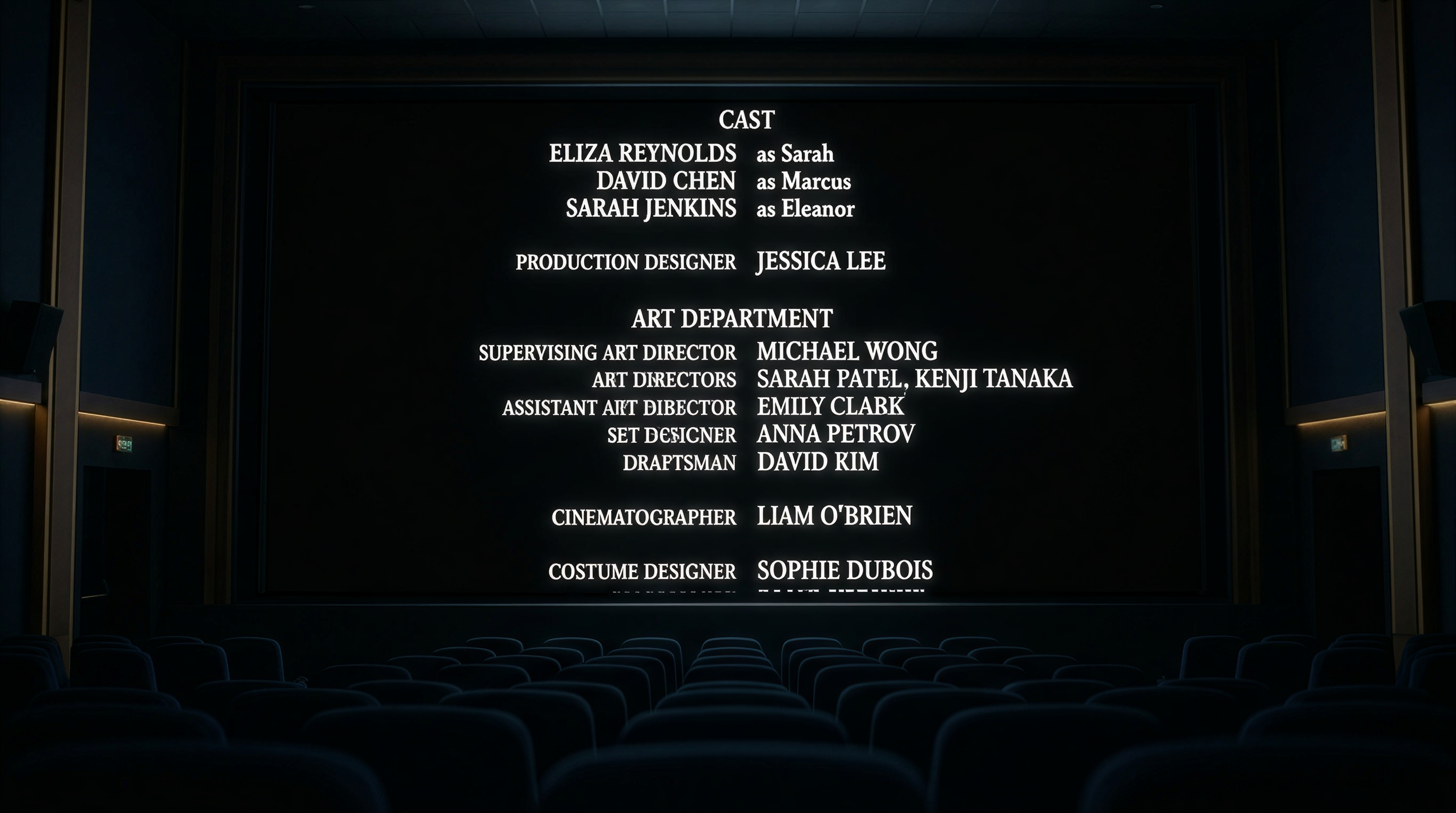
When formatting credits, consistency matters more than any single stylistic choice. Pick your font, spacing, and alignment for each section type and maintain it throughout. For guidance on typeface selection, see our guide to the best fonts for film credits.
Film Credits List
A Brief History of How We Got Here
Understanding why credits look the way they do helps you make better formatting decisions.
Before the 1960s, credits were brief. Only department heads received on-screen acknowledgment. The 1942 classic Casablanca has opening credits running just over 60 seconds and no closing credits at all. This was the norm during Hollywood’s studio system era, when the Big Five studios (Paramount, 20th Century Fox, RKO, MGM, Warner Bros.) controlled production, distribution, and exhibition.
The 1948 Supreme Court antitrust ruling broke up the studio monopolies. Actors and crew became freelancers. As San Francisco State University film professor Joseph McBride observed, “Studios realized they could pay people less if they gave them credit.” The proliferation of credits accelerated through the 1970s and 1980s.
Television played a role too. TV shows moved credits to the end to hook viewers from the first frame and keep them watching through commercial breaks. By the late 1970s, this practice migrated to theatrical features. Steven Spielberg and George Lucas popularized the cold-open approach, though Lucas famously left the DGA after being fined $250,000 for omitting opening credits from Star Wars (1977) and The Empire Strikes Back (1980).
Today, digitization has made credits virtually free to produce. Where a 35mm film print made every second of screen time expensive, digital projection costs nothing extra. The result: modern credits are longer, more inclusive, and more standardized than at any point in cinema history.
Movie Credits Format
Common Mistakes That Will Get You Called Out
After reviewing dozens of indie and student productions, these are the errors that professionals notice immediately:
-
Misspelled names. Check, double-check, and check again. People change names between pre-production and post. Confirm every spelling with the individual.
-
Missing credits entirely. Build your credit list from day one of pre-production, not during the final mix. Crew members will notice if they are left out.
-
Wrong guild formatting. Using “Directed and Written by” when the DGA and WGA require separate cards. Using “Director of Photography” when the cinematographer prefers “Cinematography by.”
-
Inconsistent formatting. Mixing ALL CAPS with Title Case randomly, or switching between “by” and no “by” across similar credits.
-
Producer credit inflation. If half your crew has a producer title, none of them will be taken seriously. The PGA has specific guidelines for who earns the “Produced by” credit.
-
Ignoring department hierarchy. Listing a Second AC before the First AC, or a Set Dresser before the Set Decorator. Within departments, seniority matters.
-
No copyright notice. Include the copyright year, production entity, and “All Rights Reserved” as the final frame.
FAQ
What is the correct order for film credits?
Opening credits run from distribution company through director (last). Closing credits reverse this: director appears first, followed by writers, producers, cast, and then departmental crew organized from production through post-production. Guild agreements from the DGA, WGA, and SAG-AFTRA dictate specific placements.
How long should end credits be?
Credit duration depends on crew size. A short film typically runs 1-3 minutes; an indie feature 3-5 minutes; a studio production 7-10 minutes. The standard scroll speed for readability is 50-70 pixels per second. Prioritize legibility over brevity.
Do I need opening credits?
No. Most contemporary American films use only a title card at the beginning and a full credit sequence at the end. The DGA, WGA, and SAG-AFTRA all permit this format. Opening credits are a stylistic choice, not a requirement.
Who decides the order of movie credits?
Guild agreements set the framework. Within that framework, producers determine below-the-line credit order, while above-the-line placements (director, writer, lead cast) are individually negotiated in contracts. The WGA uniquely determines writing credits through an arbitration process, not the producers.
Sources & Further Reading
- DGA Basic Agreement — Director credit requirements
- WGA Credits Survival Guide — Writing credit arbitration process
- SAG-AFTRA Codified Basic Agreement — Performer credit rules
Ready to build your credit sequence without the formatting headaches? EndCreditsPro generates guild-compliant credits from a single spreadsheet import. Start with our professional templates and have broadcast-ready credits in minutes, not days.