How Long Are Movie Credits?
The average feature film end credits sequence runs 7 to 9 minutes. VFX-heavy blockbusters regularly exceed 10. The longest on record tops 37.
The question sounds simple. The answer depends on genre, budget, crew size, guild agreements, and whether the director insisted on crediting every caterer in New Zealand.
How long are movie credits in practice? For a standard Hollywood feature, expect 7 to 12 minutes of scrolling names. An indie drama with a 40-person crew might wrap in 3 to 4 minutes. An animated tentpole with 2,000 VFX artists can push past 15.
This guide breaks down the actual durations for more than 20 films, explains why credits keep getting longer, and gives filmmakers a formula for estimating their own.
How Long Are Movie Credits
Exact Durations for Films You Know
The table below shows measured end credits durations for real productions. Runtime is total listed runtime; credits duration is the time from the first end credit to the final frame.
| Film | Year | Runtime | Credits Duration | Type |
|---|---|---|---|---|
| Jaws | 1975 | 124 min | ~3 min | Drama/Thriller |
| Superman | 1978 | 143 min | ~12 min | Superhero |
| The Graduate | 1967 | 106 min | <1 min | Drama |
| Who Framed Roger Rabbit | 1988 | 104 min | ~7 min | Live/Animation |
| Space Jam | 1996 | 88 min | ~7 min | Live/Animation |
| Independence Day | 1996 | 145 min | ~9 min | Action/Sci-Fi |
| The Lord of the Rings: Return of the King | 2003 | 201 min | ~10 min | Fantasy |
| The Lego Movie | 2014 | 100 min | ~8 min | Animation |
| Avengers: Endgame | 2019 | 181 min | ~12 min | Superhero/VFX |
| Once Upon a Time in Hollywood | 2019 | 161 min | ~6 min | Drama |
| Assassin’s Creed | 2016 | 115 min | ~15 min | Action/VFX |
| Barbie | 2023 | 114 min | ~7 min | Comedy |
| Oppenheimer | 2023 | 180 min | ~9 min | Drama |
| Dune: Part Two | 2024 | 166 min | ~9 min | Sci-Fi/VFX |
| Godzilla: King of the Monsters | 2019 | 132 min | ~12 min | Action/VFX |
| Spider-Man: Across the Spider-Verse | 2023 | 140 min | ~10 min | Animation |
| La Flor | 2018 | 808 min | ~37 min | Art Film |
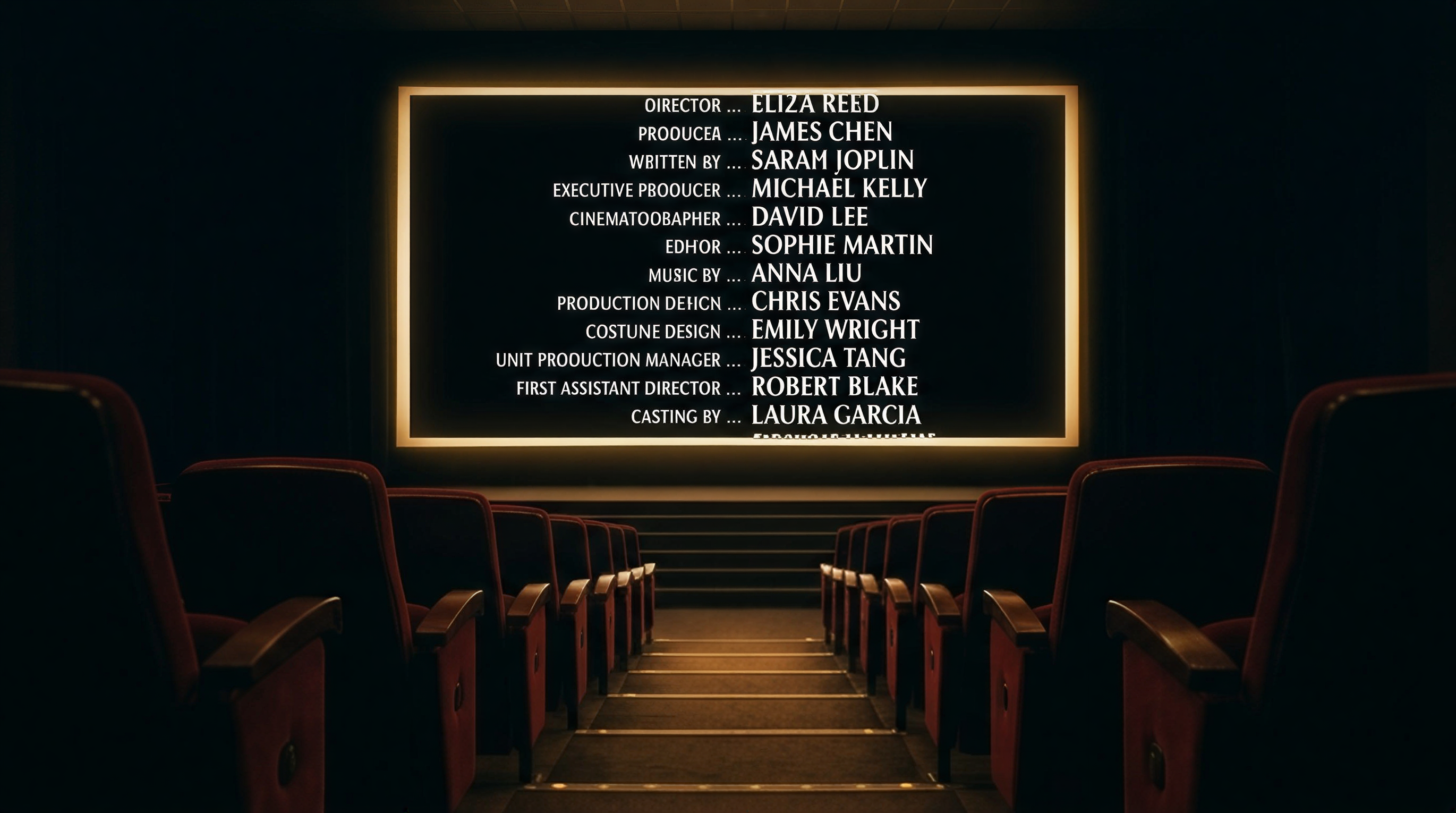
A few patterns stand out. VFX-heavy films consistently land in the 9-to-15-minute range. Dramas with practical effects and smaller crews finish in 3 to 7 minutes. Animation sits in between, typically 7 to 10 minutes, because digital productions require large teams even when the on-set crew is small.
How Long Do Credits Last
Duration Benchmarks by Genre
Not all productions are built the same. Here is what to expect based on the type of film.
Indie and Low-Budget Films (under $5M) Credits typically run 2 to 5 minutes. Smaller crews mean fewer names. A 30-person production might fill only 90 seconds of scroll time. Short films at festivals often keep credits under 45 seconds to avoid being trimmed by programmers.
Mid-Budget Dramas and Comedies ($5M-$50M) Expect 5 to 8 minutes. These productions carry union-mandated crew positions — associate producers, department heads, post-production supervisors — that add up even without massive VFX teams.
Studio Blockbusters ($100M+) Credits run 8 to 12 minutes. The combination of large physical crews, multiple VFX vendors, and location units across several countries pushes the name count into the thousands.
VFX-Heavy and Animated Films The longest credits in modern cinema. Expect 10 to 15 minutes. ILM alone staffs 300 to 400 people on a single feature for up to 18 months. A film like Avengers: Endgame contains more than 2,500 VFX shots — only 80 of which are not touched by the VFX team. Each of those shots involves modelers, riggers, animators, compositors, lighters, and pipeline engineers. The credits reflect that labor.
Television End credits on TV episodes are much shorter, typically 30 seconds to 2 minutes, though streaming-era prestige series have begun pushing longer.
Longest Movie Credits
Records and Outliers
The Guinness World Record for longest credit sequence was once shared by Sergio Leone’s Once Upon a Time in the West (1968) and Richard Donner’s Superman (1978), both at approximately 12 minutes. Superman split its credits between five minutes of opening titles and seven minutes of closing.
That record has been surpassed many times since:
- Assassin’s Creed (2016) — nearly 15 minutes of end credits, driven by VFX teams across multiple international studios
- La Flor (2018) — the Argentine art film holds the unofficial record at 37 minutes of end credits, proportional to its 13-hour runtime
- Lord of the Rings: Return of the King (2003) — approximately 10 minutes, notably including members of the Tolkien Fan Club who had contributed to the production’s community engagement
The MCU franchise deserves its own mention. Marvel credits are consistently 10 to 12 minutes long, partly because of VFX crew sizes and partly because mid-credits and post-credits scenes extend the total sequence. Avengers: Endgame begins its credits at 2:48:56 and does not reach the traditional text crawl until 2:53:17 — a five-minute gap filled with stylized title cards before the full scroll even starts.
Why Movie Credits Keep Getting Longer
A Brief History of End Credits
The explosion in credits length is not vanity. It reflects real changes in how films are made and who gets recognized.

Before 1970: The Single Card Era Most films ended with a single title card listing the principal cast. The Graduate (1967) has almost no end credits at all. Crew members rarely appeared on screen. The audience left when the story ended.
1970s-1980s: The Scroll Begins Union agreements, particularly from the DGA, WGA, and SAG, began requiring on-screen credit for more positions. Star Wars (1977) is widely cited as a turning point — George Lucas gave comprehensive crew credits at a time when most directors did not.
1990s-2000s: VFX Changes Everything The rise of digital effects introduced entirely new departments. A single VFX facility might employ 300 to 400 specialists. As films began using multiple VFX houses, credits swelled. Independence Day (1996) had such a long credit sequence that the credits required their own shipping reel of film.
2010s-Present: The 2,000-Name Credit Roll Modern tentpoles routinely credit over 2,000 people. The 14 distinct VFX roles alone — from prep/roto artists to compositors to pipeline TDs — can generate hundreds of names per facility. According to industry data, only 80 shots in Avengers: Infinity War were not created or modified by VFX teams.
Yet even 15-minute credits leave people out. A study of 4,113 films found that 7.5% of crew credits and 24.6% of cast credits go officially uncredited. In VFX departments specifically, 9% of contributors receive no on-screen credit.
How to Calculate Your Credits Length
The Math Behind the Scroll
If you are producing a film and need to estimate how long your end credits will run, here is the industry-standard approach.
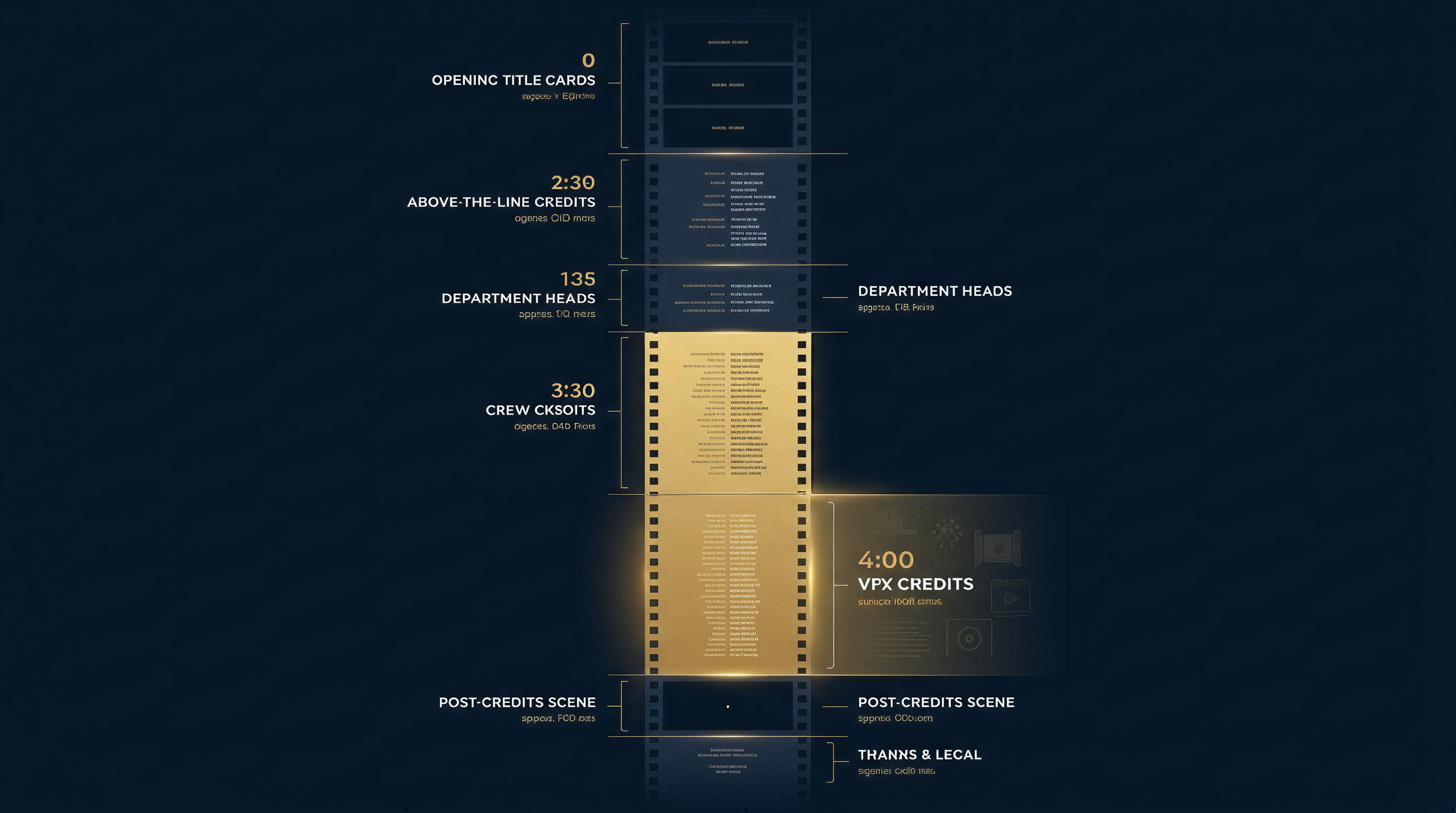
According to data from Endcrawl, which processes credits for hundreds of productions each year, the averages across 440 analyzed films are:
| Metric | Average |
|---|---|
| Credits duration | 227 seconds (~3.8 minutes) |
| Scroll speed | 93 pixels/second |
| Density | 65 pixels per name |
The 227-second average skews toward smaller productions. For a studio feature, plan for 7 to 12 minutes.
Quick estimation formula:
- Count total names to be credited
- Multiply by 65 (average pixels per name)
- Divide by 93 (pixels per second)
- Result = approximate credits duration in seconds
For example, a film crediting 800 people: 800 x 65 = 52,000 pixels / 93 px/sec = 559 seconds (~9.3 minutes).
Scroll speed guidelines for technical implementation:
| Resolution | Recommended Speed |
|---|---|
| HD / 2K | 3 pixels per frame (at 24fps = 72 px/sec) |
| Comfortable | 4 pixels per frame (96 px/sec) |
| Maximum readable | 5 pixels per frame (120 px/sec) |
| NTSC legacy | 120 px/sec |
Aim for 3 to 4 pixels per frame at 24fps. Anything above 5 pixels per frame becomes difficult to read, especially for names in smaller type sizes. The font you choose also matters — sans-serif faces hold up better at speed.
For a deeper understanding of how credits are structured, see our film credits format and order guide, which covers the full hierarchy from above-the-line talent to end-crawl departments.
Frequently Asked Questions
Does movie runtime include end credits?
Yes. The runtime listed on IMDb, theater schedules, and streaming platforms includes end credits. If a film is listed at 120 minutes, expect the story to end somewhere around 108 to 115 minutes depending on credits length. Subtract 5 to 10 minutes from the posted runtime to estimate when the narrative actually concludes.
How long are short film credits?
Typically 30 to 60 seconds. Festival programmers may trim credits that run too long, so keep them tight. A single static card or a brief 30-second scroll is standard for shorts with crews under 20 people.
Why do some credits scroll so fast you cannot read them?
Studios sometimes compress scroll speed to reduce runtime. With VFX crews numbering in the hundreds per facility, showing every name at a comfortable reading pace could add 5 additional minutes. The result is a compromise — names appear on screen (satisfying contractual obligations) but move too quickly for casual reading.
Do post-credits scenes affect total credits length?
Directly, yes. A mid-credits or post-credits scene adds 30 seconds to 3 minutes to the overall sequence. Marvel films typically include both a mid-credits scene (after the stylized credits) and a post-credits tag (after the full text crawl), extending total credits time to 10-12 minutes. Thunderbolts (2025) holds the record for the longest MCU post-credits scene at 174 seconds.
Sources and Further Reading
- Stephen Follows, “How many movie credits go uncredited?” — statistical analysis of 4,113 films and 1.45 million credits
- VFX Voice, “VFX Screen Credits: The Quest for Recognition and Respect” — industry perspectives on crew sizes and credit limitations
- Guinness World Records, “Longest Credit Sequence” — historical record holders
Knowing how long credits run is half the equation. The other half is building them. EndCreditsPro lets you assemble professional end credits with the correct format and order, export in any resolution, and adjust scroll speed to hit your target duration — whether that is 90 seconds or 12 minutes. Start with our templates and have your credits ready in minutes, not weeks.