What Is an Associate Producer in Film?
Kathleen Kennedy started as one on Raiders of the Lost Ark. Kevin Feige started as one on X-Men. The credit has no fixed definition — and that’s exactly what makes it dangerous to get wrong.

The associate producer (AP) sits below Producer, Executive Producer, and Co-Producer in the film credits hierarchy. The PGA defines it as someone “tasked with one or more essential producing functions” — but what that means in practice changes with every production.
On a studio feature, the AP manages budgets under the Line Producer. On an indie, the credit sometimes goes to whoever donated the location that saved the shoot. Both are legitimate. Both appear in the same spot in the end crawl. And the PGA treats them very differently.
What is an associate producer?
Where the Credit Sits in the Hierarchy
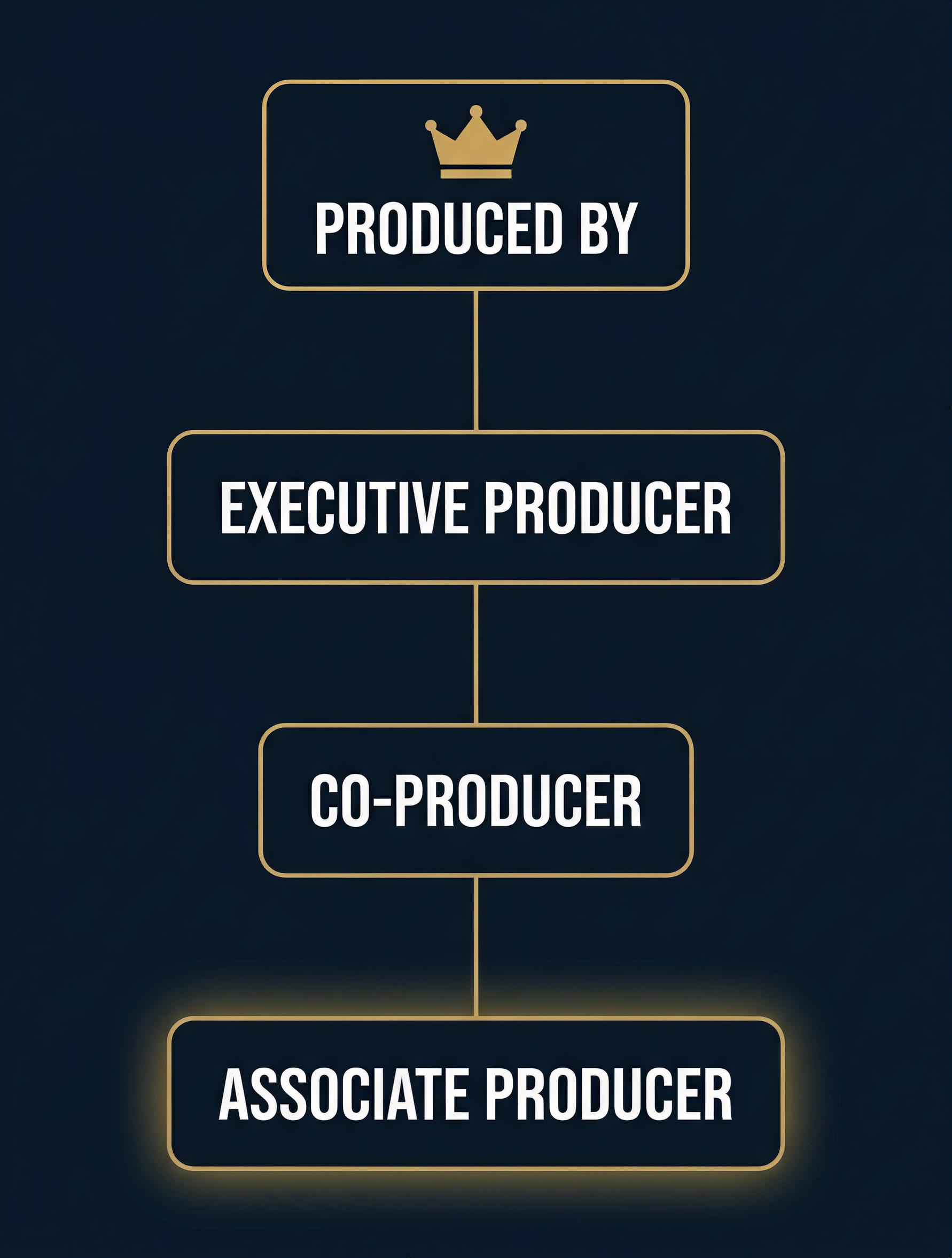
Four producing credits exist in film. Their order is contractual, not cosmetic:
- Produced by — the lead producer. The one who picks up the Oscar.
- Executive Producer — financing or high-level oversight. In TV, this means the showrunner.
- Co-Producer — shares producing duties. One step above AP.
- Associate Producer — supports the producer with delegated tasks.
Call someone your “co-producer” when you mean producing partner, and you’ve just placed them below you in the credit hierarchy. It’s a mistake new filmmakers make constantly.
The AP credit can mean a second producer running entire departments — or it can mean a $5,000 check that kept the production alive. The lead producer decides which contributions earn it.
Associate producer job description
What the Role Actually Looks Like Day-to-Day
No two AP jobs are identical. The lead producer defines the scope, and it shifts with every production. But the work clusters around three phases:
Pre-production: budget breakdowns, casting coordination, rights clearances, crew hiring. The AP often builds the infrastructure the production will run on.
Production: department liaison, daily spend tracking, on-set problem-solving. Lindsey Alba at Center Theatre Group describes her tech rehearsal days as noon-to-midnight shifts — “interfacing with crew, staff, actors, directors, and designers while troubleshooting along the way.”
Post-production: deliverables management, vendor coordination (color, sound, VFX), music licensing, distribution support.
The AP reports to the Producer or Line Producer. In scripted TV, one industry professional describes the role as “basically another Production Supervisor but with more creative input.”
Associate producer responsibilities
Film vs. Television: Two Different Jobs
The title is the same. The work is not.
| Film | Television | |
|---|---|---|
| Reports to | Producer | Line Producer / Showrunner |
| Primary focus | Varies per project | Production logistics |
| Standardization | Loosely defined | Formalized |
| Duration | Single project | Per season |
Television splits producing credits into two tracks that never cross. The production track runs AP → Line Producer → Producer. The writing track runs Staff Writer → Story Editor → Co-Producer → Supervising Producer → Co-EP → Executive Producer. These are WGA pay tiers, not interchangeable titles.
In reality TV, the AP role is closer to a senior PA. And here’s what no one tells you: reality TV AP experience does not transfer to scripted. “The skills are transferable, the roles are not,” as one r/FilmIndustryLA professional puts it. “You will be coming in at the ground floor as a production assistant.”

Associate producer salary
The $0-to-$13M Range Is Real
Associate producer pay depends almost entirely on the production budget and format:
| Type | Range | Context |
|---|---|---|
| Full-time (TV) | $35K–$69K/year | ~$52K average. 60+ hour weeks. |
| Freelance day rate | $300–$400/day | Standard scripted TV. LA/NYC command the high end. |
| Indie film | Often $0 | Deferred pay — credit now, money if it sells. |
| Studio package | Up to $13M | Tied to total production budget |
Deferred pay is rampant on indie productions. Crew work for credit only, with compensation contingent on the project making money. Most never see a dollar.
Associate producer credits
Where the AP Credit Actually Appears On Screen
No competitor covers this. Every guide explains what an AP does — none explain where the credit goes.
Opening Credits
The associate producer does not appear in opening credits. Opening cards go to above-the-line talent: studio, production company, lead cast, director, writers, and “Produced by” credits only.
Exception: on micro-budget films where the AP functioned as a de facto second producer. Non-standard, and rare.
End Credits
The AP credit sits in the producer block — one of the first sections in the end crawl. The order within that block is fixed:
- Produced by
- Executive Producer(s)
- Co-Producer(s)
- Associate Producer(s)
After the producer block come department credits (Camera, Art, Sound). On union productions governed by DGA and guild requirements, this order is contractual.
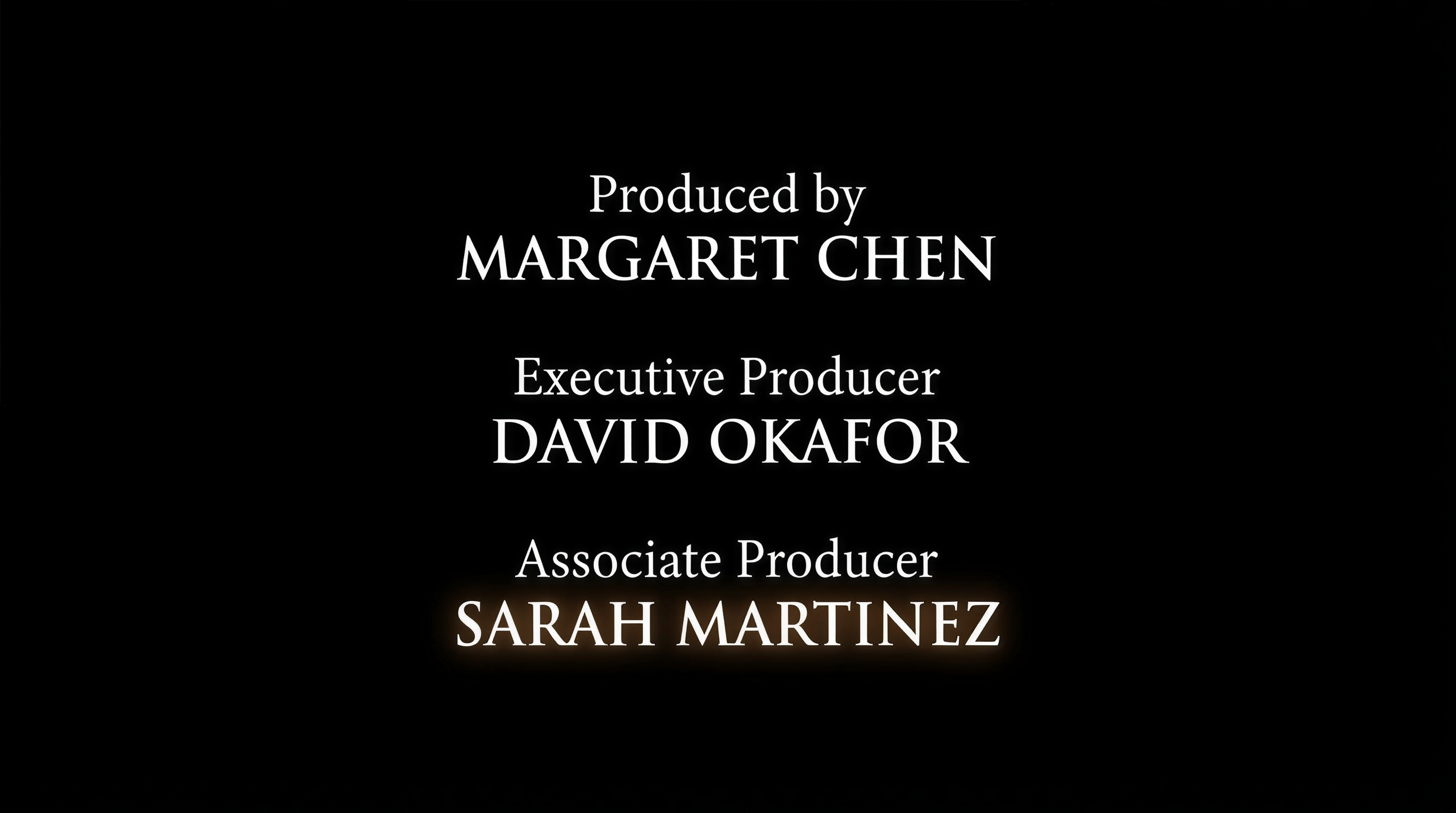
Card Format
Single AP:
Associate Producer
JANE SMITH
Multiple APs:
Associate Producers
JANE SMITH    JOHN DOE
Large productions with many APs use a scrolling list instead of static cards.
PGA Code of Credits
The PGA specifies that the associate producer credit:
- Is “granted sparingly at the discretion of the primary producer”
- Requires “one or more essential producing functions”
- Does not cover individuals “who primarily function as an assistant”
- Cannot carry the p.g.a. mark (reserved for Produced By and EP credits that pass PGA arbitration)
The lead producer controls AP credit allocation. Disputes go to PGA arbitration — though AP disputes are far less common than Produced By fights.
Formatting Rules That Matter
The credit reads Associate Producer — never hyphenated (“Associate-Producer”), never abbreviated (“Assoc. Producer”). AP is fine on call sheets. Never on screen.
If someone held both AP and another role (Production Coordinator, for example), list each credit separately in its section. Never combine them on one line.
When “Associate Producer” Is the Wrong Credit
Working APs on scripted TV put in 60+ hour weeks. The credit carries real weight. But on indie and crowdfunded projects, it’s often handed out as a perk — to investors, Kickstarter backers, or the friend who loaned their apartment for a week.
If the contribution doesn’t involve actual producing work, use “Special Thanks,” “Consulting Producer,” or “Project Consultant” instead. Diluting the AP credit hurts every professional who holds it legitimately.
Associate producer vs producer
How the Credits Stack Up
| Credit | Role | Oscar? |
|---|---|---|
| Produced by | Runs the production, development through delivery | Yes |
| Executive Producer | Financing or oversight (film). Showrunner (TV). | No |
| Co-Producer | Shares producing duties equally | No |
| Associate Producer | Delegated tasks from the producer | No |
-
AP vs. Producer: The Producer makes the creative and financial decisions. The AP executes delegated pieces. Managing the entire distribution pipeline still won’t earn a Producer credit if you weren’t in the room for the core decisions.
-
AP vs. Executive Producer: In film, EP usually means money without daily involvement. In TV, EP is the showrunner — the most powerful person on set. AP sits below both.
-
AP vs. Co-Producer: Co-Producers share responsibility more equally. On indie films, the line often comes down to creative contribution (Co-Producer) vs. logistical contribution (AP).
-
AP vs. Assistant Producer: Different roles entirely. An Assistant Producer is administrative support. An AP has independent producing responsibilities. The PGA draws this line explicitly.
Notable Associate Producers
Brandon Tamburri — AP on Hereditary (2018). The film was produced independently before A24 acquired it. Tamburri calls it the ideal position for learning end-to-end filmmaking: “The most important thing I learned is just how to make an independent film.”
Kathleen Kennedy — AP on Raiders of the Lost Ark (1981). Now president of Lucasfilm.
Kevin Feige — AP on X-Men (2000). Built the MCU. His early AP credits gave him the production foundation for the franchise model that reshaped the industry.
Sources & Further Reading
- PGA Code of Credits — Feature Films — Producers Guild of America
- What Does an Associate Producer Do? — StudioBinder
- Associate Producer: 21 Most Asked Questions — Wrapbook
- A Simple Guide to Feature Producer Credits — ScreenCraft
Recommended Videos
- What I Learned From Being an AP on Hereditary — The MAKE IT Podcast
- Working in Theatre: Associate Producer — Center Theatre Group
Create Professional Credits with EndCreditsPro
Format associate producer credits with correct hierarchy, card format, and guild-compliant ordering. Generate broadcast-ready end credits with EndCreditsPro or browse all film crew roles.