How to Credit Music in Film
Missing or wrong music credits have derailed festival submissions, blocked distribution deals, and triggered copyright infringement claims — not because the music wasn’t licensed, but because the credits were wrong.
Music credits in film are not optional formalities. They are contractual obligations tied to sync licenses, master licenses, and guild agreements. Every piece of music used in a film — original score, licensed song, or production library track — requires a specific credit format, placed in a specific location within the end credits.
This guide covers the exact credit language for each type of music, where each credit belongs in the credits sequence, and what information each credit block must contain.
Music credits in film
The Four Types of Music You Must Credit
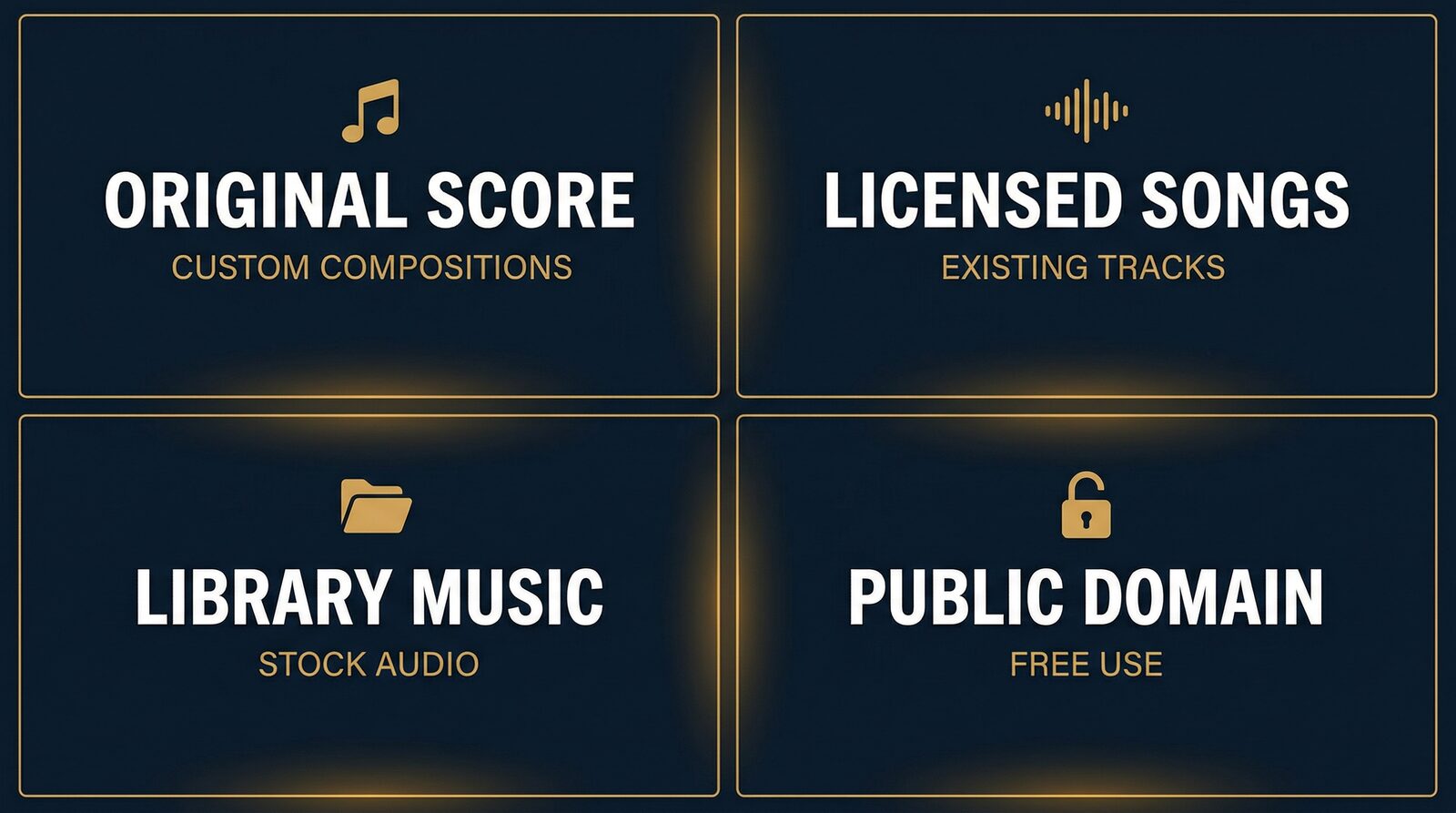
Every film production uses music that falls into one of four categories. Each has a distinct crediting requirement.
Original score — music composed specifically for the film by a hired composer. Credited under the composer’s name in the main or end credits.
Licensed commercial songs — pre-existing recordings by artists, cleared through both a sync license (covering the underlying composition) and a master license (covering the sound recording). Each licensed song requires its own credit block in the end credits.
Production library music — royalty-free or rights-managed tracks from libraries such as APM, Extreme Music, or Universal Production Music. Credited per the library’s license terms, typically in the end credits.
Public domain music — compositions whose copyright has expired (generally works published before 1928 in the United States). The composition may be public domain, but a specific recording may not be. Crediting is still required.
Failing to credit any of these correctly is not a technicality. Distributors routinely require a completed music cue sheet and corresponding credits as a deliverable before executing a distribution agreement.
Music credits format
The Exact Language and Structure for Each Credit Type
Original Score Credit
The composer’s primary credit appears in the main titles (opening credits) on significant productions, or in the end credits on lower-budget films. The standard credit reads:
Music by
COMPOSER FULL NAME
Variations used in the industry:
| Credit Line | When to Use |
|---|---|
| Music by | Most common — original score |
| Original Music Composed by | Emphasizes the music was composed for the film |
| Music Score by | Less common; used interchangeably with “Music by” |
| Score by | Informal; acceptable on indie productions |
For the film composer, the credit is a contractual matter — the Composer Agreement negotiated before production specifies the exact credit language and its placement (card size, position in the title sequence).
Licensed Song Credit Block
Each licensed song requires a structured credit block in the end credits, typically in the music credits section following the main crew credits. The standard format used across major studios:
"SONG TITLE"
Written by SONGWRITER NAME(S)
Performed by ARTIST NAME
Courtesy of RECORD LABEL
Under license from LICENSING ENTITY
A real-world example:
"Running Up That Hill (A Deal With God)"
Written by Kate Bush
Performed by Kate Bush
Courtesy of Fish People Ltd.
Under license from Parlophone Records Limited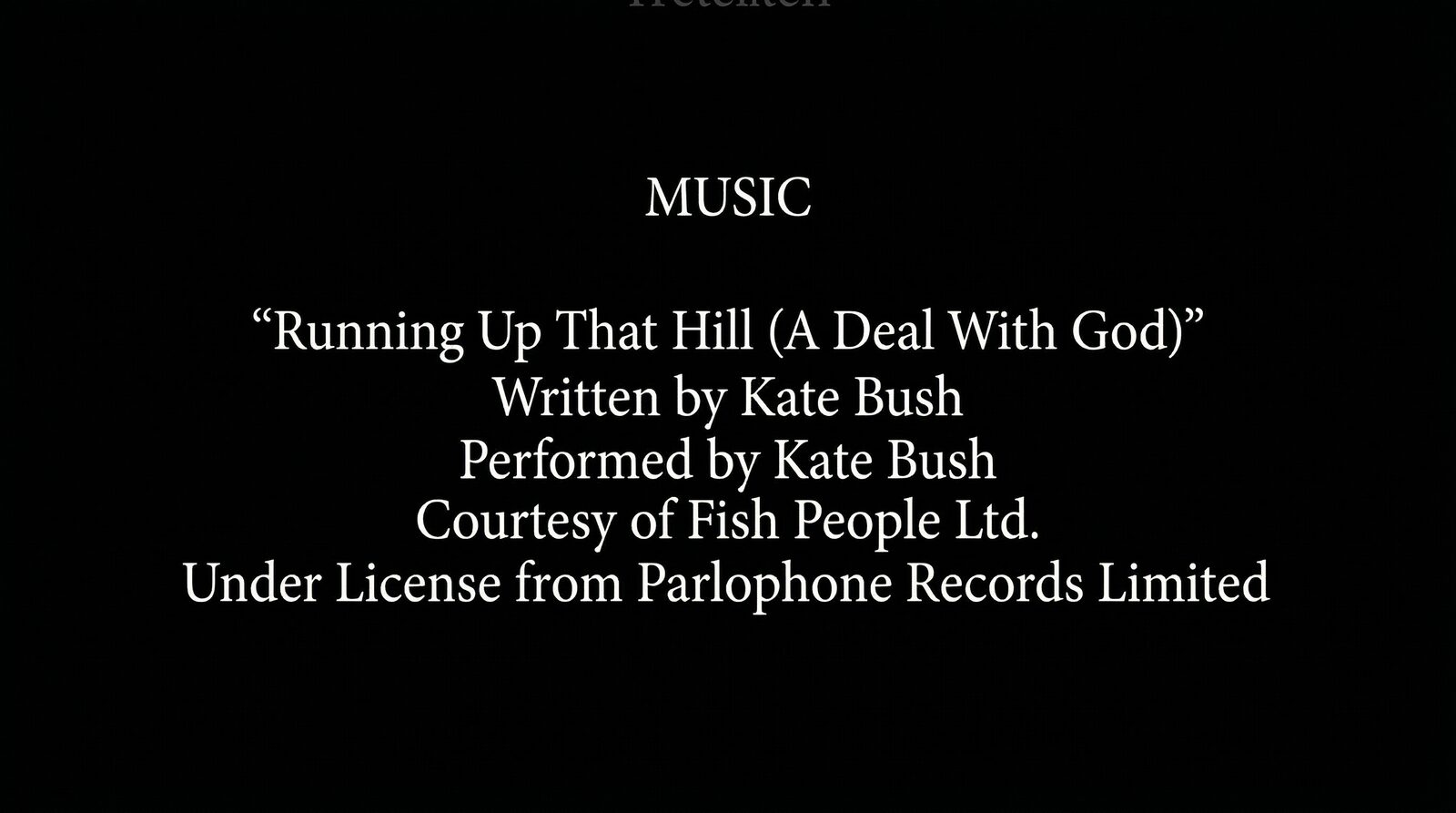
Each line serves a specific legal purpose:
- Written by — credits the songwriter(s) and satisfies the publishing/sync rights holder
- Performed by — credits the recording artist
- Courtesy of — identifies the record label or master rights holder
- Under license from — specifies who granted the master use license
If the composer and performer are the same person (common in independent music), “Written and Performed by” consolidates both lines. Some productions add a ℗ [Year] [Label] notice on the same card, which identifies the copyright owner of the sound recording.
The Two Copyright Symbols
Two copyright marks appear in music credits, and they mean different things:
- ℗ (phonogram/sound recording copyright) — identifies who owns the recording
- © (composition copyright) — identifies who owns the underlying song (publisher)
On a well-formatted credits scroll, these appear adjacent to the track listing or within the “Courtesy of” line.
Where does music appear in film credits
Placement Within the Credits Sequence
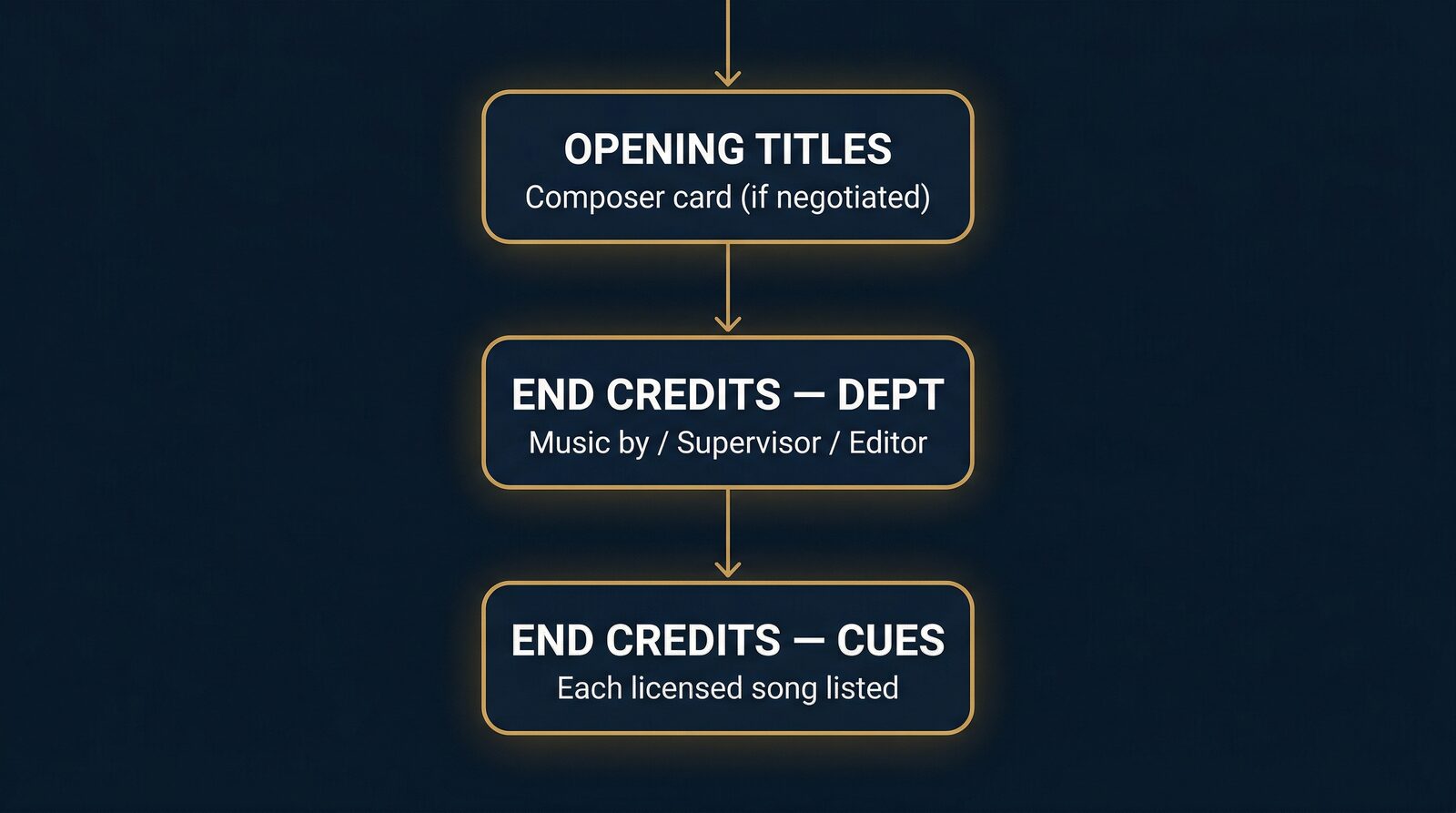
Music credits occupy a specific position in the standard film credits order. Understanding the structure prevents placement errors.
Opening Credits / Main Title Sequence
The composer receives a card in the opening credits on productions where the music contract specifies main title placement. This is negotiated — it is not automatic. On studio features, the composer’s opening credit card typically reads:
Music by HANS ZIMMEROn lower-budget productions, the composer’s credit moves entirely to the end credits.
End Credits — Primary Music Department Credits
In the end credits, music department credits appear in a specific sequence. The typical order:
- Music by (composer) — appears early in the end credits, often in the first third alongside other department heads
- Music Supervisor — follows the composer credit
- Music Editor — follows the music supervisor
- Additional Music — if applicable, credits composers of supplementary cues
- Orchestrations by / Additional Orchestrations by — credits orchestrators
- Score Recorded at / Score Mixed by — technical scoring credits
End Credits — Music Cue Section
The music cue section appears near the very end of the end credits, typically after the legal notices and before or after the final production company cards. This section lists every licensed song used in the film.
The format:
MUSIC

"Song Title One"
Written by Songwriter Name
Performed by Artist Name
Courtesy of Label Name

"Song Title Two"
Written by Songwriter Name A, Songwriter Name B
Performed by Artist Name
Courtesy of Label Name
Under License from Licensing Entity Name
Songs are generally listed in order of appearance in the film. This ordering matters for the music cue sheet, which must correspond to the credits.
How to credit an original film score
Composer Credits Beyond the Main Line
The primary “Music by” card is not the only composer-related credit. Productions with full orchestral scores include additional credits:
Score conducted by — the conductor (may differ from the composer) Score orchestrated by — the orchestrator(s) who expanded the composer’s sketches Score performed by — the orchestra or ensemble Score recorded and mixed at — studio location and engineers
Example block from a studio feature:
Music by JOHN POWELL
Score Conducted by GAVIN GREENAWAY
Orchestrations by JOHN POWELL and GAVIN GREENAWAY
Additional Arrangements by NICHOLAS DODD
Score Performed by THE LONDON SYMPHONY ORCHESTRA
Score Recorded and Mixed at AIR STUDIOS, London
When Multiple Composers Are Involved
On productions with multiple composers (common in animation or episodic television), credits specify each composer’s contribution:
Original Music Composed by HENRY JACKMAN
Additional Music by MATTHEW MARGESON
The contractual hierarchy — which name appears first, font size, card vs. shared card — is negotiated in each Composer Agreement.
How to credit licensed songs in film
Clearing Rights Before Crediting
A credit does not substitute for a license. Before formatting any song credit, confirm that two separate licenses have been secured:
- Synchronization (sync) license — grants the right to use the musical composition (the underlying song) in timed relation to the visual image. Issued by the music publisher.
- Master use license — grants the right to use the specific recorded version of the song. Issued by the record label or whoever controls the master recording.
For cover recordings, a sync license is still required for the composition, but no master license is needed — you own the recording.
The credit block must reflect what was licensed. If the production licensed a specific recording, the “Courtesy of” line names the master rights holder. If the production used a cover version it recorded itself, “Performed by” names the production’s artist and “Courtesy of” is omitted or reflects the production company.
Songs in Public Domain
Public domain compositions (typically works published before 1928 in the U.S.) still require a credit if using a specific recording. Credit the performer and recording owner; omit “Written by” only if the composer is genuinely unknown or unattributable. Example:
"Moonlight Sonata"
Composed by Ludwig van Beethoven
Performed by PIANIST NAME
Courtesy of RECORD LABEL
How to credit library music in film
Production Music and Royalty-Free Tracks
Production library music (also called library music or production music) is pre-cleared for sync use, but the license agreement specifies whether a credit is required and in what format. Read every license agreement.
Standard library music credit format:
"Track Title"
Written by COMPOSER NAME
Published by LIBRARY NAME / PUBLISHER NAME
Some libraries require only the track title and publisher. Others require the full songwriter credit. The ThinkSync model is common: the library retains the publisher’s share and collects broadcast royalties through performance rights organizations (ASCAP, BMI, PRS, JASRAC, etc.). Your credit enables that collection.
Important: If you compose original music using VST sample libraries (Spitfire, EastWest, Native Instruments, etc.), you do not credit the library. You credit yourself as composer. The library license grants you the right to use the samples in a composition without attribution to the sample library vendor.
The music editor on larger productions is typically responsible for maintaining the music cue sheet and ensuring that all library music credits match the actual cues in the film.
Music credits for short film
What Indie and Student Productions Get Wrong
Short films, student productions, and festival entries face the same crediting obligations as studio features — but with less infrastructure to enforce them.
The most common mistakes:
-
Crediting without licensing. Adding “Music courtesy of [Artist]” in the credits without an actual license. This does not protect you. At larger festivals (Sundance, SXSW, Tribeca), proof of licensing is a submission requirement. A credit without a license is still an infringement.
-
Using the wrong format. Writing “Music: Song Title by Artist Name” as a single line instead of the full block format. Acceptable for very small local screenings; not acceptable for festival submissions or any commercial use.
-
Omitting the “Courtesy of” line. If you license a commercial recording, the label must be credited. Omitting it violates the master license terms.
-
Ignoring library attribution requirements. Assuming royalty-free means credit-free. Many libraries — particularly those in the “free with attribution” category — require specific credit language as a condition of the license.
Recommended approach for short films using licensed music:
MUSIC

"[Song Title]"
Written by [Songwriter]
Performed by [Artist]
Courtesy of [Record Label]
Licensed through [Licensing Platform, e.g., Musicbed, Artlist, Soundstripe]
For library music licensed through platforms like Artlist or Musicbed, the platform’s license terms specify what credit is required. Most modern SaaS music licensing platforms do not require a credit — but check the specific license for each track.
Frequently Asked Questions
Do you have to credit music in a film?
If you licensed the music, the license agreement will specify credit requirements. In practice, all commercial music licenses require a credit. For original scores, the composer’s contract specifies credit terms. There is no blanket legal requirement to credit music in a film in U.S. copyright law — but failing to credit typically violates the terms of your license agreement, and distribution deliverables routinely require properly formatted music credits.
What is the standard format for music credits in film?
The standard music credit block for a licensed song is: Song title (in quotation marks), Written by [songwriter], Performed by [artist], Courtesy of [record label], Under license from [licensing entity]. The original score credit reads: Music by [Composer Name], placed in the main or end credits per the Composer Agreement.
Where in the credits does the composer get credited?
On significant productions, the composer receives a card in the opening title sequence. On most productions, the primary “Music by” credit appears in the end credits in the first third, alongside other department heads. The position and card type are negotiated in the Composer Agreement.
What is a music cue sheet and how does it relate to credits?
A music cue sheet is a document listing every piece of music in the film — title, composer, publisher, performing artist, timing, and type of use (background, feature, main title, etc.). It is the document performing rights organizations use to calculate and distribute royalties. The music cue sheet and the end credits must match. Distributors typically require a completed cue sheet as a delivery item.
Do I need to credit VST sample libraries?
No. If you are the composer and you used VST instruments or sample libraries (Spitfire, EastWest, etc.) to create the score, you credit yourself as composer. The sample library license grants you the right to use the samples without attribution to the library.
Building the music credits section of your end credits requires getting the format right for every track — and making sure each credit matches the corresponding license. EndCreditsPro lets you structure your entire credits sequence with the correct department order, credit language, and formatting.
Use the film credits maker built for productions that need to get music credits right →