Directors Guild of America Credits Requirements: Complete Guide (2026)
The DGA credit rules most productions violate aren’t the ones about the director — they’re the ones about the 1st AD and UPM. Both are DGA members. Both require a specific shared credit, and most productions get it wrong.
The Directors Guild of America represents approximately 18,000 members across three categories: directors, assistant directors, and unit production managers. Every DGA signatory production must comply with credit obligations for all three categories — not just the director at the top of the marquee.
Credit violations on a DGA signatory production carry real consequences: written notice of breach, mandatory correction of all prints and advertising materials, and potential financial penalties. Getting these rules right before delivery is substantially cheaper than fixing them after.

This guide covers the specific DGA credit format requirements, placement rules, possessory credit guidelines, and the less-discussed AD and UPM obligations that catch productions off guard. It’s part of our Guild Compliance series covering credit rules for every major entertainment union.
Disclaimer: Rules current as of the DGA Basic Agreement 2023 and the 2023 Television Agreement. Verify with the DGA directly for your specific production type and signatory agreement.
What is the DGA
The Directors Guild of America: Jurisdiction and Members
The Directors Guild of America was founded in 1936 as the Screen Directors Guild and merged with the Radio and Television Directors Guild in 1960 to form its current structure. Headquartered at 7920 Sunset Blvd, Los Angeles, the DGA covers theatrical motion pictures, television films, streaming productions, commercials, and new media projects under separate agreement schedules.
DGA jurisdiction extends to any production where the employer is a signatory to the applicable DGA agreement. Unlike some guilds, the DGA covers three distinct member categories — directors, first assistant directors (1st ADs), and unit production managers (UPMs) — and each has its own credit requirements under Articles 8-200 (theatrical) and 8-300 (television) of the Basic Agreement.
DGA credit rules
What the Agreement Actually Requires
The DGA’s credit provisions under Section 8-200 and 8-300 are specific where most productions assume they have discretion.
The single card requirement is the most fundamental rule: the director’s credit must appear on its own card, not shared with any other individual. This applies in both opening and closing credits. Productions may not combine the director credit with a producer credit, a writer credit, or any other individual credit on the same card — regardless of what the individual negotiates separately with a studio.
Font size and legibility are also mandated. The director’s name may not appear in a font size smaller than the largest font used for any other individual credit in the same credit sequence. If the star receives 100-point type in the opening credits, the director gets at least 100-point type. The DGA agreement does not specify a minimum absolute size — it specifies a relative minimum.
Display duration must be at least as long as the longest other individual credit in the sequence. If any performer’s card holds for three seconds, the director’s card holds for at least three seconds.
Paid advertising has its own size rules, in Article 8-203 of the Basic Agreement. The director’s credit must be at least 15% of the size of the type used for the title, and never smaller than the size and style of any credit given to a non-actor. Outdoor-type ads, 24-sheets included, are exempt only if they carry little more than the title, key art, logos and the rating and copyright notice; otherwise the director’s credit must be at least 35% of the title or of any individual credit, whichever is larger. The director’s credit is required on every one-sheet (an advance one-sheet may leave it out only if nobody but the starring actors is credited), and paid advertising is submitted to the Guild, which has two business days to object (8-210). The billing block size rules and calculator turn these percentages into pixels or inches for a poster.
Required credit formats
”Directed by” — The Exact Standard
The DGA does not mandate a single word-for-word format for director credits, but “Directed by [Name]” is the established standard and the form used in most guild contracts. The agreement specifies that the director shall receive credit in the form negotiated, and that the credit shall be clear and legible.
The standard theatrical director credit format:
Directed by
JANE DOE
Or, on a single line:
DIRECTED BY JANE DOEEither is acceptable. What is not acceptable: crediting the director in a font size smaller than a co-producer, or placing two individuals on the same card as the director.
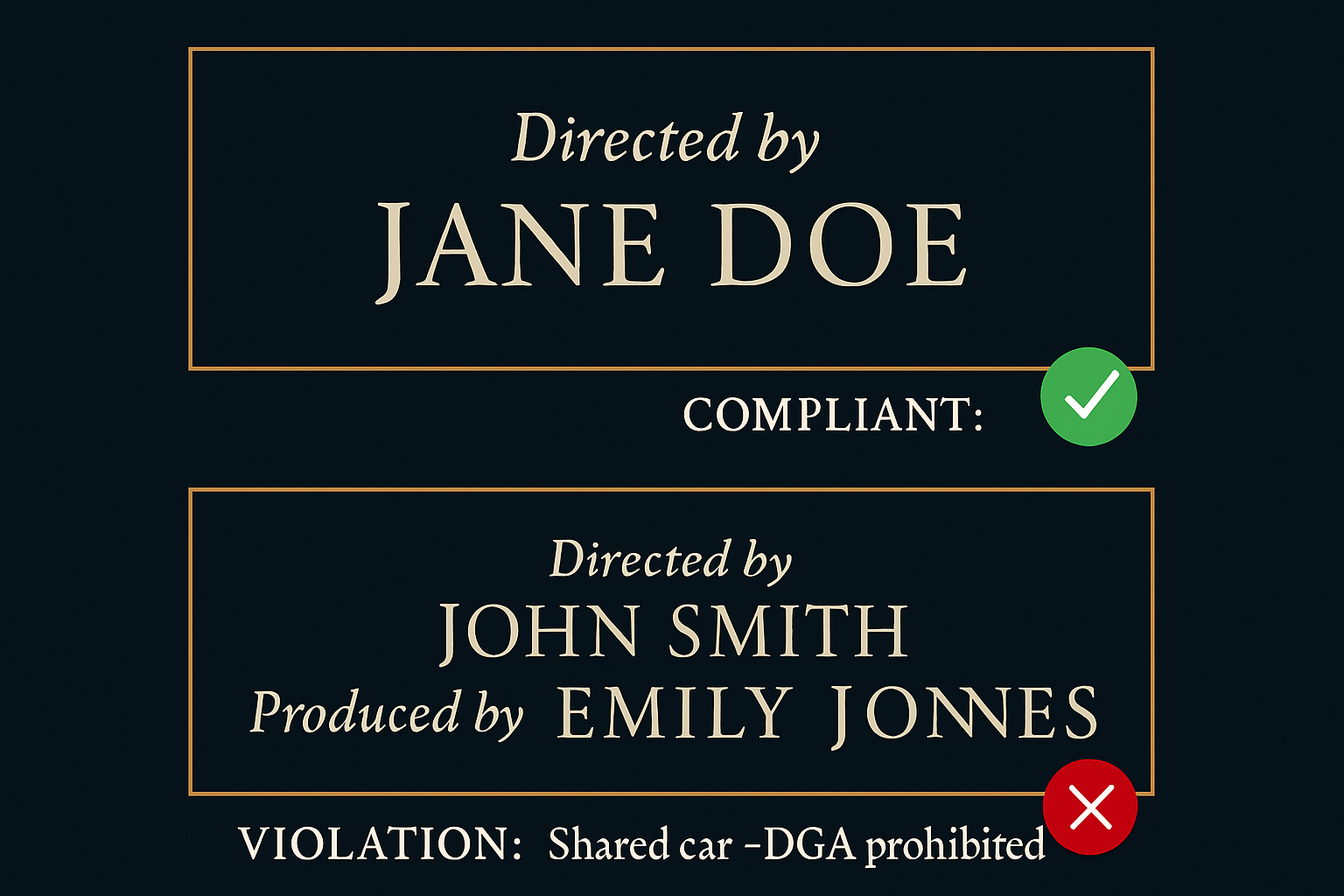
Television format: Television episodes follow similar rules, with one notable addition — the “Directed by” credit must appear after any cold open, before the main title sequence begins, or at the end of the episode depending on the show’s agreed format. The position cannot be buried mid-episode or moved without agreement consent.
The possessory credit (“A Film By [Name]” or “A [Name] Film”) is a separate category handled below.
Credit order requirements
Where the Director Credit Must Land
Opening credits: When a production includes a director credit in the opening title sequence, the DGA requires it to appear last — after cast, producers, and all other opening credits. The director’s card is the final credit before the film begins. This is not industry convention; it is a contractual requirement.
End credits: In the closing credit roll, the director’s credit must appear after all other individual credits. It is the final individual credit before any studio or distributor logos. Some productions place a second “Directed by” card at the very end of the crawl after cast and crew have been listed — this is common but must still comply with size and display requirements.
UPM, 1st AD and 2nd AD credit (section 13-209): The Basic Agreement requires the Unit Production Manager, the First Assistant Director and the Key Second Assistant Director to be credited in a “prominent place”: a separate card, or its equivalent in a crawl, shared by no more than three names, in that order and in the same size and style of type. The only technical credits allowed a more prominent place are the Director of Photography, the Art Director and the Film Editor. The agreement does not require the main titles; in practice this card usually opens the crew section of the end credits.
Television: The same section 13-209 rule applies to television motion pictures. Multi-camera prime-time pilots and series follow a variant in section 24-406(c). Credit disputes are submitted to the Guild for determination.
A practical breakdown:
| Credit | Opening Placement | Closing Placement |
|---|---|---|
| Director | Last credit before film | After all individual credits |
| UPM, 1st AD, Key 2nd AD | Not required | Usual place: their own shared card (or crawl equivalent), max three names, in that order |
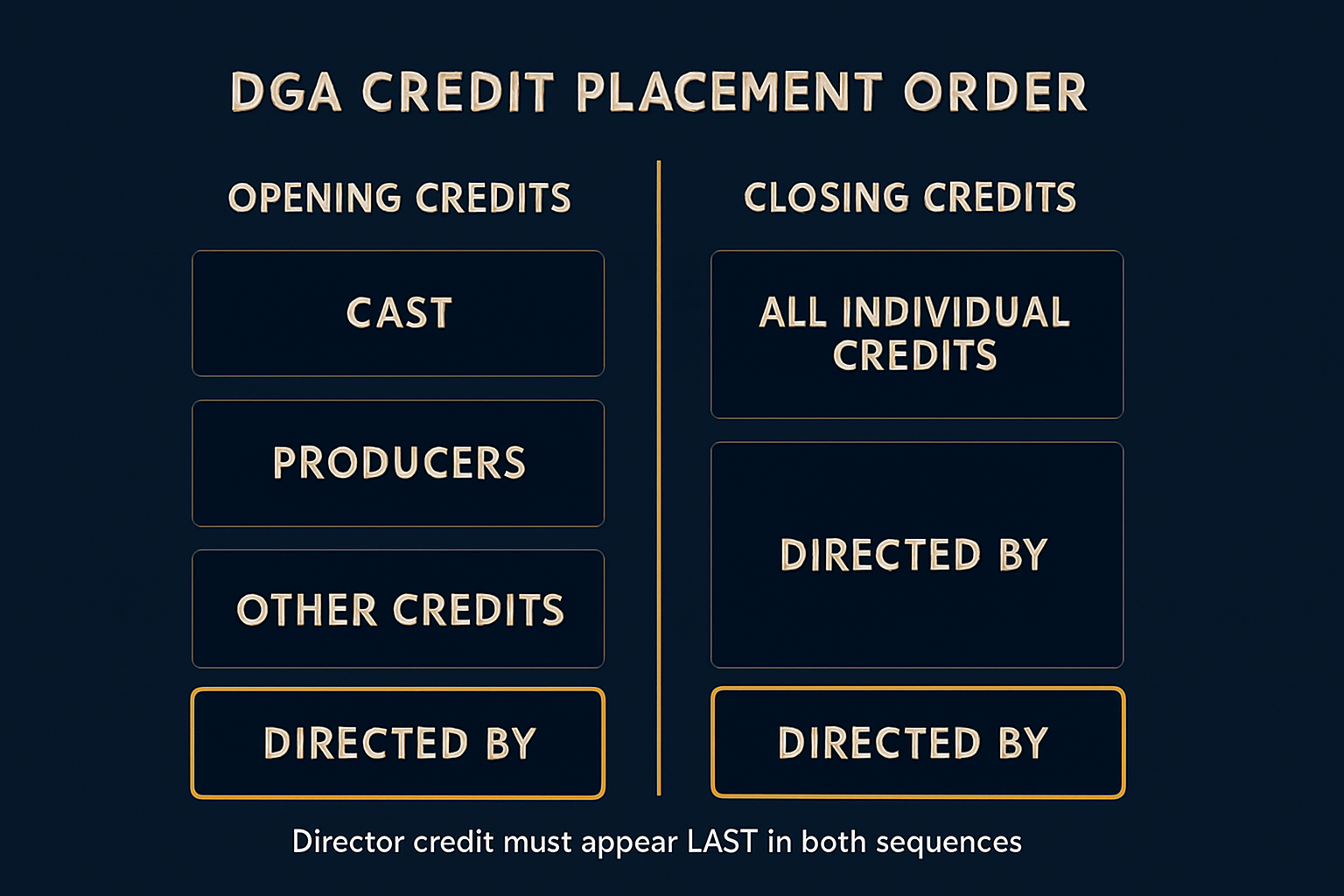
dga director credit
Single Director Rule and Exceptions
The DGA maintains a strong single director rule: only one director may be credited on a theatrical motion picture. This is not a recommendation — it is an agreement provision designed to protect the director’s singular creative authority.
Exceptions exist for established directing teams recognized prior to their engagement. The Wachowskis, the Coen Brothers, the Russo Brothers, and Lord/Miller have all received dual director credits under DGA agreements that recognized them as established teams. These exceptions were not granted automatically — each required DGA approval and documentation of the team’s prior collaborative history.
Productions that replace a director mid-shoot face a specific scenario: if the original director worked fewer than 50% of the scheduled days, the replacement director typically receives sole credit. If both worked substantial portions, the production initiates a credit determination process with the DGA. The outcome is not negotiated between the parties — the DGA arbitration process governs.
When a director is replaced and the original director wishes to remove their name entirely, the DGA pseudonym process applies.
possessory credit film
”A Film By” — When It’s Allowed and What It Costs
The possessory credit — “A [Name] Film” or “A Film By [Name]” — is one of the most contested credits in the industry. The WGA has repeatedly sought to restrict possessory credits to writers; the DGA has consistently blocked those efforts, protecting the director’s claim to the designation.
The DGA’s own guidelines for possessory credits recommend granting them only when the director has “attained widespread name recognition or received at least two established awards of merit.” In practice, possessory credits appear on films by directors well below that threshold — but any production granting one on a DGA signatory project should have the negotiated right documented in the director’s deal.
Possessory credits have a long history: the form traces back to D.W. Griffith’s The Birth of a Nation (1915). In contemporary production, they are common for directors with established brands — and occasionally contentious when the producing team objects. The DGA will not grant a possessory credit against the production’s objection without documented contractual basis.
dga credit dispute
What Happens When Credits Are Contested
The DGA credit arbitration process is separate from the WGA’s — and less formal. For most DGA credit disputes, the process involves:
- Written notice of the dispute to the DGA
- Review of the production’s shooting records and the employment agreements of all parties
- A determination by the DGA credit committee
For director replacement cases — like the Sin City situation where both Robert Rodriguez and Frank Miller were considered for director credit, or Bohemian Rhapsody where Bryan Singer was replaced by Dexter Fletcher — the DGA determines credit based on total creative contribution and days worked.
Productions cannot unilaterally resolve a disputed credit by private negotiation. Once the DGA is notified of a dispute, the arbitration process governs the outcome.
alan smithee dga
The Official Pseudonym and Its Retirement
From 1968 to 2000, “Alan Smithee” served as the DGA’s official pseudonym for directors who sought to disavow their work. The pseudonym required proof that the director had been unable to exercise creative control — it was not available simply because a director disliked the final cut.
Directors using the Alan Smithee pseudonym were forbidden from publicly acknowledging they had done so. The pseudonym debuted with Death of a Gunfighter (1969), where both Don Siegel and Robert Totten directed portions of the film. It was retired after An Alan Smithee Film: Burn Hollywood Burn (1997) drew widespread attention to the convention and undermined its purpose.
The DGA no longer maintains a standardized pseudonym. Directors seeking credit removal today petition the DGA individually, and outcomes vary by case.
Common DGA credit mistakes
What Productions Get Wrong Most Often
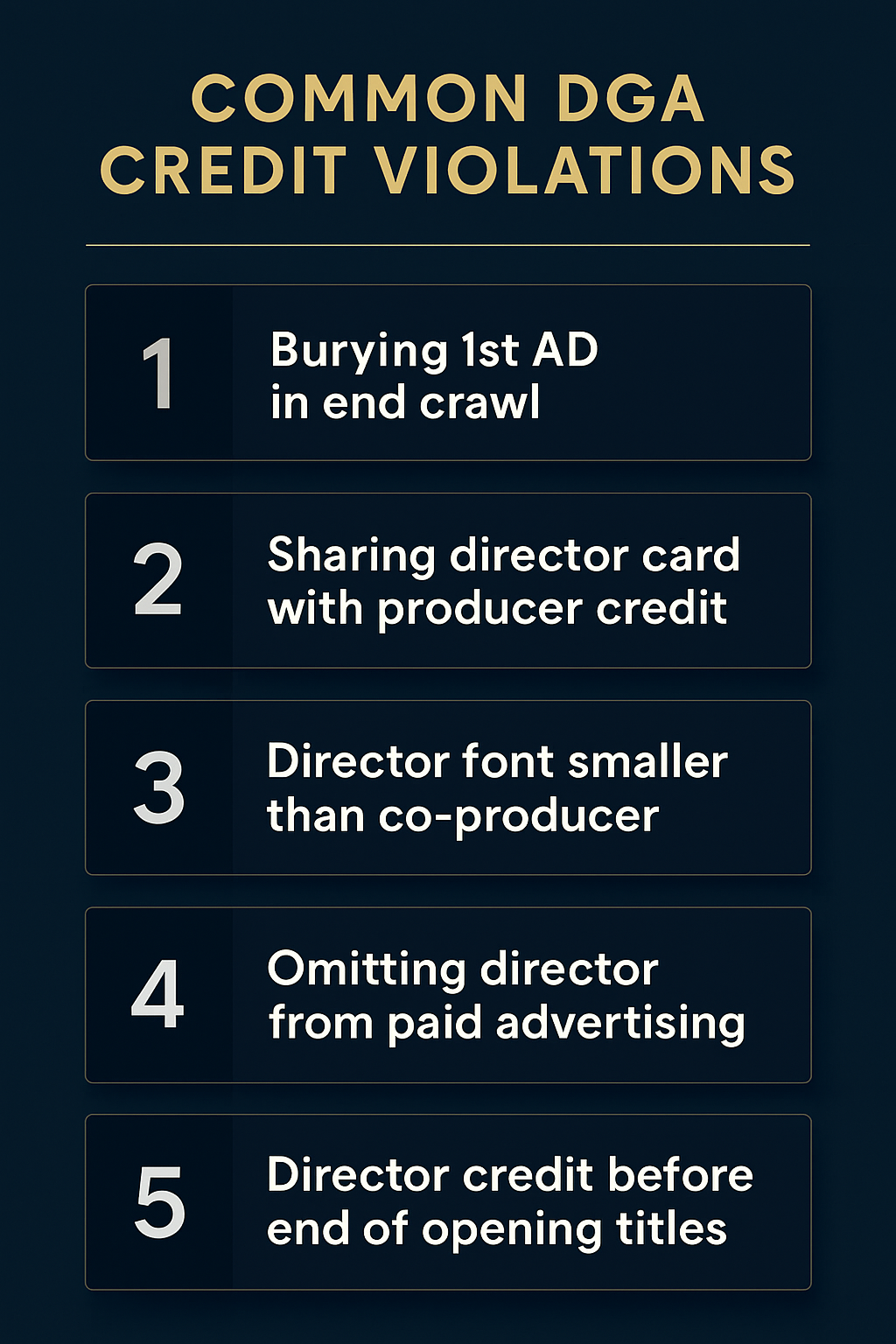
1. Breaking up the UPM / 1st AD / 2nd AD card. Section 13-209 requires these three credits together, on their own card or crawl equivalent, in that order and in the same type. Productions that treat AD credits as ordinary crew lines often omit one of them, add more names to the card, change the order, or give other crew (beyond the DP, Art Director and Editor) a more prominent place.
2. Sharing the director’s card with a producer credit. Producer-directors sometimes appear on a single card combining both credits. Unless this is specifically negotiated and agreed, the DGA single-card rule requires the director credit to appear alone.
3. Making the director’s font smaller than a co-producer. When a well-known producer negotiates prominent billing, production teams sometimes reduce the director’s font size to accommodate layout. This directly violates the relative size requirement.
4. Omitting the director credit from paid advertising. If a trailer or print ad credits a performer, it must also credit the director. Productions regularly credit the cast in advertising and omit the “Directed by” line.
5. Placing the director credit before the end of opening titles. The DGA requires the director credit to be the last opening credit. Placing it in the middle of the sequence — common when producers control credit order — violates the placement rule.
DGA credits checklist
Pre-Delivery Compliance Checklist
Use this checklist before finalizing any DGA signatory production’s credit package:
Director Credit — Format
- Director credit appears on a single card, not shared with any individual
- “Directed by” or negotiated equivalent is the credit form used
- Director’s name is no smaller than the largest individual credit in the sequence
- Card holds at least as long as the longest other individual credit
Director Credit — Placement
- In opening credits: director card appears last, after all other opening credits
- In end credits: director credit appears after all other individual credits
- Television: “Directed by” appears in the agreed position (not buried in act breaks)
Possessory Credit
- If used: possessory credit is documented in the director’s negotiated deal
- Possessory credit does not appear in conflict with the DGA’s standard credit form without approval
1st Assistant Director
- UPM, 1st AD and Key 2nd AD share a separate card (or crawl equivalent), max three names, in that order, same size and style of type
- Credit is not relegated to the fine-print end crawl
Unit Production Manager
- UPM credit appears in the position required by the applicable DGA agreement
- UPM credit has not been omitted or waived without authorization
Paid Advertising
- Any ad crediting a performer also includes the director credit
- Director’s credit in paid advertising is at least 15% of the title type (35% on outdoor ads that carry other names), and the ad was submitted to the Guild (billing block rules)
Credit Disputes
- Any replacement director situation has been reported to the DGA
- No credit arrangement involving a replaced director was settled privately without DGA involvement
Sources and further reading
Authoritative References
The primary source for DGA credit requirements is the DGA Basic Agreement, specifically Article 8 (Section 8-200 for theatrical, Section 8-300 for television). The 2023 contract update added AI protections and modified residuals structures but did not substantially alter credit format requirements.
For context on how DGA credits interact with other guild obligations, see our guide to guild credit requirements covering DGA, WGA, and SAG-AFTRA rules together. The film credits format and order guide covers the full credit sequence structure across a production.
For productions navigating credit requirements alongside SAG-AFTRA obligations, the SAG-AFTRA compliance guide covers performer credit rules and how they interact with guild placement requirements.
For an overview of all major entertainment guilds and who they represent, see the film industry unions and guilds guide. For the producers’ side, where the rules are guidance rather than contract, see PGA credits and the p.g.a. mark.
Automate DGA Compliance with EndCreditsPro
Getting DGA credit placement right requires tracking multiple rules across three member categories — director, 1st AD, and UPM — plus paid advertising obligations and the possessory credit nuances that vary by deal.
EndCreditsPro generates credit sequences formatted to DGA standards: single-card director credits, correct relative sizing, proper placement order for all DGA members, and exportable formats ready for post-production delivery. Upload your deal memos, set your guild parameters, and let the tool enforce the rules that productions miss most often.