What Is a Music Supervisor in Film?
The right song in the right scene is never an accident. It’s the result of months of pitching, negotiating, clearing rights, and fighting for budget — work that almost no one sees coming.

A music supervisor is the professional responsible for all music-related decisions in a film, television show, or other visual media production. According to the Guild of Music Supervisors, a music supervisor is “a qualified professional who oversees all music related aspects of film, television, advertising, video games and any other existing or emerging visual media platforms as required.”
In practice, this means bridging the gap between creative direction and music licensing. The music supervisor works directly with the director to define the musical tone of the project, then sources, licenses, and delivers every piece of pre-existing music that appears on screen.
The role sits within the Music Department — separate from, but collaborative with, the film’s composer, who handles original score.
What does a music supervisor do?
Music Supervisor Responsibilities in Film & TV
A music supervisor’s work spans the full production timeline, from development through post-production and delivery.
Pre-production:
- “Spotting” the film or script with the director to identify where music will appear, whether it needs to be diegetic (on-screen source music) or non-diegetic (score or soundtrack)
- Establishing a music budget — typically less than 5% of the total production budget
- Identifying target songs and researching rights ownership
Production:
- Attending set when live music performances are required
- Advising on music-related art direction (what records are on the wall, what the character is listening to)
- Coordinating with the Music Editor on temp tracks for editorial
Post-production:
- Clearing synchronization licenses (sync) and master use licenses for every pre-existing song
- Negotiating fees with publishers, record labels, and rights holders
- Submitting cue sheets to performing rights organizations (PROs) — ASCAP, BMI, or SESAC
- Supervising the final music mix in collaboration with the re-recording mixer
- Compiling all music credit information for the end crawl
Who they report to: The director and producers.
Who reports to them: The music editor, music coordinator, and assistant music supervisor (on larger productions).

Where does a music supervisor appear in film credits?
Music Supervisor Credit Placement in End Crawl
This is where the industry gets specific — and where most productions get it wrong.
The music supervisor receives a dedicated credit in the Music Department section of the end crawl. This section appears in the technical credits block, typically after the Sound Post-Production department.
Standard credit format:
Music Supervisor
JOHN DOE
Or, on productions where the supervisor works for a company:
Music Supervision by
DOE MUSIC SUPERVISION
Opening credits: Music supervisors do not typically receive an opening title card. On television (especially prestige drama), some music supervisors negotiate a “Music Supervised by” card in the end titles — separate from the main-on-end crawl — particularly if their music choices were central to the show’s identity. Euphoria music supervisor Jen Malone and Breaking Bad music supervisor Thomas Golubić are examples where the credit became part of the show’s recognized brand.
In the end crawl specifically:
- Credit appears under the “Music” heading, after the Composer and Score Producer
- Title used: “Music Supervisor” — never “Music Direction” (that’s a different role in live performance)
- On union productions, the exact credit wording must match the individual’s contract
- If music supervision was handled by a company rather than an individual, the company name appears with the individual supervisor listed below it
Cue sheet requirement: Every cue sheet submitted by the music supervisor must include accurate credit attributions — title, composer, publisher, and performing artist. This data flows directly into the production’s legal and licensing documentation and must match the end crawl.
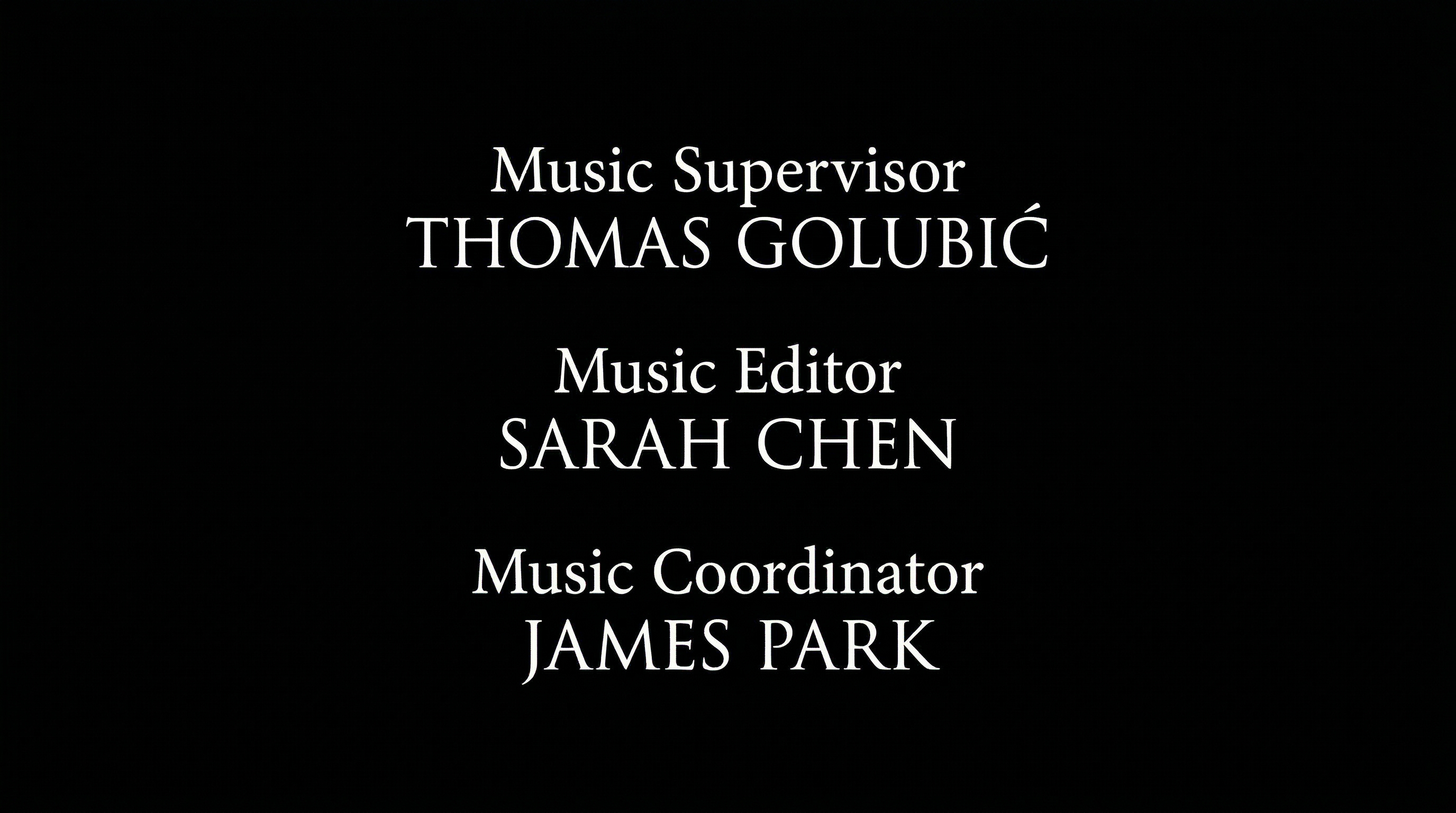
How to credit a music supervisor correctly
Music Supervisor Credit Format
The most common variations you’ll encounter:
| Credit Style | Used When |
|---|---|
Music Supervisor | Standard individual credit |
Music Supervised by | Company credit (company name follows) |
Music Supervision | Company-as-credit style (less common) |
Music Coordinator | Lower-budget productions, assistant-level work |
What to avoid:
- “Music Director” — this title belongs to live performance (theater, concerts) and is not interchangeable with music supervisor in a film context
- “Music Producer” — a separate role; music producers create recordings, supervisors license them
- Omitting the credit entirely — the music supervisor’s licensing work generates the legal documentation that protects the production; omitting the credit creates complications for distribution and E&O insurance
If one person served as both music supervisor and music editor: Credit both titles separately. Guild conventions and standard industry practice list each function independently. Do not combine them as “Music Supervisor/Editor.”
Music supervisor vs. music editor vs. composer
Roles in the Music Department: What’s the Difference?
These three titles are frequently confused — but their functions and credit placements are distinct.
| Role | Primary Function | Credit Section |
|---|---|---|
| Composer | Creates original score | Above music supervisor, often separate card |
| Music Supervisor | Sources and licenses pre-existing music | Music Department, after Composer |
| Music Editor | Edits music to picture, manages temp tracks and final conforming | Music Department, after Music Supervisor |
The music supervisor and composer divide the soundtrack between them. The supervisor handles everything with an existing recording (a specific Kate Bush track, a specific label master); the composer handles everything that needs to be written new. These two often work in close collaboration — scenes originally temped with licensed music sometimes become original score, and vice versa.
On lower-budget productions, one person sometimes holds both the music supervisor and music editor role. Both credits must still appear separately.
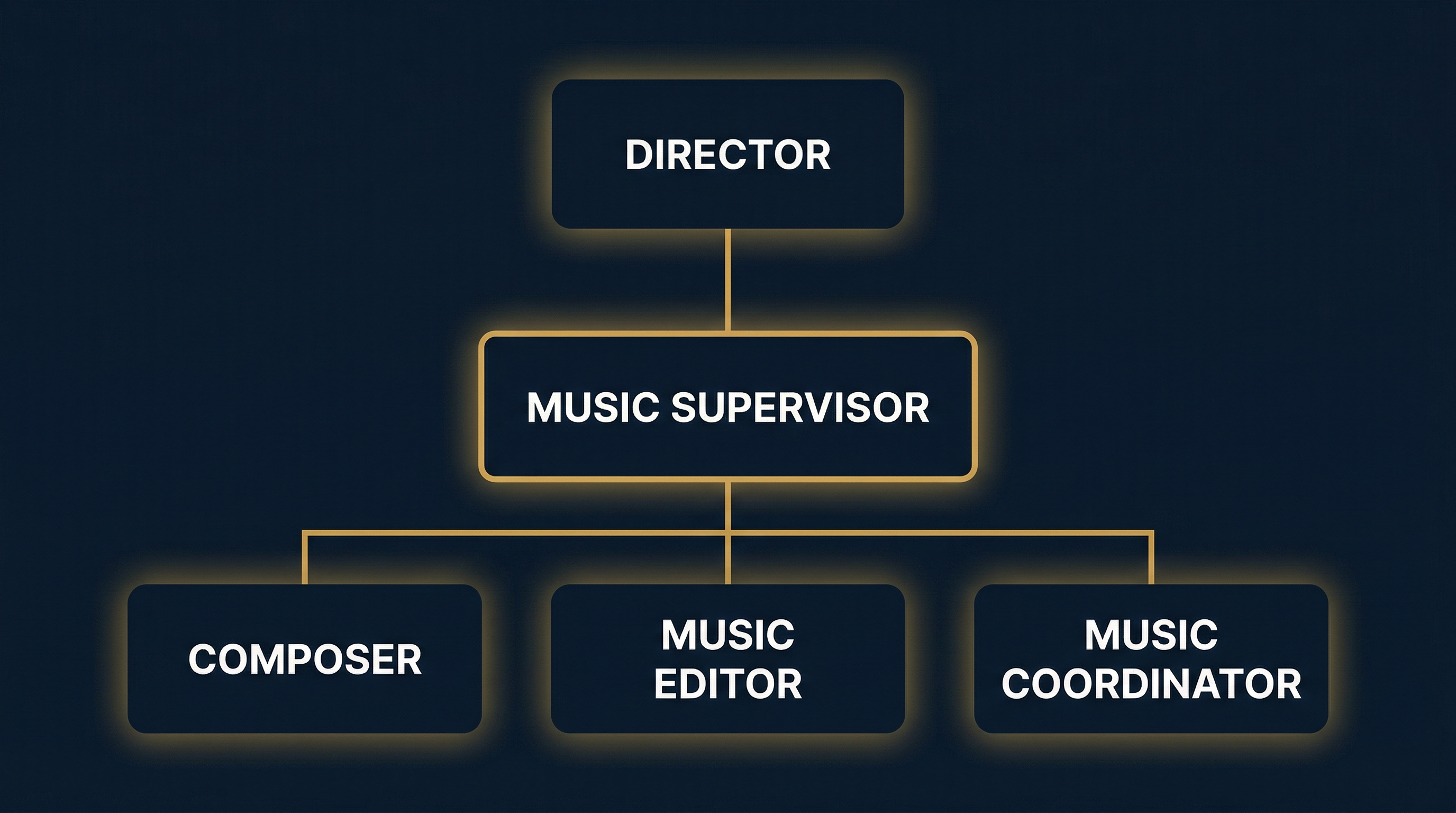
How to become a music supervisor
Music Supervisor Career Path
There is no single accredited degree in music supervision. The role is built from a combination of music industry knowledge, legal acumen, and production relationships.
Most working music supervisors came from:
- Music licensing at a label or publisher — learning the rights landscape before stepping into production
- Assistant music supervisor roles — the most common direct path on studio productions
- Music coordination — handling day-to-day logistics on shows before stepping into a supervisory role
- Independent film — building a credit list on low-budget productions before moving up
The Guild of Music Supervisors (GMS) is the primary professional organization for the role. GMS membership is not a union membership — there is no union for music supervisors — but it signals professional standing. GMS holds an annual conference and awards ceremony recognizing outstanding work in music supervision.
Berklee College of Music offers a music supervision concentration, and several universities have added music licensing coursework, but industry experience remains the primary credential.
Music supervisor salary
What Music Supervisors Earn
Because there is no union governing music supervision rates, compensation varies widely based on production budget and individual negotiating leverage.
Industry veteran Mike Turner, who has supervised major Hollywood productions, described the rate structure directly:
- $1M–$6M budget productions: $15,000–$20,000 per project
- $10M+ productions: $40,000 and up
- $100M+ studio films: $80,000–$90,000
- Entry-level / indie work: Rates are negotiable and often below $10,000; some work starts unpaid to build credits
The average annual salary for employed music supervisors (in-house at networks or studios) is approximately $54,000–$65,000. Freelance supervisors working at the studio level can earn significantly more, particularly when soundtrack album points are negotiated.
Sync license fees — for the songs the supervisor licenses — are separate from the supervisor’s fee and paid directly by the production to rights holders.
Notable music supervisors in film history
Music Supervisors Who Shaped Iconic Soundtracks
Thomas Golubić — Breaking Bad, The Walking Dead, Six Feet Under. Golubić’s work on Breaking Bad is among the most studied in music supervision, using country, blues, and corridos to build character psychology across five seasons.
Alexandra Patsavas — The O.C., Mad Men, Twilight, Grey’s Anatomy. Patsavas is credited with breaking dozens of independent artists into mainstream consciousness through sync placements in peak-era TV drama.
Randall Poster — The Grand Budapest Hotel, The Wolf of Wall Street, Moonrise Kingdom. Wes Anderson’s longtime music supervisor; his work on the director’s films demonstrates how music supervision becomes inseparable from directorial voice.
Jen Malone — Euphoria, Ramy. Malone’s curation on Euphoria turned music supervision into a critical talking point, with each episode’s soundtrack assembled as precisely as the cinematography.
Sources & Further Reading
Create Professional Music Credits with EndCreditsPro
Getting the music supervisor credit right — title, position, format — matters for distribution and E&O insurance compliance. EndCreditsPro formats your entire end crawl to industry standard, including the Music Department section, so every credit appears in the correct order and with the correct title.