What Is a Script Supervisor in Film?
The script supervisor is the director’s memory and the editor’s future best friend. Without one, continuity errors reach the final cut — and the audience notices.
A script supervisor (also called a continuity supervisor) is the crew member responsible for maintaining the continuity of the motion picture across every scene, setup, and shooting day. They document what happens in each take — actor positions, dialogue, props, wardrobe, eyelines, lens choices — so that scenes shot weeks apart cut together seamlessly.
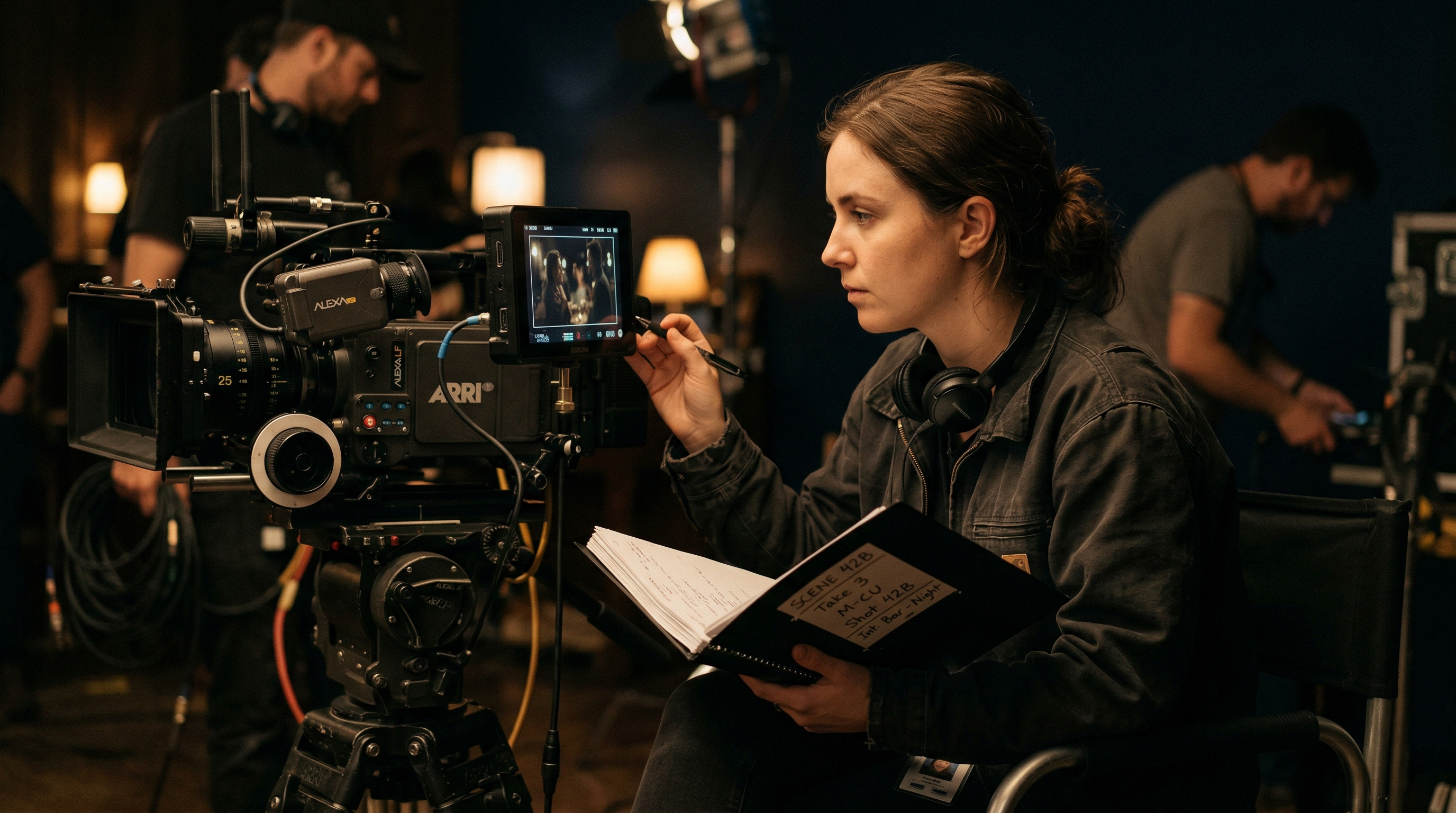
The craft was invented in 1918 by Sarah Y. Mason, who received the screen credit “Continuity Girl” on the film Arizona. The title has evolved through “continuity clerk” and “script girl” to the gender-neutral “script supervisor” that became standard by the late 1970s. The work itself has not changed: one person on set whose entire job is to watch, record, and remember everything.
The script supervisor is classified as a department head and reports directly to the director. They serve as the primary liaison between the set and the editorial team.
What does a script supervisor do?
Script Supervisor Responsibilities: Pre-Production Through Wrap
Unlike most crew roles that scale up during principal photography, the script supervisor’s work begins before cameras roll.
Pre-production duties:
- Reading the script multiple times and breaking down each scene for continuity requirements
- Building a continuity report template tailored to the production
- Meeting with the director to understand visual priorities and shot plans
- Coordinating with the art department, wardrobe, props, and makeup departments to establish what needs continuous tracking
- Preparing the initial timing breakdown — calculating projected scene run times to help the director build a shooting schedule
On-set duties:
- Maintaining the lined script: a master copy of the shooting script with vertical lines marking each camera setup, indicating what portion of the scene each shot covers
- Recording detailed notes on every take: slate number, take duration, lens and filter used, director’s preferred takes, and any continuity issues
- Tracking all continuity elements across shots — hair, makeup, wardrobe, props, actor positions, blocking, eyelines, screen direction
- Monitoring live dialogue via headset to catch missed lines, ad-libs, or transpositions in real time
- Serving as the official timekeeper: recording first shot of day, lunch breaks, last shot, and wrap times
- Preparing daily reports for the production office, including pages completed, scenes shot, and total running time accumulated
- Passing editor’s notes to post-production that describe each take’s qualities and flag the director’s selects
Post-production relationship:
The script supervisor’s logs are among the first materials the editor receives. A well-maintained set of notes — particularly the lined script and continuity reports — can cut hours off the editing process. A sloppy set of notes forces the editor to watch every take before making decisions.
Script supervisor salary
What Do Script Supervisors Earn?
Script supervisor compensation varies significantly by market, format (film vs. episodic vs. commercial), and union status.
- Non-union / indie productions: $300–$600/day, depending on budget and market
- Low-budget union productions: Minimum scale rates under IATSE agreements; in 2024 these ranged from approximately $2,200–$2,800/week
- Mid-budget studio features and network television: $3,500–$5,500/week
- High-budget features and prestige streaming: $5,000–$7,500/week or negotiated flat deals above scale
- Industry average: Approximately $83,000/year for experienced script supervisors in major markets
The highest-earning script supervisors are the ones who work continuously on long-format productions (feature films, streaming series with large episode orders) and maintain long-term relationships with directors who specifically request them. Like most crew roles, consistent employment matters more than peak day rate.
Where does the script supervisor appear in film credits?
Script Supervisor Credits Placement: Exactly Where the Credit Lands
This is where most guides stop — they explain the job but never explain the credit. Here is the full breakdown.
Opening Credits
Script supervisors do not appear in opening credits. Opening cards are reserved for above-the-line talent: studio, distributor, production company, lead cast, director, producer, and occasionally the director of photography on prestige productions. No script supervisor receives an opening card regardless of budget level or union status.
End Credits
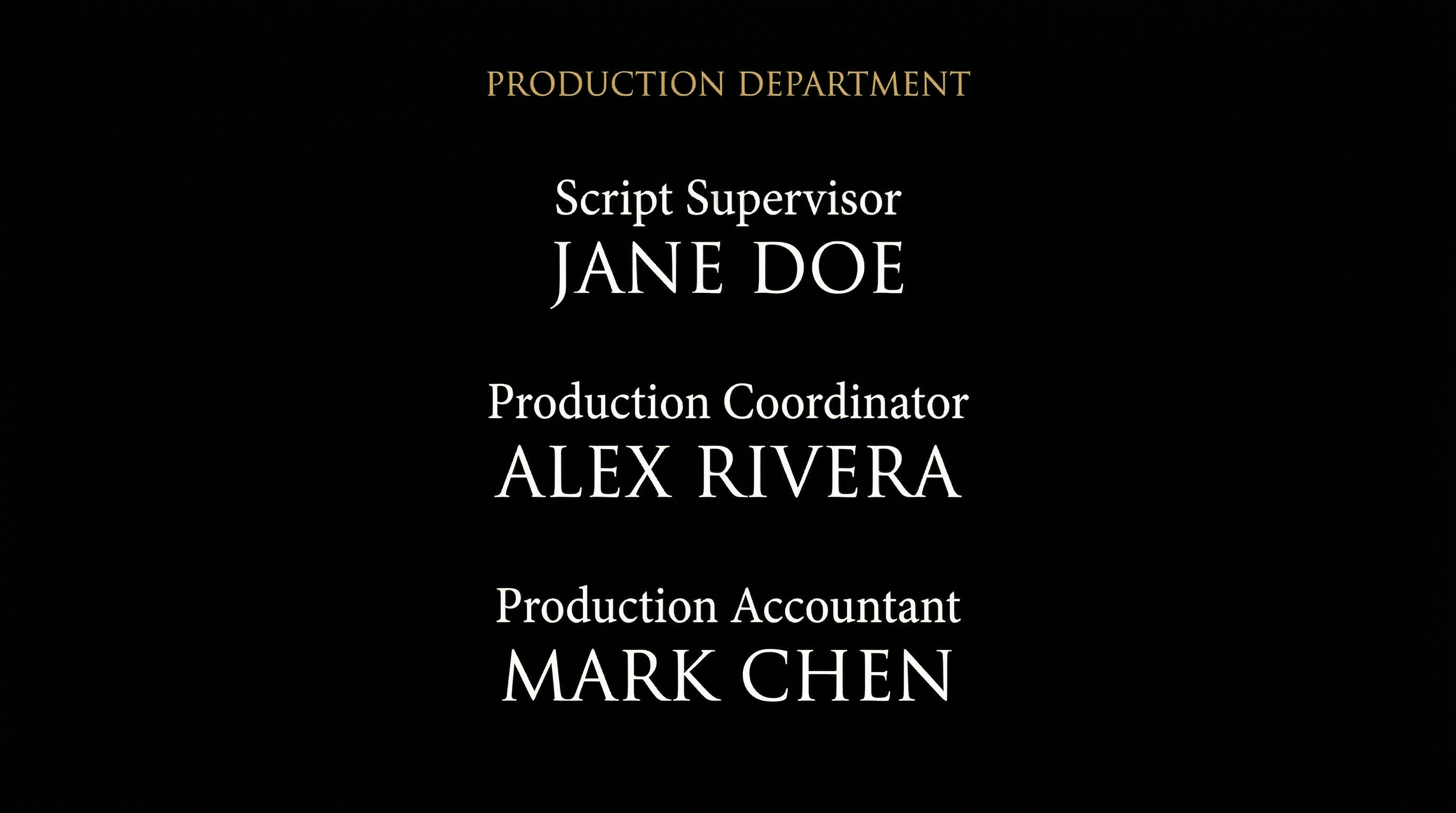
The script supervisor appears in the production department section of the end credit crawl — typically grouped near or within the production management block rather than under any specific technical department. On many productions, the script supervisor is listed alongside the production coordinator, production accountant, and UPM rather than with the camera or grip departments.
Standard credit order within the production/continuity section:
| Position | Credit Order |
|---|---|
| Script Supervisor | First in the continuity section |
| Assistant Script Supervisor | After the Script Supervisor (if applicable) |
| Second Unit Script Supervisor | After main unit (if applicable) |
On some productions — particularly large studio features — the script supervisor may appear under a dedicated “Script Department” or “Continuity” heading within the crawl. On others, they appear in a general crew section labeled “Production Staff” or similar.
The key fact: the script supervisor appears once, credited by their full name under the title “Script Supervisor.” The alternate title “Continuity Supervisor” is used on some British and European co-productions. Either is acceptable, but “Script Supervisor” is the US industry standard.
Single Card vs. Scroll
Script supervisors receive a shared scroll credit within the end crawl on the vast majority of productions. They do not receive a solo card. The exception would be a personal deal negotiated by a prominent script supervisor, but this is rare — the role does not typically receive solo card treatment.
How to credit a script supervisor correctly
Exact Format, Variations, and Guild Requirements
The standard screen credit format for a script supervisor:
Script Supervisor .......................... JANE DOEOr in a department block layout:
SCRIPT SUPERVISOR
JANE DOE

ASSISTANT SCRIPT SUPERVISOR
JOHN SMITH
Accepted title variations:
- Script Supervisor — the US industry standard; use this on all domestic productions
- Continuity Supervisor — used on UK and some European co-productions; also acceptable
- Script Continuity — older British usage; still seen on some international productions
- Continuity — occasionally used as a shortened credit on very low-budget productions; not recommended
Avoid “Script Girl” — the archaic term is both outdated and unprofessional. It should never appear in a screen credit issued after 1975.
Guild requirements: In Los Angeles, script supervisors on IATSE-signatory productions are covered by IATSE Local 871 (Script Supervisors, Continuity Coordinators, Accountants & Allied Productions Specialty Guild). In New York, the equivalent local is IATSE Local 161, which covers script supervisors, production coordinators, continuity coordinators, and production accountants.
IATSE does not mandate a specific credit title format the way the DGA or WGA do for directors and writers, but the screen credit itself is a contractual obligation on union productions. Omitting the script supervisor credit on a union show is a violation of the collective bargaining agreement.
Multiple units: If the production used both a main unit and second unit script supervisor, credit both:
Script Supervisor
JANE DOE

Second Unit Script Supervisor
JOHN SMITH
For complete guidance on formatting credits across all departments, see the film credits format and order guide.
Script supervisor tools and forms
What a Script Supervisor Actually Works With
The script supervisor’s toolkit has evolved — but the core documents are the same ones used on Citizen Kane.
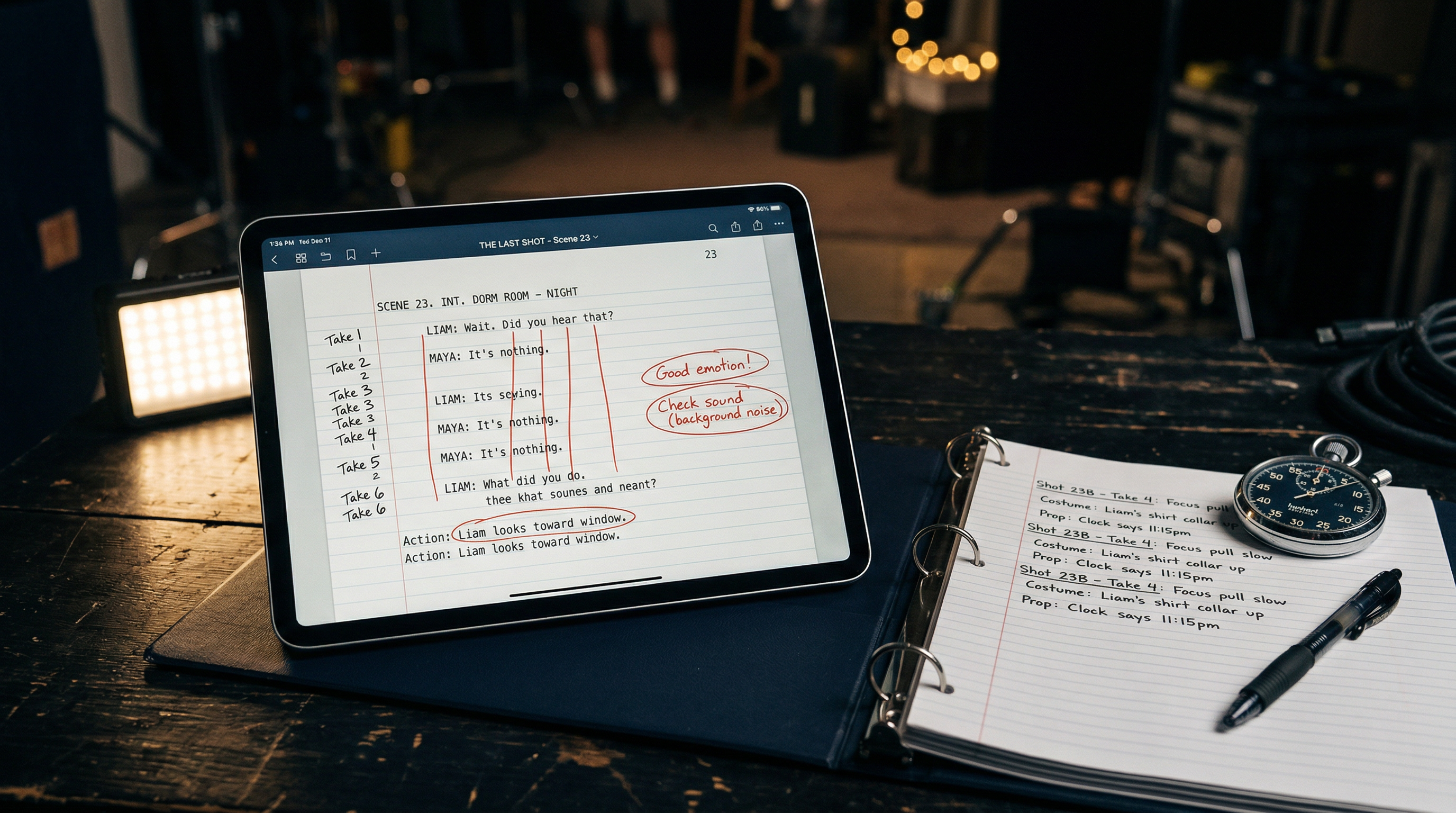
The lined script: The primary working document. A paper (or digital) copy of the shooting script with vertical lines drawn through each scene, one line per camera setup. Each line is labeled with the setup identifier (Scene 12A, Scene 12B, etc.). The lined script is delivered to the editor with the dailies.
Continuity reports: One per scene, detailing every continuity element photographed. Distributed to wardrobe, props, makeup, and hair departments.
Daily progress report: A production document summarizing the shooting day — scenes completed, pages shot, running time accumulated, timing of first shot, meals, and wrap. Submitted to the production office nightly.
Editor’s notes (or “facing pages”): The document the editor relies on most. One page per scene, with a row for each take. Columns typically include: take number, duration, lens, issues/flags, and the director’s preferred take circled or starred. The quality of the script supervisor’s facing pages directly affects how quickly the editor can begin assembly.
Modern tools:
- ScriptE — the industry-standard script supervision app for iPad; replaces most paper documentation
- Scriptr — alternative app used on many US productions
- Final Draft — used during prep to work with the script before shooting starts
- Paper binders remain common on smaller productions and with supervisors who prefer analog methods
Script supervisor vs script coordinator
Two Different Roles That Share the Word “Script”
The terms sound similar and cause persistent confusion — even among production staff.
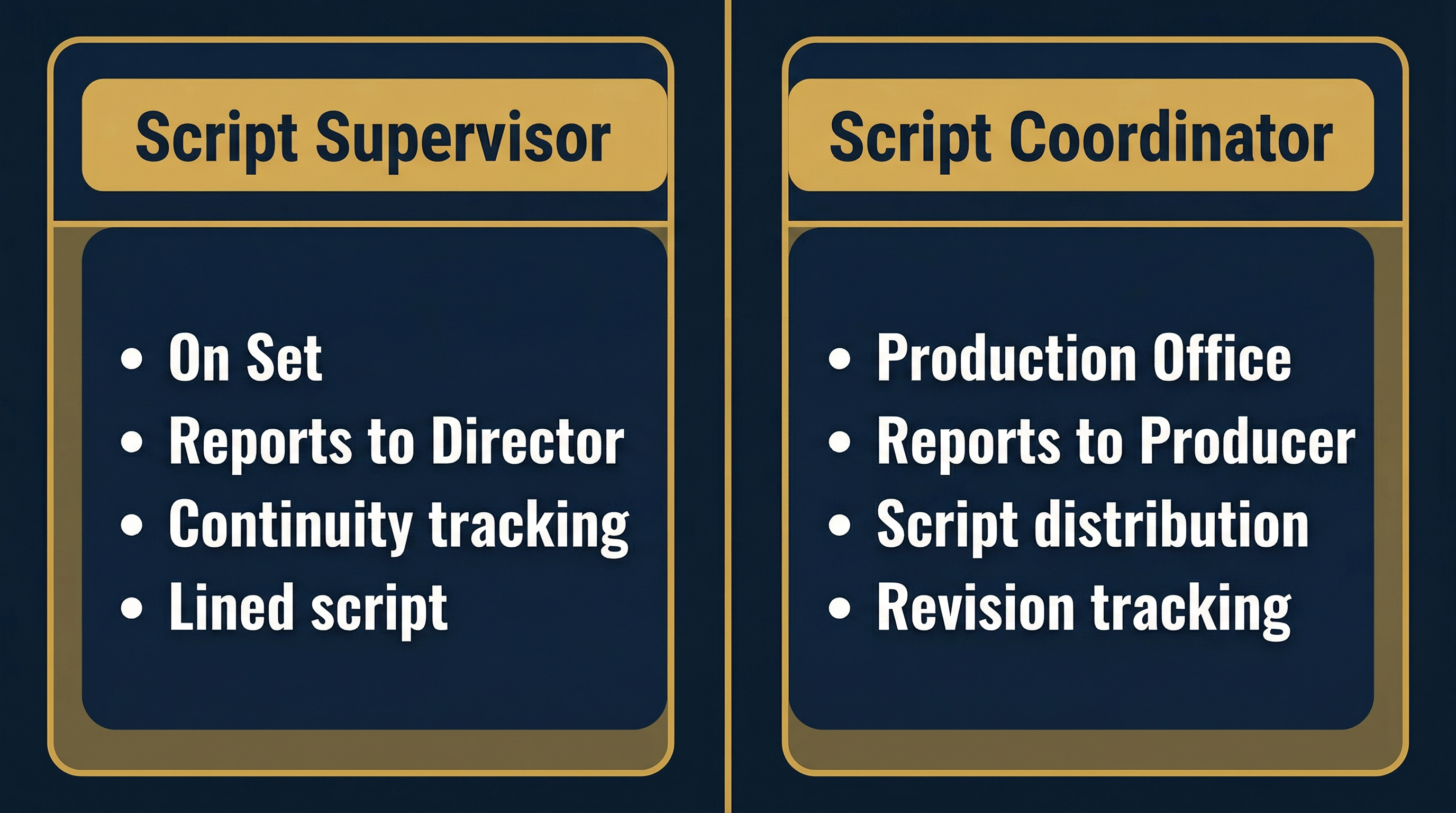
| Script Supervisor | Script Coordinator | |
|---|---|---|
| Department | Production (set-based) | Production office |
| Where they work | On set, every day | Production office |
| Primary function | Continuity, documentation of photography | Script distribution, revision tracking, office support |
| Reports to | Director | Producer / Showrunner |
| During shooting | On the shooting floor | In the office |
| Credit | ”Script Supervisor" | "Script Coordinator” |
The script supervisor watches the monitor. The script coordinator manages the documents. On a feature film, there is almost no overlap in daily responsibilities. On a small production without a script coordinator, the script supervisor may handle some office script duties during prep — but once cameras roll, continuity is the sole focus.
How to become a script supervisor
Career Path and Education for Script Supervisors
There is no single credentialed entry point into script supervision, but the career path is relatively consistent across the industry.
Common routes into the role:
- Production assistant → script supervisor trainee: Start as a PA on set, observe the script supervisor over multiple productions, then begin taking on short films and student productions as the script supervisor
- Script supervisor training programs: Raindance, UCLA Extension, and the IATSE Training Trust all offer dedicated script supervision courses. These are taken seriously by hiring producers
- Continuity PA position: On large productions, some hire a PA specifically to assist the script supervisor — this is the fastest route to direct on-the-job training
Key things to build:
- A portfolio of continuity reports, lined scripts, and facing pages from real productions — even unpaid shorts
- Software proficiency in ScriptE (the dominant app on professional productions)
- A working understanding of editing — script supervisors who understand how editors use their notes produce dramatically better documentation
IATSE membership: In Los Angeles, joining IATSE Local 871 requires completing an approved training program or accumulating a threshold of verified non-union work days. The union provides a voucher system and official directory listings that significantly increase hirability on studio and network productions.
Notable script supervisors in film history
The Professionals Behind Seamless Cinema
Script supervisors remain invisible when they do their job well. The best-known names in the craft are the ones who stayed with major directors across long careers.
-
Meta Wilde — Worked with Alfred Hitchcock for most of his career, including Rear Window (1954), Vertigo (1958), and Psycho (1960). Hitchcock’s meticulous storyboarding made the script supervisor’s role unusually demanding — every shot had a precise intended place in the edit, and any continuity variance required an immediate fix.
-
Jeanne Bates — Long-time script supervisor for Robert Altman. Altman’s overlapping-dialogue, multi-camera style made standard continuity methods nearly impossible. Bates developed her own documentation system to handle the chaos of films like Nashville (1975) and Short Cuts (1993).
-
Ana Maria Quintana — Script supervisor on Pan’s Labyrinth (2006), The Shape of Water (2017), and multiple other Guillermo del Toro productions. Del Toro’s practical effects and complex set pieces make continuity supervision particularly demanding.
Sources and further reading
Official resources:
- IATSE Local 871 — the union representing script supervisors in Los Angeles
- IATSE Local 161 — the New York local covering script supervisors and production coordinators
Further reading:
- Script Supervisor Breakdown from raindance.org — career guide from a respected film school
- ScreenSkills — Script Supervisor Job Profile — UK industry perspective
Recommended video:
Related EndCreditsPro guides:
Create Professional Credits with EndCreditsPro
Getting the script supervisor credit in the right section, in the right format, and under the correct title — it matters, especially on union productions. EndCreditsPro auto-formats your end credits with correct role hierarchy, department ordering, and guild-compliant layouts.