What Is a Second Assistant Director in Film?
The call sheet hits your inbox at midnight. The 2nd AD sent it — then spent three more hours managing background paperwork, transport calls, and tomorrow’s actor logistics before going to bed.
The second assistant director (2nd AD) is the operational backbone of base camp. They sit one step below the first assistant director in the AD chain and one step above the 2nd 2nd AD and production assistants. Their domain isn’t the camera — it’s everything that has to be organized, communicated, and ready before the camera rolls.
The 2nd AD belongs to the Direction & Production department and works under a DGA contract on union productions.
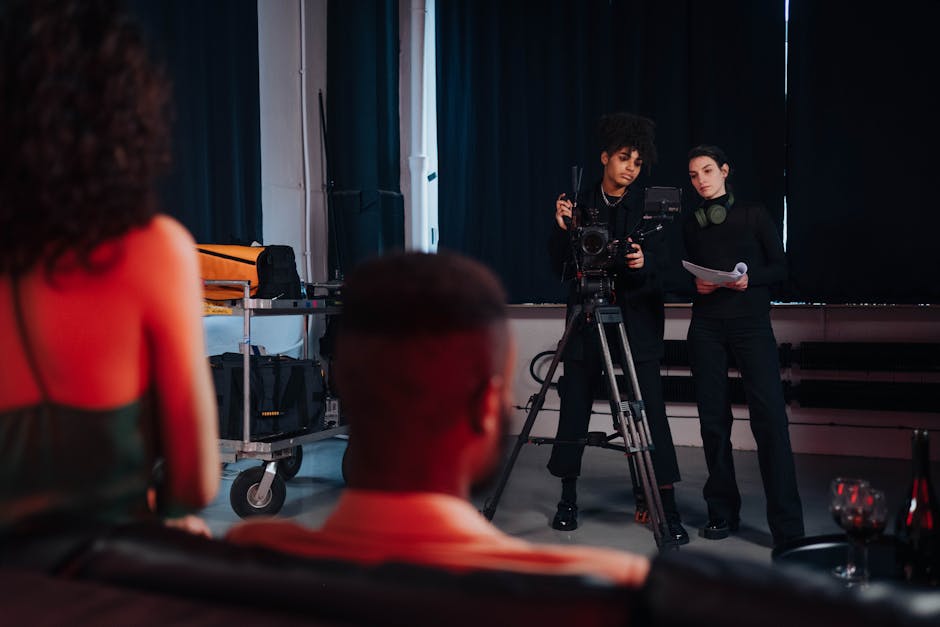
What does a second assistant director do?
The Second Assistant Director’s Core Responsibilities
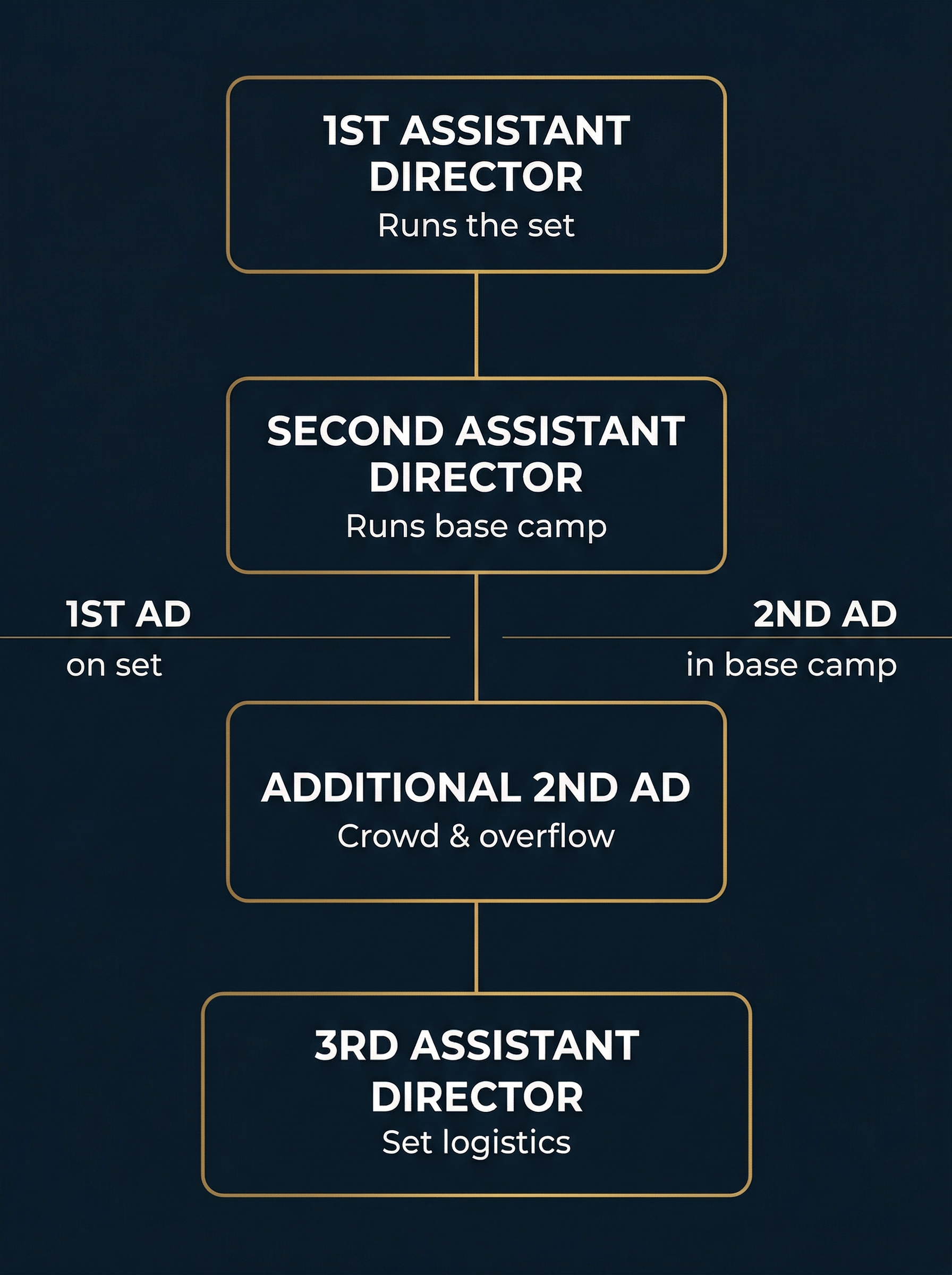
The split between 1st and 2nd AD is simple in theory: the 1st AD runs the set; the 2nd AD runs base camp. In practice, that means the 2nd AD handles almost everything that keeps a shoot day moving without stepping onto the floor.
Primary responsibilities:
- Call sheet creation — Generates the daily call sheet from the 1st AD’s shooting schedule, including call times for cast and crew, scenes to be shot, location details, and special equipment needs. This is the document that reaches every department by end of day.
- Cast coordination — Ensures principal actors are camera-ready at their call time by managing their flow through makeup, hair, and wardrobe. The 2nd AD knows where every actor is at all times.
- Background management — Directs extras and background performers, oversees their vouchers, manages their holding areas, and coordinates their movement into and out of scenes.
- Department communication — Acts as the communication hub connecting set (the 1st AD) with base camp (makeup, wardrobe, transport, catering). When the 1st AD calls for an actor, the 2nd AD makes them appear.
- Stand-in wrangling — Coordinates stand-ins during lighting setups so the DP can work without the principal cast on their feet all day.
- Production reporting — Maintains daily production reports alongside the script supervisor, tracking pages shot, scenes completed, and any deviations from the schedule.
On large productions, a Key 2nd AD supervises one or more additional 2nd ADs and takes ownership of the most complex logistical problems. An additional 2nd AD (sometimes called a 2nd 2nd AD) handles crowd-heavy sequences or splits off to manage separate units.

Where does the second assistant director appear in film credits?
How the 2nd AD Is Credited in Film End Credits
No opening credits. The 2nd AD — like almost all crew — appears in the end credits scroll, within the direction department block.
Standard placement:
The AD department is typically credited near the top of the crew scroll, immediately after or alongside the Line Producer and Unit Production Manager. The standard hierarchy reads:
First Assistant Director .......... [Name]
Second Assistant Director ......... [Name]
Additional Second Assistant Director .. [Name]
Third Assistant Director .......... [Name]
DGA productions list the 2nd AD by their full title — “Second Assistant Director” — not “2nd AD.” The abbreviation is industry shorthand; the formal credit is spelled out.
Key 2nd AD credit: On UK and European co-productions, the title “Key Second Assistant Director” is used when multiple 2nd ADs are on call. The hierarchy becomes:
Key Second Assistant Director ..... [Name]
Second Assistant Director ......... [Name]
Crowd 2nd AD: On productions with large-scale background work — crowd scenes, extras-heavy sequences — a “Crowd Second Assistant Director” credit is sometimes used:
Crowd Second Assistant Director ... [Name]The DGA Basic Agreement (Article 14) governs credit for covered productions. Under the agreement, any individual who qualifies as a 2nd AD must receive screen credit when they work a minimum number of days on the production, though specific thresholds depend on the individual deal memo.
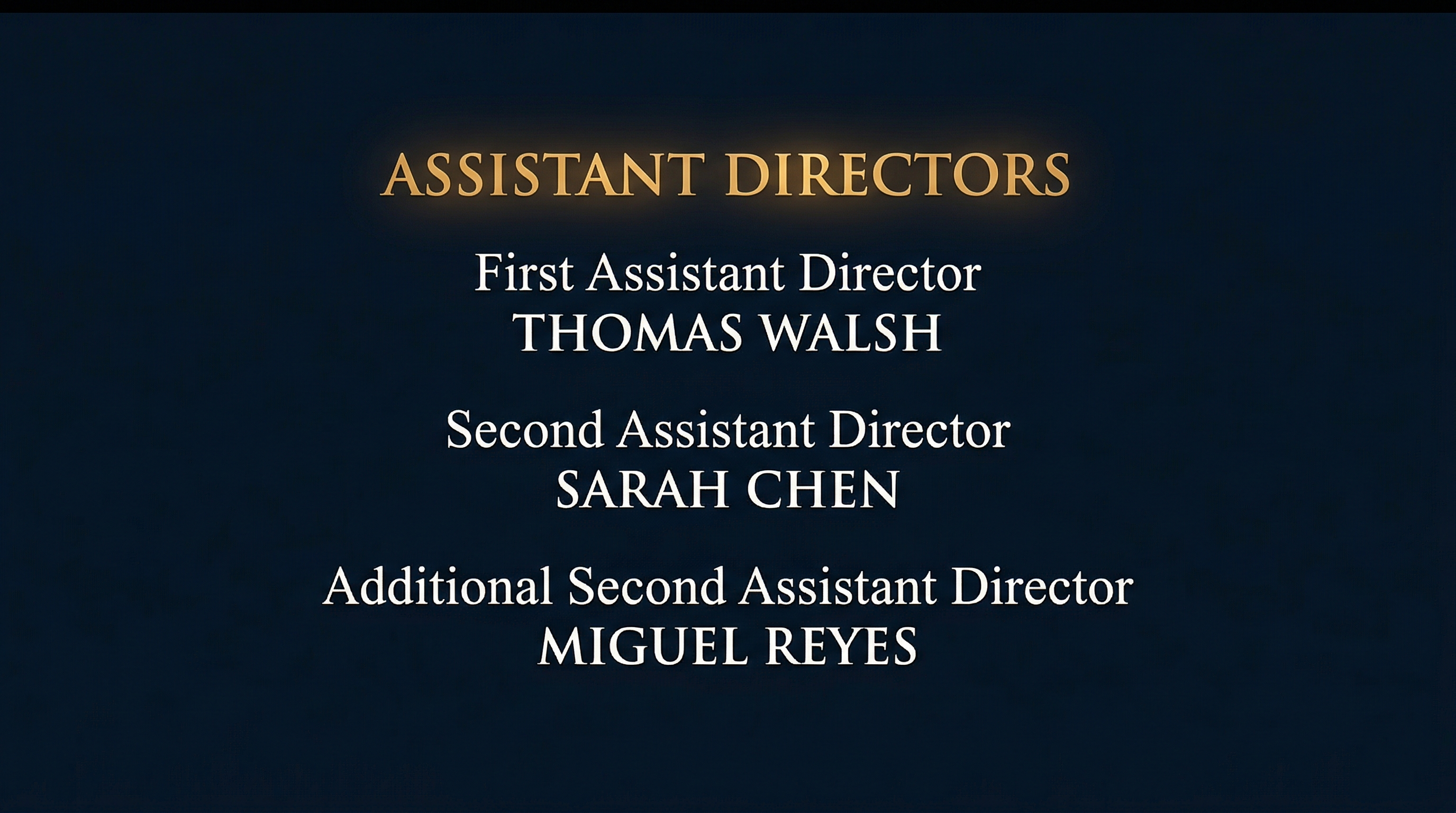
How to credit a second assistant director correctly
Credit Format, Title Variations & Common Mistakes
Use the full title in screen credits: “Second Assistant Director” — not “2nd AD,” “Asst. Director,” or “Second A.D.” unless a specific production style guide dictates otherwise.
Standard end credit format:
Second Assistant Director ......... JANE SMITHOr in a department block:
ASSISTANT DIRECTORS
First Assistant Director .......... Tom Burke
Second Assistant Director ......... Jane Smith
Additional Second Assistant Director .. Carlos Reyes
When one person performs multiple AD roles: If a small production uses one person as both 2nd AD and 2nd 2nd AD, credit them under the higher title only — “Second Assistant Director.”
Multiple 2nd ADs: Credit each one on a separate line, using “Additional Second Assistant Director” for any beyond the first. Do not stack names on a single credit line.
UK productions: “2nd AD” is occasionally used as a formal credit in British productions alongside “First Assistant Director.” If co-producing with a US studio, default to the spelled-out DGA convention.
Second assistant director vs. related AD roles
2nd AD vs. 1st AD vs. 2nd 2nd AD
| Role | Primary Responsibility | Location During Shoot |
|---|---|---|
| 1st Assistant Director | Runs the set; enforces the schedule | On set, next to the director |
| Second Assistant Director | Runs base camp; creates call sheets | Base camp / production office |
| Additional 2nd AD (2nd 2nd) | Supports the 2nd AD; handles crowds | Base camp or crowd holding |
| 3rd Assistant Director | PA-adjacent; set logistics, walkie management | Set and base camp |
The 1st AD and 2nd AD are two halves of the same operational machine. The first assistant director maintains the shooting environment — yells “rolling,” manages blocking rehearsals, and shields the director from logistics. The 2nd AD handles everything that would otherwise break that concentration.
The 2nd 2nd AD is effectively a junior version of the 2nd — they handle overflow: background paperwork on complex days, additional holding areas, or support for a second unit.
Second assistant director salary
2nd AD Rates: DGA Union vs. Non-Union
DGA union rates (2024–2025):
| Experience Level | Weekly Rate |
|---|---|
| Entry-level | $3,056 – $4,268 |
| Mid-level | $4,000 – $4,500 |
| Experienced | $4,322 – $6,040 |
Union rates include overtime provisions, turnaround minimums (10 hours between calls), per diems on location, and pension/health contributions (19.5% added on top of negotiated rate on DGA projects).
Non-union rates: $200 – $500/day depending on market, budget, and experience. Feature films with larger non-union budgets may exceed these ranges.
Crowd 2nd AD: Often negotiated separately when background counts exceed a certain threshold, reflecting the additional scope of work.
How to become a second assistant director
Career Path to the 2nd AD Chair
The standard progression: Production Assistant → 2nd 2nd AD → Second Assistant Director. There is no formal film school shortcut — the role is almost entirely earned through on-set days.
DGA membership (DGACA Article 14): To become a union 2nd AD, you need 400 qualifying days of employment in covered production roles, with at least 300 of those days in actual shooting (not office prep). Crowd control work does not count toward the 300.
DGA Training Program: The Directors Guild-Producer Training Plan (trainingplan.org) offers a structured assistant director training program — one of the few formal paths into the DGA for people who didn’t start on non-union productions.
A working 2nd AD typically carries experience with Movie Magic Scheduling, SetHero for call sheets, and a working knowledge of SAG-AFTRA and DGA contracts — specifically turnaround rules, meal penalties, and forced calls.
The next step up from 2nd AD is first assistant director — though some experienced 2nd ADs also transition laterally into unit production manager roles.
Notable second assistant directors
From 2nd AD to Director
Several prominent directors passed through the 2nd AD chair before getting behind the camera. The position teaches production management, people skills, and the mechanics of a shoot in ways that no directing workshop can replicate.
David Fincher began his career as a PA and 2nd AD before moving to music videos and then features. The logistical obsessiveness visible in productions like Zodiac (2007) and The Social Network (2010) reflects the AD’s perspective on the shoot day.
Kathleen Kennedy, before becoming one of the most powerful producers in Hollywood and the president of Lucasfilm, worked early in her career in AD-adjacent production roles. Her understanding of production logistics came from ground-level experience.
The 2nd AD role is one of the most reliable pipelines into directing and producing — not because it trains you to work with actors creatively, but because it forces you to manage every other variable so someone else can.
Sources & Further Reading
- Directors Guild of America Basic Agreement (Article 14) — DGA 2nd AD qualification requirements
- DGACA SC 2nd AD Requirements — https://www.dgaca.org/sc-specific-requirements/sc-2nd-ad
- DGA-Producer Training Plan — https://www.trainingplan.org
Create Professional End Credits with EndCreditsPro
Getting the 2nd AD credit right — title spelled out correctly, in the right department block, in the right order — takes time to verify manually. EndCreditsPro formats your entire crew list automatically, with the correct DGA-aligned hierarchy for the AD department built in.