SAG-AFTRA Credits Requirements: Complete Guide (2026)
Most guilds dictate exactly where and how credits appear. SAG-AFTRA doesn’t — and that’s what trips producers up. The rules are fewer, but the penalties for the ones that exist hit hard.

SAG-AFTRA — the Screen Actors Guild–American Federation of Television and Radio Artists — represents over 160,000 performers across film, television, new media, and commercials. Unlike the DGA or WGA, which mandate precise credit placement and ordering, SAG-AFTRA takes a surprisingly hands-off approach to screen credits. Most billing terms are negotiated individually between performers and producers.
That doesn’t mean there are no rules. The rules that do exist — readability standards, minimum cast listing, logo placement, credit scroll speed — are the ones most frequently violated. And violations carry real consequences: arbitration, financial damages, and correction of all prints and advertising materials.
This guide covers every SAG-AFTRA screen credit obligation a production must meet, organized by what the agreement actually requires versus what’s industry convention. It’s part of our Guild Compliance series covering credit rules for every major entertainment union.
Disclaimer: Rules current as of the 2023 TV/Theatrical Agreement. Verify with SAG-AFTRA for your specific production.
What is SAG-AFTRA?
Overview of the Screen Actors Guild–AFTRA
SAG-AFTRA was formed in 2012 through the merger of the Screen Actors Guild (founded 1933) and the American Federation of Television and Radio Artists (founded 1937). Headquartered in Los Angeles, the union represents performers working in:
- Film (theatrical motion pictures)
- Television (network, cable, streaming)
- New media (digital platforms, streaming originals)
- Commercials (broadcast and digital advertising)
- Sound recordings, radio, and interactive media
Any production that hires SAG-AFTRA members — or becomes a signatory to a SAG-AFTRA agreement — must comply with the union’s credit provisions. This applies regardless of budget level, from micro-budget indie films to studio tentpoles.
| Fact | Detail |
|---|---|
| Founded | 2012 (merger of SAG and AFTRA) |
| Members | 160,000+ |
| Headquarters | Los Angeles, CA |
| Jurisdiction | Film, TV, new media, commercials, interactive media |
| Official site | sagaftra.org |
SAG credits
SAG-AFTRA Credit Rules: What the Agreement Actually Requires
Here’s what surprises most producers: SAG-AFTRA’s credit requirements are thin compared to other guilds. The DGA dictates the exact position and size of a director’s credit. The WGA runs multi-round arbitrations over writing credits. SAG-AFTRA, by contrast, leaves most credit terms to individual negotiation.
But the requirements that do exist are non-negotiable:
1. Minimum Cast Listing (End Titles)
Section 25 of the Theatrical Agreement and Section 54 of the Television Agreement require that end titles include at least 50 cast members — or the entire cast if fewer than 50 performers appear in the production. This is a floor, not a ceiling.
2. Readability Standard
All performer credits must be displayed “in a readily readable color, size and speed” — the exact language from Section 54(a)(1) of the Television Agreement. This isn’t a suggestion. The majority of SAG-AFTRA citations stem from violations of this standard, particularly credit scroll speed.
3. Credit Scroll Speed
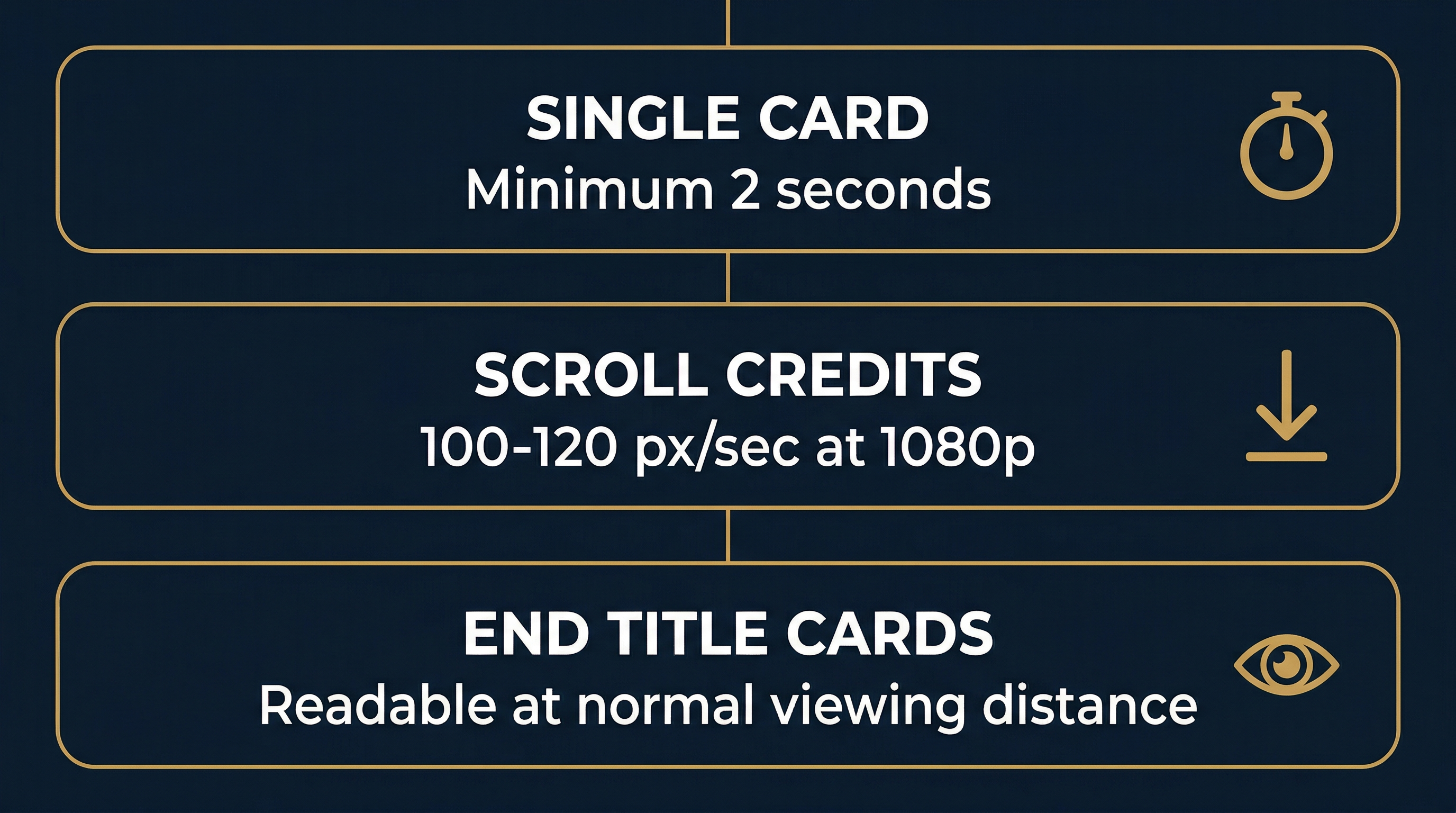
Specific time standards for credit display speed were established at an AMPTP (Alliance of Motion Picture and Television Producers) meeting. While the exact figures aren’t published in the agreement text, the industry standard is:
- Single card credits: Minimum 2 seconds on screen
- Crawl/scroll credits: Readable at normal viewing distance — typically no faster than 100-120 pixels per second at 1080p
- End title cards: Sufficient time for an average viewer to read each name
Credit speed is the number one area of SAG-AFTRA citations. If a viewer can’t read a performer’s name before it scrolls off screen, the production is in violation.
4. Billing as Negotiated
Individual performer contracts may specify credit placement, size, position, and order. The production must deliver exactly what was negotiated — no less. A “main title” credit means main title, not end crawl.
SAG-AFTRA screen credits format
Required Credit Formats
Unlike the DGA (which specifies “Directed by” or “A Film By”), SAG-AFTRA does not mandate a specific text format for performer credits. The format depends on what’s negotiated in the performer’s contract.
Common negotiated formats include:
JANE DOE

or

Starring
JANE DOE

or

JANE DOE as Character Name

or

And JANE DOE as Character Name
What SAG-AFTRA does require:
| Requirement | Standard |
|---|---|
| Color | ”Readily readable” against background |
| Size | Legible at normal viewing distance |
| Speed | Readable before scrolling off screen |
| Duration | Single cards: minimum ~2 seconds |
| Cast count | Minimum 50 names (or full cast) in end titles |
Variations by production type:
- Theatrical films: Full end crawl with complete cast and crew. Performer credits typically appear in the main-on-end sequence before department crew.
- Television episodes: End credits may be squeezed or overlaid with promotions on broadcast. SAG-AFTRA’s readability requirement still applies — squeezed credits must remain legible.
- Streaming/new media: Same readability standards as theatrical. Most platforms display credits in a scrollable format, which must still meet speed requirements.
SAG-AFTRA credit order requirements
Where SAG-AFTRA Credits Appear in the Sequence
SAG-AFTRA does not mandate a fixed credit order the way the DGA mandates the director’s position. Instead, credit placement is determined by:
- Individual negotiation — lead and supporting actors negotiate placement in their contracts
- Industry convention — the standard hierarchy places performers after the title card and before department heads
- Other guild requirements — DGA and WGA credits have mandated positions that frame where performer credits can go
Standard opening credits order (when used):
- Production company / distributor logos
- “A [Producer] Production”
- Lead cast (1-5 names)
- Film title
- Supporting cast
- Casting Director
- Composer, Costume Designer, Associate Producer
- Editor, Production Designer
- Director of Photography
- Executive Producers, Producers
- Writer (WGA-governed)
- Director (DGA-governed — always last)
Standard end credits order:
- Director, Writer, Producer (reversed from opening)
- Full cast list — by billing, then alphabetical or by appearance
- Department heads and crew (by department)
- Additional cast / stunts / stand-ins
- Post-production credits
- Music credits
- Special thanks
- Guild and union logos (including SAG-AFTRA)
- Production company / distributor logos
The key SAG-AFTRA-specific rule: all performers with negotiated “main title” billing must receive credits in the main titles (opening or main-on-end). Relegating a contracted main title credit to the end crawl is a breach.
For a complete breakdown of credit ordering across all guilds, see the Film Credits Format & Order Guide.
SAG-AFTRA logo in end credits
SAG-AFTRA Logo Requirements

Every SAG-AFTRA signatory production must display the SAG-AFTRA logo in the end credits. This is a contractual obligation, not optional branding.
Placement rules:
- The logo appears in the end titles, typically in the final card grouping alongside other guild logos (DGA, WGA, IATSE, PGA)
- Standard placement is after the crew credits and before the production company/distributor logos
- The logo should be clearly visible and not obscured by other elements
Logo specifications:
- Use the official SAG-AFTRA logo artwork provided by the union
- The logo must be “readily readable” — same standard that applies to performer credits
- Color and sizing should match the visual treatment of other guild logos in the sequence
Who must display it:
All signatory productions — including those under Short Film, Ultra Low Budget, Modified Low Budget, Low Budget, and standard Theatrical/Television agreements. One notable exception: major studio productions have historically not always displayed the logo prominently, though the contractual obligation technically applies.
If you’re unsure about logo specifications, contact your SAG-AFTRA regional office. They provide logo artwork and placement guidance to signatory productions.
SAG-AFTRA credit requirements special cases
Special Cases and Exceptions
Pseudonyms
Performers may use a professional name (stage name) for credits. The credited name must match what’s registered with SAG-AFTRA. Unlike the WGA’s historical “Alan Smithee” provision for directors, SAG-AFTRA has no equivalent anonymity mechanism — performers are credited under their registered professional name or not at all.
Multi-hyphenate credits
When a performer also serves as writer, director, or producer, each credit is governed by its respective guild. A performer-director’s acting credit falls under SAG-AFTRA rules; their directing credit falls under DGA rules. Credits are listed separately unless a combined credit is specifically negotiated (e.g., “Written and Directed by” — a DGA provision).
Team and ensemble credits
SAG-AFTRA permits ensemble cast billing — listing several performers on a shared card. This is common for supporting casts. The readability standard applies to each name individually: if six names share a card, each must be legible.
Credit disputes and arbitration
When a performer believes their credit obligations weren’t met, the dispute goes through SAG-AFTRA’s arbitration process:
- Performer or their representative files a complaint with SAG-AFTRA
- The union contacts the producer for resolution
- If unresolved, the matter goes to formal arbitration
- Penalties for daily/weekly performers: Set financial damages defined in the agreement
- Penalties for other performers: The arbitrator has authority to award appropriate remedy, including damages and/or correction of prints, advertising materials, and digital deliverables
Credit corrections are expensive. Fixing credits on a film that’s already been delivered to distributors means re-creating DCPs, updating streaming masters, and amending all marketing materials that include cast billing.
Non-union productions
If a production is not a SAG-AFTRA signatory, none of these rules apply. However, any production that hires even one SAG-AFTRA member must either become a signatory or risk violating Global Rule One — the union’s prohibition on members working for non-signatory producers.
SAG-AFTRA common credit mistakes
Common SAG-AFTRA Credit Mistakes

1. Credit scroll too fast
The most common violation. Productions compress end credits to shorten runtime, making performer names unreadable. SAG-AFTRA actively monitors deliverables, and speed violations trigger immediate correction demands.
Fix: Test your credit scroll at the intended display resolution. Every name should be on screen long enough for a viewer to read it. When in doubt, slow down.
2. Missing performers from end titles
Productions forget to include day players, background performers upgraded to principals, or performers added during reshoots. The minimum-50 rule (or full cast) applies to all performers who worked under SAG-AFTRA contracts.
Fix: Cross-reference your end credits against the Final Cast Info Sheet (FCL) submitted to SAG-AFTRA. The FCL is your authoritative cast list.
3. Incorrect billing position
A performer negotiated “first position, main titles” but appears third in the end crawl. Contract-specific billing is legally binding. Getting it wrong triggers arbitration.
Fix: Before locking credits, review every performer contract for specific billing provisions. Flag negotiated credits in your credits management system.
4. Squeezed or overlaid broadcast credits
Networks frequently squeeze end credits to promote upcoming shows. If the squeezed credits are no longer “readily readable,” the production — not the network — is responsible for the SAG-AFTRA violation.
Fix: Negotiate credit protection with the network. If credits will be squeezed, ensure the readability standard is maintained at the reduced size.
5. Missing SAG-AFTRA logo
Forgetting the union logo in end titles. Simple to fix, embarrassing to miss, and a guaranteed call from your SAG-AFTRA rep.
Fix: Add guild logos to your credit template before you start building the sequence. Don’t treat them as an afterthought.
SAG-AFTRA credits by agreement type
Credits Across Different SAG-AFTRA Agreements
Credit obligations vary depending on which SAG-AFTRA agreement your production falls under. Budget level determines your agreement, and each agreement has specific provisions:
| Agreement | Budget | Key Credit Provisions |
|---|---|---|
| Theatrical | $2M+ | Full credit requirements. Minimum 50 cast in end titles. All readability standards apply. |
| Television | Varies | Section 54 readability standard. Squeezed credits must remain legible. |
| New Media | Varies | Same readability standards as theatrical. Streaming platform display rules apply. |
| Low Budget | $700K–$2M | Standard credit obligations. Reduced minimum compensation but full credit requirements. |
| Modified Low Budget | $300K–$700K | Standard credit obligations apply. |
| Ultra Low Budget | $300K or less | Credit requirements apply but with more flexibility in negotiation. Mixed union/non-union casts permitted. |
| Short Film | Under $50K | Max 35 minutes, 30 shooting days. Credit all SAG-AFTRA performers. Logo required. |
| Student Film | Deferred | Educational productions. Credit requirements still apply to SAG-AFTRA performers. |
Short Film Agreement specifics:
- All SAG-AFTRA performers must be credited
- Festival exhibition does not trigger deferred payment obligations
- Uploading to a public platform (YouTube, Vimeo, etc.) does trigger full compensation — and credits must be in place before public distribution
- Non-union performers may work alongside SAG-AFTRA members under this agreement
New Media Agreement specifics:
- Covers content made for initial exhibition on the internet
- Performer credits must meet the same readability standards as theatrical
- Budget tiers mirror the theatrical tiers, with credit obligations scaling accordingly
For a complete breakdown of how credits differ across production types, see the Credits Guide section.
SAG-AFTRA digital replica credits
AI, Digital Replicas, and Credit Provisions

The 2023 TV/Theatrical Agreement introduced the first contractual framework for AI and digital replicas in SAG-AFTRA history. These provisions directly affect how performers are credited when digital technology is involved.
Employment-Based Digital Replicas
Digital replicas created during an actor’s employment (motion capture, face scanning, body scanning) require:
- Clear and conspicuous consent with 48-hour notice
- Separate consent for use in additional projects beyond the original
- The performer receives credit and compensation as if they performed the work — because the replica is their performance
Independently Created Digital Replicas
Replicas built from existing footage or materials without the performer present:
- Require performer consent for use
- Compensation is negotiated between producer and performer
- If used as a recognizable character, the performer’s credit must appear
Synthetic Performers
Digitally created characters not recognizable as any real person:
- SAG-AFTRA must be notified of intended use
- If the synthetic performer replaces a role that would otherwise be performed by a human, SAG-AFTRA has the right to bargain for consideration
- No credit obligation to a specific performer — but the union is watching how this evolves
The core principle: A human must be behind the performance to receive credit. AI-generated performances do not independently earn credit under the current agreement. If a digital replica of a real performer appears on screen, that performer is credited.
SAG-AFTRA credits checklist
SAG-AFTRA Credits Compliance Checklist
Use this before locking your final credit sequence:
Cast listing:
- ☑ All SAG-AFTRA performers included in end titles (minimum 50 or full cast)
- ☑ Day players and upgraded background performers included
- ☑ Cast list cross-referenced against Final Cast Info Sheet (FCL)
- ☑ Performer names match SAG-AFTRA registered professional names
Billing and placement:
- ☑ All negotiated billing positions honored (main title, card position, etc.)
- ☑ “And” / “With” / “Introducing” credits placed per contract terms
- ☑ No contracted main-title credit relegated to end crawl
Readability:
- ☑ Credits displayed in readily readable color against background
- ☑ Font size legible at standard viewing distance
- ☑ Single card credits displayed for minimum ~2 seconds
- ☑ Scroll speed allows every name to be read before leaving screen
- ☑ If broadcast credits are squeezed, they remain readable
Logo and branding:
- ☑ SAG-AFTRA logo appears in end titles
- ☑ Logo is clearly visible and properly sized
- ☑ Logo placement consistent with other guild logos
Digital and AI provisions (if applicable):
- ☑ Digital replica performers credited per their consent agreement
- ☑ Employment-based replicas credited as standard performer credits
- ☑ SAG-AFTRA notified of any synthetic performer usage
Final review:
- ☑ Credits reviewed by someone who has read each performer contract
- ☑ Credit sequence tested at final delivery resolution and format
- ☑ Backup of credit data maintained for potential correction requests
Sources and further reading
Sources & Further Reading
Official SAG-AFTRA resources:
- SAG-AFTRA 2023 TV/Theatrical Contracts — full agreement text and summaries
- SAG-AFTRA Production Notices & Resources — includes Section 54 credit standards
- SAG-AFTRA Rates & Agreements — current rate sheets for all agreement types
- SAG-AFTRA AI Resources — digital replica and AI provisions
Industry guides:
- Film Credits Format & Order Guide — complete credit ordering reference across all guilds
- DGA Credit Requirements — director credit compliance
- WGA Credit Requirements — writing credit compliance
- IATSE Credit Requirements — crew credit compliance
Additional resources:
- Wrapbook: Essential Guide to SAG-AFTRA Rates 2025 — budget tiers and agreement types
- Perkins Coie: How the 2023 Contracts Address Generative AI — legal analysis of AI provisions
Automate SAG-AFTRA compliance
Generate Guild-Compliant Credits with EndCreditsPro
Building SAG-AFTRA compliant credits manually means cross-referencing performer contracts, checking scroll speeds, validating cast lists against the FCL, and remembering the logo. EndCreditsPro handles all of it.
- Auto-format credits to meet readability standards — color, size, and scroll speed pre-validated
- Import cast lists directly from production management tools
- Guild logo placement built into every template
- Contract-aware billing — flag negotiated credit positions before they get missed
Stop worrying about SAG-AFTRA citations. Start building compliant credits with EndCreditsPro.