Writers Guild of America Credits Requirements: Complete Guide (2026)
The most consequential decision a production makes about writing credits often happens before a frame is shot — in which names appear, and in which order. Get it wrong on a WGA signatory production, and every print, every streaming file, every broadcast copy is non-compliant.
The Writers Guild of America represents approximately 11,500 working writers across film, television, and streaming. Any production that employs WGA writers through a signatory company must comply with the Guild’s credit rules — not just for the marquee name, but for every writing credit that appears anywhere on the film or series.
This guide covers the WGA’s credit requirements for theatrical and television productions, including the contribution thresholds that determine eligibility, the on-screen format rules, and the arbitration process that resolves disputes. Compliance starts before lock picture. End credits are your last opportunity to get it right.
For an overview of multi-guild compliance across writing, directing, and performance, see the WGA, DGA, and SAG-AFTRA compliance hub.

Writers Guild of America Overview
What the WGA Is and Who It Covers
The Writers Guild of America is split into two regional organizations: WGA West (Los Angeles-based, covering film and television) and WGA East (New York-based, covering broadcast news and new media). Both operate under a shared Minimum Basic Agreement (MBA) that governs wages, residuals, and — critically — credit requirements.
WGA jurisdiction covers writing services performed for any signatory company: the major studios, most streaming platforms, and a large number of independent producers. If a production company has signed the MBA, its productions must comply with WGA credit rules for any writer employed under that agreement.
Productions can verify signatory status using the WGA Signatory Confirmation Lookup. Non-signatory independent productions are not bound by these rules, though they often adopt them as industry best practice.
The WGA’s credit authority covers theatrical motion pictures, long-form television, episodic television, and new media productions over 15 minutes. The specific manuals that govern each format are the Screen Credits Manual, the Television Credits Manual, and the New Media Credits Procedures Guide.
WGA Credit Rules
The Six Credit Forms — and When Each Applies
The WGA does not allow freeform writing credits. The MBA specifies the exact credit designations permitted on any signatory production. Using a non-approved form — “Script by,” “Written and directed by” as a combined credit without Guild waiver, or any other variation — constitutes a violation.
Permitted credit forms for theatrical productions:
| Credit Form | When It Applies |
|---|---|
| Written by | When the same writer(s) receive both Story and Screenplay credit; generally not used when significant source material exists |
| Screenplay by | When story and screenplay writers differ; covers individual scenes, dialogue, substantial script contribution |
| Story by | Covers the original “basic narrative, idea, theme or outline” when it differs from the screenplay contributor |
| Screen Story by | When a writer takes limited elements from existing source material and develops substantially new content |
| Adaptation by | Reserved for rare cases where a writer shapes the screenplay’s direction without qualifying for Screenplay by |
| Narration Written by | For major writing contributions delivered primarily as off-camera narration |
| Additional Literary Material | Listed alphabetically for participating writers who don’t receive primary writing credit |
| Based on Characters Created by | Applied on theatrical sequels when a writer holds separated rights to the original characters |
For television and streaming:
The credit forms parallel the theatrical system, with two key substitutions:
- “Teleplay by” replaces “Screenplay by”
- “Television Story by” parallels the theatrical “Story by”
The combination credit “Written by” applies when one writer receives both Teleplay and Story credit on the same episode.
Minimum Contribution Thresholds
How Much Writing Is Required to Receive Credit
The most common misconception about WGA credits is that every writer who works on a project receives credit. The Guild’s system is built on contribution thresholds — quantitative minimums a writer must meet to be eligible for credit. These thresholds vary based on whether the screenplay is original or adapted, and whether the writer also serves in a production executive capacity.
Theatrical screenplay thresholds:
| Writer Type | Original Screenplay | Non-Original Screenplay |
|---|---|---|
| Non-executive first writer | > 33% of final script | > 33% of final script |
| Non-executive subsequent writer | > 50% of final script | > 33% of final script |
| Production executive (any position) | > 50% of final script | > 50% of final script |
What qualifies as a “production executive”? Any writer who also receives a directing or producing credit on the same project. This category faces automatic arbitration whenever any other writer has contributed to the project — and must meet the higher threshold regardless of their writing position.
How contribution is assessed: Arbiters evaluate writing holistically, looking at dramatic construction, original scenes, development of character relationships, and dialogue. The Guild does not use a page-count formula. An arbitration panel of three Guild members reads all drafts anonymously and makes a collective determination.
Television thresholds: The Teleplay credit follows the same logic — a non-executive writer must contribute over 33% of the final teleplay. The WGA has developed a shorthand for television credit weighting: “Written by = 100%; Teleplay by = 75%; Story by = 25%.” This reflects the relative weight of each credit type in award submission contexts, not a literal page-count formula.
Required Credit Formats
On-Screen Format: What the Credits Must Look Like
The WGA specifies not just which credits appear, but how they appear on screen. Productions submit main and end title formats to the Guild for approval before prints or final files are prepared.
Ampersand (&) vs. “and” — the most misunderstood rule in credits:
The punctuation between writers’ names carries legal and professional meaning. It is not interchangeable.
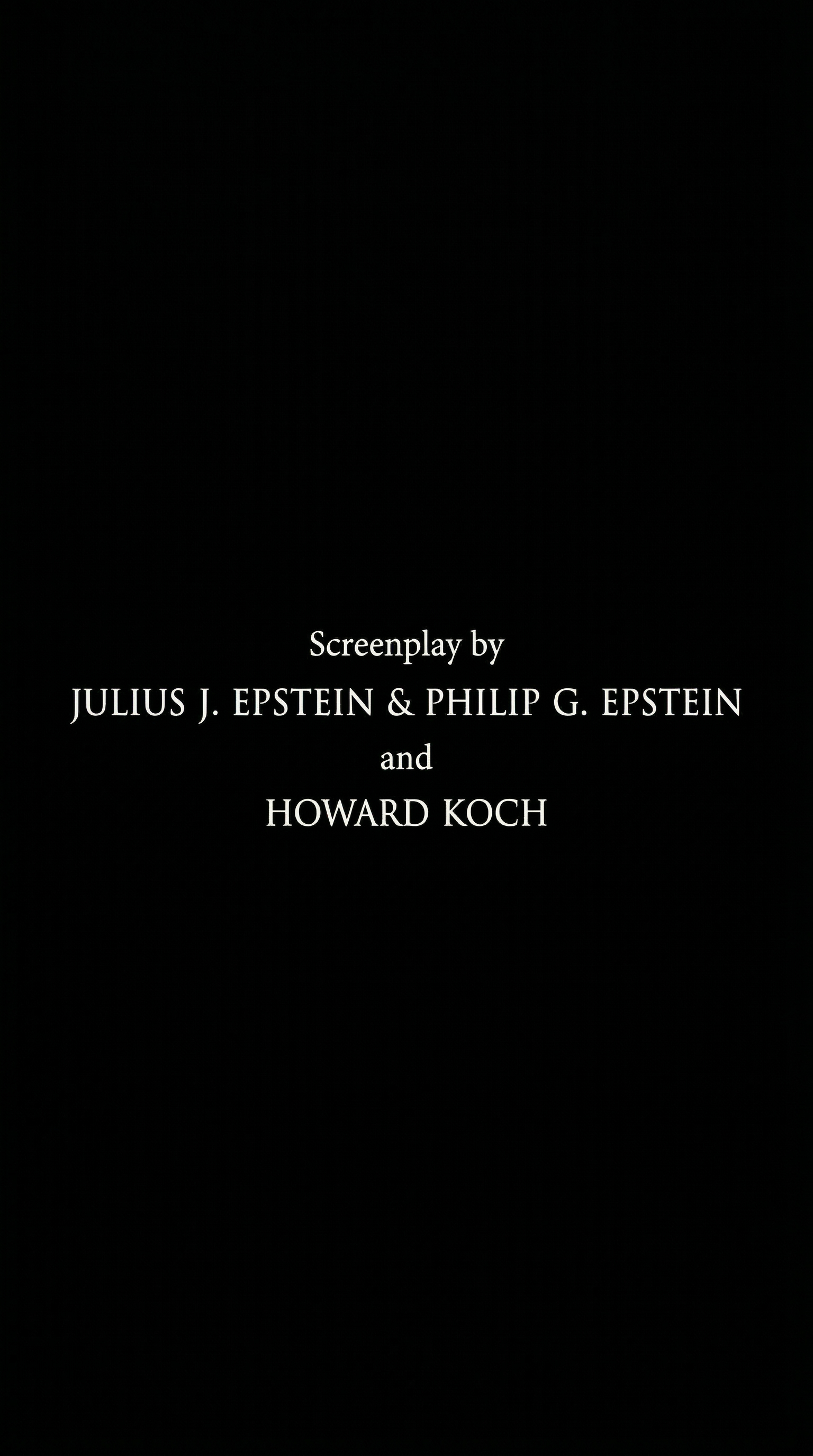
- Ampersand (&) designates a writing team: two writers assigned simultaneously to work together on the same material at approximately the same time. They are treated as a single creative unit.
- “and” designates separate writers who worked independently, typically in successive drafts — one rewrote the other.
Screenplay by
JULIUS J. EPSTEIN & PHILIP G. EPSTEIN
and
HOWARD KOCH
The example above (modeled on Casablanca’s credit structure) shows both forms in use: the Epstein brothers were a team (&), while Koch contributed a separate draft (and).
“Written by” on a single card:
When one writer or team receives both Story and Screenplay credit, the single “Written by” credit is used:
Written by
ROBERT TOWNE
When Story and Screenplay differ:
In main titles, if both credits appear on the same card, “Screenplay by” occupies the top half. In end titles, “Screenplay by” always precedes “Story by” — regardless of the writing order chronologically.
Additional Literary Material:
Writers who receive this designation are listed alphabetically by last name on a separate card.
Credit Order Requirements
Placement Rules: Where Writing Credits Must Appear
The WGA’s placement rules are specific and non-negotiable without a Guild waiver.
The contiguous card rule:
The writing credit must appear on a separate card immediately adjacent to the director’s credit. No other credit may appear between the writing card and the director card.
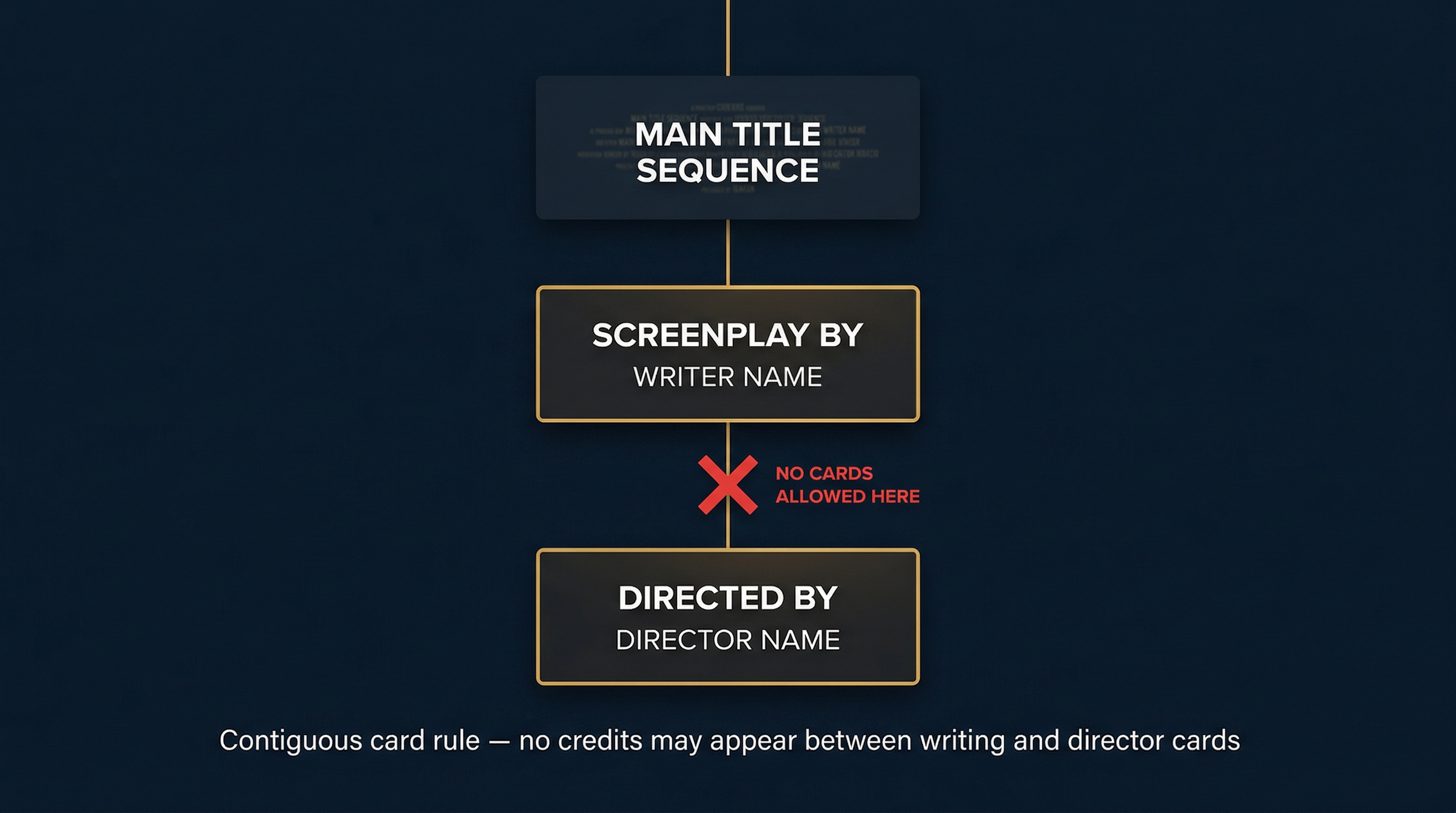
For television, the writing credit may alternatively appear on the same card as the episode title, or on a separate card immediately adjacent to the episode title card.
Main titles trigger:
If any personal names appear in the main titles — including the director’s name, producers’ names, or any above-the-line talent — the writing credit must also appear in the main titles. Productions cannot front-load other names and push writing credits to the end crawl unless all personal names are reserved for the end.
In the end crawl:
When writing credits appear in the end titles (as is standard for many theatrical productions where main titles show only the film title), the “Screenplay by” credit precedes “Story by.” Source material credits — “Based on the novel by,” “Based on characters created by” — appear on separate cards and cannot be placed between the screenplay credit and the director credit on adjacent cards.
“Created by” in television:
For television series, the “Created by” credit must appear on a separate card immediately adjacent to the episodic writing credit. With the writer’s written permission, it may alternatively appear after the main cast in the main titles.
Writing Credits in Paid Advertising
Posters, One-Sheets and the 24-Sheet Rule
Writing credits have minimum sizes in paid advertising too. Under Theatrical Schedule A, paragraph 22.g of the WGA Theatrical and Television Basic Agreement (2023), the writers’ names must appear in the same size and style as the individual producer or the director, whichever is larger, and, outside 24-sheets, not less than 15% of the height of the title type. On a 24-sheet the names must be at least 3½ inches tall (2½ inches when the credit is shared by more than two writers). When the title’s letters vary in size, the percentage is taken from the average size of all the letters (22.i). Some ads are excluded, such as teaser advertising and ads under four column inches (22.j). Advertising is submitted to the Guild before it is issued, and the Guild has 24 hours (Los Angeles) or 36 hours (New York) to protest (paragraph 26). Check the current agreement: the guilds negotiated new contracts in 2026.
The billing block page turns these figures into a calculator (points, inches, millimetres, centimetres or pixels) and has a free generator that exports the block as a transparent PNG or SVG.
Credit Arbitration
How Disputed WGA Credits Are Resolved
Credit arbitration is the WGA’s mechanism for resolving disputes when the proposed credit allocation is challenged. Approximately one-third of all WGA credit determinations go to arbitration.
How arbitration is triggered:
- On completion of principal photography (or upon production’s request earlier), the producing company submits its proposed writing credits to the Guild.
- The Guild circulates the final script and all previous drafts to every writer who worked on the project.
- Each participating writer has 6-12 business days (depending on urgency) to protest the proposed credits in writing.
- If any writer protests, or if the proposed credit includes a production executive, arbitration begins automatically.
The arbitration process:
A panel of three WGA member volunteers reads all literary material — beat sheets, outlines, treatments, drafts, and the final shooting script. Source material is also included for non-original projects. Arbiters are kept anonymous from one another and from the writers. They assess each writer’s contribution against the thresholds described above.
If arbiters cannot agree unanimously, a majority decision controls. If the vote is split, additional arbiters may be called.
Timeline:
- Theatrical arbitration: 21 business days
- Television arbitration: 8 business days

Appeals: Writers may appeal to the WGA Policy Review Board, but only on procedural grounds — not on the merits of the credit decision.
Notable arbitration cases:
Fear and Loathing in Las Vegas (1998): Director Terry Gilliam and co-writer Tony Grisoni claimed their version of the screenplay bore no resemblance to Alex Cox and Tod Davies’s earlier adaptation. The WGA initially denied Gilliam and Grisoni credit; following complaints, all four writers received credit. Gilliam resigned from the Guild over the outcome.
Wag the Dog (1997): David Mamet reportedly wrote most of the shooting script but shared credit with Hilary Henkin, who wrote the original draft. Mamet subsequently adopted a policy of attaching his name only to projects where he was the sole writer.
These cases illustrate the core principle of WGA arbitration: the system prioritizes written evidence (what’s on the page in each draft) over writer statements, director testimony, or subjective assessments of quality.
Special Cases and Exceptions
Pseudonyms, Possessory Credits, and Unusual Situations
Pseudonyms:
Writers paid below certain thresholds (less than $200,000 for theatrical; less than three times the applicable minimum for television) may request a pseudonym on their writing credit. The pseudonym must be registered with the Guild within five business days of final credit determination. It cannot duplicate an existing writer’s name or the name of a public figure.
Unlike the Directors Guild’s now-retired “Alan Smithee” pseudonym — which was the only DGA-approved anonymous credit until 2000 — the WGA’s pseudonym system is individualized. Writers choose their own pseudonym; there is no shared placeholder name.
Possessory credits (“A Film By…”):
The WGA has a formal, longstanding position that possessory credits — “A Film by,” “[Name]‘s [Film Title],” or “A [Name] Film” — imply authorship of a film. The Guild’s position is that such credits should be limited to writers, or to writer-directors who have both written and directed the same project.
In practice, this dispute remains active with the Directors Guild, which allows its members to negotiate possessory credits. Productions on WGA signatory projects should be aware that these credits exist in contested territory and may require Guild waiver discussions.
Writing teams exceeding three members:
If more than three writers collaborate simultaneously and seek team designation, a Guild waiver is required. The three-person limit applies to the team designation (ampersand grouping); the overall credit limits remain: a maximum of two writers or two teams for Screenplay by, and a maximum of two writers for Story by in theatrical films.
Multi-hyphenate credits (writer-director):
A writer who also directs the same film is a production executive for credit purposes and must meet the higher contribution threshold. The writing credit and directing credit appear on separate cards; they are never combined on a single card without a specific Guild waiver.
Common WGA Credit Mistakes
What Productions Get Wrong — and What It Costs
Mistake 1: Using unapproved credit forms.
“Script by,” “Written and Directed by” (combined on one card), or any variation not in the MBA’s approved list constitutes a violation. The approved forms are specific; productions must use the exact language.
Mistake 2: Misusing the ampersand.
Using ”&” between writers who worked separately — not simultaneously as a team — misrepresents the collaborative relationship and is a factual error in the credit record.
Mistake 3: Violating the contiguous card rule.
Placing a producer card, studio card, or any other personal credit between the writing card and the director card is a placement violation. This happens most often in productions that add late-breaking executive producer credits.
Mistake 4: Missing the main titles trigger.
If any above-the-line name appears in main titles — a common situation with stars who negotiate a “name above the title” deal — the writing credit must also appear in main titles. Productions that move writing credits to the end crawl while leaving other names in main titles are in breach.
Mistake 5: Submitting credits after picture lock without Guild review.
The WGA requires productions to submit proposed credits for review while there is still time to correct them. Submitting after delivery creates a compliance problem with no easy remedy.
Consequences of non-compliance:
Violations trigger written notice of breach from the Guild. All non-compliant materials — theatrical prints, broadcast masters, streaming files, physical media, trailers, and advertising — must be corrected. The cost of recutting and replacing these materials routinely exceeds the cost of proactive compliance. Repeated violations can affect a company’s signatory status.
WGA Credits Checklist
Pre-Delivery Compliance Reference
Use this checklist before finalizing credits on any WGA signatory production.
Credit determination:
- All writers who contributed to the project have been identified and notified
- Proposed credits submitted to WGA before picture lock
- Guild-determined credits match what appears on screen exactly
- Credit arbitration completed (if triggered) and decision implemented
Credit forms:
- Only approved credit forms used (Written by / Screenplay by / Story by / Teleplay by / etc.)
- “Written by” used only when same writer(s) receive both Story and Screenplay credit
- No unapproved credit forms (“Script by,” combined “Written and Directed by,” etc.)
Ampersand and “and” usage:
- Ampersand (&) used only for writers who collaborated simultaneously as a designated team
- “and” used for writers who contributed separate, sequential drafts
Placement:
- Writing credit appears on a card immediately adjacent to director credit (no cards in between)
- If any personal names appear in main titles, writing credit also appears in main titles
- “Screenplay by” precedes “Story by” in end titles
- “Teleplay by” precedes “Story by” in television credits
- “Created by” (TV series) appears on a card immediately adjacent to the episodic writing credit
- Source material credits not placed between writing credit and director credit
Special cases:
- Production executive writers verified to meet higher contribution threshold (> 50%)
- Any pseudonym registered with Guild within 5 business days of final credit determination
- Possessory credit (“A Film By”) reviewed with Guild if applicable
Sources and Further Reading
Official WGA Resources
The following Guild documents are the authoritative sources for credit compliance. Rules are updated with each MBA cycle; always verify against the current agreement for your production.
- Screen Credits Manual — theatrical credit forms, thresholds, and procedures
- Television Credits Manual — episodic and long-form television
- Theatrical Credits Procedures Guide — placement and format rules
- Television Credits Procedures Guide — TV placement and format rules
- Credits Survival Guide — writer-focused guidance on protecting credit rights
- New Media Credits Procedures Guide — streaming and digital production rules
Rules current as of April 2026. Verify with the WGA Credits Department for your specific production.
WGA Credits Department: (323) 782-4528
Automate WGA Credit Compliance with EndCreditsPro
WGA credit formatting has a lot of moving parts: the right credit form, the right punctuation between names, the right card sequence. EndCreditsPro auto-formats writing credits to WGA standards — correct ampersand vs. “and” usage, correct placement of Screenplay/Story cards relative to the director card, and correct alphabetical ordering for Additional Literary Material credits.
Build your end crawl to Guild spec, export broadcast-ready files, and deliver with confidence.
Start formatting WGA-compliant credits →
Related Compliance Guides
Producing on a multi-guild production? Writing credits are only one part of the compliance picture.
- DGA Credits Requirements: Complete Guide (2026) — director, first AD, and UPM credit rules
- SAG-AFTRA Credits Requirements: Complete Guide (2026) — performer credit requirements and union rules
- PGA Credits: Code of Credits and p.g.a. Mark — the producers’ side, where the rules are guidance rather than contract
- Guild Credits Compliance Hub — all guild requirements in one place
- Film Credits Format and Order Guide — the complete production guide to end crawl structure