What Is an Assistant Editor in Film?
The film editor cuts the movie. The assistant editor makes the cut possible — every frame, every session, every turnover.
The assistant editor (AE) is the post-production department’s technical backbone. They sit directly below the film editor in the editorial hierarchy, responsible for everything required to keep the cutting room running: ingesting and organizing footage, syncing dailies, managing project files, preparing deliverables, and handling the endless administrative load that would otherwise fall to the editor.
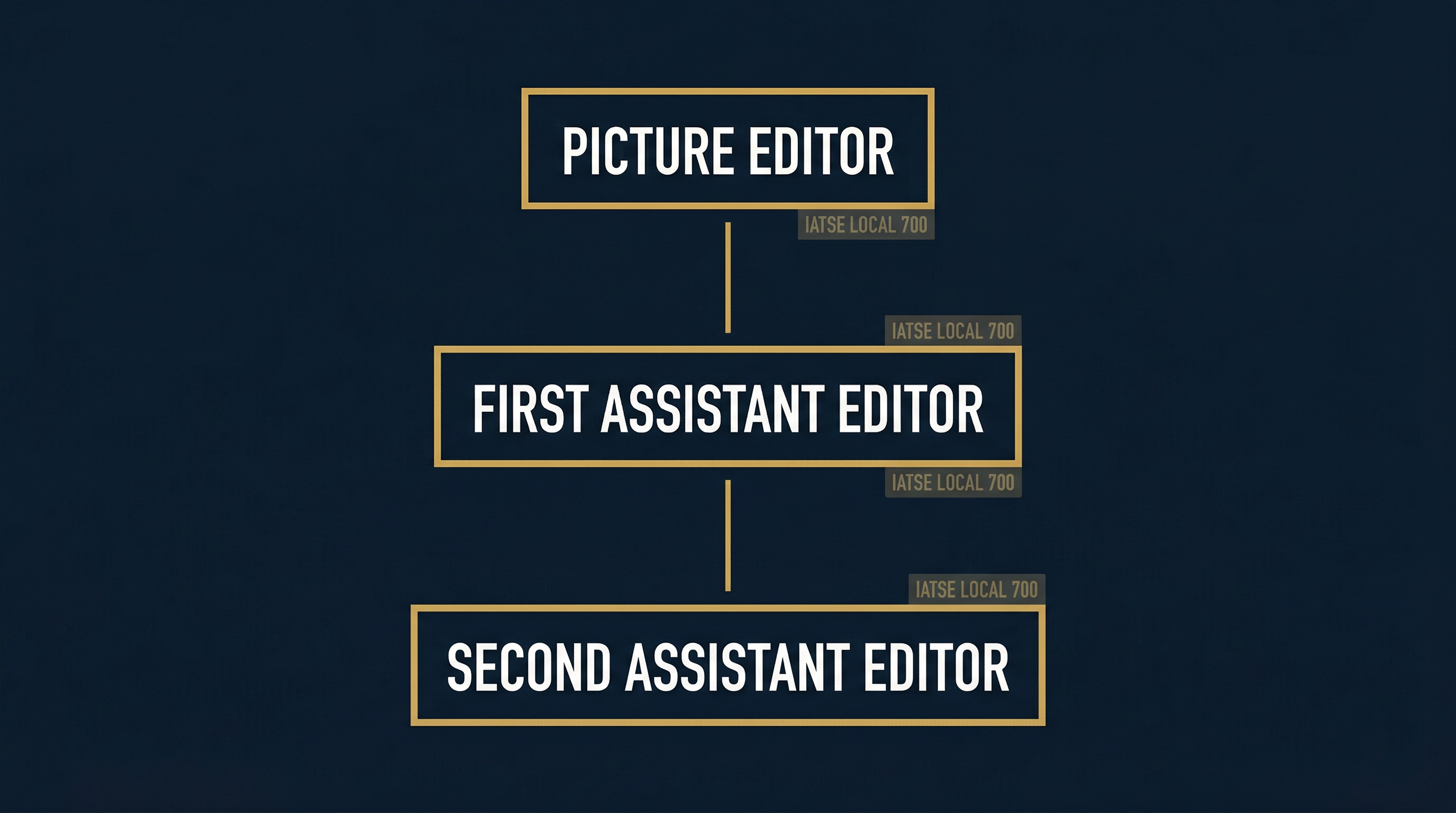
On most feature films and scripted TV series, the AE reports directly to the picture editor. On larger productions, the role splits into First Assistant Editor (1st AE) and Second Assistant Editor (2nd AE), with the 1st AE overseeing the cutting room and the 2nd handling more foundational tasks like ingest and sync.
The position falls under the editorial department and, on union productions, is covered by IATSE Local 700 (Motion Picture Editors Guild).
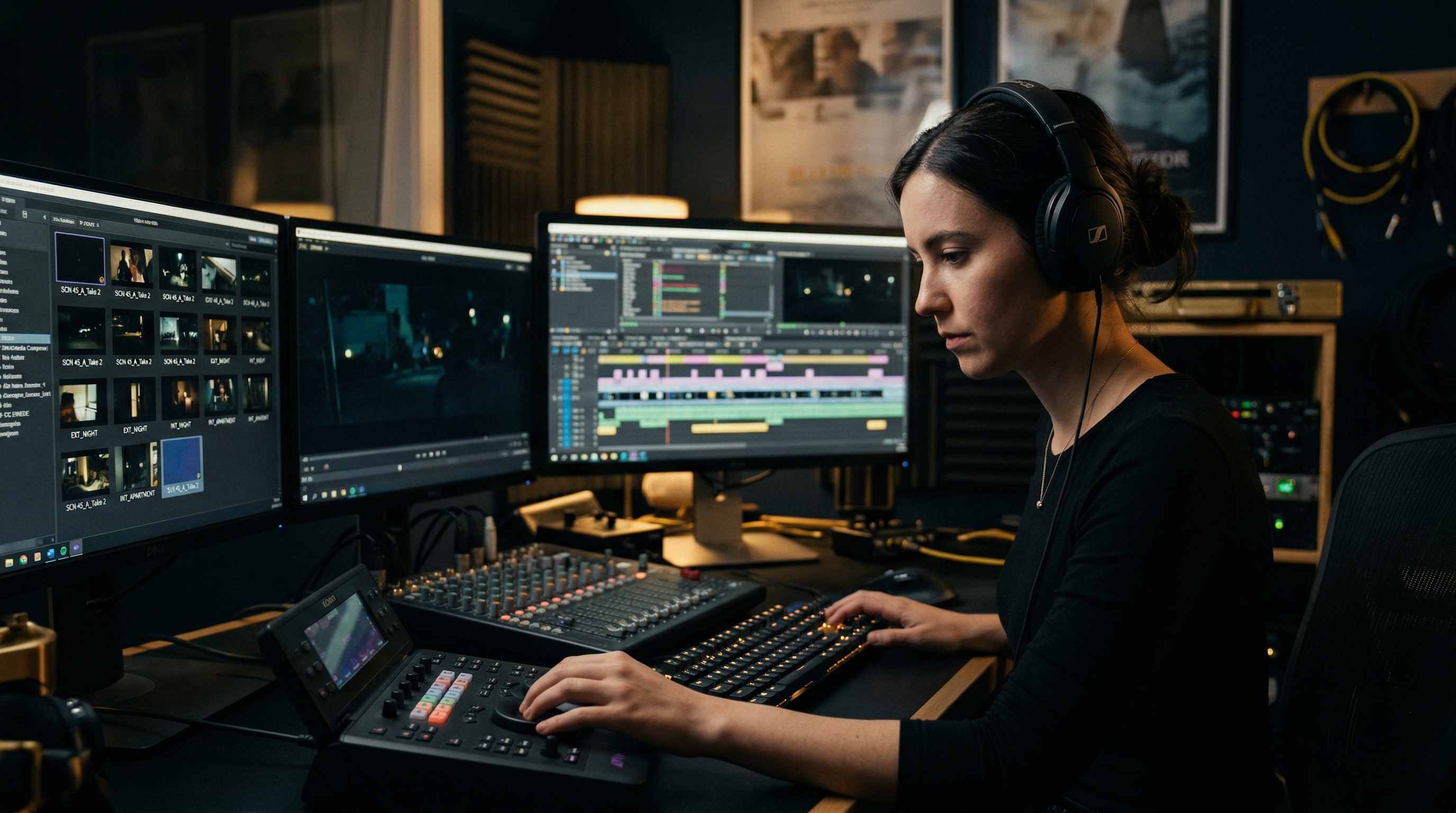
What is the job of an assistant editor?
What Does an Assistant Editor Do in Film?
The AE’s overriding mandate is simple: make it so the editor can sit down and cut. In practice, that mandate covers a wide range of technical and administrative tasks.
Daily responsibilities typically include:
- Ingest and transcode — Offloading footage from camera cards to drives, converting to editing-friendly formats (e.g., DNxHD or ProRes proxies), and backing up media
- Syncing dailies — Matching audio and video using slate information and timecode; on digital productions this is done in Avid or Premiere using PluralEyes or the NLE’s built-in sync tools
- Bin organization — Building and maintaining a logical project structure so the editor can find anything instantly; naming conventions follow the editor’s preference or the post house standard
- Assembly edits — Laying footage into a rough timeline in scene order, giving the editor a starting point rather than a blank sequence
- Turnovers — Packaging the current cut with all associated media, EDLs, AAFs, and VFX pulls, then delivering them to the sound, music, VFX, and color departments at the right stage of post
- Exports and review links — Outputting dailies and cuts to Frame.io, Vimeo, or other review platforms; watching exports frame-by-frame before delivery to catch glitches
- Scheduling and communication — Updating post schedules, fielding requests from producers, and coordinating between the editor and other departments
On larger productions with both a 1st and 2nd AE, the 2nd AE handles ingest, sync, and prep while the 1st AE manages the cutting room, runs turnovers, and takes on more complex technical tasks like VFX pulls and conform prep.

The dominant software platform is Avid Media Composer. Most union features and scripted TV series require Avid proficiency. Premiere Pro and DaVinci Resolve are common in documentary, commercial, and non-union work.
Assistant editor salary
What Does an Assistant Editor Earn?
Compensation varies significantly based on union status, market, and project type.
| Category | Salary |
|---|---|
| Average annual (U.S.) | ~$69,969 |
| Salary range | $56,000 – $89,000 |
| Los Angeles average | ~$76,993 |
| IATSE union scale | Set per contract; Local 700 negotiations determine minimum rates |
IATSE Local 700 members earn union-negotiated minimums, which have historically been higher than non-union rates. Non-union AEs on freelance projects set their own day rates, typically $350–$600/day depending on market and experience.
Hours are deadline-driven. When a picture lock or turnover is due, the editing room runs well past five o’clock — nights and weekends included. Post house staff positions usually offer more predictable schedules than freelance work.
Where does the assistant editor appear in film credits?
Where the Assistant Editor Appears in End Credits
The assistant editor appears in the end crawl, within the editorial department block. They do not typically receive an opening credit or a single card.
Standard credit placement:
- Listed under the section heading EDITORIAL or POST PRODUCTION, immediately following the picture editor
- On large features with multiple AEs, they appear in hierarchy order: 1st AE first, then 2nd AE
- On smaller productions with a single AE, the credit reads simply Assistant Editor
Typical editorial block in end credits:
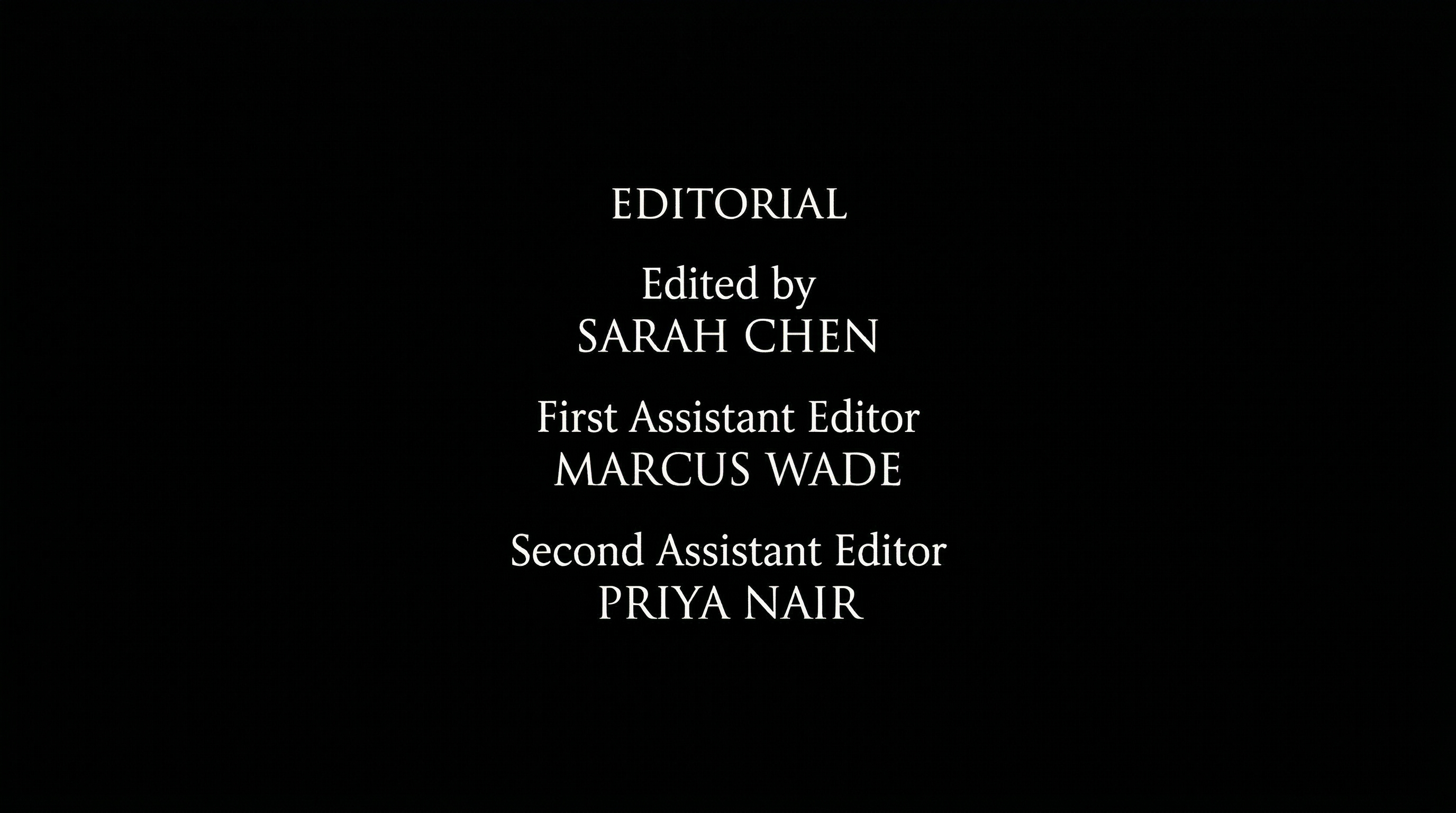
Edited by
SARAH CHEN

First Assistant Editor
MARCUS WADE

Second Assistant Editor
PRIYA NAIR
On TV series, the credit format often differs:
EDITORIAL
Editor ........................... SARAH CHEN
Assistant Editor ................. MARCUS WADE
Union-specific note: IATSE Local 700 agreements specify minimum credit requirements for covered editors and assistant editors. The collective bargaining agreement (CBA) requires that any AE employed under the contract receive a screen credit. The exact format — “Assistant Editor,” “First Assistant Editor,” or “Second Assistant Editor” — must accurately reflect the role as engaged.
How to credit an assistant editor correctly
How to Credit an Assistant Editor
The standard title is Assistant Editor. On productions with two AEs:
- First Assistant Editor — senior AE who runs the cutting room
- Second Assistant Editor — junior AE handling ingest and prep
Common variations and when to use them:
| Title | When Used |
|---|---|
| Assistant Editor | Single AE on most indie features, docs, shorts |
| First Assistant Editor | Senior AE on large features and scripted TV |
| Second Assistant Editor | Junior AE on large features and scripted TV |
| Post Production Coordinator | Sometimes conflated with AE duties — keep separate |
If one person handled both AE duties and additional responsibilities (e.g., also served as colorist or post coordinator), credit them for their primary role. Multiple credits on a single card are acceptable when the additional role is in a different department:
Assistant Editor / Additional VFX
ALEX TORRES
Do not credit an AE as “Editor” unless they actually edited a credited portion of the film — even if they cut sequences. This matters for IATSE jurisdictional reasons and resume accuracy.
Assistant editor vs. associate editor
Assistant Editor vs. Associate Editor: What’s the Difference?
These titles are regularly confused, particularly in TV:
- Assistant Editor — A technical/operational role. Manages the cutting room infrastructure: footage, project organization, turnovers. Reports to the editor. This is an IATSE-covered craft position.
- Associate Editor — A creative role. Often handles second-unit material, additional scenes, or sequences the editor delegates. More common in TV series. Can be editorial guild-covered, but the title varies by contract.
In end credits, “Associate Editor” often appears above “Assistant Editor” within the editorial block. Neither should be confused with the editor of record (the picture editor), whose credit appears separately and often prominently — “Edited by” or “Film Editor.”
Notable assistant editors in film history
Notable Assistant Editors Who Became Major Editors
The AE position has historically been the primary path to becoming a picture editor.
- Thelma Schoonmaker — Assisted Martin Scorsese on Who’s That Knocking at My Door (1967) before becoming one of cinema’s most celebrated editors, winning three Academy Awards for Raging Bull, The Aviator, and The Departed
- Walter Murch — Began his post-production career as a sound editor/mixer before moving into picture editing; his unconventional path from sound to picture editing is documented in In the Blink of an Eye
- Anne V. Coates — Worked her way through the British cutting room system before cutting Lawrence of Arabia (1962), widely regarded as one of the finest-edited films ever made
Before digital editing, union rules in the U.S. required eight years as an assistant before a member could be considered for an editor position. That mandatory apprenticeship produced generations of deeply technically fluent editors. The digital transition eliminated the requirement — and shortened careers.
Sources & Further Reading
- IATSE Local 700 — Motion Picture Editors Guild — Union contract terms, minimum rates, and credit requirements
- ScreenSkills — First Assistant Editor — UK skills framework for the AE role in scripted TV and film
Create Professional End Credits with EndCreditsPro
Getting editorial credits right — correct titles, correct order, correct formatting — matters for union compliance and professional credibility. EndCreditsPro formats your editorial department block automatically, following the standard hierarchy from picture editor through first and second assistant editors.
Generate guild-compliant credits in minutes →
See also: Film Crew Roles → · Compositor → · IATSE Credit Requirements → · Film Credits Format & Order Guide →