What Is a Steadicam Operator in Film?
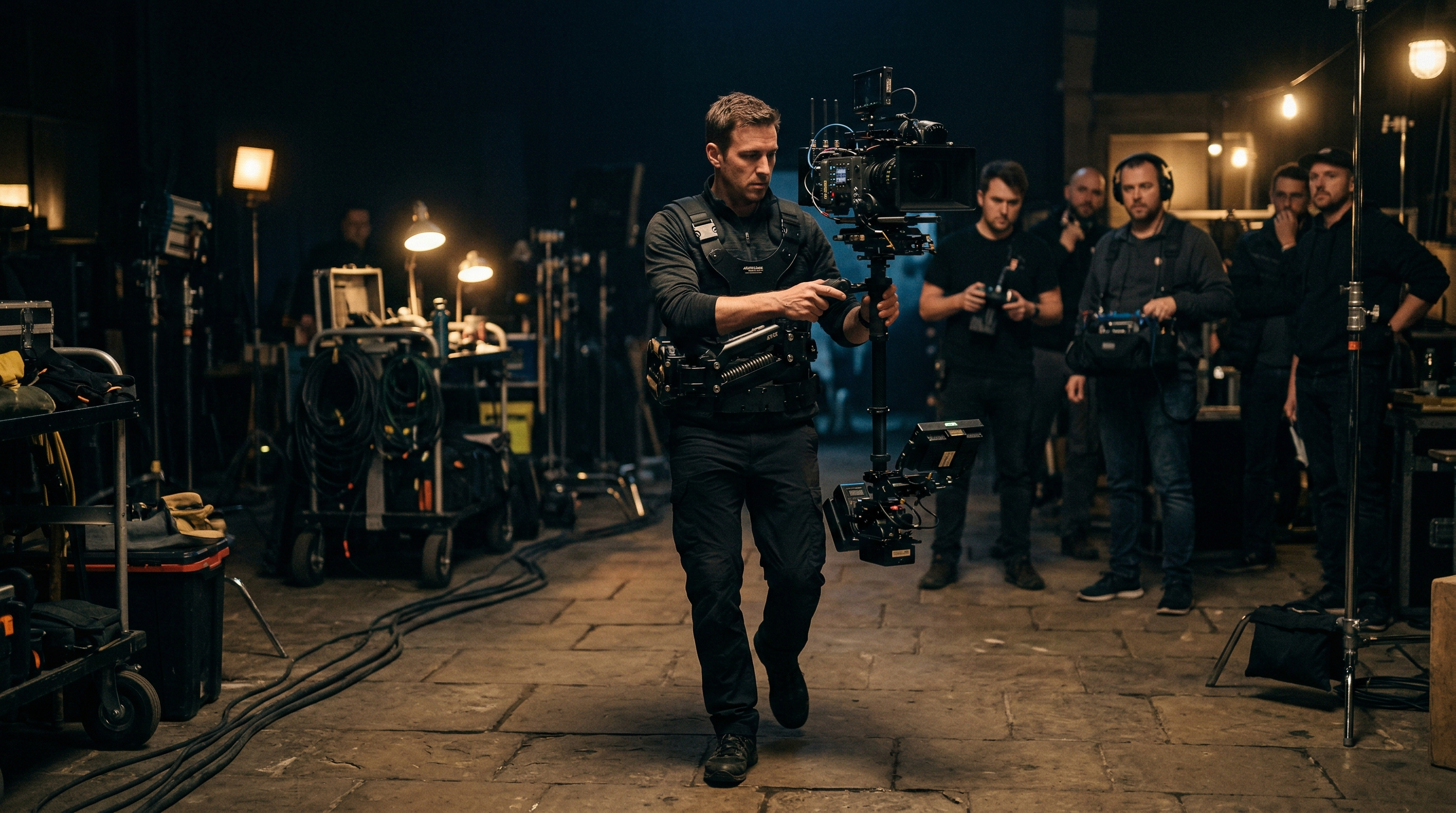
Garrett Brown invented the Steadicam, then used it himself to shoot Rocky running through Philadelphia in 1976. No other camera move had ever looked like that — and the person executing it needed an entirely new skill set to pull it off.
A Steadicam operator is a specialized camera operator trained to operate a Steadicam stabilization system — a body-worn rig consisting of a weighted vest, iso-elastic arm, and camera sled — to produce fluid, movement-tracking shots that neither a handheld camera nor a dolly can replicate. They work within the camera department under the Director of Photography (DP), executing specific shots the DP or director has designed around the system’s unique capabilities.
Steadicam operators are specialists, not generalists. On large-scale productions, they are hired specifically for the Steadicam work and operate alongside the A-camera operator rather than replacing them. On mid-budget productions, the B-camera operator may double as the Steadicam operator if they have the training. Either way, the designation appears separately in the end credits.
What does a Steadicam operator do?
The Steadicam Operator’s Role on a Film Set
The Steadicam operator’s core job is executing complex, mobile camera moves that require the camera to follow action through environments too irregular or dynamic for a dolly track. Think of the long-take corridor shot in 1917, the frenetic kitchen sequence in Goodfellas, or Danny Torrance’s tricycle rides through the Overlook Hotel in The Shining — every one of those shots required a skilled operator managing 30–50 lbs of balanced equipment while walking, turning, and adjusting framing simultaneously.
Pre-production duties:
- Reviewing shot lists and storyboards to assess which scenes require the Steadicam
- Collaborating with the DP on lens choices and rig configuration for each sequence
- Scouting locations for floor surface quality, elevation changes, and obstacle clearance
- Rigging the sled (camera platform) and balancing the system to the specific camera and lens combination
On-set duties:
- Operating the Steadicam rig in coordinated movement with actors and other crew
- Managing framing and composition through the onboard monitor (the rig blocks the camera’s eyepiece)
- Communicating with the focus puller, who must pull focus on a moving camera in motion
- Resetting the rig between takes: rebalancing, checking monitor, confirming lens position
- Executing “low mode” shots (rig inverted, camera at ground level) for specific angles
Technical responsibilities:
- Balancing the sled for each new camera/lens combination — a process that can take 15–30 minutes
- Managing the vest fit and arm spring tension to match the operator’s body weight and fatigue level
- Coordinating with the grip department on any floor surfaces, ramps, or platforms built for the shot
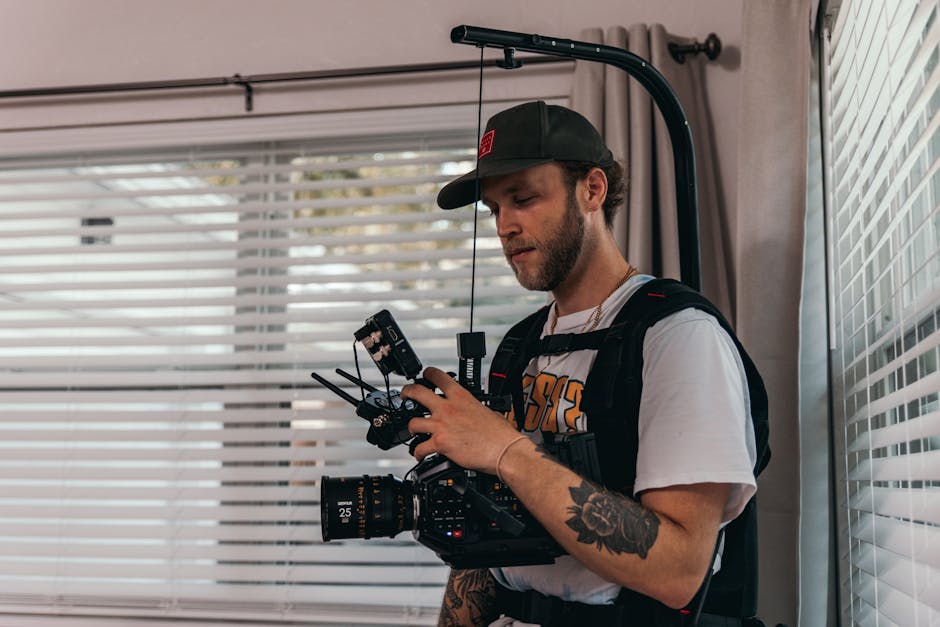
The Steadicam operator reports directly to the DP. They work closely with the key grip and dolly grip, whose departments sometimes construct custom floor surfaces to give the operator a clean path.
What does a Steadicam operator do with the equipment?
The Three-Part System Every Operator Masters
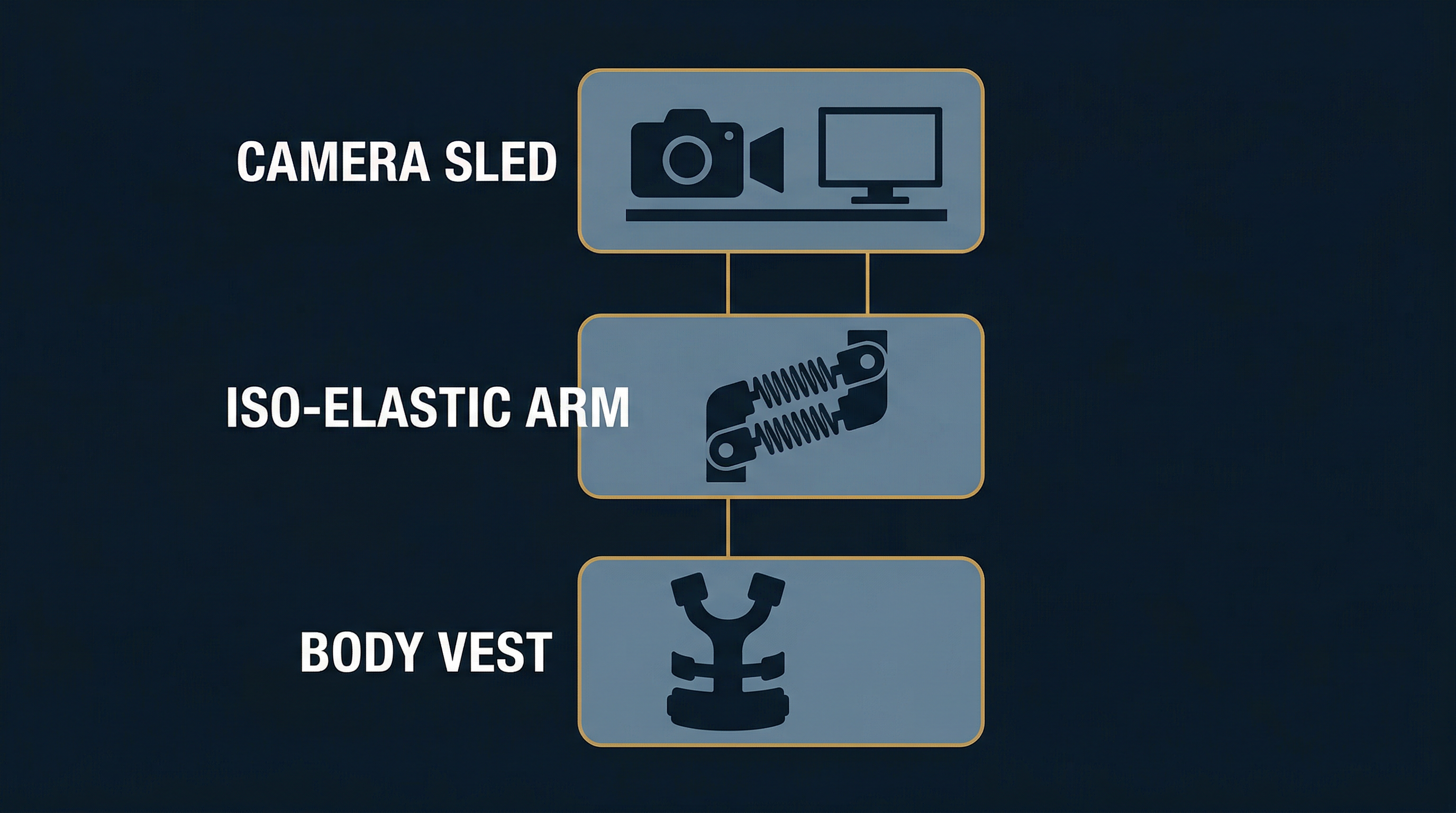
The Steadicam system has three main components, and every operator needs to understand all three:
| Component | Function |
|---|---|
| Vest | Body harness that transfers the rig’s weight to the operator’s hips and shoulders. Custom-fitted to each operator. |
| Iso-elastic arm | Spring-loaded arm that connects vest to sled; absorbs the operator’s up-and-down body motion during walking. |
| Sled | The vertical post holding the camera at the top and a counterbalance monitor/battery at the bottom. The system pivots at the gimbal — a low-friction three-axis joint at the top of the arm. |
The physics behind it: the rig stays upright because the bottom (monitor/batteries) is slightly heavier than the top (camera), creating a pendulum effect. The operator steers by applying gentle pressure to the gimbal, not by turning their body.
Steadicam operator salary & day rates
What Steadicam Operators Earn
Steadicam operators command a premium over standard camera operators because of the specialized equipment, training costs, and physical demands of the role.
Day rates in the United States (IATSE Local 600):
- Low-budget features / indie: $500–$800/day (operator rate only)
- Mid-budget features / cable TV: $800–$1,400/day
- Studio features / network episodic: $1,500–$3,000/day
- Equipment rental (operator-owned rig): $500–$1,500/day on top of the operating rate
Most professional Steadicam operators own their rigs — a complete studio-level Steadicam system (vest, arm, sled) runs $15,000–$80,000+ depending on configuration. The equipment rental fee is negotiated separately from the operating fee and is standard practice on union productions.
Annual salary range varies significantly based on market. In Los Angeles and New York, experienced Steadicam operators working steadily on episodic TV can earn $100,000–$180,000/year. The work is project-based, so income depends heavily on booking frequency.
IATSE Local 600 (the International Cinematographers Guild) covers Steadicam operators on union productions under the same basic agreement as camera operators. Minimum rates, overtime, and turnaround rules apply.
Where does the Steadicam operator appear in film credits?
Credit Placement in End Crawl
The Steadicam operator is credited in the Camera Department section of the end crawl, below the Director of Photography and above the camera assistants. On productions with multiple camera units, each unit’s Steadicam operator may be listed separately under that unit’s block.
Typical end credit order within the camera department:
- Director of Photography
- Camera Operator / “A” Camera Operator
- “B” Camera Operator (if applicable)
- Steadicam Operator (listed here, or directly under the camera operator(s))
- First Assistant Camera (“A” Camera)
- First Assistant Camera (“B” Camera)
- Second Assistant Camera / Loader
- Digital Imaging Technician (DIT)
On productions where the camera operator doubles as the Steadicam operator, the credit typically reads “Camera Operator / Steadicam” or lists both on separate lines. The credit format follows what IATSE Local 600 negotiated on that production.
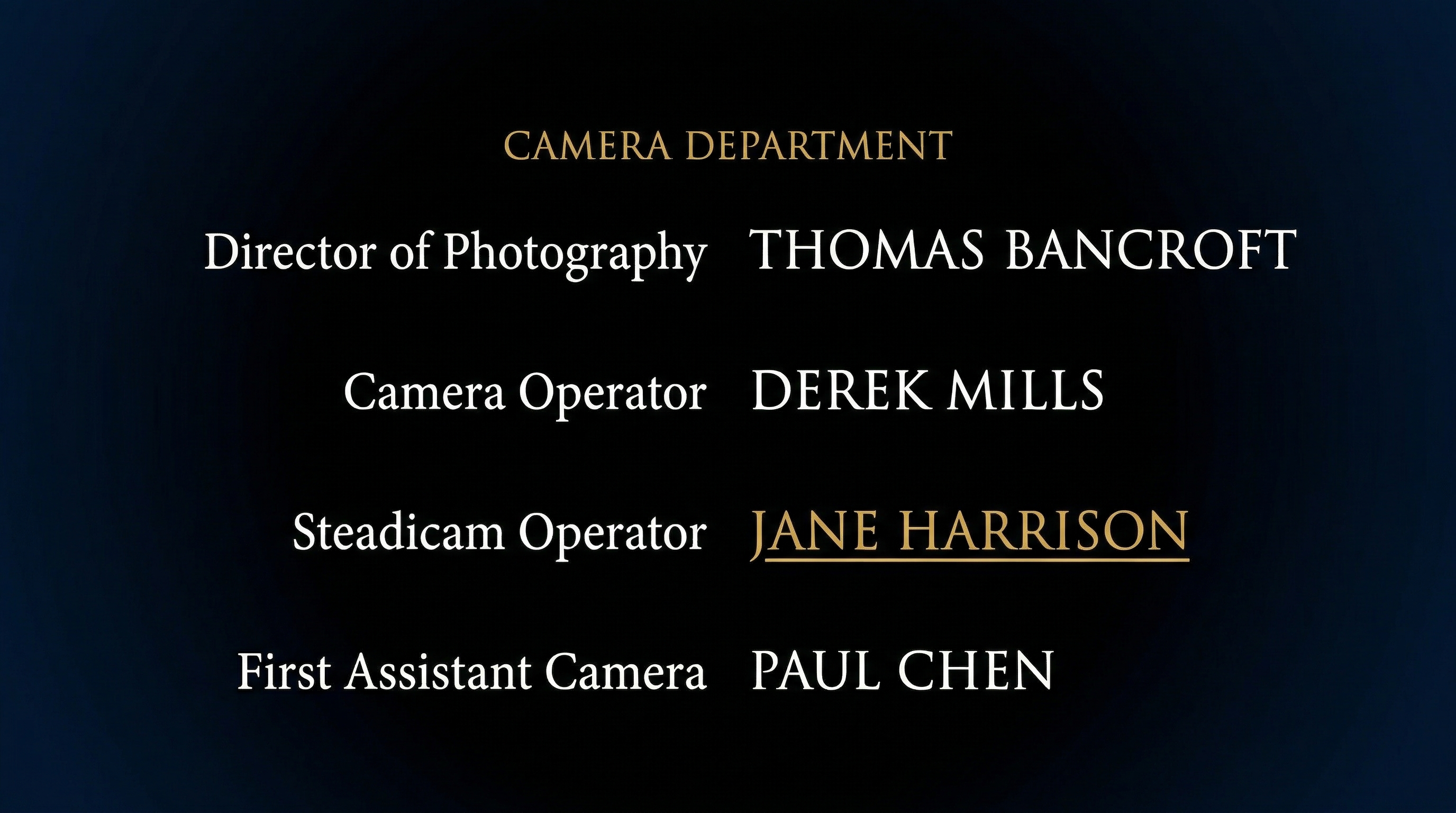
Opening credits: Steadicam operators do not typically receive a main title card. Their credit appears exclusively in the end crawl.
How to credit a Steadicam operator correctly
Credit Format and Common Variations
The standard credit format for a Steadicam operator in an end crawl:
Steadicam Operator ............... JANE DOECommon variations you’ll see in practice:
| Format | Usage |
|---|---|
Steadicam Operator | Standard — most feature films and episodic TV |
Steadicam® Operator | Tiffen’s trademarked form; used when production wants to be precise |
Camera Operator / Steadicam | When one person handles both roles |
"A" Camera / Steadicam Operator | When the A-camera operator also Steadicam operates |
Steadicam | Shorthand sometimes used on lower-budget productions |
Guild and trademark considerations:
Steadicam is a registered trademark of Tiffen (acquired from Cinema Products Corporation in 2000). Some productions use the generic term “stabilized camera operator” or “camera stabilizer operator” — particularly when using non-Steadicam branded equipment like a Glidecam or MōVI. However, in practice, “Steadicam Operator” remains the industry-standard credit designation regardless of the actual equipment brand.
If a production used a gimbal (electronic stabilization) rather than a mechanical Steadicam rig, the credit may read “Gimbal Operator” or the operator may still receive a “Camera Operator” credit depending on the deal memo.
What if one person operated both A-camera and Steadicam? List the primary role first, then Steadicam. Credit as: "A" Camera Operator / Steadicam — both on one line, separated by a slash.
Steadicam operator vs gimbal operator
Steadicam vs Gimbal: Different Tools, Different Credits
The question of whether to use a Steadicam or electronic gimbal (DJI Ronin, MōVI, Tilta) comes up on every production that requires camera movement without tracks. The choice affects both the visual result and how the operator is credited.
| Steadicam | Gimbal | |
|---|---|---|
| Stabilization type | Mechanical (mass/balance) | Electronic (motors + gyroscopes) |
| Weight on operator | 30–50 lbs via vest | 10–25 lbs handheld or on low-profile rig |
| Movement character | Organic, slightly floating — distinctive “Steadicam look” | Locked-off, digital-smooth — can feel uncanny |
| Setup time | 15–30 min to balance per camera/lens | 5–10 min |
| Credit format | ”Steadicam Operator" | "Gimbal Operator” or “Camera Operator” |
| Training path | SOA workshops, Tiffen Gold/Silver/Bronze | Manufacturer training, self-directed |
The “Steadicam look” — that slightly buoyant, alive quality to the camera — comes from the pendulum physics of the mechanical system. Gimbals produce a different aesthetic that many DPs specifically want to avoid on narrative work. Stanley Kubrick used Steadicam precisely for its organic movement quality in The Shining; digitally stabilized footage would not have produced the same psychological effect.
From a credits standpoint: if a gimbal was used, calling the operator “Steadicam Operator” in the credits is inaccurate. Use the appropriate designation based on the equipment actually operated.
Notable Steadicam operators in film history
The Operators Who Defined the Role
Garrett Brown — the inventor — was also its first master practitioner. His work on Rocky (1976), Bound for Glory (1976), and The Shining (1980) established what the tool could do. He operated on hundreds of productions over a career spanning five decades.
Larry McConkey became one of the most sought-after Steadicam operators in Hollywood, working on Goodfellas (1990), The Silence of the Lambs (1991), Schindler’s List (1993), and Gangs of New York (2002). His work on the Copa sequence in Goodfellas — a single uncut Steadicam shot following Henry Hill and Karen through the back entrance of the Copacabana — is studied in film schools worldwide.
Peter Cavaciuti is among the most decorated operators in the UK, with work on major studio features and a long association with top British and Hollywood DPs.
What separates elite Steadicam operators from competent ones is anticipation — reading actor movement before it happens, adjusting weight distribution preemptively, and maintaining clean framing through chaotic multi-actor blocking. The physical and technical demands are substantial; operators train for years before working on studio-level productions.
Sources & Further Reading
- Steadicam Operators Association (SOA) — founded by Garrett Brown in 1988; runs workshops and maintains operator standards
- Tiffen Steadicam Workshops — Bronze, Silver, and Gold training programs; Gold is considered the professional standard
- The Steadicam Operator’s Handbook by Jerry Holway and Laurie Hayball — the definitive technical reference, co-authored by a longtime Tiffen instructor
- IATSE Local 600 – International Cinematographers Guild — covers Steadicam operators under the camera department contract
Create Professional End Credits with EndCreditsPro
Steadicam operators belong in the camera department block, listed in the right order, with the correct credit format. EndCreditsPro formats your entire camera department automatically — from DP to DIT — so every crew member gets the credit they earned.