What Is a Unit Production Manager in Film?
The director decides what gets shot. The UPM decides what can actually be afforded. On most productions, that’s the harder job.
The unit production manager (UPM) is the Directors Guild of America–approved title for the top below-the-line staff position on a feature film or television production. They manage the logistics, budget execution, and crew administration that keep a production from collapsing under its own weight. Where the line producer sets the financial strategy, the UPM executes it — down to the daily call sheet, the location contracts, and every vendor invoice.
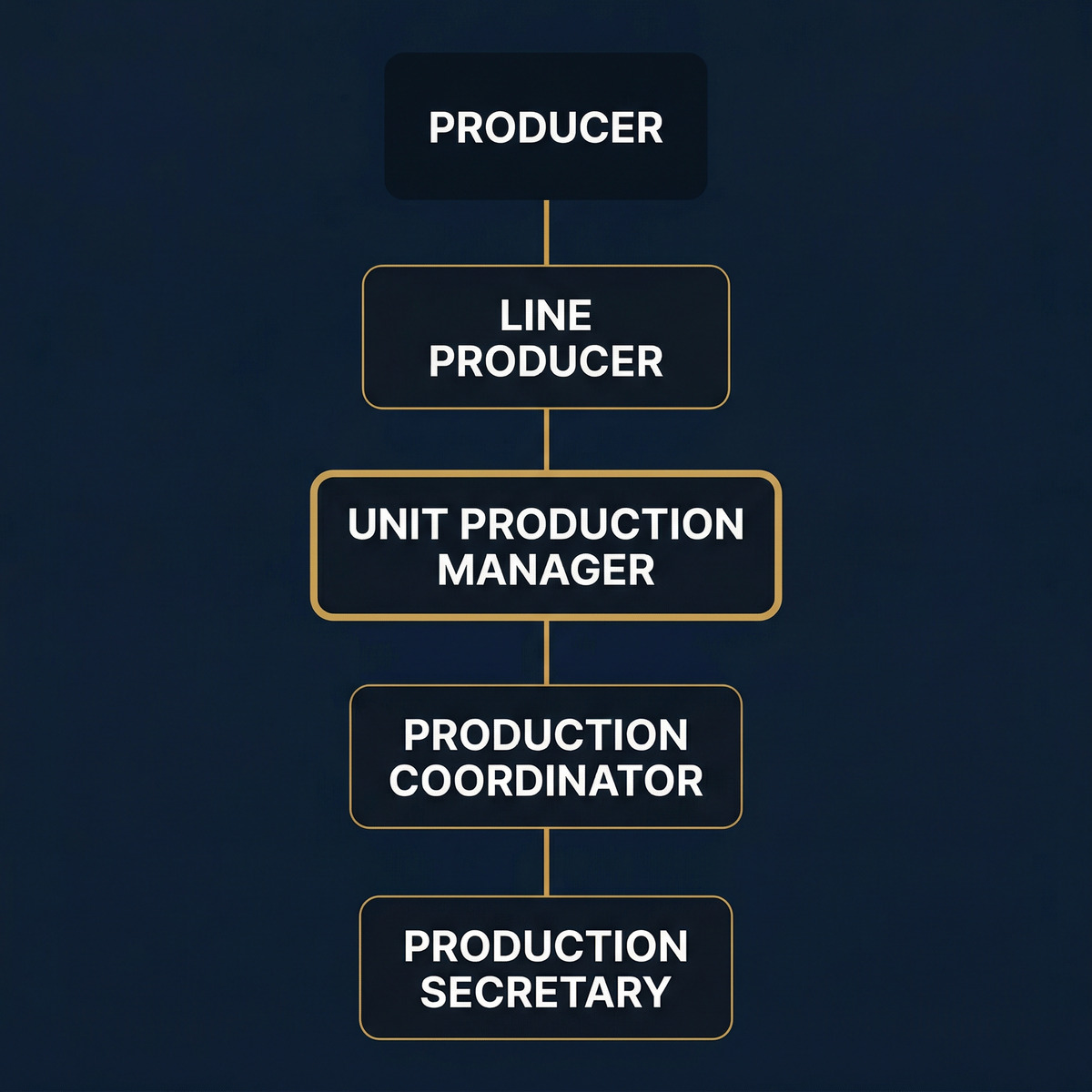
In the film crew hierarchy, the UPM sits at the head of the production management chain, directly below the line producer. Their credit reflects that position — placed at the very top of the below-the-line section of the end crawl, before every department head.

What does a unit production manager do?
Running the Machine: UPM Responsibilities
The UPM’s job exists across all three production phases, but the balance shifts dramatically between them.
Pre-production is where UPMs earn their keep. They prepare the production breakdown, build the shooting schedule, and finalize the budget line by line. They scout locations, negotiate contracts with vendors, and execute crew deals. By the time cameras roll, the UPM has touched every budget line and every department hire.
During production, the UPM is in the office 70-80% of the time — not on set. Their job is oversight, not supervision. On any given shooting day they’re processing daily production reports, managing petty cash and purchase orders, handling permit issues, and fielding requests from every department head. When a grip truck breaks down at 4am or a location falls through, the UPM gets the call.
Post-production brings budget reconciliation and closeout. The UPM works with the production accountant to reconcile final costs, process returns, close out vendor accounts, and prepare the final cost report for the studio or financier.
Who the UPM Works With

| Reports to | Manages |
|---|---|
| Producer / Line Producer | Production Coordinator |
| Production Secretary | |
| Office PA staff | |
| Location Manager (logistical oversight) | |
| All department heads (budget/schedule coordination) |
The UPM also manages union relations — maintaining compliance with DGA, SAG-AFTRA, WGA, IATSE, and Teamsters contracts throughout the shoot. Any union grievance or dispute lands on the UPM’s desk first.
The UPM’s Financial Authority
Every dollar spent on a production requires the UPM’s prior knowledge and approval. This isn’t bureaucracy — it’s control. As one industry professional puts it: “Your job is not to save money. Your job is to spend money wisely. Get it on the screen, not in trailers and fancy gear rental cars.”
A UPM who isn’t involved in every spending decision has lost control of the production. In practice, this means:
- Approving all purchase orders and check requests
- Negotiating and executing location contracts
- Reviewing daily cost reports against the budget
- Flagging overages before they compound
- Deciding whether a creative request is financially feasible
Where does the unit production manager appear in film credits?
This is what most guides skip. Every industry resource explains what a UPM does — almost none explain where the credit actually appears.
Why the UPM Appears First in End Credits
The UPM holds the first credit in the below-the-line section of the end crawl — before every department head, every crew member, every grip and gaffer. This placement is not arbitrary.
The production management section traditionally opens the crew crawl because the UPM is the operational head of the entire below-the-line crew. Every department, in some sense, works under their logistical authority. Crediting the UPM first acknowledges that hierarchy on screen.
On union productions, the DGA Basic Agreement governs how UPM credits are formatted and positioned. The title “Unit Production Manager” is the DGA-approved designation — not “Production Manager,” not “PM,” and not any informal variant. Using the correct title is a contractual requirement, not a stylistic choice.
Opening Credits
The UPM does not appear in opening credits. Opening title sequences are reserved for above-the-line talent: studio logos, production companies, lead cast, the director, and the producing credits.
The one exception: if a UPM has been elevated to Co-Producer or Producer credit through deal negotiation (see below), that elevated credit may appear in opening cards per the producing credit arrangement. But the UPM title itself stays in the end crawl.
End Credits: Credit Placement
On DGA productions the DGA Basic Agreement (section 13-209) fixes this credit: the UPM, the First Assistant Director and the Key Second Assistant Director share a separate card, or its equivalent in a crawl, with no more than three names, in that order and in the same size and style of type:
Unit Production Manager ......... SARAH CHEN
First Assistant Director ........ TOM BURKE
Second Assistant Director ....... MAYA ORTIZ
On non-DGA productions there is no such rule, and the UPM often simply heads the production management section:
Unit Production Manager ......... SARAH CHEN
Production Coordinator .......... JAMES MILLER
Production Secretary ............ OLIVIA REYES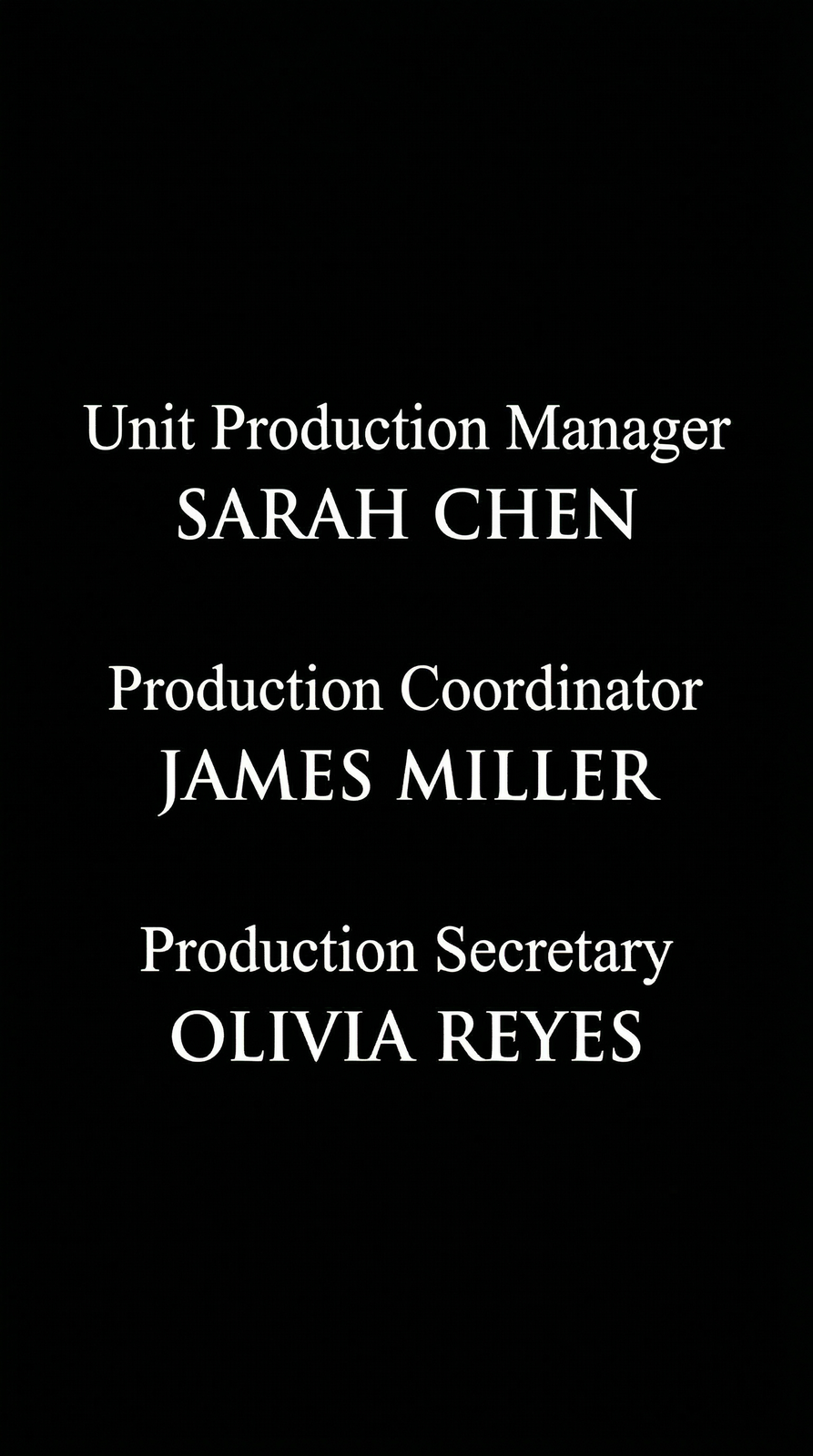
On larger productions with both a line producer and a UPM, the line producer’s credit typically appears first (in or near the producing block), followed immediately by the UPM at the start of the crew crawl:
Line Producer
DAVID PARK

---

Unit Production Manager
SARAH CHEN

Production Coordinator
JAMES MILLER
Where that shared credit appears is not fixed by the agreement. In practice it usually opens the crew section of the end credits, as its own card or as a separated block of the crawl.
Credit Format
Single UPM:
Unit Production Manager
SARAH CHEN
Multiple UPMs (second unit, multiple shooting units, or international co-productions):
Unit Production Managers
SARAH CHEN     DAVID OSEI
Never abbreviate to “UPM” on screen. Never use “Production Manager” alone on a DGA-covered production — the full title “Unit Production Manager” is required by DGA contract.
How to credit a unit production manager correctly
The Correct Text Format
The on-screen credit is always Unit Production Manager — in full, not abbreviated. “UPM” is internal shorthand for call sheets and production documents. It never appears on screen.
Credit Variations
| Credit | When Used |
|---|---|
Unit Production Manager | Standard DGA credit on all union productions |
Production Manager | Non-DGA productions; sometimes used on non-union indie films |
Co-Producer | UPM elevated through deal negotiation; common when LP gets full Producer credit |
Line Producer | UPM elevated when LP receives Co-Producer credit (PGA cascading rule) |
The PGA Cascading Credit Rule
The PGA’s Code of Credits allows the cascade below; it is guidance, not a contract term.
When a line producer is elevated to Co-Producer credit, the UPM may receive a Line Producer credit in their place — creating a cascade effect down the production management chain. This means the UPM credit that appears on screen doesn’t always match the person’s functional role. Always check the deal memo against the final credit block.
Common Crediting Mistakes
Using “Production Manager” on a DGA production. If the production is DGA-signatory, the title must be “Unit Production Manager.” Using “Production Manager” is a contract violation.
Placing the UPM credit in the wrong section. The UPM credit belongs at the head of the crew crawl — not buried mid-scroll with department heads, and not grouped with the producing block unless an elevated credit applies.
Combining UPM and Production Coordinator credits. On micro-budget productions where one person handles both functions, list each credit separately in its proper position. The UPM credit comes first.
Abbreviating on screen. “UPM” and “Prod. Mgr.” are internal shorthand. The screen credit is always the full title.
Unit production manager salary
What the Market Pays
UPM compensation is negotiated per production, not salaried. DGA Basic Agreement minimums set the floor; experienced UPMs negotiate above those rates based on production scale and track record.
| Production Level | Weekly Rate | Notes |
|---|---|---|
| Low-budget / indie | $1,500–$2,500/wk | Often at or near DGA scale |
| Mid-budget film / TV | $3,500–$5,000/wk | Most common range for working UPMs |
| Major studio / streaming | $6,000–$10,000+/wk | Feature films and prestige TV |
The $3,500–$4,800/week figure cited in most industry sources reflects the mid-tier working range. On large studio features or high-end streaming productions, weekly rates can run significantly higher. Annual earnings depend almost entirely on how many productions a UPM books in a year — most UPMs are not on staff year-round.
DGA UPMs also receive pension, health, and welfare contributions under the DGA Basic Agreement, plus overtime rates for hours worked beyond the contractual guarantee.
Unit production manager vs. line producer
The Most Confused Distinction in Production Management
On lower-budget productions, one person frequently holds both roles. That convergence creates genuine confusion about what each title actually means.
| Unit Production Manager | Line Producer | |
|---|---|---|
| Guild status | DGA below-the-line position | Not a DGA-jurisdictional title |
| Primary focus | Execution: schedule, logistics, crew operations | Strategy: budget ownership, department head hires |
| Budget role | Executes the budget; approves spending | Creates and owns the overall budget |
| Reporting | Reports to line producer or producer | Reports to producer or executive producer |
| Credit flexibility | Fixed DGA title; may be elevated to LP or Co-Producer | Can flex to Co-Producer or Producer through negotiation |
| On set vs. office | Primarily office-based during production | More fluid; involved in creative conversations |
The practical distinction: the line producer sets the financial strategy and hires the UPM to execute it. On a $1M indie where both functions are handled by one person, the credit is usually “Line Producer” — the more senior title. On a studio feature with a full production management team, expect both credits on screen separately.
A line producer from John Duffy’s perspective: “I’ll hire a production manager or UPM beneath me to handle a lot of the day-to-day and micromanagement of the production — while I handle the overall picture, making sure that we come in on schedule, on budget, and being the diplomatic person between all the different department heads, the director, the producer, the completion bond company.”
How to become a unit production manager
The Career Path
There is no direct route to UPM. The role requires working knowledge of production budgets, union contracts, scheduling software (Movie Magic Scheduling and Budgeting are industry standard), vendor negotiations, and crew management. That knowledge comes from time spent in production offices.
The most common path:
- Production Assistant — Learn the office, the call sheets, the lingo
- Office PA → Production Secretary — Move to office-specific work
- Assistant Production Coordinator → Production Coordinator — Manage day-to-day production logistics
- UPM on low-budget / short films — Build the track record
- UPM on mid-budget productions — Establish DGA standing
Some UPMs come through production accounting — knowing a budget from the inside is a direct path to managing one. Others come through the 1st AD track, though those who move from the set side must rebuild office-side credibility.
DGA membership is required for UPM work on DGA-signatory productions. Entry into the DGA typically requires documented days worked as a production assistant or coordinator, plus a qualifying sponsorship from a DGA member.
Notable unit production managers in film history
The Professionals Behind the Logistics
Barbara Boyle served as UPM and later line producer on several Roger Corman productions in the 1970s and 1980s, developing a reputation for making impossible budgets work. She later became a full producer and studio executive.
Kathleen Kennedy began her career as a production coordinator and manager before ascending to produce alongside Steven Spielberg. Her early experience managing the operational demands of Raiders of the Lost Ark (1981) gave her the logistical foundation for one of Hollywood’s most enduring production careers.
Georgia Kacandes has UPM credits on multiple Spike Lee productions, including Malcolm X (1992) — a production with a notoriously difficult shoot and financing challenges that tested every limit of production management.
Sources & Further Reading
- DGA Basic Agreement — Directors Guild of America
- PGA Code of Credits — Feature Films — Producers Guild of America
- Production Management Handbook — IMDB credits reference
Recommended Videos
- John Duffy: Difference Between Line Producer and UPM — Industry professional explaining the key distinction in plain terms
- The Role of the Unit Production Manager — Financial philosophy of the UPM role
Create Professional Credits with EndCreditsPro
Format UPM credits with the correct DGA-required title, billing position, and placement in the production management section. Generate broadcast-ready end credits with EndCreditsPro or browse our credit format guide for film credits.