What Is a Line Producer in Film?
Every dollar spent on a production passes through one person’s hands. Not the director. Not the studio exec. The line producer.
Video: What Does a Line Producer Do? Role, Credits & Where the Name Goes On Screen, from our series Film Crew Roles, Explained. It loads from YouTube when you press play. Watch it on YouTube.
The line producer (LP) is the operational backbone of any film or television production. While the producer focuses on the creative vision and financing, the line producer manages every below-the-line dollar from script breakdown through final delivery. All department heads report to them. The budget lives and dies with them.
In the film credits hierarchy, the line producer sits in a unique position — functionally indispensable, but with a credit that shifts depending on production scale, union status, and deal negotiation. Understanding where that credit appears, and how to format it correctly, is something few guides bother to explain.
What does a line producer do?
The Three Phases of the Job
The title comes from the budget itself. A production budget is divided into “above-the-line” costs (director, writers, lead cast, producer) and “below-the-line” costs (crew, equipment, locations, post-production). The line producer owns everything below that line.
Pre-production is where the LP earns their money. They break down the script scene by scene, estimate the cost of each shooting day, build the initial budget, and create the production schedule. They hire department heads — the Director of Photography, Production Designer, Location Manager, and others — and negotiate vendor contracts and equipment rentals. Insurance, permits, and union agreements all fall in their scope.
Production shifts the job from planning to oversight. The LP monitors daily spend against the budget, liaises with the production accountant to ensure payroll runs on time, and solves logistical problems the moment they arise. They serve as the communication link between the director’s creative demands and the financial reality of what can actually be done.
Post-production includes equipment returns, final vendor reconciliation, and coordination with the post-production supervisor on facilities, sound, color, and VFX delivery. On smaller productions, the LP often stays on through deliverables.
Who Reports to a Line Producer
Every below-the-line department head reports to the LP: the Unit Production Manager (UPM), Key Grip, Gaffer, Production Designer, Location Manager, and others. On larger productions, a UPM sits directly below the LP and handles operational details while the LP manages the bigger financial picture.
The LP reports upward to the Producer and Executive Producer. See the full film crew roles hierarchy for how the production management chain fits together.
Line producer salary
What the Market Actually Pays
Line producer compensation is project-based, not salaried: the rate is negotiated for each production. According to SetHero’s 2024 salary guide, the average line producer salary in the United States was $91,992 a year (October 2023):
| Experience | Annual pay | Day rate |
|---|---|---|
| Entry level | around $50,000 | $100–$200 |
| Average | $91,992 | — |
| Experienced | $150,000+ | $1,000–$2,000 |
Skills and experience, project size and budget, geographic location (LA and NYC command premiums) and union status all move the number.
Unlike the Associate Producer, whose credit sometimes involves deferred pay, experienced line producers typically negotiate flat weekly rates.
Where does the line producer appear in film credits?
This is what no other guide covers. Every industry resource explains what a line producer does — almost none explain where the credit actually goes.
Opening Credits
The line producer does not appear in opening credits. Opening title sequences are reserved for above-the-line talent: studio, production company logos, lead cast, director, writer, and the “Produced by” credit.
The one exception: when a line producer has been elevated to Co-Producer or Producer credit on a given production (see below). In that case, the elevated credit may appear in opening cards per whatever contractual arrangement governs main title placement.
End Credits
The line producer’s placement in end credits depends on what credit they are actually receiving. This is the source of most confusion.
When credited as “Line Producer”
On productions where a separate “Line Producer” credit exists, it typically appears in one of two locations:
Option 1 — The producer block (above-the-line section): When the line producer’s contribution warrants recognition alongside producing credits, the LP credit appears at the top of the end crawl, within or immediately after the producer block:
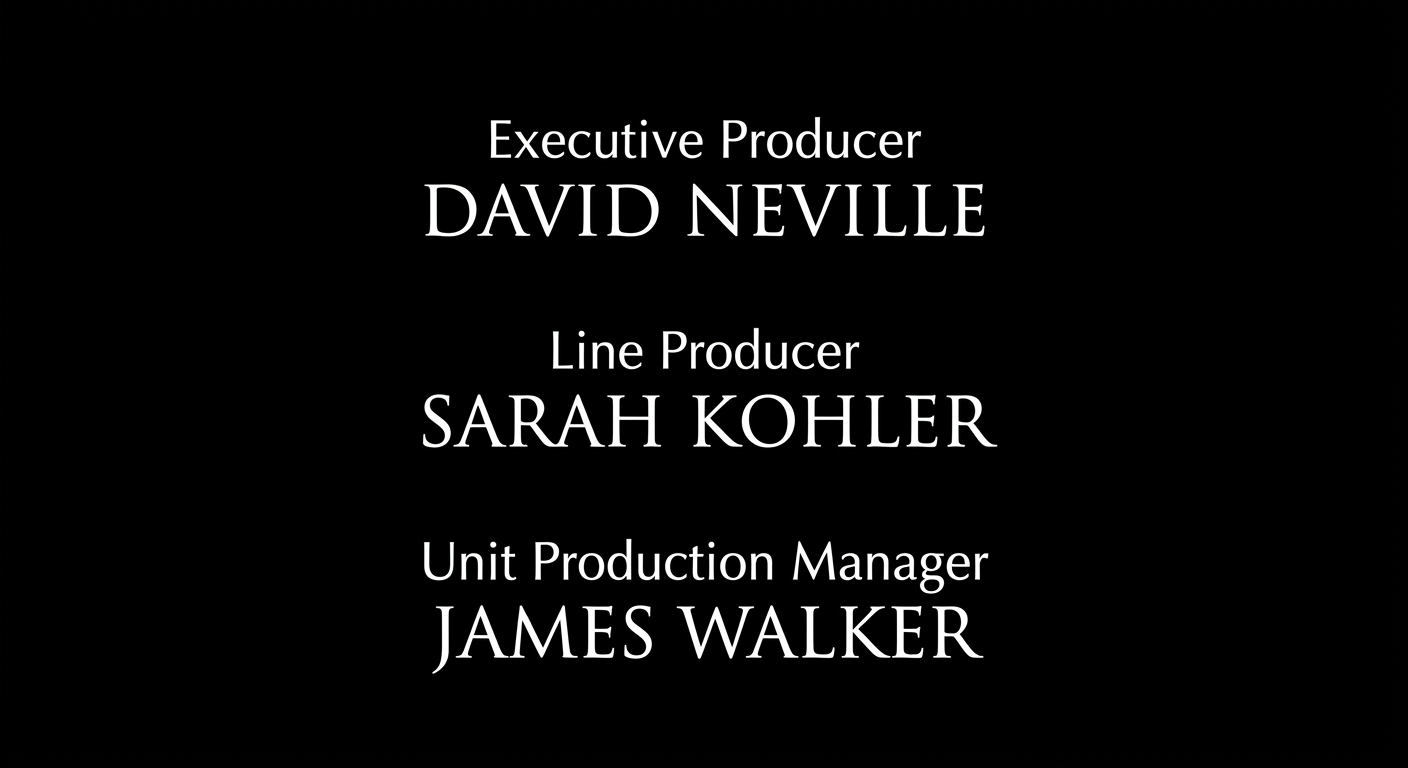
Executive Producer
DAVID NEVILLE

Line Producer
SARAH KOHLER
This placement is common on mid-budget and streaming productions where the LP was a core above-the-line collaborator.
Option 2 — Production management section: On studio features with large producing teams, the line producer credit sometimes appears in the production management section at the start of the below-the-line crawl, listed before or alongside the UPM:
Line Producer ............. JAMES WALKER
Unit Production Manager ......... MARIA CHEN
Which placement applies depends on the individual deal memo and the negotiated billing position.
When credited as “Co-Producer”
This is where it gets complicated. The PGA’s Code of Credits states that the line producer may receive Co-Producer credit “under certain circumstances” — specifically when the LP has taken on producing functions that go beyond logistical management. On many studio features, the “Line Producer” credit is never actually used on screen; instead, the LP receives a Co-Producer card.
When this happens, the credit appears in the producer block alongside other co-producers:
Co-Producers
JAMES WALKER     RACHEL OSEI
The fact that one of those Co-Producers was functionally the line producer is invisible on screen.
The UPM Displacement Rule
The PGA guidelines note: “If both a separate Line Producer and Unit Production Manager (UPM) are employed, the Co-Producer credit may be granted to the UPM, reporting directly to the primary producers.”
In practice: titles can move up the production-management chain, so never copy credits from the crew list. Check each person’s deal memo. And on smaller productions the reverse happens too: the PGA notes that “in some scenarios, the Production Manager or UPM is the Line Producer” (see Whiplash below).
Card Format
Single LP:
Line Producer
JAMES WALKER
Multiple LPs (second unit, multi-territory productions):
Line Producers
JAMES WALKER     RACHEL OSEI
On productions with extensive producing blocks, the LP card is usually a static single card before the crawl begins, or listed within an early crawl card. Purely scrolling placement within the department crawl is uncommon for LP credits.
How to credit a line producer correctly
The Correct Text Format
The credit reads Line Producer — never hyphenated (“Line-Producer”), never abbreviated (“LP” on screen). On call sheets and internal documents, LP is standard. On screen, always the full title.
Credit Variations to Know
| On-Screen Credit | When Used |
|---|---|
Line Producer | LP retained their functional title; common on indie and mid-budget |
Co-Producer | LP elevated to producing credit per deal; most common on studio features |
Produced by | Rare; when LP assumed full producing responsibility across the project |
Common Crediting Mistakes
Using “Line Producer” when the contract specifies “Co-Producer.” Always check the deal memo. If an LP negotiated a Co-Producer credit, crediting them as “Line Producer” is a contract violation.
Listing the LP in the department crawl alongside crew. The line producer is not a department head in the crew sense. Their credit belongs in the producing or production management block, not buried with grips and drivers.
Combining credits. If someone served as both Line Producer and Production Supervisor on a micro-budget shoot, list each credit separately in its proper section. Never combine them on one line — each credit has its own screen position.
Abbreviating on screen. “LP” and “Ln. Prod.” are internal shorthand. The screen credit is always Line Producer.
Guild Considerations
The DGA governs UPM credits (UPM is the DGA-approved title for the top below-the-line staff position). The LP title itself is not a DGA-jurisdictional credit, which is one reason it can flex into “Co-Producer” or “Producer” territory based on negotiation.
The PGA Code of Credits defines the LP/Co-Producer role as “the single individual who has primary responsibility for the budget and logistics of the feature film’s production, from pre-production through completion of production.” Productions seeking the p.g.a. mark for their produced-by credit must go through PGA arbitration — but LP credits do not require the mark and are not subject to the same arbitration process.
Line producer vs. unit production manager
The Most Confused Distinction in Production
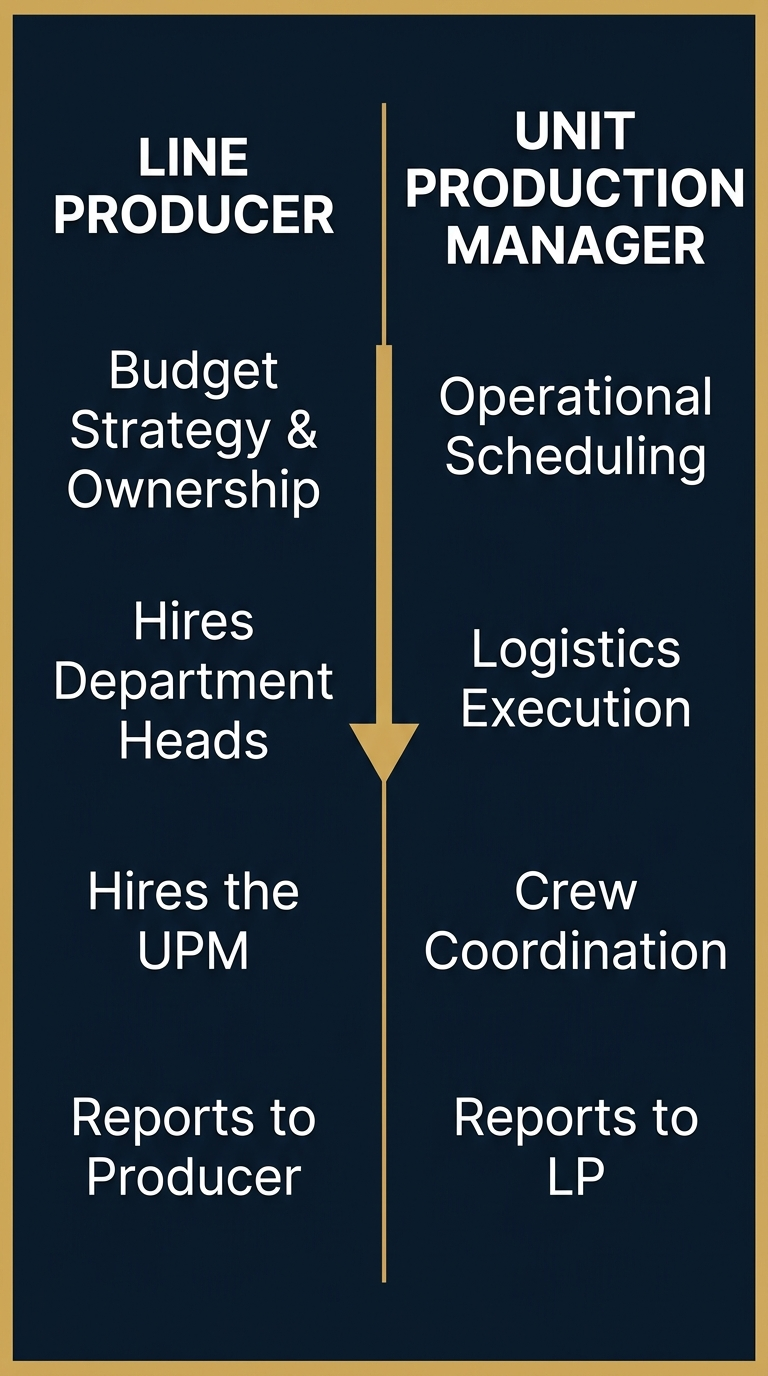
The line producer and the UPM are the two most operationally important roles below the producing tier — and on lower-budget productions, one person often fills both. That creates real confusion about what each title means.
| Line Producer | Unit Production Manager | |
|---|---|---|
| Primary responsibility | Budget strategy and overall production oversight | Operational scheduling and logistics execution |
| Who they hire | Department heads; oversees the UPM | Coordinates crew hires under LP direction |
| Budget relationship | Creates and owns the budget | Executes the budget created by LP |
| Guild | Not a guild-specific title | DGA-approved title |
| Credit flexibility | Can become Co-Producer or Producer | Sometimes elevated to Line Producer when LP gets Co-Producer |
| Typical seniority | Higher | Reports to LP |
The short version: the LP sets the financial strategy and hires the UPM to execute it. On a $500K indie where both functions are handled by one person, the credit is usually “Line Producer.”
When both roles are filled separately, expect to see both credits on screen — the LP near the top of the crawl, the UPM at the start of the production management section.
Line producer vs. producer
Where the Credit Sits in the Hierarchy
The producer credit structure in film is contractual, not cosmetic. From top to bottom:
- Produced by — owns the project end-to-end; picks up the Oscar
- Executive Producer — financing or high-level oversight (or, in TV, the showrunner)
- Co-Producer — shares producing duties; often the LP’s elevated credit on studio films
- Line Producer — logistics and budget, pre-production through delivery
- Associate Producer — delegated producing tasks
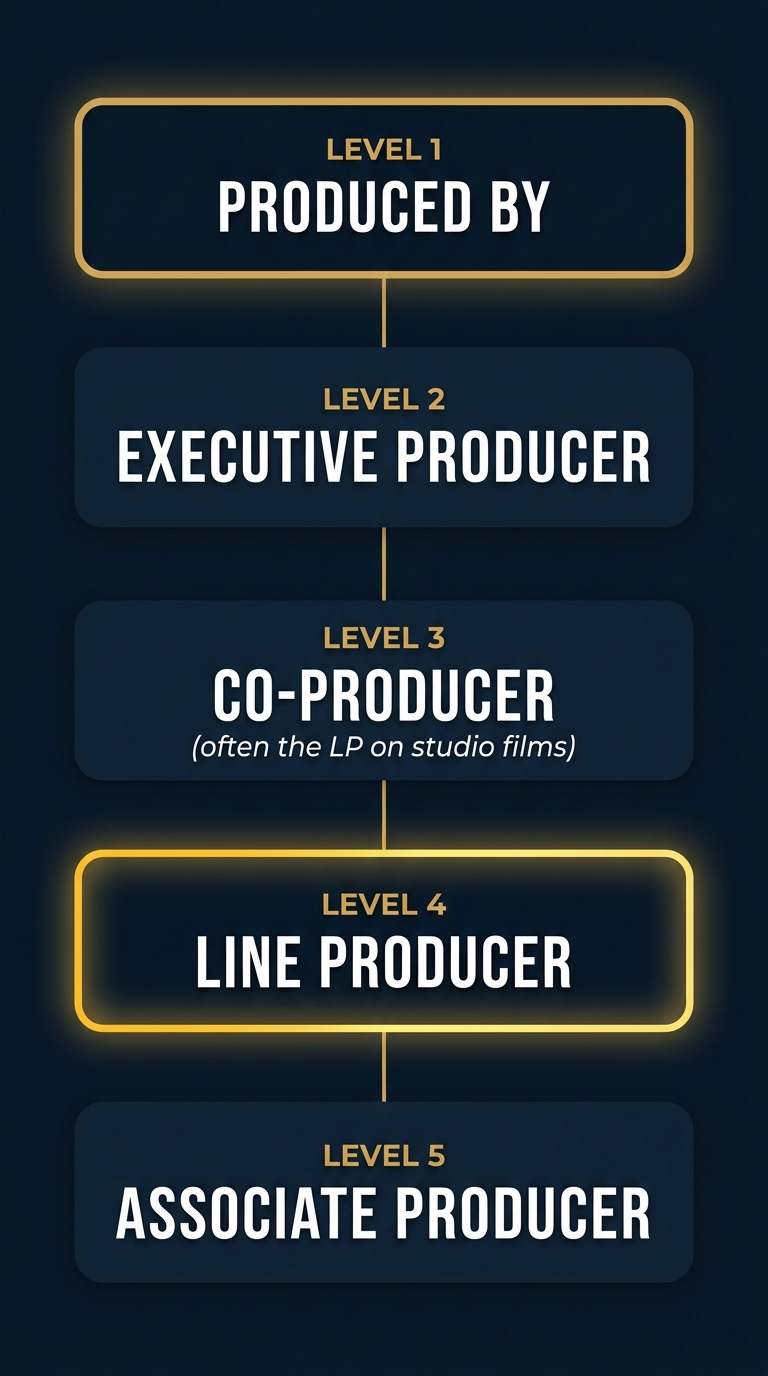
The Associate Producer sits below the line producer in the hierarchy. The LP sits below the Co-Producer. But as noted above, the LP often receives Co-Producer credit — which places them in a different position on screen than their actual function would suggest.
The practical distinction between LP and Producer: the Producer is in the room for creative and development decisions. The LP is not. The LP turns those decisions into a schedule and a budget, and runs the production. On independent films, the PGA notes that a line producer is sometimes hired even earlier, “to prepare a budget and schedule prior to raising funds”, though typically not as a deciding voice on financing.
Line producer credits in real films
What the Credits Actually Show
The clearest way to understand the role is to look at real credits. All three examples below can be checked on IMDb’s full cast and crew pages.
Whiplash (2014): one person, two credits. Mark D. Katchur is credited twice on Damien Chazelle’s film, as Unit Production Manager and as Line Producer. In the film’s end crawl, “Unit Production Manager — MARK D. KATCHUR” comes first, followed by the assistant directors, then “Line Producer — MARK D. KATCHUR”, then the co-producers, the associate producer and the cast. Two jobs, two separate lines, both at the top of the crawl: exactly the case the PGA describes when it notes that “in some scenarios, the Production Manager or UPM is the Line Producer.”
Moonlight (2016): the Co-Producer credit. On the Best Picture winner, IMDb lists Veronica Nickel as “co-producer / line producer”, with a separate unit production manager (Jennifer Radzikowski). The job was line producing; the negotiated credit includes Co-Producer. That is the PGA’s “Line Producer/Co-Producer” category in practice.
Mark Huffam: the production-management road to producer. Huffam’s IMDb credits trace the classic path: stagehand (1985), third assistant director (1987), location manager (1990–94), production manager (1995–98, including Saving Private Ryan), co-producer (Quills, 2000), then producer on Captain Corelli’s Mandolin and Game of Thrones, executive producer on Prometheus, and “producer (p.g.a.)” on Ridley Scott’s Napoleon (2023). Operational expertise, converted step by step into producing credit.
Sources & Further Reading
- PGA Code of Credits — Feature Films — Producers Guild of America
- Whiplash (2014) — Full cast & crew — IMDb
- Moonlight (2016) — Full cast & crew — IMDb
- Mark Huffam — filmography — IMDb
- What is a Line Producer — WeMakeMovies
- Line Producer vs. Production Manager — Paus
- Ultimate Line Producer Salary Guide — SetHero
- What’s the Difference Between Line Producer and UPM — The Film Fund
Recommended Videos
- What Is a Line Producer? Key Role Explained — 54K views, practical breakdown by phase
- John Duffy: Difference Between Line Producer and UPM — Industry professional explaining the key distinction
Create Professional Credits with EndCreditsPro
Format line producer credits with the correct billing position, card format, and guild-compliant ordering — whether your LP is credited as “Line Producer,” “Co-Producer,” or anything in between. Generate broadcast-ready end credits with EndCreditsPro or browse our credit templates.