Everything Everywhere All at Once End Credits: Technical Breakdown
Six VFX artists, 500 visual effects shots, and whispered voices from parallel universes bleeding through a seven-minute credit scroll. The credits for EEAAO are as unconventional as the film itself.
Everything Everywhere All at Once (2022) is a science-fiction comedy-drama written and directed by Daniel Kwan and Daniel Scheinert — collectively known as the Daniels. Produced by the Daniels and Jonathan Wang through AGBO, Ley Line Entertainment, and A24 on a reported $25 million budget, the film grossed over $140 million worldwide and swept the 95th Academy Awards with seven wins including Best Picture, Best Director, Best Actress (Michelle Yeoh), Best Supporting Actor (Ke Huy Quan), and Best Supporting Actress (Jamie Lee Curtis).
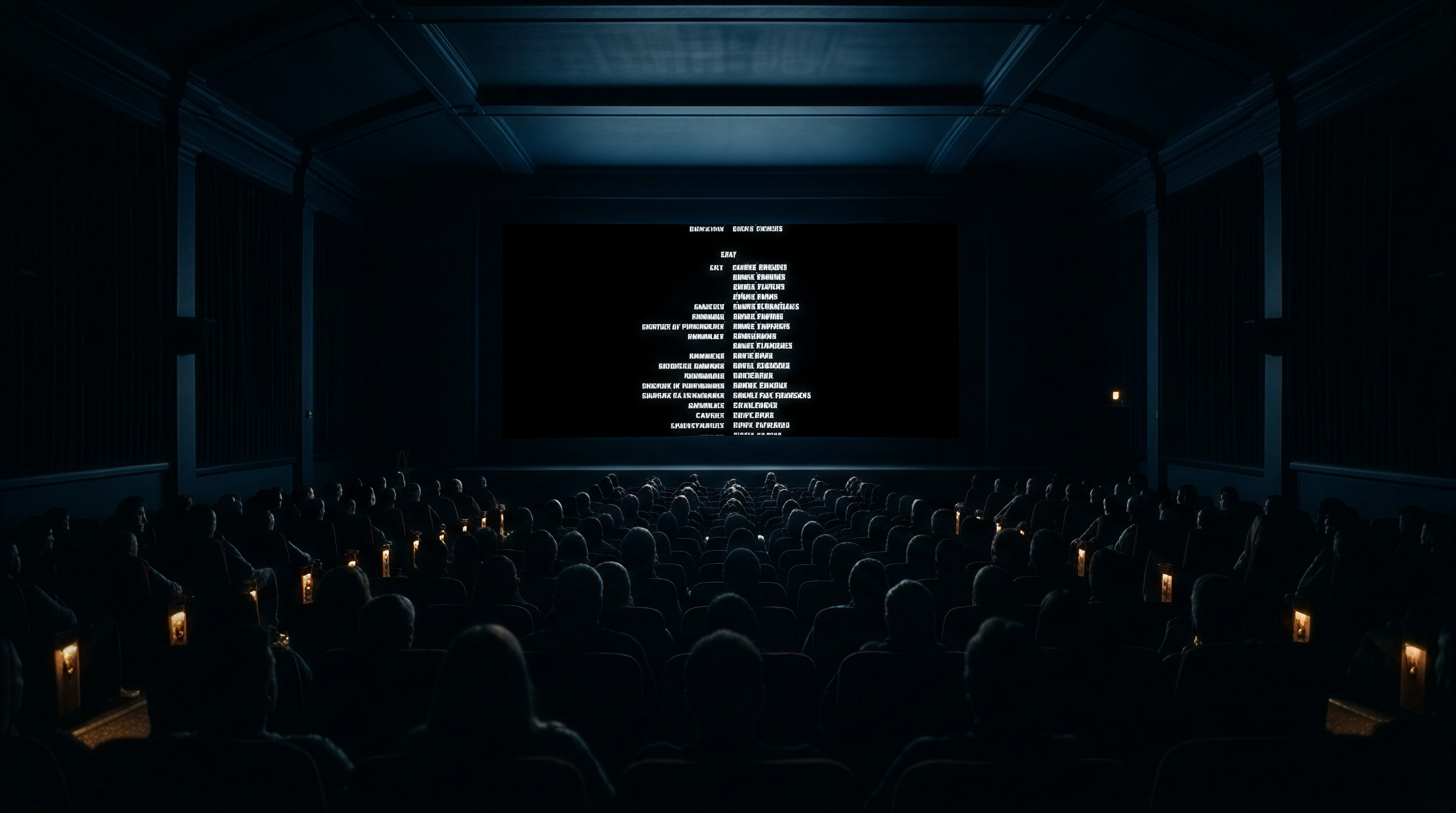
The end credits that follow the film’s emotionally charged finale are anything but standard. They extend the multiverse concept through sound design, compress a bilingual title reveal into their final frames, and quietly document one of the leanest VFX crews to ever work on an Oscar-winning film.
Everything everywhere all at once end credits at a glance
Credits Overview
| Detail | Value |
|---|---|
| Credits duration | ~7 minutes |
| Total runtime | 132 minutes (2h 19m) |
| Title font | Cubano Sharp (Lost Type Co-op) |
| Credits scroll font | Unidentified sans-serif |
| Style | Scroll on black |
| Background | Solid black |
| Post-credits scene | No (re-release added outtakes) |
| End credits song | ”This Is a Life” — Son Lux feat. Mitski & David Byrne |
| Guild compliance | DGA, WGA, SAG-AFTRA |
Everything everywhere all at once credits structure
How the Credits Sequence Unfolds
The Daniels structured the film in three titled parts: Part 1: Everything, Part 2: Everywhere, and Part 3: All at Once. Part 3 lasts barely two minutes before arriving at the title card — which is itself a piece of typography worth analyzing (more on that below). The end credits begin immediately after.
Production logo cards: Three production company logos appear in sequence before the scroll begins:
- AGBO (the Russo Brothers’ production company)
- Ley Line Entertainment
- A24
Opening credits cards (pre-scroll): The initial title cards present the above-the-line billing block:
- MICHELLE YEOH
- KE HUY QUAN, STEPHANIE HSU
- JAMES HONG, JAMIE LEE CURTIS
- Written and Directed by DANIEL KWAN & DANIEL SCHEINERT
- Produced by DANIEL KWAN & DANIEL SCHEINERT, JONATHAN WANG
Scroll section: After the billing cards, the credits transition to a continuous vertical scroll following standard feature film credits hierarchy:
- Cast (including multiverse character variants — credited with their alternate-universe role names)
- Casting
- Music — Son Lux (Ryan Lott, Rafiq Bhatia, Ian Chang)
- Costume Designer
- Production Designer
- Editor — Paul Rogers
- Director of Photography — Larkin Seiple
- Executive Producers — including Joe Russo, Anthony Russo, Mike Larocca, Tim Headington
- Department crews (camera, sound, art, wardrobe, stunts, VFX, music, post-production)
One notable casting detail: Daniel Scheinert is credited both as co-director and as a cast member — he plays several minor roles including “Fight Choreographer Randy” in the Daniels’ signature self-referential style.
Everything everywhere all at once credits typography & design
Cubano Sharp and the Multiverse of Fonts
The title typography for Everything Everywhere All at Once uses Cubano Sharp, designed by Chandler Van De Water and published through Lost Type Co-op in 2012. It is a bold, rounded sans-serif with distinctive sharp-cut terminals — geometric and playful in a way that matches the film’s tone perfectly.
But the title font is only the beginning. The Daniels deployed different typefaces throughout the film to establish visual identity for each narrative layer:
| On-Screen Text | Font | Notes |
|---|---|---|
| Film title (poster, cards) | Cubano Sharp | Bold rounded sans-serif with sharp corners |
| ”10,000 BC” scene | Cinzel (modified) | Classical serif for the prehistoric sequence |
| ”Part 2: EVERYWHERE” | Minion (or similar) | Elegant serif for the chapter break |
| Universe description text | Old Standard TT Bold | Traditional serif for universe labels |
| Title card in film | Inlow Bold | Clean sans-serif |
The rolling credits scroll itself uses a clean, unidentified sans-serif — likely a standard titling font consistent with A24’s typically restrained credits aesthetic. For more on how type choices shape the credits experience, see our guide to the best fonts for film credits.
The Bilingual Title Animation
The final title reveal is one of the most inventive pieces of credits-adjacent typography in recent cinema. At the end of Part 3, the five English words of the title — “Everything Everywhere All at Once” — appear on screen as one continuous word, run together without spaces, animated on a black background. Simultaneously, the four Chinese-language glyphs of the title (天馬行空) are superimposed over the English text.
The full, correctly formatted English title does not appear on screen until the last approximately 30 seconds of the credit scroll, just before the copyright notice. This is a deliberate design choice: the title itself is fragmented and layered, just like the film’s multiverse.
Everything everywhere all at once VFX credits
Six Artists, Five Hundred Shots
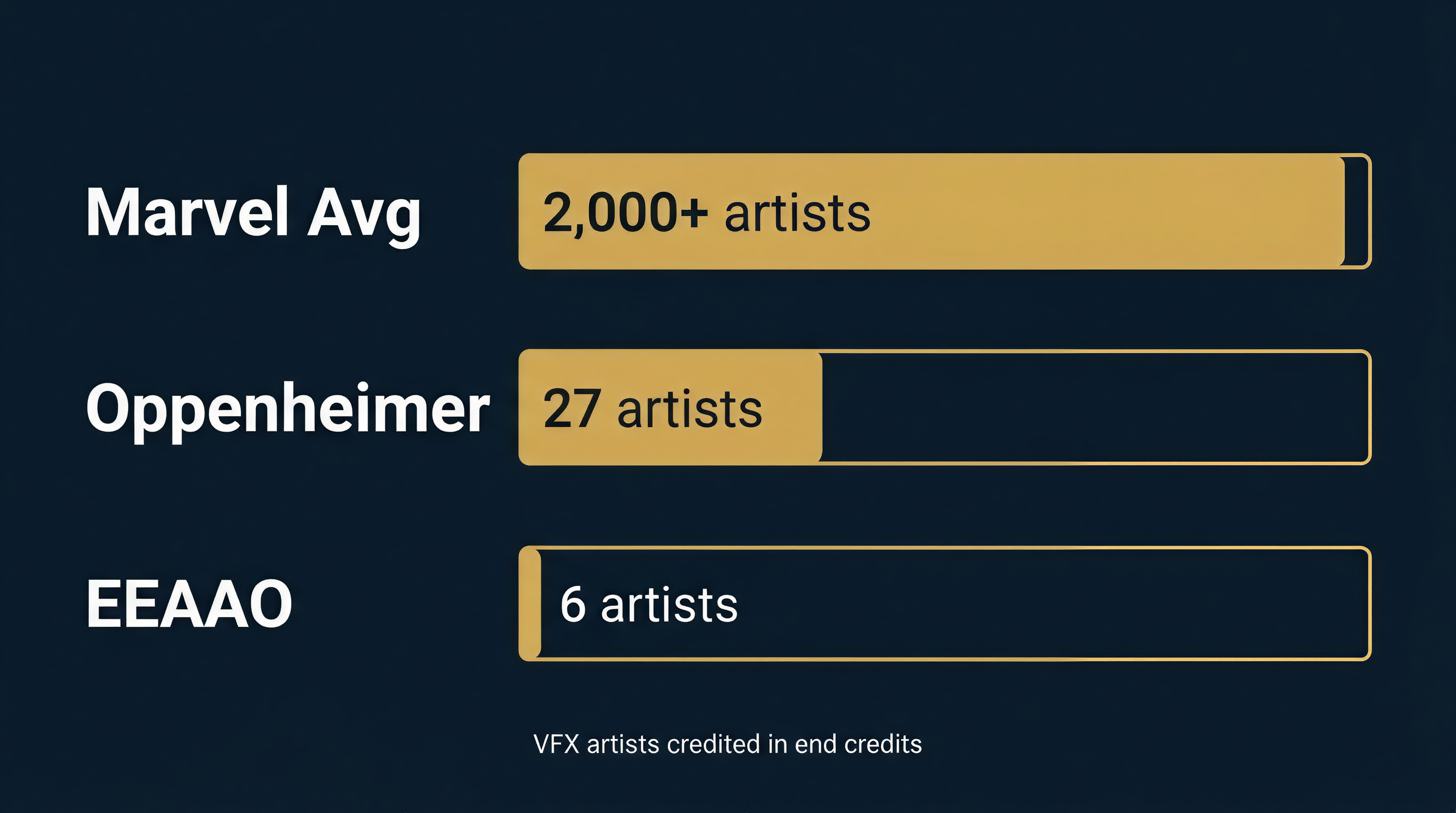
The most remarkable number in these credits is the VFX crew size. Everything Everywhere All at Once contains roughly 500 visual effects shots — yet the end credits list approximately six to seven VFX artists.
For context: Oppenheimer credited 27 VFX artists (and even that was controversial for leaving out 130+ more). Marvel films routinely credit 2,000+ VFX artists. EEAAO won Best Picture with a VFX-to-credit ratio that is virtually unheard of in the modern era.
Ethan Feldbau served as lead VFX artist and was responsible for all graphic user interfaces and on-screen design elements — the Alphaverse UI, multiverse maps, phone screens, and computer displays. Zak Stoltz created the initial vector line art layouts for these elements. Both worked primarily in Adobe Photoshop, After Effects, and Illustrator.
The Daniels deliberately chose what they described as a “hideous retro computer graphics” aesthetic for the film’s on-screen elements — intentionally bucking the clean, futuristic UI design trends that dominate contemporary science fiction. The VFX work was completed by a handful of generalists rather than a large, departmentalized team, which is reflected directly in the brevity of the VFX credits section.
This lean approach to visual effects is a credit to the production’s indie roots. The film proves that a small, skilled VFX team can deliver Oscar-winning work — and the credits document that fact with unusual clarity.
Everything everywhere all at once end credits music
”This Is a Life” and the Multiverse Score
The end credits are accompanied by “This Is a Life”, performed by Son Lux featuring Mitski and David Byrne. The song was nominated for Best Original Song at the 95th Academy Awards.
Son Lux — the trio of Ryan Lott, Rafiq Bhatia, and Ian Chang — composed the entire film score. The music department credits in the scroll are notably large for an indie production, with approximately 45 people credited across scoring, recording, orchestration, and music preparation. Lott discussed the score’s creative process on the Song Exploder podcast, describing how the music mirrors the film’s layered narrative structure.
The score features over 100 musical cues across the film’s 132-minute runtime — an unusually dense ratio that reflects how deeply the Daniels integrated music into the storytelling.
Everything everywhere all at once credits audio design
The Whispering Voices from Parallel Universes
The most distinctive element of these end credits is not visual — it is auditory. Throughout the entire seven-minute credit scroll, whispering voices speak from what seems to be random universes, coming from random directions.
This is a deliberate sound design choice documented in IMDb’s Crazy Credits database. The whispers extend the multiverse concept beyond the film’s narrative conclusion and into the credits themselves. While most films treat end credits as a space for score or licensed music alone, the Daniels layered ambient voices that reinforce the film’s central conceit: that infinite realities are always overlapping, always present, even after the story ends.
It is a rare example of credits that serve as narrative extension rather than simple attribution — the kind of choice that makes an audience sit through the full scroll rather than heading for the exits.
Everything everywhere all at once guild compliance
Credits Requirements
Everything Everywhere All at Once’s credits comply with the relevant guild agreements:
- DGA (Directors Guild of America): Daniel Kwan and Daniel Scheinert receive a shared “Written and Directed by” credit. The ampersand (&) indicates a writing team, per WGA convention — meaning they wrote together as a team, not sequentially.
- WGA (Writers Guild of America): Original screenplay credit to Daniel Kwan & Daniel Scheinert.
- SAG-AFTRA: Cast credits include the multiverse character variants, with actors credited for their primary roles. The ensemble billing — Yeoh on a solo card, Quan and Hsu sharing a card, Hong and Curtis sharing a card — reflects contractual negotiation and billing hierarchies.
The lean production scale (compared to a major studio release) means fewer guild departments are visibly represented in the credits than on a film like Oppenheimer, but the core crediting structures remain compliant.
For a full guide to guild crediting requirements, see our compliance guides.
Everything everywhere all at once post-credits scene
No Stinger — But the Re-Release Added Extras
The original theatrical release of Everything Everywhere All at Once has no post-credits scene. The credit scroll ends with the copyright notice.
However, the film’s theatrical re-release on July 29, 2022, added a Daniels-hosted introduction and approximately eight minutes of outtakes that play after the credits. These extras were exclusive to the re-release and are not included in standard home video editions.
The credits run approximately seven minutes against a 132-minute total runtime, yielding a credits-to-runtime ratio of about 5.3% — slightly above average for an indie production but well within normal range. For reference data on typical credits lengths, see how long are movie credits.
Sources & Further Reading
- Everything Everywhere All at Once full cast & crew on IMDb
- IMDb Crazy Credits — EEAAO
- VFX Voice — The Art of Being Everything Everywhere All at Once
- Frame.io — Art of the Cut: Everything Everywhere All at Once
- School of Motion — Behind the Scenes: EEAAO
Build credits as inventive as your film. Whether you are finishing an indie feature or a studio production, EndCreditsPro helps you create professional, guild-compliant credits with precision. Start with a template or explore our credits tools.