What Is a Location Manager in Film?
The director picks the camera angle. The production designer dresses the room. The location manager finds the room — and convinces someone to let 80 strangers with cable reels and generator trucks inside it.
The location manager is the head of the locations department, responsible for scouting, securing, and managing every filming location from prep through wrap. They belong to the production department, reporting directly to the Line Producer and Producer. On union productions in Hollywood, they are members of the International Brotherhood of Teamsters Local 399.
Every exterior, every real-world interior, every practical set that isn’t built on a stage — the location manager put it there. The role is part logistician, part diplomat, part scout, and entirely indispensable.

What is a location manager in film?
The Role That Finds the World the Story Lives In
Wikipedia’s definition is accurate but bloodless: “a member of the film crew responsible for finding and securing locations to be used, obtaining all fire, police and other governmental permits, and coordinating the logistics for the production to complete its work.”
The reality is more demanding. Location managers are often among the first people hired on a production — sometimes before even the production designer. Brian M. O’Neill, a veteran location manager, describes his approach to reading a new script: “I try to not even take notes the first time I read a script — focus on how the material makes me feel,” saving logistical analysis for later passes.
Location managers answer to the Director, the Producer, and the Line Producer. In New York and Chicago, location managers are DGA members; in Hollywood, they are Teamsters Local 399. In Canada, they fall under the Directors Guild of Canada (DGC). The Location Managers Guild International (LMGI) represents professionals globally and presents its own annual awards — established in 2014 — for outstanding location work.
What does a location manager do?
Responsibilities Across Pre-Production and Production
The work divides into two distinct phases with different skill demands.
Pre-Production (scouting and securing):
- Read the script and identify all locations required — by period, visual tone, and practical constraints
- Manage and direct a team of location scouts who search for options
- Present curated location packages (high-res photography, video walkthroughs, logistical assessments) to the Director, Production Designer, and Director of Photography
- Negotiate access fees and terms with property owners
- Apply for all necessary filming permits from municipal authorities — fire department, police department, transportation, parks
- Draft and execute location agreements (contracts with property owners)
- Coordinate with neighbors of filming locations — notice letters, community relations, noise waivers
Production (managing active locations):
- Serve as the on-site liaison between the production and property owners
- Manage parking and holding areas for crew, trucks, and equipment
- Coordinate generators, base camp setup, restrooms, and craft services placement
- Solve real-time problems when locations become unavailable or conditions change
- Ensure all permitted activity stays within agreed boundaries
- Oversee location restoration — returning the site to its original condition after filming

Location manager Will Avati describes the role as “50% logistics management and 50% salesmanship — in a lot of instances you are trying to convince everyday people to let a bull enter their china shop, and part of that is being able to convince them that their needs will be met.”
The department hierarchy below the location manager includes:
- Assistant Location Manager (ALM) — manages day-to-day on-set logistics
- Location Scout — searches for and photographs candidate locations
- Location PA — handles parking, basecamp setup, neighborhood liaisons
Location manager salary
Day Rates and Weekly Rates in the Current Market
Location managers work on weekly rates (or flat deals), not hourly. On Teamsters Local 399 covered productions in Los Angeles, rates are set by the union contract and scale with production budget.
| Market / Format | Approximate Rate |
|---|---|
| Low-budget film | $1,500–$2,500/week |
| Mid-range film | $2,500–$4,000/week |
| Studio feature | $4,000–$6,000+/week |
| High-end TV drama | $3,500–$5,500/week |
| Commercials | $700–$1,200/day |
Location managers on commercials often work day rates rather than weekly deals, reflecting the compressed production schedules. Non-union and micro-budget rates vary widely and can fall well below these figures.
Location scouts — the role below location manager — typically earn $300–$600/day on mid-range productions.
Where does the location manager appear in film credits?
Credit Placement in the End Crawl
This is where most guides stop short. The location manager is a below-the-line crew member and does not appear in opening credits under any standard practice. Their credit lives exclusively in the end crawl.
Department position in the end crawl:
The locations department typically appears in the Production or General Crew section of the end credits — after above-the-line credits, after Camera and Grip/Electric departments, and generally in a grouping with other production service departments.
The precise placement varies by production and studio convention, but a common credit order in the production section:
- Unit Production Manager
- First Assistant Director / Second Assistant Director
- Location Manager
- Production Coordinator
- Production Accountant
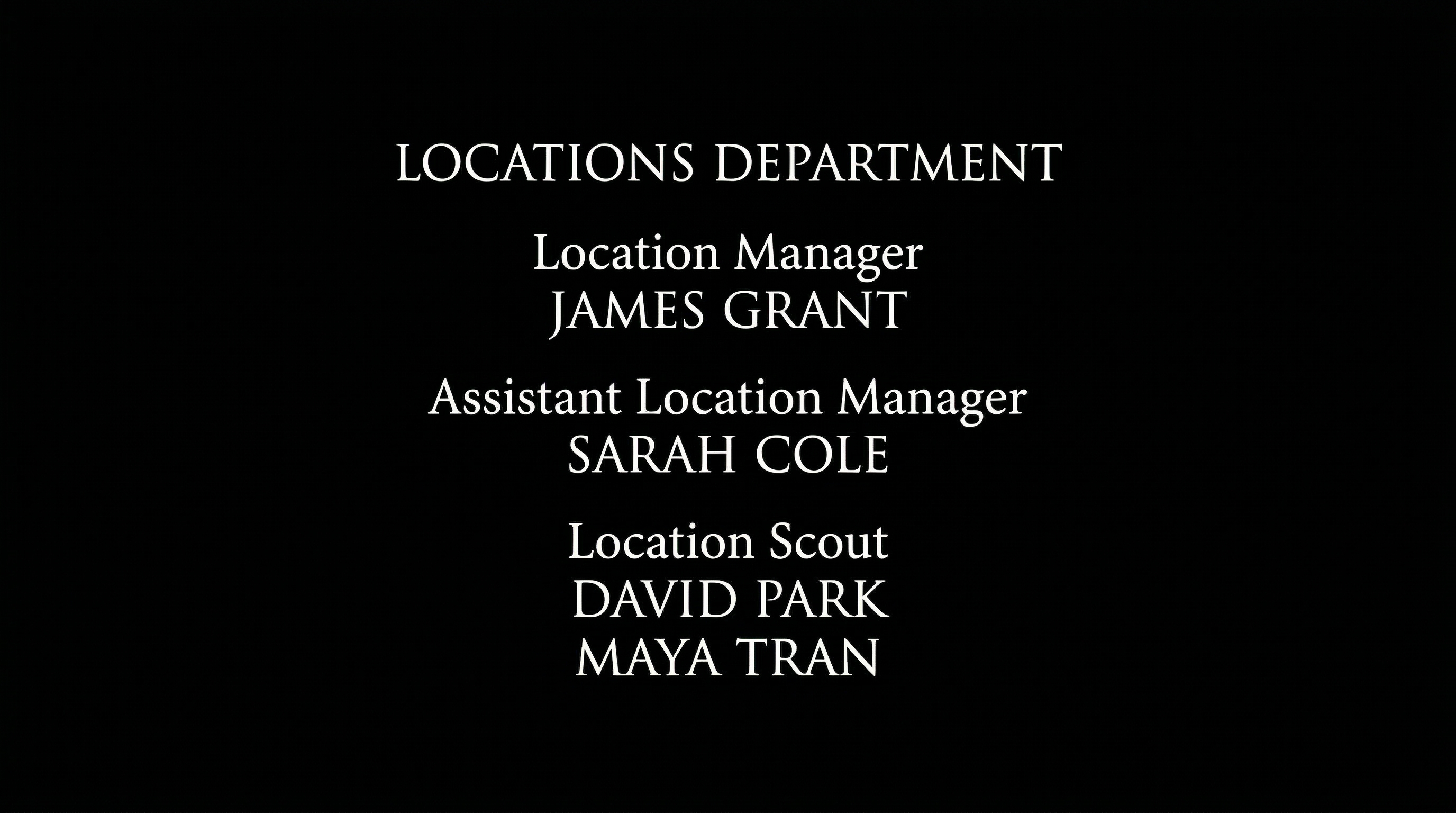
On large productions, the locations department block may include multiple titles:
Location Manager
JAMES GRANT

Assistant Location Manager
SARAH COLE

Location Scout
DAVID PARK
Or a condensed department block:
LOCATIONS DEPARTMENT
Location Manager .............. JAMES GRANT
Asst. Location Manager ........ SARAH COLE
Location Scouts ............... DAVID PARK
                                MAYA TRAN
Card Format vs. Scroll
On feature films, the Location Manager usually appears in the rolling end crawl — not on a dedicated single card. Single cards are reserved for above-the-line talent and department heads with individual card deals negotiated in their contracts.
On television, the Location Manager frequently appears in the crew crawl at the end of each episode, grouped with production services.
How to credit a location manager correctly
Title Variations and Formatting Rules
The standard credit title is:
Location ManagerIn the UK and some international productions, the title is often rendered as “Locations Manager” (plural) — both are accepted. Use whichever convention matches the production’s country of origin or guild affiliation.
What to avoid:
- Never abbreviate to “Loc. Manager” or “LM” on screen
- Never combine the Location Manager credit with another title on one line (e.g., if the same person also served as Production Coordinator, credit each role in its respective section)
- Do not use “Location Director” — this is not a standard industry title
Union credit requirements:
Teamsters Local 399 contracts specify credit requirements for covered classifications. On productions covered by the Local 399 agreement, the Location Manager credit is contractually required in the end crawl. Failure to credit a covered employee can result in a grievance. Confirm credit language with your UPM and Production Counsel before the final credits lock.
When one person covers multiple location roles:
On micro-budget productions where one person scouts, manages, and wraps all locations, the credit should read the role they primarily performed:
- If they managed the production’s locations throughout — Location Manager
- If they only scouted during prep — Location Scout
Giving a scout a Location Manager credit inflates their title. On future productions, that credit will be taken at face value.
Location manager vs. location scout
Different Jobs, Different Credits
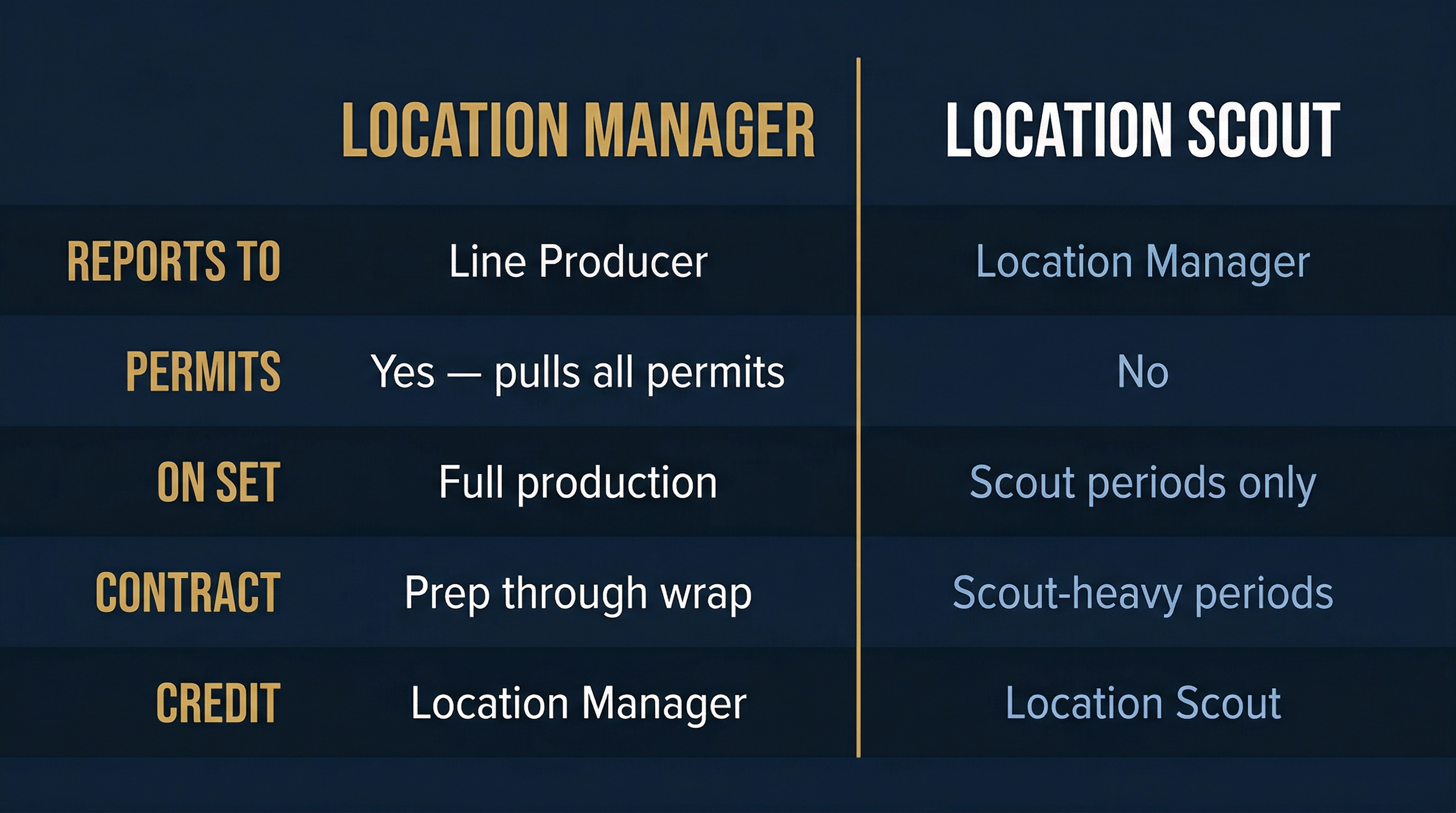
The distinction matters operationally and in the credits.
| Location Manager | Location Scout | |
|---|---|---|
| Reports to | Line Producer / Producer | Location Manager |
| Responsibility | Manages the department, secures locations | Finds and photographs candidate locations |
| Contract stage | On payroll from prep through wrap | Often brought on for scout-heavy periods |
| Permits | Yes — handles all permitting | No — does not pull permits |
| Union | Teamsters Local 399 (LA); DGA (NY/Chicago) | Teamsters Local 399 (LA) |
| Credit title | ”Location Manager" | "Location Scout” |
A location scout presents options. A location manager closes the deal, pulls the permits, and is on-site when 80 people show up with cable drums. On productions with tight schedules and few locations, one person sometimes handles both functions and takes the Location Manager title.
Notable location managers in film history
Defining Careers in the Locations Department
James Grant — Location Manager on Quantum of Solace (2008) and several other major studio productions. Featured in interviews discussing the logistical scale of managing international action film locations across multiple countries simultaneously.
Robin Citrin — one of the most prominent location managers working in Hollywood, with credits including Men in Black, Batman Forever, and numerous studio tentpoles. She helped elevate the profession’s visibility through involvement with the Location Managers Guild.
Scott Trimble, LMGI — credited on multiple Award-winning productions and active in LMGI governance. His work demonstrates the growing professionalization of locations as a discipline distinct from general production management.
The LMGI Compass Award, established in 2014, is the only peer-awarded recognition specifically for location achievement in film and television — the locations department equivalent of an Oscar for below-the-line craft.
Sources & Further Reading
- Location Manager — Wikipedia
- Location Managers Guild International
- A Sense of Place: The Job of the Location Manager — LMGI
- Teamsters Local 399 — Location Managers
- California Film Commission — Location Management & Scouts
Recommended Videos
- 8 Film & TV Location Scout & Management Tips — A-Team
- Know Your Crew: Location Managers — Film Independent
Create Professional Credits with EndCreditsPro
Format location manager credits with correct title, department placement, and scroll ordering — automatically. Generate broadcast-ready end credits with EndCreditsPro or explore the full film crew roles glossary and the film credits format guide.