What Is a Stunt Coordinator in Film?
Every car crash, rooftop fall, and bar fight you’ve ever watched was somebody’s day job. That somebody had a coordinator making sure no one died doing it.
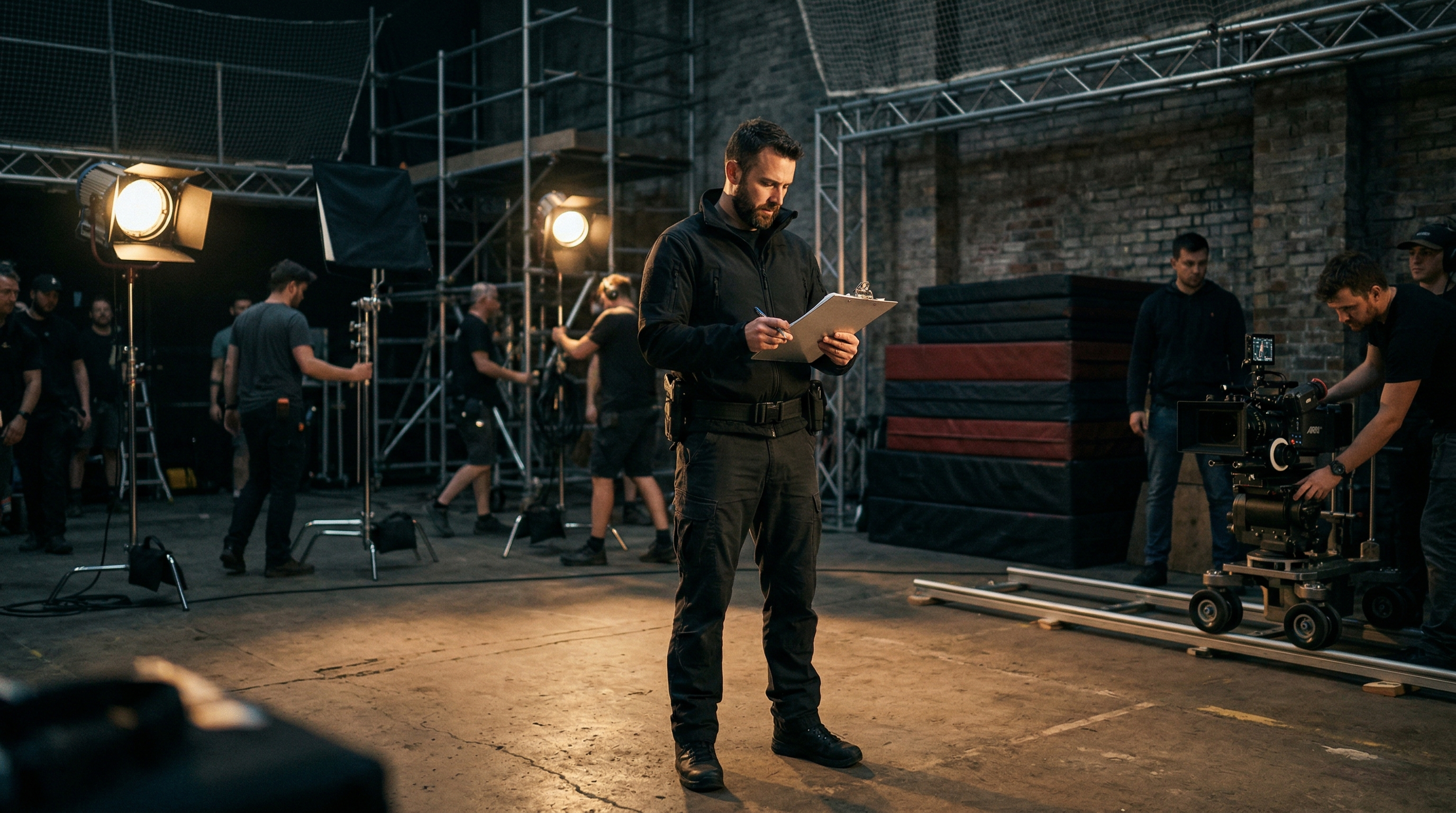
A stunt coordinator is the head of the stunt department on a film or television production. They design, budget, and supervise every physical stunt sequence — from a simple slip on stairs to a full-scale vehicle crash. Most stunt coordinators are experienced stunt performers who’ve moved into coordination after years of on-set work.
They sit within the stunt department, operating independently from the camera, grip, and electric departments, but working directly with the director and 1st AD to integrate action sequences into the shooting schedule.
What does a stunt coordinator do?
What Does a Stunt Coordinator Do?
The stunt coordinator owns the physical safety of every stunt on the production. Before a single camera rolls on an action sequence, the coordinator has already done weeks of preparation work.
Pre-production responsibilities:
- Break down the script to identify every stunt — including anything that could qualify as a hazard for SAG-AFTRA members
- Design and choreograph each sequence in collaboration with the director
- Budget for stunt performer fees, rigging equipment, safety mats, harnesses, and costume modifications to hide protective gear
- Scout locations alongside the 1st AD to assess practical constraints: ceiling heights, surface conditions, clearance distances
- Hire specialist performers — stunt drivers, wire riggers, fight performers — based on the specific sequences required
During production:
- Run rehearsals before camera days, coordinating with costume and makeup to ensure safety equipment is hidden correctly
- Communicate directly with the 1st AD on scheduling and rehearsal windows
- Stand by on set during every stunt execution, with authority to halt filming if conditions are unsafe
- Work with the camera department on coverage angles that maximize the stunt’s visual impact while protecting the performers
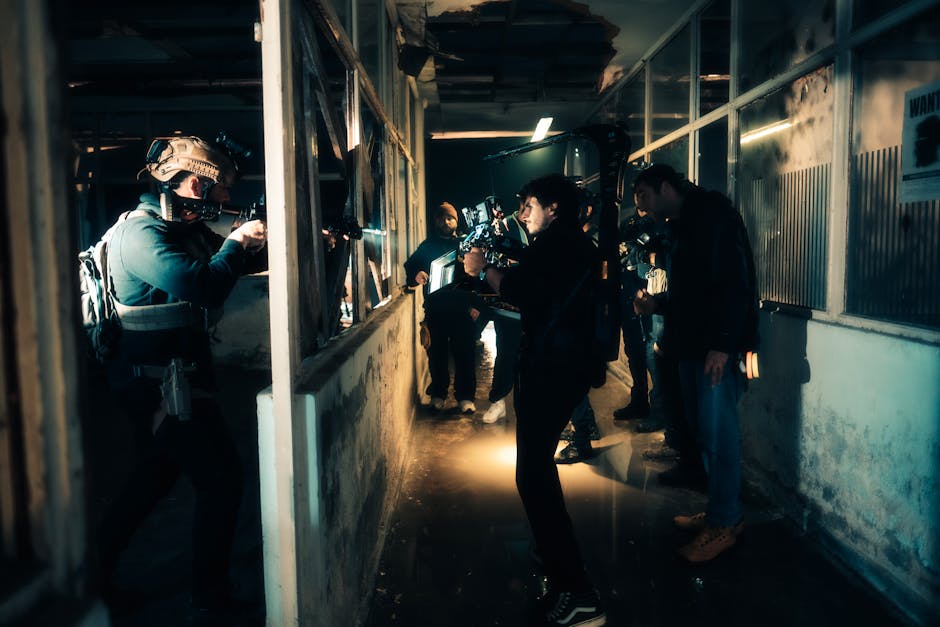
Safety authority: SAG-AFTRA contracts require the stunt coordinator to be consulted whenever a stunt sequence is involved. The coordinator — not the director — has final say on whether a stunt is executed safely. On union productions, this authority is codified in the agreement.
As Ryan Sturz, an experienced coordinator, described it: “I feel sometimes the coordinator is looked at as a technician, rather than a contributor to the filmmaking or the storytelling process.” The best coordinators push back on that — they design sequences that serve the story, not just the physics.
Where does the stunt coordinator appear in film credits?
Where Does the Stunt Coordinator Appear in Film Credits?
The stunt coordinator receives a dedicated above-the-department credit in the end crawl. Unlike most below-the-line crew who appear grouped under their department heading, the stunt coordinator’s name is placed prominently — either as a single card in the main title sequence (on larger productions) or immediately following the director of photography in the end crawl.
Standard credit placement:
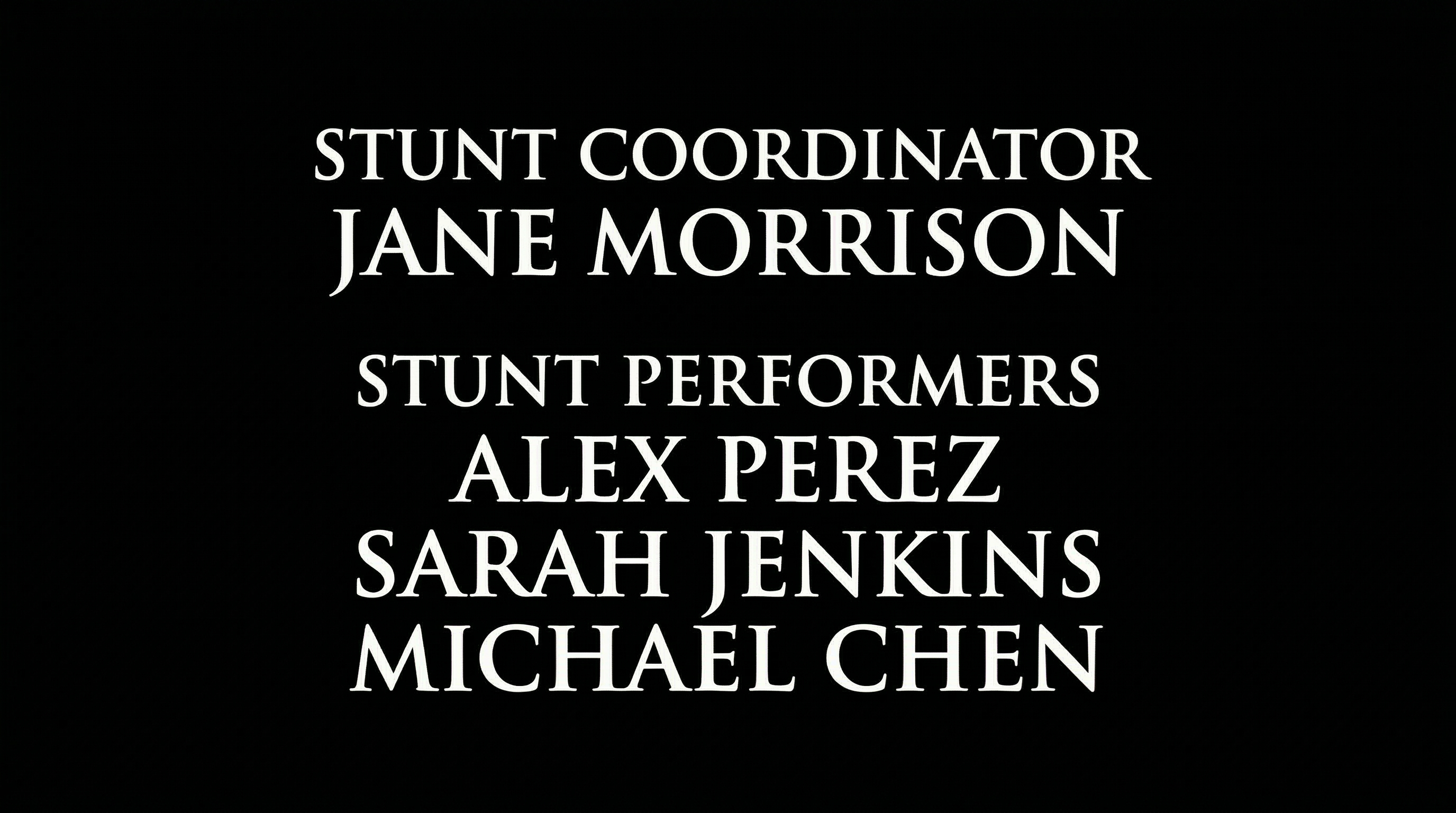
In the end credits, stunt coordinators typically appear in the Stunts section, near the top of the below-the-line department listings — typically after the art department and before the transportation department. The section reads:
STUNT COORDINATOR
Jane Doe

STUNT PERFORMERS
John Smith
Maria Garcia
Alex Johnson
Opening credits: On action-heavy productions, the stunt coordinator may receive an above-the-title or below-the-title on-screen card during the main title sequence — particularly if the stunt work is a significant selling point of the film.
SAG-AFTRA credit requirements: SAG-AFTRA’s Basic Agreement requires that all stunt performers receive individual screen credit on the production. The stunt coordinator’s credit must appear no smaller than 35% of the size of the production title credit when displayed in advertising materials for productions where they received a negotiated credit.
Single vs. shared cards: On most productions, the stunt coordinator receives a solo card. On smaller productions, the coordinator’s credit may appear on a shared card alongside the 2nd unit director, particularly when the same person fills both roles.
How to credit a stunt coordinator correctly
How to Credit a Stunt Coordinator Correctly
The standard credit title is “Stunt Coordinator” — no abbreviation, no variation. Some productions use “Stunt/Fight Coordinator” if the same person handled both disciplines, or “Action Coordinator” in the UK market.
Standard format:
Stunt Coordinator ............... CHAD STAHELSKIOr in the vertical department block:
STUNT COORDINATOR
Chad Stahelski
Common credit variations:
| Credit Title | When Used |
|---|---|
| Stunt Coordinator | Standard US film and TV |
| Action Coordinator | Common in UK/European productions |
| Stunt/Fight Coordinator | When fight choreography is same person |
| Supervising Stunt Coordinator | Multi-unit productions with subordinate coordinators |
| 2nd Unit Stunt Coordinator | Separate unit with dedicated coordinator |
Guild abbreviation: SAG-AFTRA does not assign an abbreviation to the stunt coordinator credit — the full title is always spelled out.
Dual roles: If the stunt coordinator also performed stunts as a performer in the film, they appear twice: once as “Stunt Coordinator” in the department header, and once under “Stunt Performers” with their name.
Stunt coordinator vs. fight coordinator
Stunt Coordinator vs. Fight Coordinator
These two titles get conflated constantly, and on smaller productions they’re often the same person. They are distinct disciplines.
| Role | Scope | Training Background |
|---|---|---|
| Stunt Coordinator | All physical stunts: falls, vehicles, fire, wire work, fights | Broad stunt performance background |
| Fight Coordinator | Choreography of combat sequences only | Martial arts, stage combat, weapons work |
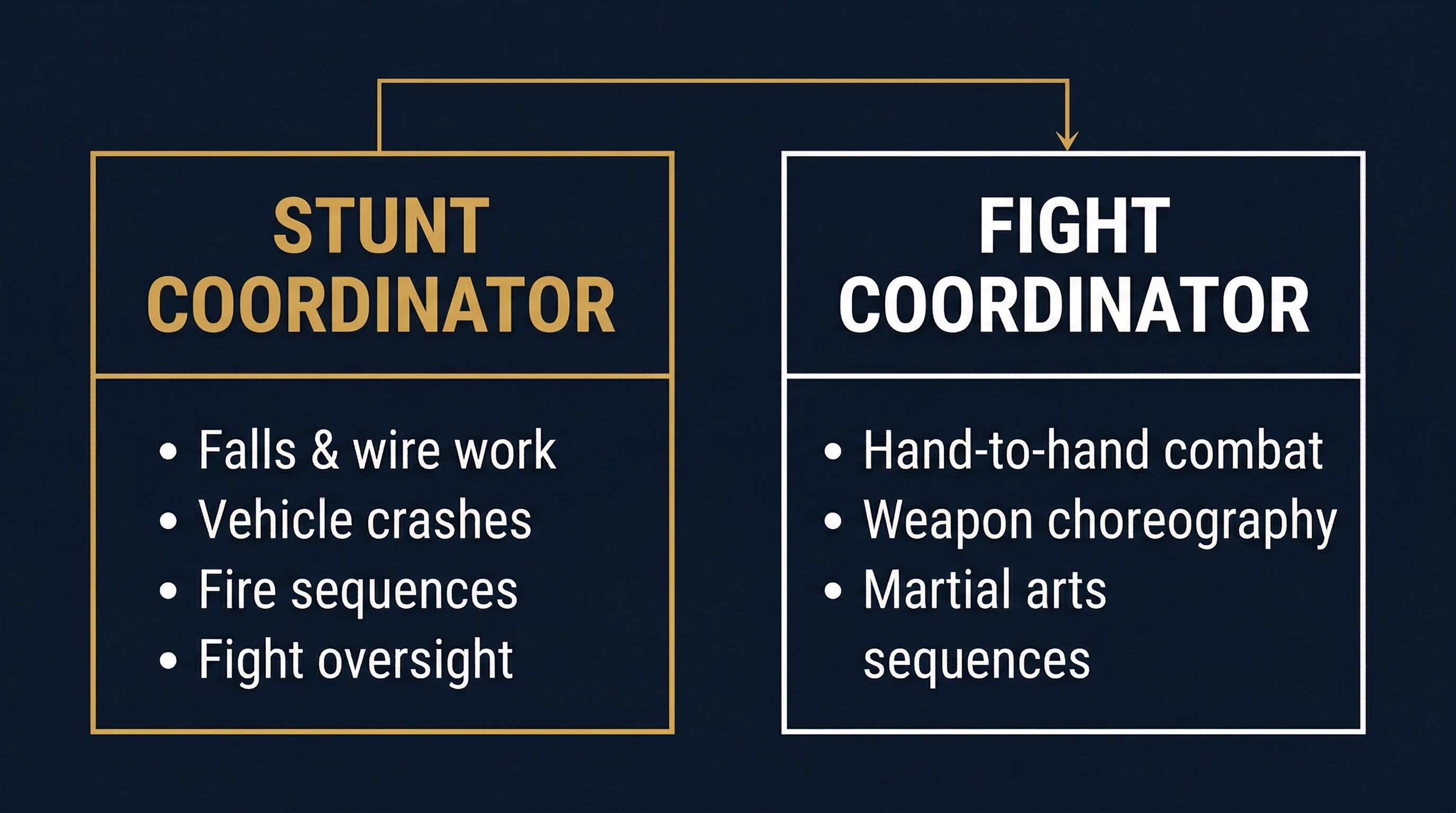
The stunt coordinator oversees the fight coordinator when both are present. On action films, a dedicated fight coordinator — sometimes called a “fight choreographer” or “action choreographer” — handles the detailed movement vocabulary of hand-to-hand sequences while the stunt coordinator manages the broader department.
Chad Stahelski and David Leitch, both of whom coordinated the Matrix trilogy before becoming directors, were primarily fight coordinators by training. The John Wick franchise later gave Stahelski, as director, the platform to merge both disciplines under a single creative vision.
On SAG-AFTRA productions, the fight coordinator must also be a SAG-AFTRA member if they’re directing stunt performers.
Stunt coordinator salary & day rates
Stunt Coordinator Salary & Day Rates
Stunt coordinator compensation varies significantly based on production scale, location, and whether the production is SAG-AFTRA signatory.
SAG-AFTRA minimums (Basic Agreement): Stunt coordinators on SAG-AFTRA productions negotiate their rates individually — there is no codified minimum in the way there is for stunt performers. Most work under deal memos negotiated per production.
Typical market rates:
- Low-budget independent films: $800–$1,500/day
- Mid-range studio films: $2,500–$5,000/day
- Major studio action films: $5,000–$15,000+/day (flat deal or weekly)
- Television (episodic): $1,500–$4,000/episode
These figures are pre-negotiation starting points. Top coordinators on franchise productions — Mission: Impossible, Fast & Furious, Marvel projects — negotiate package deals that can exceed $50,000/week when accounting for prep, shoot, and wrap periods.
The stunt coordinator typically negotiates a prep fee (paid during pre-production design work), a shoot rate (daily or weekly during principal photography), and sometimes a post fee if visual effects supervision of stunt-related shots is required.
Notable stunt coordinators in film history
Notable Stunt Coordinators in Film History

Chad Stahelski coordinated The Matrix trilogy alongside David Leitch before directing John Wick (2014) — a film that redefined action choreography for American cinema and launched an entire school of “gun-fu” action filmmaking.
Sam Hargrave coordinated the Avengers films before directing Extraction (2020), which featured a 12-minute oner action sequence built entirely around stunt work he designed. He trained as a gymnast before entering stunt work.
Vic Armstrong served as Indiana Jones’s stunt double across multiple films and coordinated dozens of major productions — he was recognized by the Guinness Book of World Records as the world’s most prolific stunt performer before moving primarily into coordination.
Zoë Bell, who appeared as herself in Quentin Tarantino’s Death Proof (2007), began as Uma Thurman’s stunt double on Kill Bill and went on to coordinate action sequences while continuing to perform — a model of the coordinator-performer hybrid that’s increasingly common in the industry.
Sources & Further Reading
Create Professional End Credits with EndCreditsPro
Correctly formatting stunt department credits — coordinator, performers, rigging crew — is easy to get wrong. EndCreditsPro generates guild-compliant end credits that automatically handle department ordering, card formatting, and SAG-AFTRA credit standards. Try it free today.
See also: Film Crew Roles · Armorer · Animal Wrangler · Gaffer · Camera Operator · Film Credits Format & Order Guide