What Is an Armorer in Film?
Every firearm on a professional set — real, replica, or blank-firing — passes through one person’s hands. The armorer owns that chain of custody from prep to wrap.
The armorer, also called the weapons master, is the film crew specialist responsible for sourcing, maintaining, and supervising all weapons on a production — primarily firearms, but also knives, swords, bows, and other period or specialty weapons. They sit within the art department’s property branch, typically hired by and reporting to the prop master, though on large productions the armorer operates semi-independently with direct access to the first AD and production coordinator.
The armorer does not belong to any single below-the-line department in the traditional sense — they’re a licensed specialist embedded in production for the duration of any weapons work. In the United States, IATSE Local 44 (Property Crafts) classifies armorers within the property department, which determines their union rates, working conditions, and on-screen credit placement.

What is the job of an armorer on a film set?
What Does a Film Armorer Do?
The armorer’s responsibilities span all three phases of production. They’re not a day-call vendor — on any production with significant weapons work, they’re present from early prep through the final day of principal photography.
Pre-Production
- Script breakdown: identify every scene involving weapons, note period requirements and character-specific needs
- Source firearms from licensed rental houses or personal inventory; obtain permits for NFA items (suppressors, short-barreled rifles, etc.)
- Create a weapons inventory with serial numbers, condition reports, and chain-of-custody documentation
- Collaborate with the production designer and director on which weapons fit the visual language of each character
- Present the director and lead actors with 4-5 weapon options per character; narrow down collaboratively
Production
- Retrieve weapons from locked storage before each weapons scene; load blank cartridges immediately before each take
- Walk weapons directly onto set and hand them to actors — never leave them unattended or passed through an intermediary
- Verify the weapon is clear before every handoff; physically retrieve from actors immediately when the director calls “cut”
- Conduct daily safety briefings with cast and crew before any weapons scene
- Maintain detailed logs of every weapon handled, every round expended
- Train actors on safe handling protocols, trigger discipline, and weapon mechanics — tailored to whether the actor learns visually or verbally
Post-Production
- Return rental weapons with condition reports
- Dispose of all unused ammunition through licensed channels
- Submit final weapons logs to the production for insurance and legal documentation purposes
The armorer is one of the few below-the-line crew members with unilateral authority to halt production. If a safety condition is not met, they can — and must — stop the shot.
Where does the armorer appear in film credits?
Where Does the Armorer Appear in Film Credits?
The armorer appears in the end credits, not the opening titles. They are listed within the property department section of the scrolling end crawl, grouped under or adjacent to the prop master.
Standard placement hierarchy within the property section:
- Property Master
- Assistant Property Master
- Armorer (or Weapons Master)
- On-Set Dresser (if listed separately)
- Property Assistant(s)
On productions with extensive weapons work — action films, westerns, war films — the armorer may receive a dedicated card or a bolded listing that sets them apart from the general property crew. This is increasingly common post-2021.
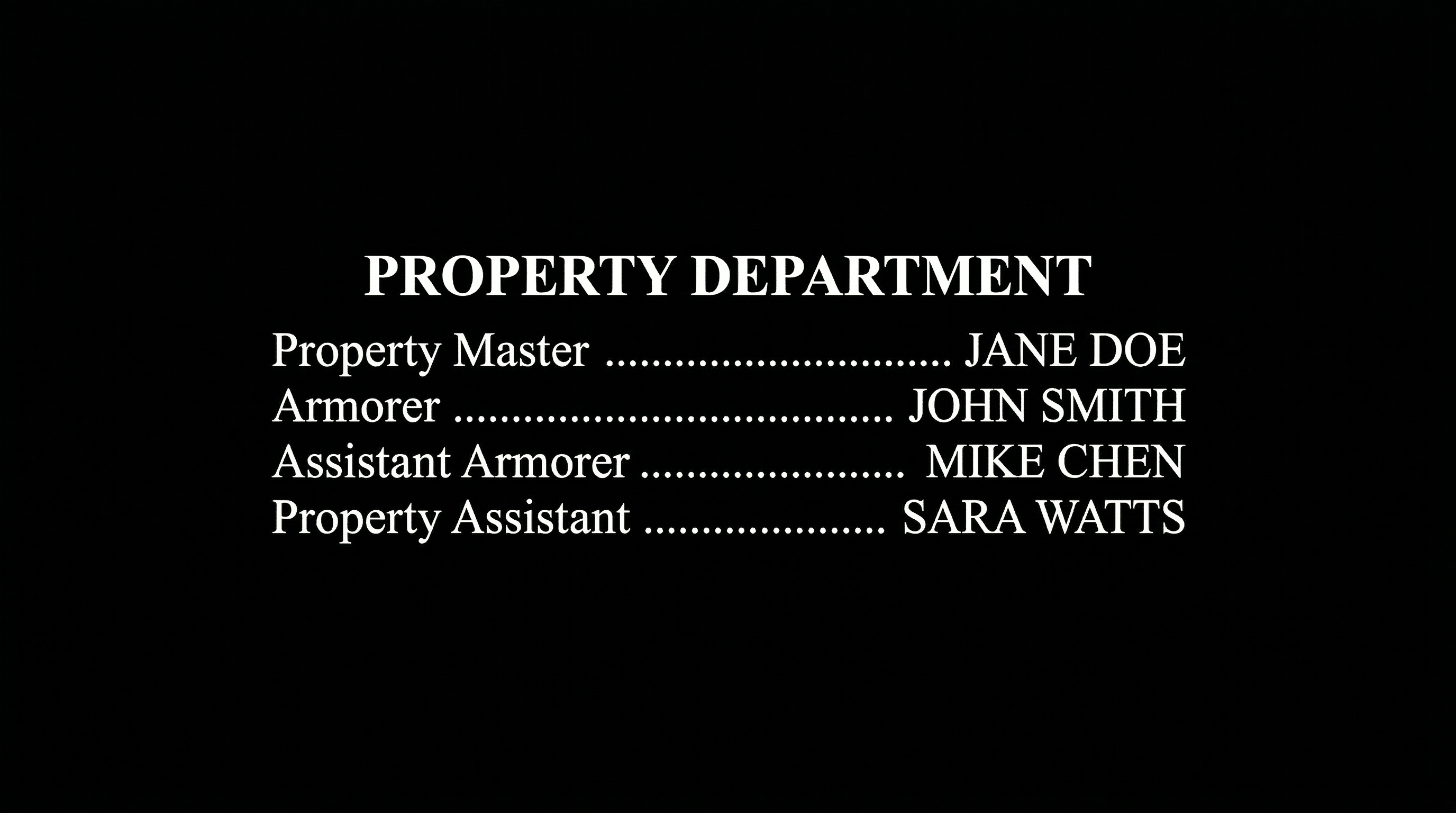
Typical credit format in the scroll:
Property Master .......... JANE DOE
Armorer ................. JOHN SMITH
or in a two-column property department block:
PROPERTY DEPARTMENT

Property Master           JANE DOE
Armorer                   JOHN SMITH
Prop Assistant            [Name]
The credit title itself varies. The most common credit titles, in rough order of frequency:
- Armorer — most common on American productions
- Weapons Master — preferred by some veterans; common on action-heavy productions
- Weapons Coordinator — used on larger productions with multiple armorers
- Weapons Specialist — less common; appears on some period and military films
- Weapons Handler / Weapons Wrangler — rare; used on lower-budget productions
None of these credit titles are governed by a strict guild mandate — the choice is typically negotiated between the armorer and production. What matters is consistency: the same title should appear on the call sheet, crew list, and final credits.
How to credit an armorer correctly
How to Credit an Armorer in the End Credits
Standard format:
Armorer ................. FIRSTNAME LASTNAMEFor a lead armorer with an assistant:
Armorer ................. FIRSTNAME LASTNAME
Assistant Armorer ........ FIRSTNAME LASTNAME
When one person served as both prop master and armorer (common on low-budget productions):
Property Master / Armorer ... FIRSTNAME LASTNAMEDo not credit the same person twice under two separate titles unless the production intentionally split the billing. One credit, one name, one title.
Common crediting mistakes to avoid:
- Listing “Weapons Coordinator” when only one armorer was employed (coordinator implies managing multiple armorers)
- Crediting the armorer under the wrong department section — they belong in Property, not Stunts and not Special Effects
- Omitting the armorer entirely on productions where weapons appeared — if they worked on it, they get credited
For productions subject to IATSE collective bargaining, the armorer’s credit title must match the classification used on their deal memo. Mismatched credits can create problems at residuals time.
Use EndCreditsPro to generate properly ordered end credits that place the armorer in the correct property department position automatically.
Armorer vs. prop master
Armorer vs. Prop Master: How They Differ in Credits and Responsibility
The prop master owns all physical props on a production — furniture, hand props, set dressing items, and yes, weapons. The armorer is a weapons-specific specialist who typically works under the prop master’s oversight but with independent authority over weapon safety.
| Prop Master | Armorer | |
|---|---|---|
| Scope | All props | Weapons only |
| Reports to | Production Designer / Line Producer | Prop Master (operationally); First AD (on-set) |
| Who reports to them | Prop assistants, set dressers | Assistant armorer (if any) |
| IATSE classification | Local 44 (Property) | Local 44 (Property) |
| Credit position | Above armorer in property section | Below prop master in property section |
| Authority to halt production | Rarely | Yes — on any safety matter |
On smaller productions (under $1M budget), the prop master often is the armorer — they hold both roles, handle the weapons themselves, and receive one combined credit. On studio productions, they’re always separate hires.

For more on related roles, see what a gaffer does on set and the stunt coordinator’s role in production.
On-set armorer safety reforms after Rust
Post-Rust Safety Requirements (2021–Present)
The October 2021 shooting on the set of Rust — in which cinematographer Halyna Hutchins was killed by a live round fired from a prop firearm — fundamentally changed what armorers are required to do and how productions must document weapons use.
Key legislative and contractual changes:
- California AB 45 (2023): Bans live ammunition on set; requires productions to submit a weapons safety plan before filming any weapons scenes
- New Mexico, New York, Georgia enacted similar legislation following California’s lead
- SAG-AFTRA contract enhancements: Union must be notified before firearm use; actors have the right to refuse unsafe weapons work without penalty
- Chain-of-custody logs are now standard and expected by production insurance underwriters — not optional
- Mandatory daily safety briefings involving the armorer before any weapons scene
These requirements elevated the armorer from a vendor-style hire to a core production safety officer. Productions that skip or shortcut the armorer role now face significant insurance and legal exposure.
Notable armorers in film history
Notable Armorers and Weapons Masters
Harry Lu — weapons master on Terminator Genisys (2015) and multiple major action productions. Known for meticulous weapon selection process: presenting director and lead actor 4-5 options per character and narrowing down collaboratively to match character identity with period accuracy and mechanical reliability.
Thell Reed — veteran armorer with decades of film and television credits. Father of Hannah Gutierrez-Reed, who served as armorer on Rust (2021).
Rock Galotti — long-time weapons master on productions including Heat (1995), known for the technically accurate firearms work that gave Michael Mann’s film its distinctive look and sound.
Michael Papac — extensive film and television credits; member of the American Entertainment Armorers Association.
The American Entertainment Armorers Association (AEAA) is the primary professional organization for US-based armorers. It maintains safety standards, conducts training, and provides a directory of certified practitioners.
Sources & Further Reading
- IATSE Local 44 — Property Crafts — union classification for armorers in US film production
- American Entertainment Armorers Association (AEAA) — professional standards and certification for US-based film and television armorers
- California AB 45 Summary — on-set firearms legislation
- Film Independent: Want Weapons in Your Film? Ask a Pro — practical guide for independent productions
- Wikipedia: Weapons master — overview of the role and notable practitioners
Create Professional End Credits with EndCreditsPro
Every armorer who worked on your production deserves a properly formatted credit in the right place. EndCreditsPro generates guild-aware end credit scrolls that automatically position the armorer within the property department — no manual column alignment or ordering guesswork required.
Related roles: Stunt Coordinator · Art Director · Production Designer · Second Assistant Director · Film Crew Roles Hub
See also:
- SAG-AFTRA Compliance Guide — post-Rust performer protections covering weapons work
- IATSE Compliance Guide — Local 44 (Property Crafts) classification for armorers
- Film Credits Format Order Guide — where the armorer credit sits in the end crawl