Back to the Future Credits: Eric Stoltz, the Fake George McFly and 4 More Secrets
Eric Stoltz played Marty McFly for six weeks and is nowhere in the credits. In Part II, George McFly is another actor wearing Crispin Glover’s face, and Glover’s own credit sits below the photo doubles. The end credits of Back to the Future tell the story the posters never did.
Most people leave Back to the Future when the DeLorean flies off. We stayed. We read the end credits of the trilogy line by line on the DVD Collector’s Edition, then checked every story against interviews and the record. Six stories are hiding in there: a teenager who doesn’t exist with a real music credit, a rock star who asked not to be credited, a middle initial that stands for nothing, a recast girlfriend, an actor who was fired, and a face that came back without its owner.
We told all six in a short video. This article adds the sources, the exact wording of each credit and what each story means for anyone putting credits together today. It’s part of our credits breakdown series.
Video: Before Deepfakes, Back to the Future Faked an Actor (5:51), our countdown of the six secrets. It loads from YouTube when you press play. Watch it on YouTube.
Back to the Future credits at a glance
Six Credit Stories in One Table
| Story | Film | What the credits say | What really happened |
|---|---|---|---|
| Johnny B. Goode | Part I (1985) | “Performed by Marty McFly with the Starlighters” | Fox played Marty on screen; the credit goes to the character |
| The audition judge | Part I | Huey Lewis appears only in the music credits | He played the judge on condition of no credit and a disguise |
| The “J.” | All three | ”Michael J. Fox” | His middle name is Andrew; the J was added for the Screen Actors Guild |
| Jennifer Parker | Part II (1989) | Elisabeth Shue is first in the cast list | Claudia Wells played her in Part I; the ending was reshot with Shue |
| Marty McFly | Part I | ”Marty McFly — Michael J. Fox” | Eric Stoltz shot the role for about six weeks before being replaced |
| George McFly | Part II | ”George McFly — Jeffrey Weissman”; Crispin Glover at the bottom, “in footage from Back to the Future” | Weissman wore prosthetics made from molds of Glover’s face; Glover sued |
| ”To Be Continued…” | Part I | Not in the theatrical prints | Added to the 1986 home video release once a sequel was decided |
That’s seven rows for six secrets: the last one isn’t a credit at all, it’s a title card that cinemas never showed. More on that at the end.
Marty McFly music credit
#6: A Music Credit for a Character Who Doesn’t Exist
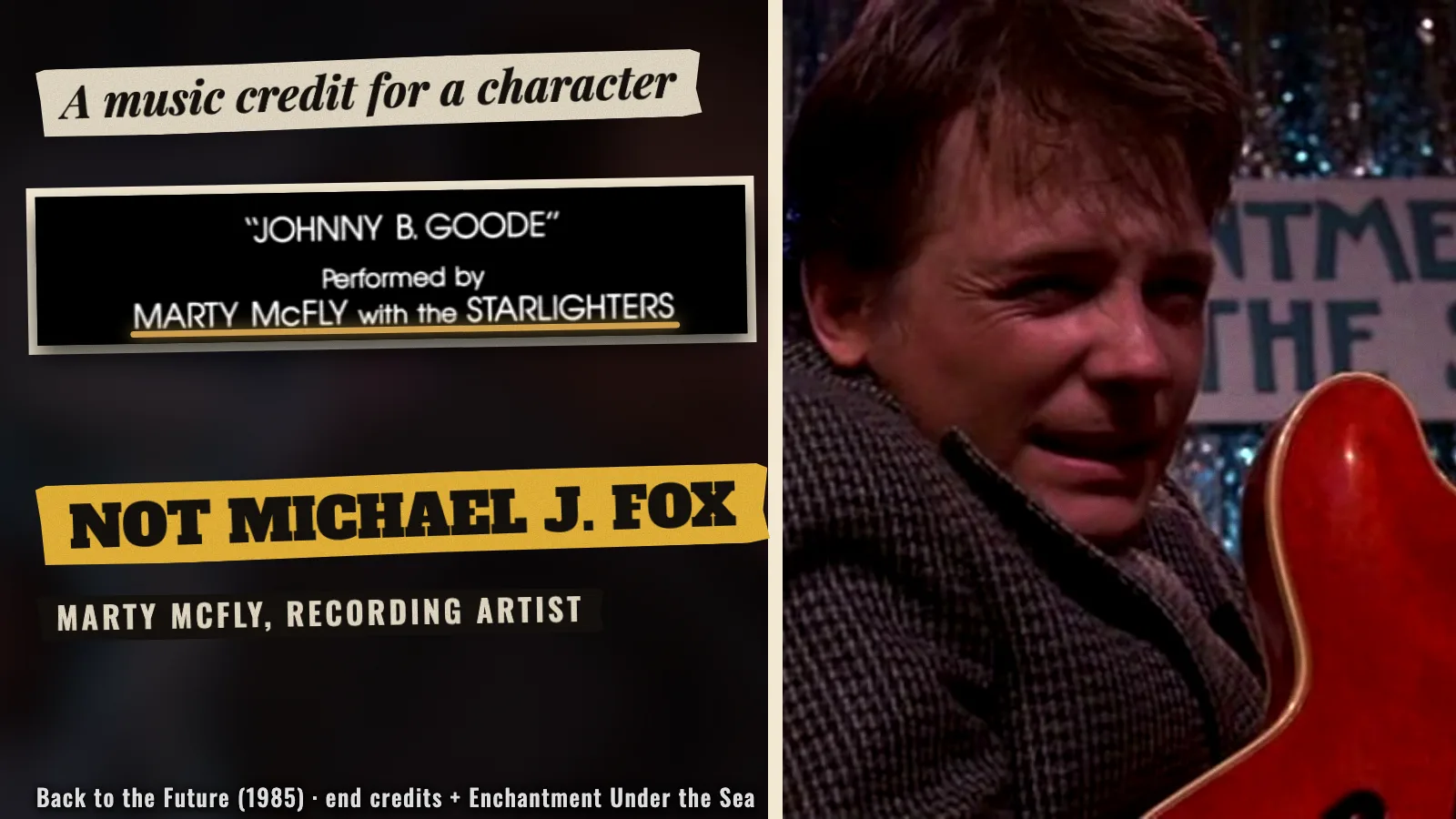
Sit through the end crawl of the first film, past the cast, into the song list. “The Power of Love”, performed by Huey Lewis and the News. “Heaven Is One Step Away”, performed by Eric Clapton. And then “Johnny B. Goode”, performed by Marty McFly with the Starlighters.
Not Michael J. Fox. Marty. A fictional teenager gets a real music credit, a few lines below Eric Clapton. The Starlighters are fictional too: they’re the band on stage at the Enchantment Under the Sea dance.
It’s a joke for the people who stay until the end, and it works because music credits follow their own rules. A song credit names the title, the writers and the performer as the track was released or performed in the film, separate from the cast list. For how those lines are normally written, see our guide on how to credit music in film.
Huey Lewis cameo uncredited
#5: The Judge Who Asked for No Credit
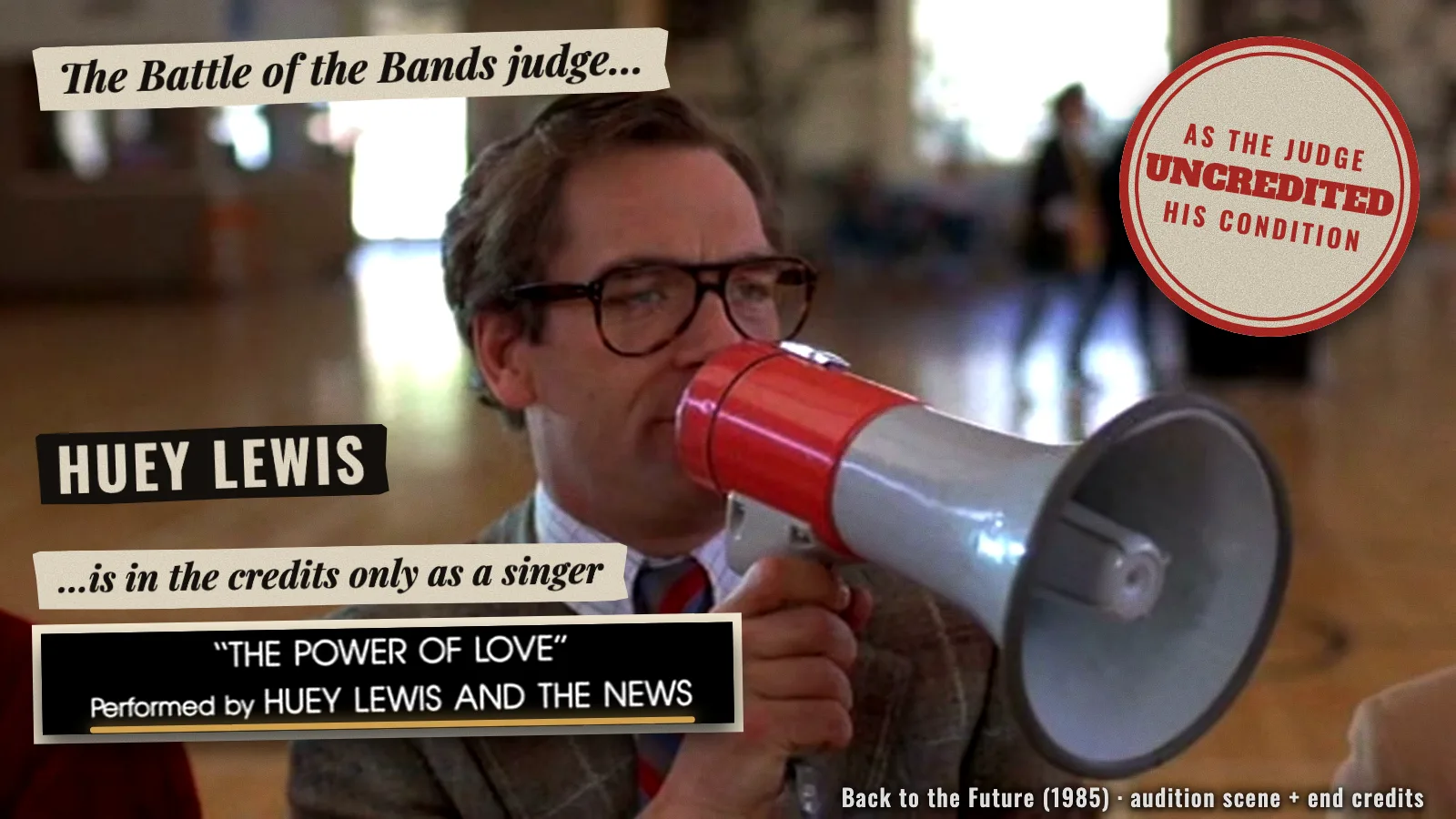
At the start of Part I, Marty’s band auditions for the school dance. A judge with glasses picks up a megaphone and tells him they’re just too loud. That judge is Huey Lewis, the man who sings “The Power of Love”, the film’s theme.
According to Wikipedia’s production history, Lewis “agreed to appear as long as he was uncredited and could wear a disguise.” So look for him in the cast list: he isn’t there. Huey Lewis is in the credits of Back to the Future only as a musician, never as the man who told Marty McFly he was too loud.
Uncredited cameos are more common than most viewers think. Stephen Follows’ study of 4,113 films, which we cover in how long movie credits are, found that 24.6% of cast credits are listed as uncredited. Usually it’s because of the role’s size. Sometimes, as here, the actor asks for it.
Michael J. Fox middle name
#4: What Does the J in Michael J. Fox Stand For?
Nothing. His birth name is Michael Andrew Fox. His first credits, the TV film Letters from Frank and the features Midnight Madness (1980) and Class of 1984 (1982), just say “Michael Fox”.
Then he registered with the Screen Actors Guild and found that a veteran actor called Michael Fox was already on its books. The Guild doesn’t let two members work under the same professional name. Fox tells the rest in his memoir Lucky Man (2002), as quoted by Wikipedia:
“My middle name is Andrew, but ‘Andrew Fox’ or ‘Andy Fox’ didn’t cut it for me. ‘Michael A. Fox’ was even worse […] It also sounded uncomfortably Canadian – Michael Eh? Fox […] And then I remembered one of my favorite character actors, Michael J. Pollard, the guileless accomplice in Bonnie and Clyde. I stuck in the J, which sometimes I tell people stands for either Jenuine or Jenius, and resubmitted my forms.”
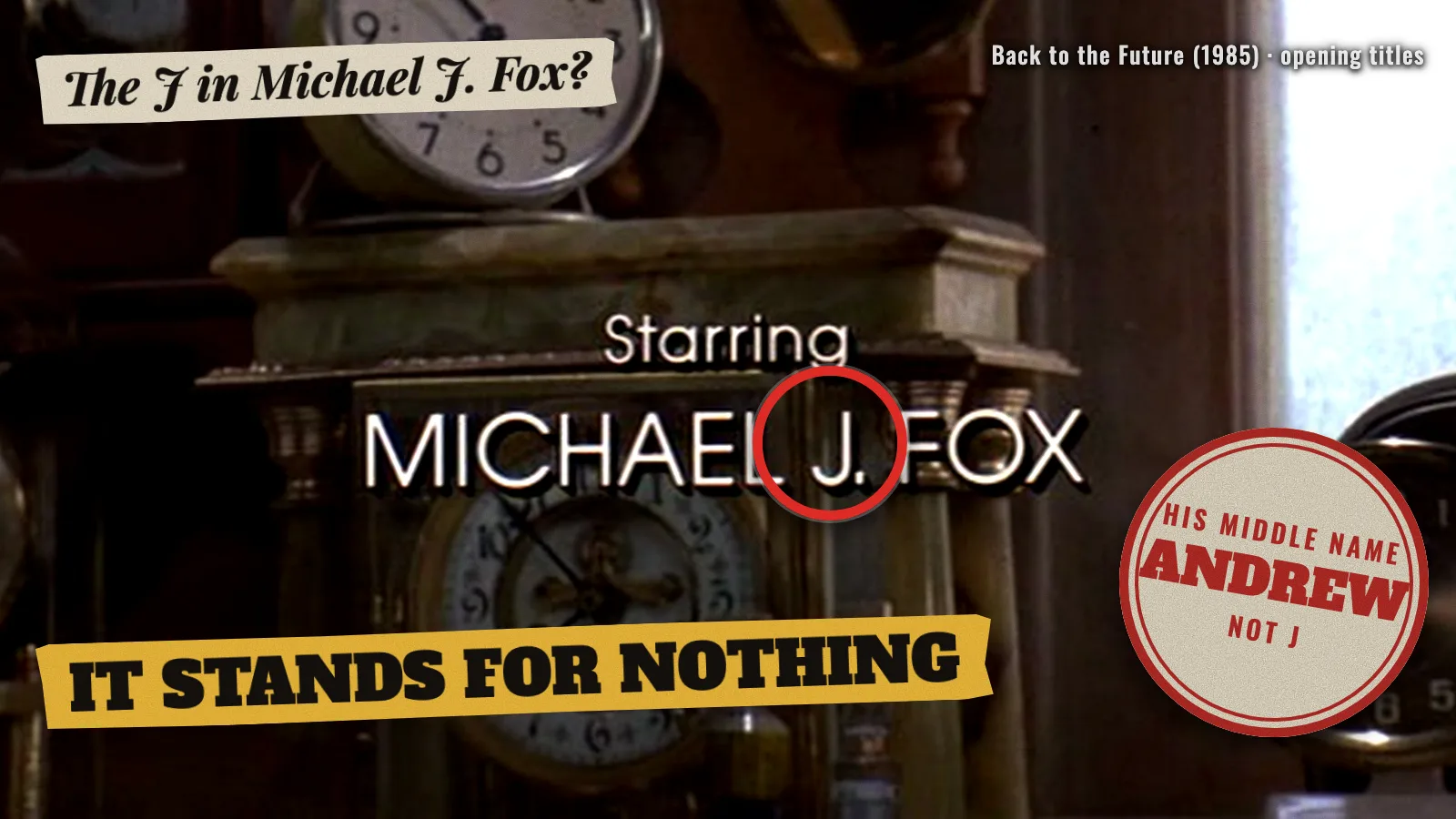
Short: the J in Michael J. Fox, in 44 seconds. Watch it on YouTube.
The rule still applies. A performer can be credited under a professional name, but the credited name must match the one registered with SAG-AFTRA. So the name on your call sheet isn’t enough: check how each actor is registered, and use exactly that. Our SAG-AFTRA credits guide covers the screen credit rules in full.
Back to the Future 2 Jennifer recast
#3: Same Scene, Different Jennifer
At the end of Part I, Marty’s girlfriend Jennifer Parker gets into the DeLorean with Marty and Doc. She’s played by Claudia Wells. Part II begins at that exact moment, with a different actress.
Wells had stepped away from acting to care for her mother, who was ill with cancer (Wikipedia, Back to the Future Part II). The producers cast Elisabeth Shue and “re-shot the closing scenes of the first film for the beginning of Part II, in a nearly shot-for-shot match.” Same lines, same car, different Jennifer.
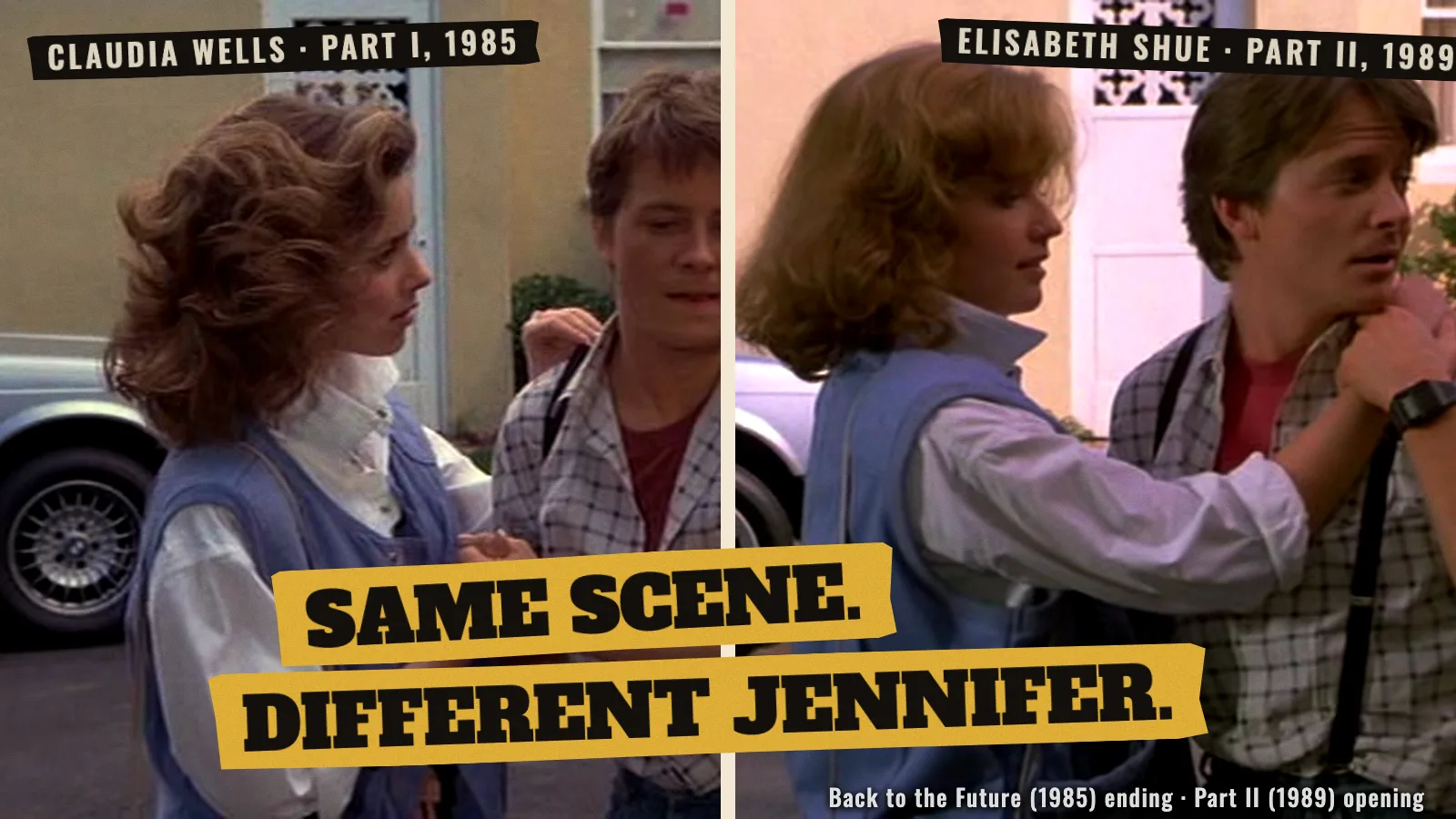
In the end credits of Part II, the cast list opens with “Jennifer — Elisabeth Shue”. Claudia Wells isn’t in them: the opening is new footage, not her scene, so there’s nothing to credit her for.
Eric Stoltz Back to the Future
#2: Eric Stoltz, the First Marty McFly
Michael J. Fox was the first choice for Marty, but he was busy with the sitcom Family Ties. Steven Spielberg asked the show’s producer, Gary David Goldberg, to let Fox read the script. Goldberg, worried about losing his star while co-lead Meredith Baxter was on maternity leave, never passed it on. With the start date approaching, Robert Zemeckis went with Eric Stoltz, the studio’s preferred choice.
Principal photography began on November 26, 1984. Stoltz played Marty with “an intense and serious tone, not the ‘screwball’ energy they desired”, and producer Bob Gale characterized him as a good actor in the wrong role (both from Wikipedia’s account of the production). On January 10, 1985, about six weeks in, Zemeckis told Stoltz he was being fired.
The cost: 34 days of filming lost and an extra $3.5–4 million, which included Stoltz’s salary, paid in full. Fox took over, shooting Family Ties by day and Marty by night.
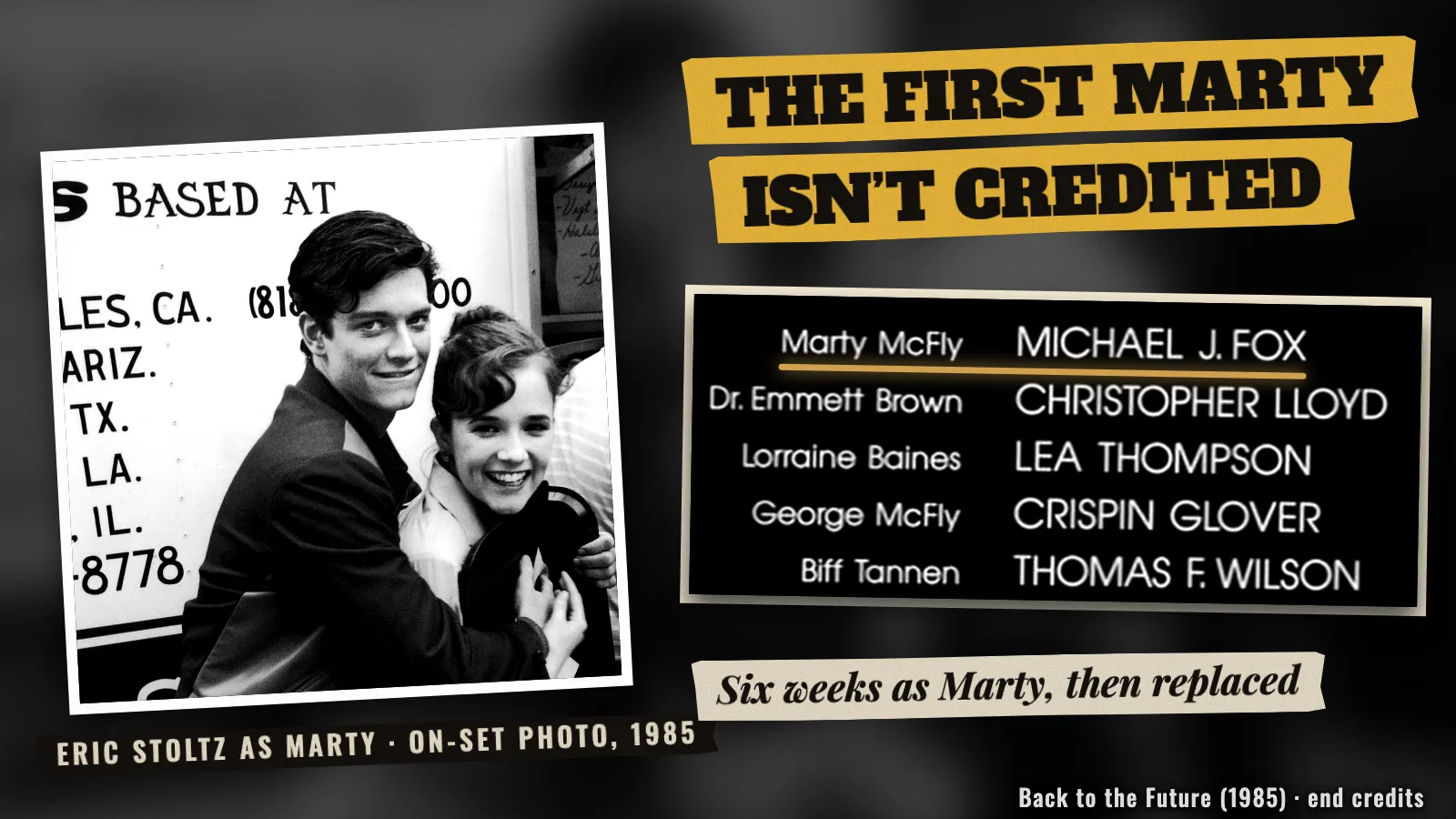
Now read the cast list of Part I: “Marty McFly — Michael J. Fox”, and then everyone else. Eric Stoltz isn’t anywhere in it.
Short: Eric Stoltz, the first Marty, in 35 seconds. Watch it on YouTube.
Why Isn’t Eric Stoltz in the Credits?
Because none of his performance is in the finished film. Every Marty scene shot with Stoltz was reshot with Fox. Screen credit follows what’s on screen: an actor who was paid but whose work was entirely replaced has no credit to claim. You’ll find fan theories that Stoltz is still visible in a shot or two; none has been confirmed by the filmmakers.
The same logic runs in the other direction. If any of a replaced actor’s footage stays in the cut, they’re owed a credit. That’s exactly what happened with George McFly.
Crispin Glover Back to the Future 2
#1: The Fake George McFly
Crispin Glover played George McFly, Marty’s nervous, wonderful father, in the first film. He didn’t come back for Part II. Accounts differ on why; Glover has said the pay he was offered was less than half of what the other returning actors got (as reported by Den of Geek and Mental Floss).
So the producers hired another actor, Jeffrey Weissman, and gave him prosthetics (a chin, a nose, cheekbones) made from molds of Glover’s face taken for the first film. Then they hid him: hanging upside down in 2015, in the dark and far away in 1955. To fill the gaps, they reused shots of Glover from the first movie. For millions of viewers, that was George McFly.
Short: the fake George McFly, in 41 seconds. Watch it on YouTube.
How the Credits Handle Two George McFlys
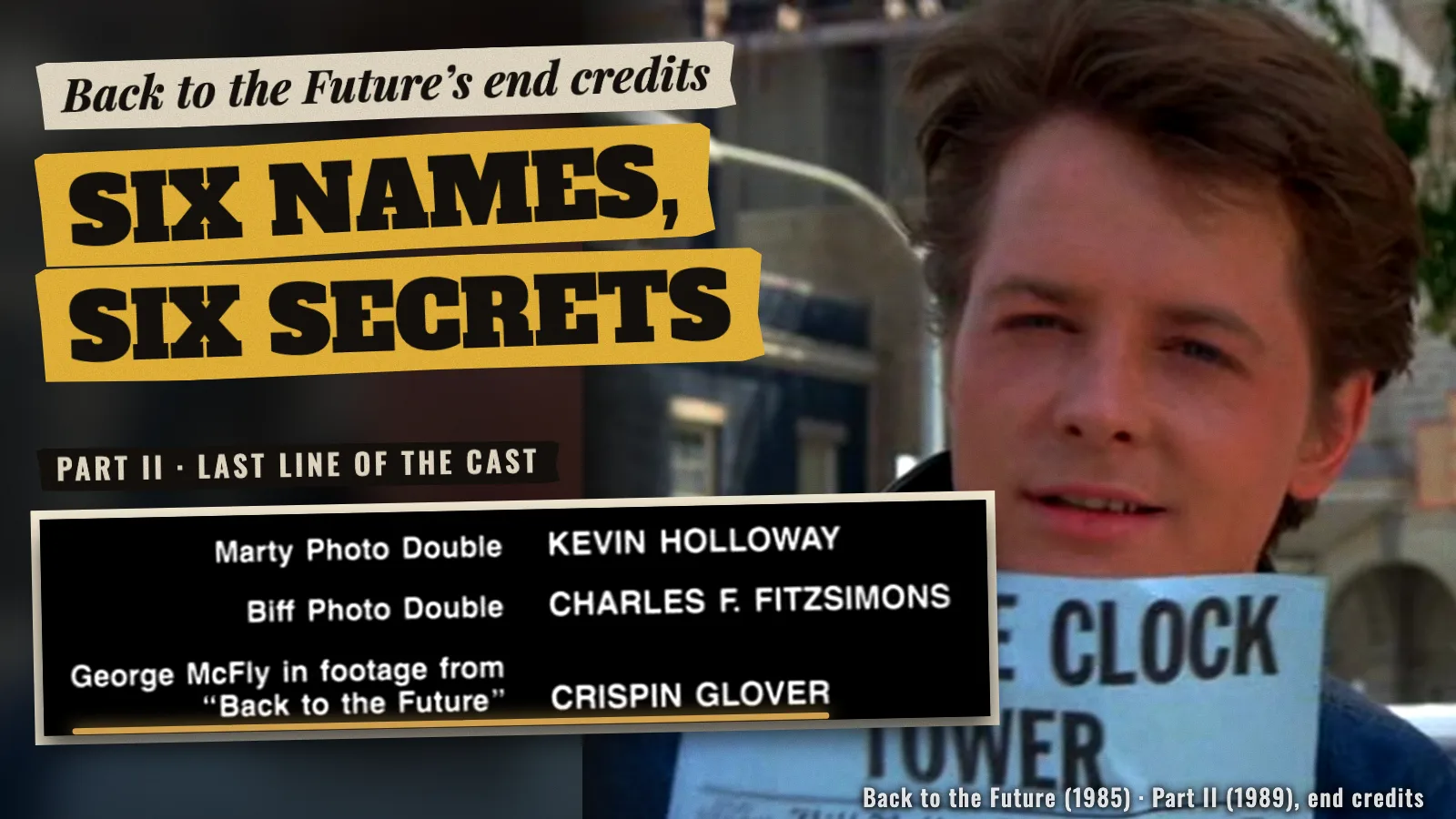
This is where the credits tell the truth. In the Part II cast list, George McFly is Jeffrey Weissman, listed third, right after Elisabeth Shue and James Tolkan. Keep reading. Past the extras. Past Marty’s photo double, past Biff’s. At the very bottom of the cast:
“George McFly in footage from ‘Back to the Future’ — Crispin Glover”
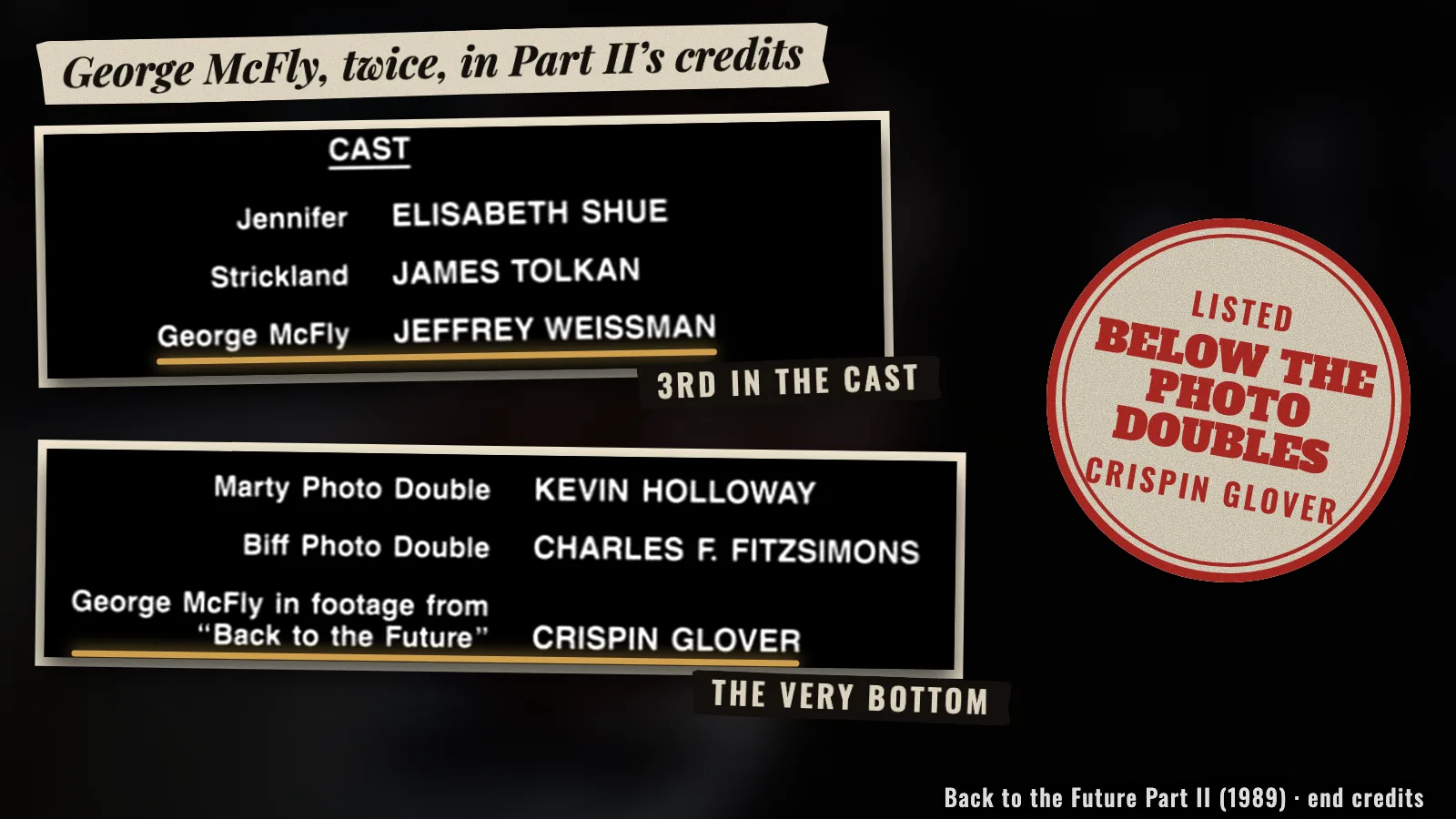
The man who created the character is credited below the doubles, as footage. Technically it’s accurate: Glover appears in Part II only through reused shots from Part I. It’s also the clearest example we know of a credit that is correct and still tells you something is wrong. If you’re laying out a cast list with archive footage, the billing block and the end crawl are where that line has to be negotiated, not improvised.
The Lawsuit and the Rule That Followed
Glover sued the producers, arguing that they neither owned his likeness nor had permission to use it (Wikipedia, Back to the Future Part II). The case was settled out of court. The terms weren’t made public.
Glover says his case changed the Screen Actors Guild’s rules on using an actor’s likeness. That’s his own account (BBC, 2011), and the union has never confirmed the link. But today the principle is written down: under the 2023 SAG-AFTRA TV/Theatrical contract, a producer needs an actor’s clear, informed consent before creating or using a digital replica of them. In 1989 copying an actor took rubber, glue and a camera upside down. Today it takes a laptop. Our SAG-AFTRA guide covers the digital replica provisions and how they touch the credits.
Back to the Future To Be Continued
Bonus: The “To Be Continued…” That Cinemas Never Showed
Ask anyone how Back to the Future ends and they’ll say: the DeLorean flies at the camera, and “To Be Continued…” appears. If you saw it in a cinema in 1985, you didn’t see that card. The film just ended: a flash, then the credits.
Bob Gale has said so more than once. “If you saw the first film in theaters, we never had that ‘To Be Continued’ on there at the end,” he told HuffPost in 2015. The card was added to the home video release in 1986. In a 2020 Screen Rant interview, Gale explained why: by then “we had decided there was going to be a sequel, and what better way to announce it than to put ‘to be continued’ at the end of the video tape?” The AFI Catalog, citing the Academy’s production files, also notes that the card “had not appeared on the original film prints.” When the DVD came out in 2002, the card was removed again, so the film would match what audiences saw in theaters.
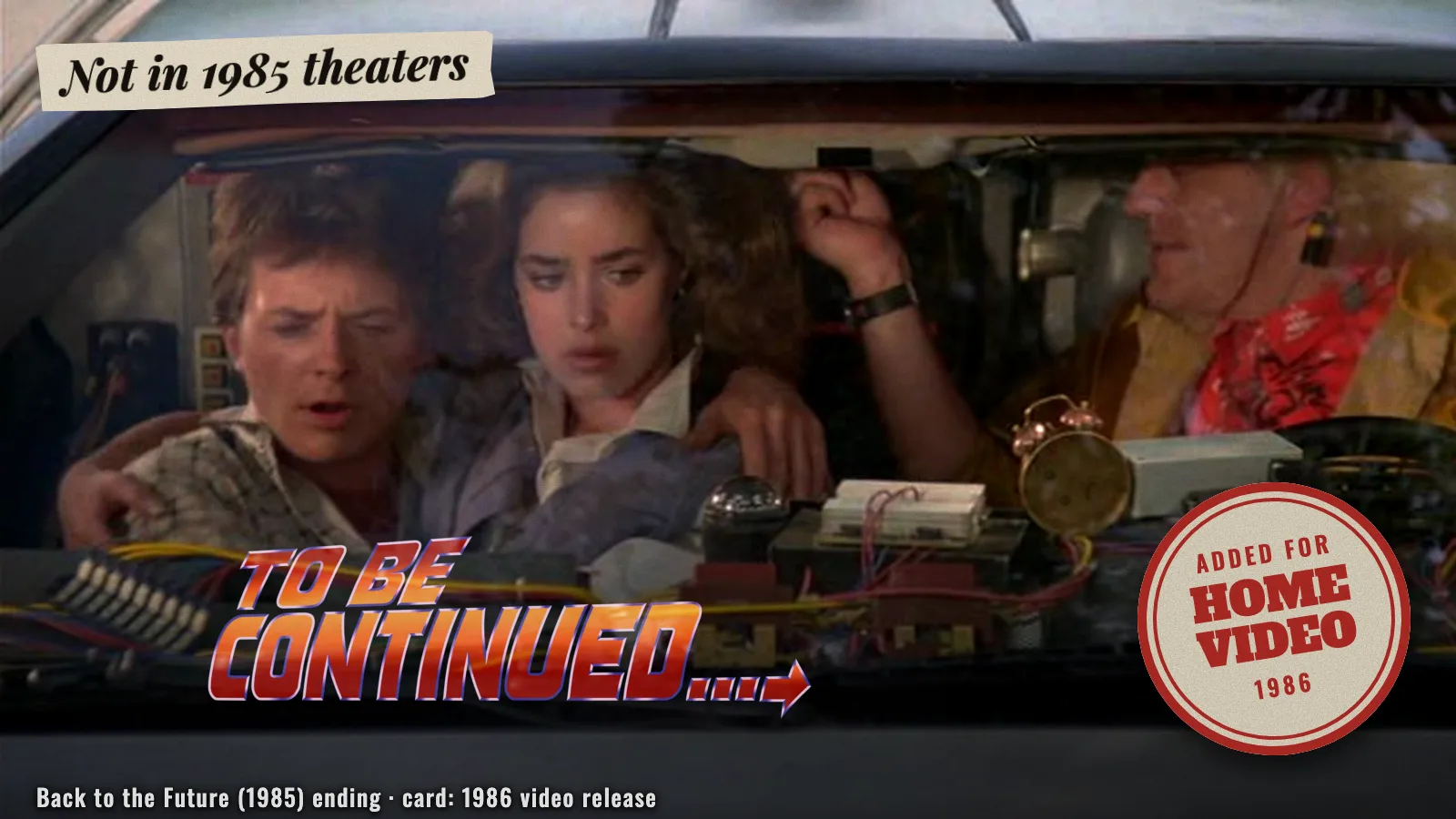
There was a catch. Putting Jennifer in the car meant the sequel had to deal with her. Gale says Zemeckis has always said: “If I knew we were going to do a second movie, I wouldn’t have put Jennifer in the car.” Gale’s own solution, in a 2015 interview with The Hundreds: “we actually ended up having to have her unconscious for most of Back to the Future II.”
Short: the "To Be Continued…" card, in 35 seconds. Watch it on YouTube.
The lesson for productions: the version of your credits isn’t fixed at the premiere. Home video, streaming and broadcast masters can and do differ from the theatrical print, so keep track of which version carries which card.
What Back to the Future teaches about credits
Five Lessons for Your Own End Credits
- Credit what’s on screen. A replaced actor whose work is fully reshot gets no credit (Stoltz). An actor whose footage stays in the film does, even if they never set foot on your set (Glover).
- Label archive footage clearly. “In footage from…” is accurate and protects you. Where the line sits in the cast list is a negotiation, so settle it before the crawl is locked.
- Use the registered professional name. The credited name must match the SAG-AFTRA registration; check it, don’t copy the call sheet (Michael J. Fox).
- Honor no-credit requests in writing. An uncredited cameo should be a deliberate, documented choice, not an omission someone discovers later (Huey Lewis).
- Track every version. Theatrical, home video and streaming masters can carry different cards. Know which credits file belongs to which master.
The standard order of all of this, from the main titles to the last logo, is in our guide to film credits order. If you want to see how a franchise from the same era fought the guilds over its credits, read our Star Wars credits breakdown.
Back to the Future credits FAQ
Frequently Asked Questions
Why did Eric Stoltz get replaced in Back to the Future? Robert Zemeckis felt Stoltz was playing Marty with an intense, serious tone rather than the comic energy the film needed. Bob Gale called him a good actor in the wrong role. Stoltz was fired on January 10, 1985, about six weeks into filming, and Michael J. Fox took over.
Is Eric Stoltz in the Back to the Future credits? No. All of his scenes were reshot with Michael J. Fox, so the end credits list Fox as Marty McFly and don’t mention Stoltz.
Who played George McFly in Back to the Future Part II? Jeffrey Weissman, wearing prosthetics made from molds of Crispin Glover’s face. Glover appears only in reused footage from the first film and is credited at the bottom of the cast as “George McFly in footage from ‘Back to the Future’”.
Why wasn’t Crispin Glover in Back to the Future Part II? He and the producers didn’t reach a deal. Accounts differ; Glover has said he was offered less than half of what the other returning actors were paid.
Was Jennifer recast in Back to the Future? Yes. Claudia Wells played Jennifer Parker in the first film; Elisabeth Shue took over for Parts II and III after Wells stepped away to care for her mother.
What does the J in Michael J. Fox stand for? Nothing. His middle name is Andrew. He added the J, after the actor Michael J. Pollard, because the Screen Actors Guild already had a member called Michael Fox.
Did Back to the Future end with “To Be Continued” in theaters? No. The card was added to the 1986 home video release, after a sequel was decided, and removed again for the 2002 DVD.
Sources & Further Reading
- Back to the Future (1985) and Back to the Future Part II (1989), end credits, DVD Collector’s Edition (our own frames)
- Back to the Future, production history (Wikipedia)
- Back to the Future Part II, production history (Wikipedia)
- Michael J. Fox, early life, quoting Lucky Man (Wikipedia)
- Bob Gale interview on the “To Be Continued” card (Screen Rant, 2020)
- Did Back to the Future originally end with “To Be Continued”? (HuffPost, 2015)
- Back to the Future Part II (AFI Catalog)
- Bob Gale interview (The Hundreds, 2015)
- 11 things we just learned about the Back to the Future trilogy (Mental Floss, 2015)
- Bob Gale on Jennifer in the car (io9 / Gizmodo, 2026)
- SAG-AFTRA 2023 TV/Theatrical Contracts
Credits are where a film says who really did what. EndCredits.pro helps productions build their credits from the first day of prep to the final crawl: one list of names, guild-compliant layouts and a render you can drop into the edit. Start with a template or try EndCredits.pro free.