Movie Poster Billing Block: Generator, Template & Rules
The billing block is the strip of condensed capitals at the bottom of a one-sheet. It looks like typographic noise. It is the visible result of contracts that fix who must be credited, in what order and how large.
Below: a free generator that exports a transparent PNG or SVG, the standard order of the block, and the minimum credit sizes written in the DGA and WGA agreements, quoted from the contract text.
Billing block generator
Enter the credits in the order they should appear. The preview updates as you type. Export a transparent PNG for Photoshop, Figma or Canva, an SVG with live text for Illustrator, or plain text for your designer. Everything runs in your browser; nothing is uploaded.
The height follows the text, so the proportions stay true. A 27 × 40 in one-sheet at 300 dpi is 8100 px wide: 7290 px is a block at 90% of that width. The SVG scales to any size without loss.
Placeholder names only. The PNG is always transparent and exported at the width you set. The SVG keeps live text in the typeface you chose: install the font, or convert the text to outlines, before it goes to print. The three typefaces are self-hosted under the SIL Open Font License (downloads in the fonts section). The layout is a starting point; a distributor’s design team sets final sizes against the title treatment, so check the size rules below.
What is a billing block?
A billing block is the list of names at the bottom of a film’s official poster, the one-sheet, and of the advertising built from it. “Billing” is the industry term for the order and prominence in which credits are presented. The block is where that order becomes type.
John August, introducing Ben Schott’s 2013 New York Times explainer, puts it this way: it looks like a bar code of haphazardly packed type, but it is “in fact the product of detailed legal agreements and intense contract negotiation.” It is also a different thing from the on-screen credits.
| Billing block | End credits | |
|---|---|---|
| Where it appears | One-sheets, key art and other paid advertising | The last minutes of the film |
| Who is named | A contractual selection: billed cast, department heads, producers, writers, director | Everyone, department by department |
| What governs it | Individual deals plus guild advertising clauses that set minimum sizes against the title | Guild screen-credit clauses on wording and placement |
| Typography | Ultra-condensed capitals, set small | Readable type, sized for the screen |
For the sequence on screen, see the film credits order guide and the credits format and order guide. Who sits behind each guild rule is mapped in the who’s who of unions and guilds.
Billing block order: what goes where
No single document fixes the order. It comes from contracts, guild rules and convention, but posters converge on the same sequence, reading from the distributor down to the director.
| # | Position | What goes there |
|---|---|---|
| 1 | Presentation credits | Distributor first, then co-financiers, then the producer's banner: "[Distributor] presents / in association with [Financier] / a [Producer] production". Fixed by the deal, read top-down from the company that releases the film. |
| 2 | Possessory credit | "A [Director] Film" above the title. Negotiated. On outdoor-type ads with six or more personal credits, the DGA requires an "A Film By" above the title, no smaller than "Directed By". |
| 3 | Above-title cast | Only the stars whose deals guarantee a position before the title. Negotiated individually. SAG-AFTRA does not set order or size. |
| 4 | Title | Not part of the block, but it sets the scale: every DGA and WGA minimum is measured against the title's type. Size rules below. |
| 5 | Cast after the title | Usually two or three names, in alphabetical or negotiated order, with "with", "and" or "introducing" where the deal calls for it. Negotiated; billing positions are called first, second and third position. |
| 6 | Department heads | Casting by, Costume Designer, Edited by, Production Designer, Director of Photography, Music by. The usual run. Placement of the director of photography and the composer is often negotiated. |
| 7 | Producers | Executive Producers, then Produced by (with the p.g.a. mark where awarded). Co-Producers and Associate Producers appear only where a deal calls for it. The p.g.a. mark is certified by the Producers Guild project by project. |
| 8 | Writers | Story by, Screenplay by, or Written by when one writer or team did both. On guild films the WGA determines the credit. Use "&" between writers on a team and "and" between writers who worked separately. |
| 9 | Directed by | The last name in the block. "Directed by" is the only form the DGA accepts in paid advertising. Required on every one-sheet issued at release. |
| 10 | Bottom bar | Studio and sales logos, the MPA rating, website, social handles and release date. Logos and the rating are known as "bugs". |
Writing teams: & or and
The WGA’s own rule: an ampersand between names denotes a writing team. The word “and” means the writers worked separately, usually one rewriting the other. Get it wrong and you have changed the credit. Source: WGA Screen Credits Manual.
The p.g.a. mark
The Producers Guild certifies the mark project by project for producers who carried out a major share of the producing functions. It follows the name in the “Produced by” credit. See the PGA Producers Mark our guide to PGA credits and our guide to who decides credits.
Roles in the department run, in detail: casting director, costume designer, film editor, production designer, director of photography, composer and director. The common run follows StudioBinder’s poster credits breakdown; guild rules are quoted from the agreements below.
Movie poster billing block examples
Five real one-sheets, cropped to the billing block. Read each against the order above: presentation credits first, the director’s credit last, and on most of them the role titles set in two small lines.
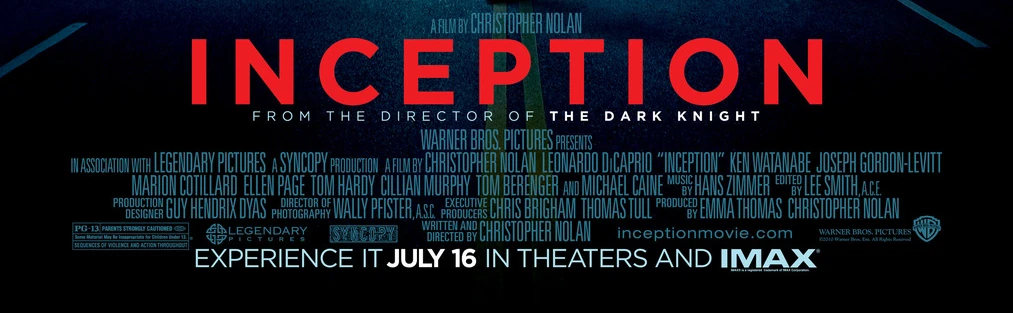




Crops of the original one-sheets, shown here for commentary and education. The posters belong to their respective studios and distributors. If you hold the rights to one and would like it removed, contact us.
Billing block size rules: DGA and WGA minimums
Contracts do not fix point sizes. They fix sizes relative to the title: a credit must be at least a stated percentage of the title’s type. That one constraint explains the whole look of the block.
The result is a convention: the type of the block runs between 15% and 35% of the average letter height of the title logo (Wikipedia, citing industry practice). Those two numbers match the DGA’s 15% floor for paid advertising and its 35% figure for outdoor ads. Condensed type lets the letters reach the required height while the whole list still fits across the poster.
| Credit | Minimum | Clause |
|---|---|---|
| Director, paid advertising | At least 15% of the title's type size, and never smaller than the size and style of any credit given to a person other than an actor. | DGA 8-203(a) |
| Director, one-sheets | Required on every one-sheet. Advance one-sheets may be waived only if no one but starring actors is credited, and the director must appear clearly on the one-sheet issued at release. | DGA 8-203(c) |
| Director, outdoor-type ads | Not required if the ad carries only the title, key art (no more than two starring actors), logos, the rating and copyright notice, and copy that names no one else. Otherwise at least 35% of the title or of any individual credit, whichever is larger. | DGA 8-203(d) |
| Director, boxed | Boxed when a writer or producer appears in a presentation credit as well as another credit, or when the ad carries five or more personal credits. Two starring actors count as one personal credit; hyphenated credits ("Produced and Written by") count separately. | DGA 8-203(d) |
| Writers (story, screenplay, written by) | Same size and style of type as the individual producer or the director, whichever is larger, and never under 15% of the height of the title type. | WGA Sch. A, ¶22.g |
| Writers, 24-sheets | At least 3½ inches tall; 2½ inches if the credit is shared by more than two writers. | WGA Sch. A, ¶22.g(3) |
| Three or more writers | The credit need not take more area than the first two writers would. The type may be reduced in height and narrowed. | WGA Sch. A, ¶22.g(1) |
| Title in letters of varying size | Percentages are measured against the average size of all the letters in the title. | WGA Sch. A, ¶22.i |
Quoted from the DGA Basic Agreement 2023, Article 8-203 and the WGA 2023 Minimum Basic Agreement, Theatrical Schedule A, Paragraph 22. Last checked October 2026. Both guilds negotiated new agreements in 2026: confirm each figure against the current text. Star and producer deals often demand more than these floors. This is reference material, not legal advice.
Minimum credit size calculator
Enter the height of the title’s letters (the average, if the title mixes sizes) and get the minimum heights for the director and the writers.
| Credit | Minimum height |
|---|
When a billing block is not required
- Teaser posters can leave out the credits, or even the title.
- Advance one-sheets may omit the director only if no one but starring actors is credited (DGA 8-203(c)).
- Outdoor-type ads that carry only title, key art, logos, rating and copyright are exempt from the director credit (DGA 8-203(d)).
- The WGA excludes teasers and ads under four column inches, unless they include a “Produced by” or “Directed by” credit (Sch. A, ¶22.j).
Who checks the proofs
Under DGA Article 8-210, press books and paid advertising are submitted to the Guild for approval of the director’s credit before public release; if the Guild does not object within two business days, that is deemed a waiver. The WGA’s Schedule A (¶26) also requires advertising material to be submitted before it is issued: the Guild has 24 hours (Los Angeles) or 36 hours (New York) to protest, and the company may not issue the material before that window closes.
Billing block fonts
There is no standard billing block font. Posterwire, answering the question it is asked most, says no single typeface is used: most good ultra-condensed sans-serifs work. What matters is character height against width. The three typefaces in the generator are free, and we host them so you can install them.
| Typeface | Licence and commercial use | Get it |
|---|---|---|
| Univers 39 Thin Ultra Condensed (and Univers 49) The classic poster face. | Licence needed Commercial (Linotype). | Univers on MyFonts ↗ |
| Bee URW's 1992 digitisation of the "B-series" faces long used for poster credits. | Licence needed Commercial (URW). | Bee on Fonts In Use ↗ |
| Steel Tongs Built for billing blocks: role titles are glyphs typed from a character map. | Check before use Unclear. Listed as "free for personal use" on one site and "unknown license" on another; derived from Steelfish. | Steel Tongs on Abstract Fonts ↗ |
| Saira Extra Condensed Light, extra-condensed capitals. The generator default. | Free for commercial use SIL Open Font License 1.1. | Download ZIP (400 KB) |
| Antonio A bolder condensed face (variable weight). | Free for commercial use SIL Open Font License 1.1. | Download ZIP (45 KB) |
| Bebas Neue Popular and widely available. Lacks the specialty glyphs of purpose-built block fonts. | Free for commercial use SIL Open Font License 1.1. | Download ZIP (30 KB) |
See them on a real billing block
The free generator sets your credits in Saira Extra Condensed, Antonio or Bebas Neue and exports a transparent PNG or SVG.
The licences in plain words
- Saira Extra Condensed, Antonio and Bebas Neue use the SIL Open Font License. Per its official FAQ, you may use them for posters and video titling without extra permission, you remain the author and copyright holder of the artwork, and no acknowledgement is required. You cannot sell the fonts by themselves. Each download includes the licence text.
- The files you export contain only the text you typed, set in the typeface you chose. With these three typefaces that means you can use the PNG or SVG commercially.
- Univers and Bee are commercial typefaces: buy a licence that covers print and advertising use from the vendor.
- Steel Tongs has no clear licence, so we do not host it. Confirm the terms with its author before using it on a paid project.
Licence summary for information, not legal advice.
For the full comparison, with the on-screen end crawl too, read the best fonts for film credits.
Billing block template
Copy this skeleton into your design tool or send it to your designer. Delete the lines your deals do not require, and replace the bracketed fields. Prefer a finished graphic? The generator exports it as PNG or SVG.
[DISTRIBUTOR] presents
in association with [FINANCIER]
a [PRODUCTION COMPANY] production

[A DIRECTOR FILM]                     <- only if negotiated
[STAR]   [STAR]                       <- above-title billing, only if negotiated

[TITLE]

[CAST 1] · [CAST 2] · [CAST 3]

CASTING BY [NAME]   COSTUME DESIGNER [NAME]   EDITED BY [NAME, A.C.E.]
PRODUCTION DESIGNER [NAME]   DIRECTOR OF PHOTOGRAPHY [NAME, A.S.C.]   MUSIC BY [NAME]
EXECUTIVE PRODUCERS [NAME] · [NAME]   PRODUCED BY [NAME, p.g.a.]
STORY BY [NAME] & [NAME]   SCREENPLAY BY [NAME]
DIRECTED BY [NAME]

[LOGOS]  [RATING]  [WEBSITE]  [RELEASE DATE]
Add the billing block to Photoshop
The generator’s PNG is transparent and exported at print size, so it drops straight onto your poster artwork. Five steps, and the video below shows each one.
The video loads from YouTube when you press play. Watch it on YouTube.
More guides on the EndCreditsPro YouTube channel.
-
New document. File › New: 27 × 40 in at 300 pixels/inch. Image › Image Size should read 8,100 × 12,000 px: the US one-sheet at print resolution.
-
Place the PNG. Export the block at 7,290 px (the One-sheet 7290 preset), then File › Place Embedded and pick the file. It arrives as a Smart Object, so you can resize it later without degrading the original.
-
Check the width. The block should span about 90% of the canvas. If it lands at another size, scale it proportionally, with the chain linked. The Properties panel can read a little under 7,290 px: it measures the visible pixels, not the transparent margin.
-
Position it. Centre it below the title with a margin above the bottom edge, and keep it on its own layer. Because the PNG is transparent, the artwork shows through around the letters.
-
Measure the title. With the Ruler tool (I), read the height of a capital of the title in pixels, then enter it in the size calculator to get the minimum credit heights.
Working in Figma or Canva? Place the SVG instead, after installing the typeface from the fonts section.
Billing block checklist before it goes to print
Eight checks drawn from the contract clauses above.
- Director credit appears on every one-sheet issued at release, worded exactly "Directed by".
- Director credit is at least 15% of the title's type size, and not smaller than any credit given to a non-actor. On outdoor-type ads that carry other names, it is at least 35% and boxed where the DGA requires it.
- Writing credits match the guild's final determination, sit at the larger of the producer or director size, and are at least 15% of the title height.
- Every star's billing position, connector ("with", "and", "introducing") and size is checked against the deal memo, not against another poster.
- The p.g.a. mark follows the producer names it was awarded to, and society suffixes (A.C.E., A.S.C.) follow members' names.
- Logos, rating and copyright line sit in the bottom bar; the website and release date are final.
- Press books and paid advertising are submitted to the DGA (Art. 8-210) and to the WGA (Schedule A, ¶26) before release, and the guilds' review windows have closed.
- A producer, lawyer or business-affairs lead has read the proofs against the contracts before the files go to print.
The poster is done. The end credits are next.
The billing block covers the poster. The credits on screen follow a different hierarchy, with guild-mandated cards and a department-by-department crawl. EndCreditsPro, the end credits platform for productions, is in development: join the waitlist and we will email you when it opens.
Meanwhile: the end credits template and the film credits order guide.
Frequently asked questions
What is a billing block?
The billing block is the list of names set in condensed capitals at the bottom of a film's official poster, the one-sheet, and of other advertising. "Billing" is the industry term for the order and prominence of credits. The block is distinct from the on-screen credits and from the end crawl, and some posters and ads do not need one.
What font is used for the billing block on movie posters?
There is no single font. Billing blocks use any good ultra-condensed sans-serif; Univers 39, Univers 49 and Bee are the classic choices. Steel Tongs is a specialty font built for billing blocks, with role titles such as "Produced by" as glyphs in two small lines (its licence is unclear, so check it before commercial use). Bebas Neue, Saira Extra Condensed and Antonio are free alternatives, and the generator above sets role titles in that two-line style in any of the three. The type is condensed because contracts set credit sizes as a percentage of the title, so the letters have to be tall while the list stays narrow enough to fit.
What is the order of credits in a billing block?
Presentation credits, possessory credit, above-title cast, the title, cast after the title, department heads (casting, costume, editor, production designer, director of photography, music), producers, writers, and "Directed by" as the last name, followed by a bottom bar with logos, rating, website and release date. Star billing and the placement of some department heads are negotiated, so the order varies from film to film.
How big does the director's name have to be on a movie poster?
Under the DGA Basic Agreement (Article 8-203), at least 15% of the size of type used for the title in paid advertising, and never smaller than any credit given to a non-actor. On outdoor-type ads that carry other names it rises to 35% of the title, or of any individual credit if larger, and the credit must be boxed in certain cases. Use the calculator on this page to turn those percentages into sizes.
Does every movie poster need a billing block?
No. Teaser posters can leave out credits or even the title. The DGA allows advance one-sheets without the director's credit when nobody but starring actors is credited, and exempts outdoor-type ads that carry only the title, key art, logos, rating and copyright notice. The WGA excludes teasers and ads under four column inches, unless the ad includes a "Produced by" or "Directed by" credit, in which case the writing credit must appear too.
Can I use these billing block fonts commercially?
Saira Extra Condensed, Antonio and Bebas Neue use the SIL Open Font License, which allows use in posters and video titling, commercial work included, without extra permission or attribution. You remain the author of the artwork you make; you just cannot sell the fonts themselves. Univers and Bee are commercial typefaces and need a licence that covers print and advertising. Steel Tongs has no clear licence, so check it before using it on a paid project.
Who decides who gets top billing on a poster?
Top billing is negotiated deal by deal. SAG-AFTRA does not set billing order or size for actors. Poster billing can even differ from on-screen billing: on All the President's Men (1976), Robert Redford had top billing on posters and trailers while Dustin Hoffman was billed first in the film itself.
How do I make a billing block for Photoshop, Figma or Canva?
Fill in the generator, set the export width, and download the transparent PNG (or the SVG for Illustrator and Figma). Place it at the bottom of your poster canvas. The standard US one-sheet is 27 × 40 inches, which is 8100 px wide at 300 dpi; the 7290 px preset is a block at 90% of that width. Set the text color against the artwork, then check each credit against the title height with the size calculator before you send files to print.
What is the difference between the billing block and the end credits?
The billing block is a contractual selection of names printed small on posters and ads, with sizes governed by percentages of the title. The end credits are the full list of cast and crew on screen, ordered by department. They follow different rules and different typography. See the film credits order guide for the on-screen sequence.
Sources: DGA Basic Agreement 2023, Art. 8, WGA MBA 2023, Theatrical Schedule A, WGA Screen Credits Manual, PGA Producers Mark, Wikipedia: Billing (filmmaking), John August, Posterwire and StudioBinder and the SIL OFL FAQ. Guild rules by role: compliance guides.