Project Hail Mary End Credits: Technical Breakdown
After the “Directed by” card, the film says “with” — then scrolls the entire crew. No other major studio release in 2026 opens its credits that way. And it gets stranger from there.
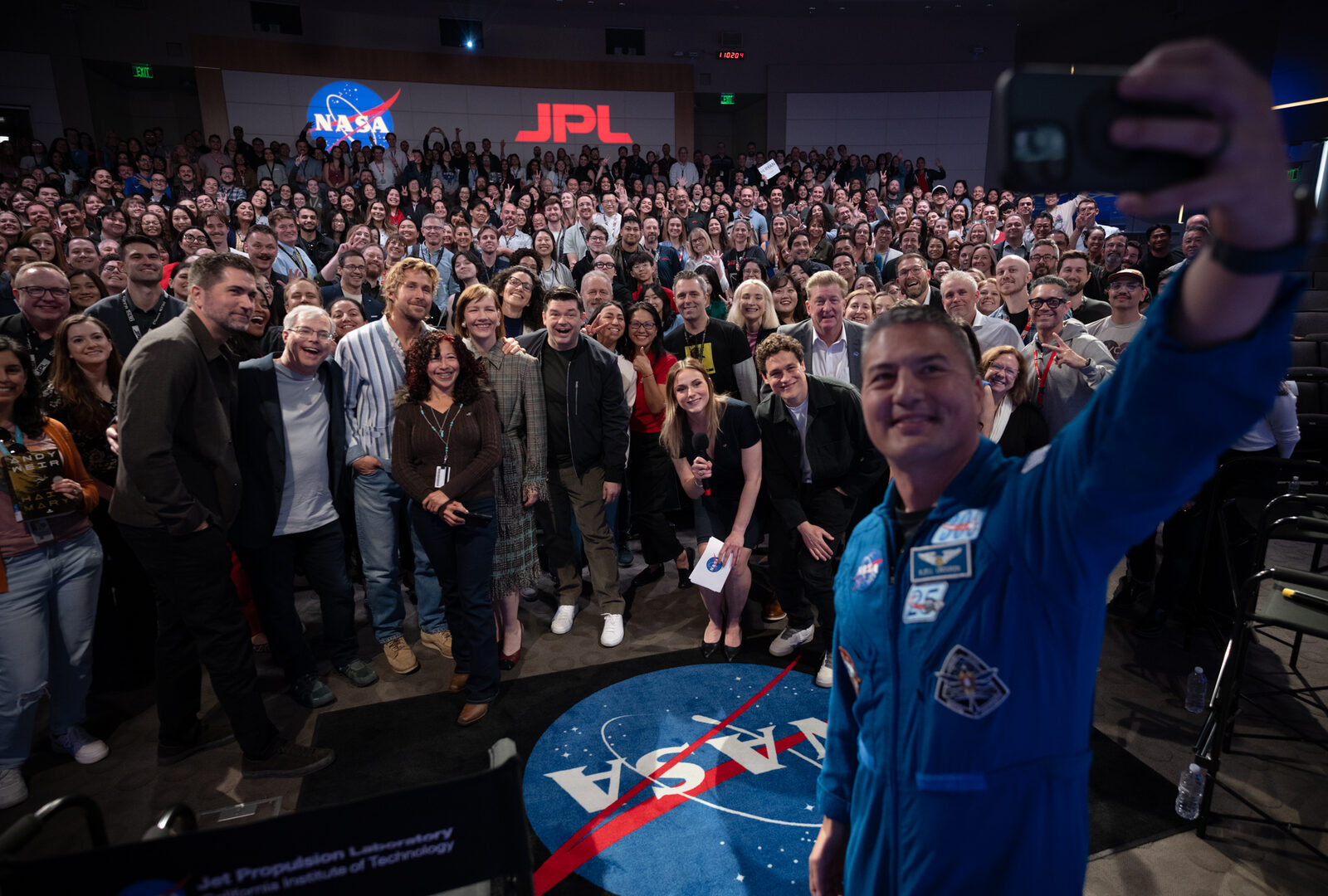
Project Hail Mary (2026) is a science-fiction film directed by Phil Lord and Christopher Miller, written by Drew Goddard, and based on Andy Weir’s 2021 novel. Produced by Amazon MGM Studios with Ryan Gosling starring and producing, the film was shot by cinematographer Greig Fraser on the ARRI ALEXA 65 with custom vertical-squeeze anamorphic lenses — the same DP behind Dune and The Batman. It opened to $141 million globally.
The end credits tell a production story worth examining: five VFX houses, a 38-track score built on cristal baschets and children’s body percussion, a deliberately untranslated alien farewell, and a typography system rooted in optometrist sight-test charts.
Project hail mary end credits at a glance
Credits Overview
| Detail | Value |
|---|---|
| Total runtime | 156 minutes (2h 36m) |
| Title font | Cindie Mono C (Lewis McGuffie) |
| Credits scroll font | Unidentified |
| Style | Scroll on black |
| Post-credits content | 4 production badges + Rocky audio easter egg |
| End credits song | ”Glory, Glory” — Ike & Tina Turner |
| Score | Daniel Pemberton (38 tracks, 119m 46s) |
| VFX studios | 5 (Framestore, ILM, Sony Imageworks, BUF, Wylie Co.) |
| Guild compliance | DGA, WGA, SAG-AFTRA, PGA |
Project hail mary credits structure
How the Credits Sequence Unfolds
Project Hail Mary’s credits begin with one of the most unusual choices in recent studio filmmaking. After the title card reading “Directed by Phil Lord and Christopher Miller,” the screen displays the word “with” — followed by a scrolling list of the production crew. This is not the standard end credits scroll. It is a deliberate acknowledgment, placing the directors’ credit in direct grammatical relationship with every crew member who follows.
Film observer Adam Hlavac noted on X: “One detail I appreciate about PROJECT HAIL MARY, that I don’t think I’ve seen anyone mention yet, is that after the ‘Directed by Phil Lord and Christopher Miller’ title card it says ‘with’ followed by scrolling credits of the crew. A nice touch.”
Above-the-line billing cards:
- RYAN GOSLING
- Directed by PHIL LORD and CHRISTOPHER MILLER
- Screenplay by DREW GODDARD
- Based on the novel by ANDY WEIR
- “with” + crew scroll
Scroll section: After the opening billing, the credits transition to the standard vertical scroll following feature film credits hierarchy:
- Cast (36+ credited roles, including James Ortiz as Rocky’s puppeteer and voice)
- Casting
- Music — Daniel Pemberton
- Costume Designer
- Production Designer — Charlie Wood
- Editor — Chris Dickens
- Director of Photography — Greig Fraser
- Executive Producers
- Produced by — Ryan Gosling, Phil Lord, Christopher Miller, Amy Pascal, Drew Goddard, Andy Weir
- Department crews (camera, sound, art, wardrobe, stunts, VFX, music, post-production)
- Licensed songs
- Production company badges
- Guild and union logos
Project hail mary credits typography & design
Cindie Mono C and the Science of Lettering
The title typography for Project Hail Mary uses Cindie Mono C, a commercial monospaced display font designed by Lewis McGuffie. The typeface family comes in six widths — from condensed to super extended — and draws its visual DNA from the lettering found on optometrist sight-test charts. The result is clean, technical, and clinical: uniform letter widths, minimal detailing, and an aesthetic that reads as “scientific instrument” rather than “Hollywood blockbuster.”
It is a sharp choice for a film about a microbiologist saving the world through methodical experimentation. The monospaced structure — where every character occupies the same horizontal width — evokes data readouts, command-line interfaces, and laboratory labels. A free alternative with similar characteristics is SONGER Semi Expanded Bold.
The trailer title design was created by Ann Kruetzkamp at Wild Card creative studio, using Photoshop. Her work introduced the visual motifs that carry through the film’s marketing: light refraction effects, prismatic geometry, and gold/warm tones set against the blackness of space.
The rolling credits scroll itself uses a clean, unidentified font — likely a standard titling sans-serif. For more on how type choices shape the credits experience, see our guide to the best fonts for film credits.
Project hail mary VFX credits
Five Studios, One Alien
The VFX credits for Project Hail Mary span five studios — a significant vendor count that reflects the film’s blend of practical and digital effects:
| VFX Studio | Key Supervisor(s) |
|---|---|
| Framestore | Studio VFX supervisor(s) |
| Industrial Light & Magic (ILM) | Studio VFX supervisor(s) |
| Sony Pictures Imageworks | Studio VFX supervisor(s) |
| BUF | Studio VFX supervisor(s) |
| Wylie Co. | Studio VFX supervisor(s) |
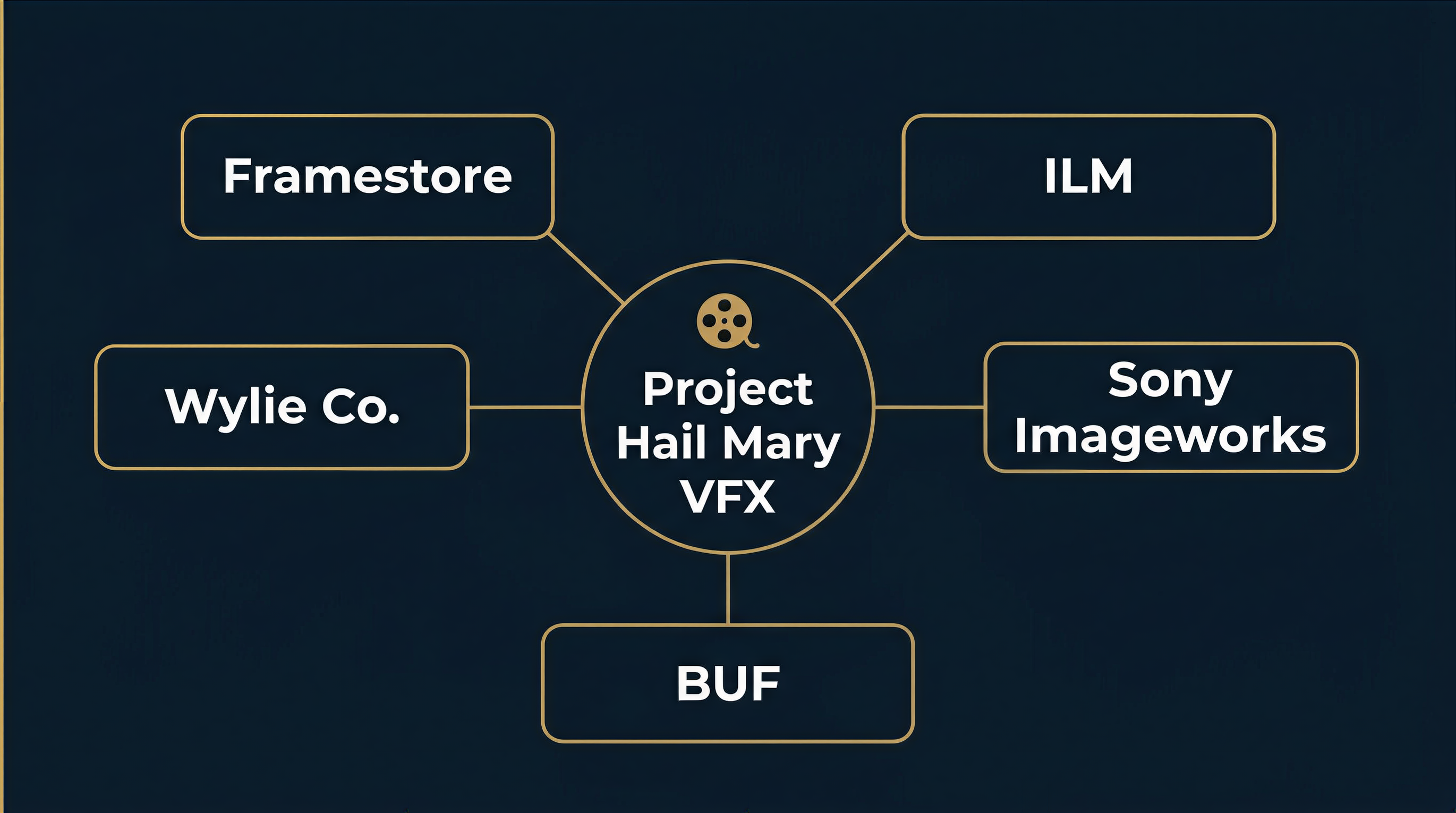
The production-side VFX supervision was led by Paul Lambert and Mag Sarnowska, with Barrie Hemsley serving as VFX producer. Lambert is a two-time Oscar winner (Blade Runner 2049, Dune) — his involvement signals the scale of the visual effects work.
What makes the VFX credits particularly interesting is the production’s emphasis on practical effects. The Hail Mary ship was built as a full physical set. Rocky — the alien deuteragonist — was realized as a practical puppet operated and voiced by James Ortiz, with zero green screen used for Rocky’s in-camera scenes. The five VFX studios handled space environments, astrophysics simulations, and digital augmentation of practical elements rather than replacing them.
For comparison, Everything Everywhere All at Once credited just six VFX artists for 500 shots, while Oppenheimer credited 27 (controversially omitting 130+ more). Project Hail Mary’s five-studio approach represents the opposite end of the spectrum: distributing specialized work across multiple vendors, each contributing their own credited team.
Project hail mary end credits music
”Glory, Glory” and a 38-Track Score
The end credits roll to “Glory, Glory” by Ike & Tina Turner — a licensed track that plays from approximately the 2:32:35 mark. The choice of a classic soul/gospel track over a score cue is notable: it signals celebration and catharsis after a film built on isolation and sacrifice.
The original score by Daniel Pemberton is one of the most ambitious film scores in recent memory. Pemberton relocated to Los Angeles and composed alongside the editing suite as Lord and Miller refined their cut.
Score by the numbers:
| Detail | Value |
|---|---|
| Tracks | 38 (digital), additional on vinyl |
| Total runtime | 119 minutes 46 seconds |
| Orchestra | Chamber Orchestra of London |
| Conductor | Edward Farmer |
| Label | Milan Records (released March 20, 2026) |
| Vinyl edition | 4 LPs on gold vinyl + zoetrope disc, 16-page booklet |
Unconventional instrumentation: Lord and Miller described the film’s tonal approach as “Hope Core” — and Pemberton translated this into a score that blends familiar orchestral language with deeply unusual sound sources:
- Cristal baschet — a French acoustic instrument using glass rods and metal
- Ondes Martenot — an early electronic instrument (also used in Radiohead recordings)
- Glass harmonica — the instrument Benjamin Franklin invented
- Body percussion by Wells Cathedral School children — clapping, drumming, and vocal rhythms
- Vocal ensemble Shards — mouth percussion and extended vocal techniques
- Musique concrète samples — including the sound of a squeaky tap
- Opera singers — soaring religioso choir alongside the orchestra
The score builds around a four-note main motif introduced on ethereal vocals in the opening track, recurring throughout the film from “floating serenity” to “grand determination.” Rocky’s presence gets its own playful percussive theme. The finale track, “Amaze Amaze Amaze (Life on Erid)”, reprises the main theme with Rocky’s percussion “dancing happily alongside” — closing on what reviewers called “an enjoyably and aptly peaceful note.”
A dedicated credit track titled “Project Hail Mary (Credits)” appears on the expanded vinyl release but is absent from the 38-track digital album.
The music department credits are extensive, covering orchestrations (Andrew Skeet, Edward Farmer, Andy Kyte, Danny Ryan, Cameron Smith), featured soloist Thomas Bloch, vocalist Grace Davidson, and recording/mixing engineer Sam Okell.
Project hail mary guild compliance
Credits Requirements
Project Hail Mary’s credits comply with multiple guild agreements:
- DGA (Directors Guild of America): Phil Lord and Christopher Miller receive a shared “Directed by” credit using “and” — indicating the DGA recognized them as a directing team (distinct from “A Film By,” which neither director took).
- WGA (Writers Guild of America): Drew Goddard receives sole “Screenplay by” credit, with “Based on the novel by Andy Weir” as the source material credit. The “Based on” phrasing (rather than “Based upon”) follows current WGA convention.
- SAG-AFTRA: Ryan Gosling receives solo above-the-title billing. The 36+ credited cast includes James Ortiz credited for Rocky’s voice and puppetry — a notable inclusion given that puppeteers are not always credited on-screen.
- PGA (Producers Guild of America): Producer credits for Gosling, Lord, Miller, Amy Pascal, Drew Goddard, and Andy Weir. Watch for the “p.g.a.” mark indicating PGA-certified producing contributions.
For a full guide to guild crediting requirements, see our compliance guides.
Project hail mary post-credits scene
Rocky’s Untranslated Farewell
Project Hail Mary does not have a traditional post-credits scene. What it has is more interesting.
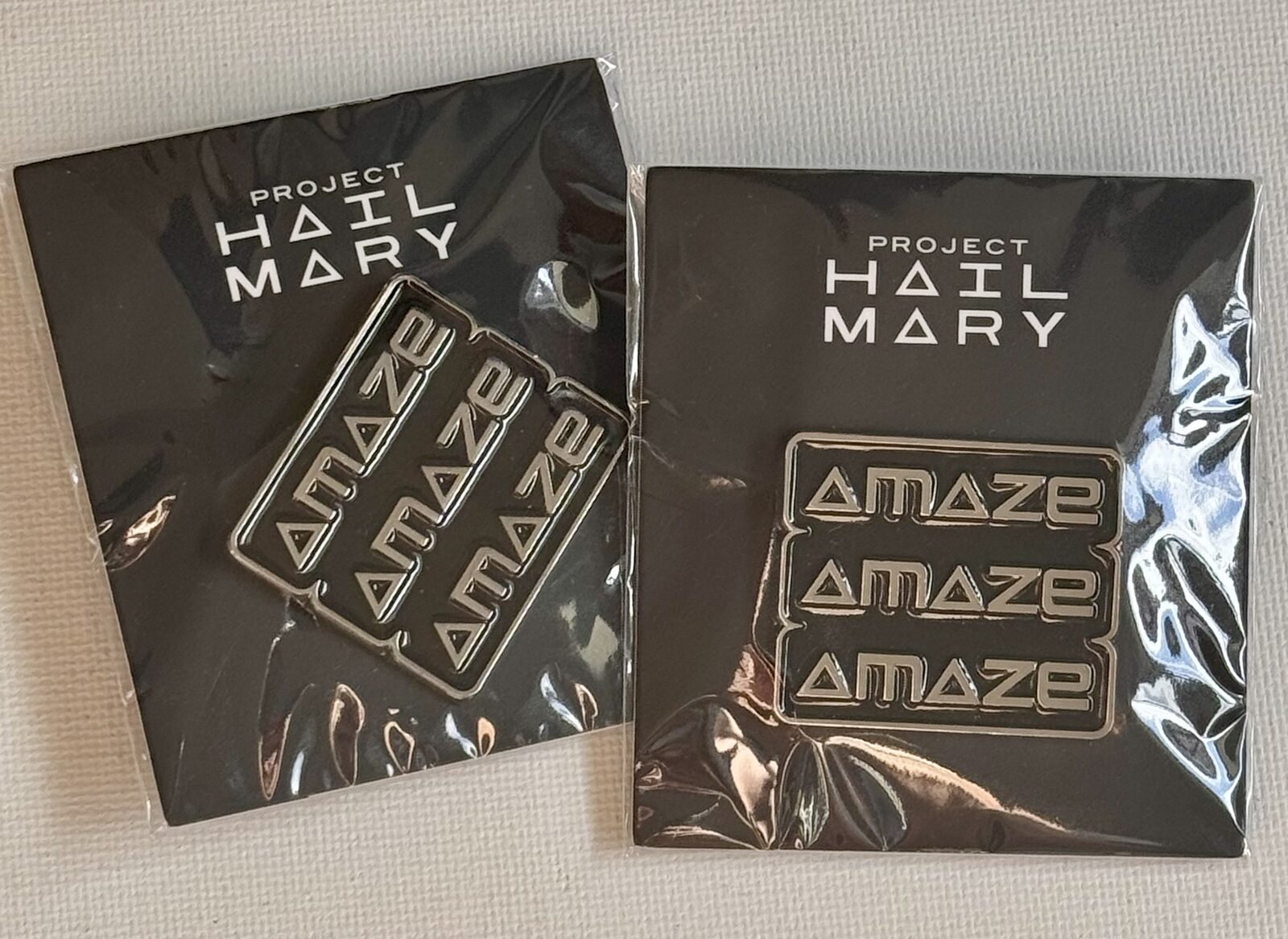
After the credits finish scrolling, four astronaut-suit-style badges appear on screen — styled after the mission patches seen throughout the film:
- PPI (production company)
- Open Invite Films (production company)
- Lord Miller Productions
- Metro-Goldwyn-Mayer — the animated MGM lion logo
After the MGM lion, the screen goes black. Then: Rocky’s singing-like alien communication plays as audio — with no subtitles, no translation, no visual. Throughout the film, Dr. Ryland Grace translates Rocky’s musical vocalizations for the audience. Here, for the first and only time, Rocky speaks directly to us without a translator.
Fan theories on what Rocky says range from “Goodbye” (the most popular guess, though Eridians explicitly lack a word for goodbye in the film’s lore) to “Thank You” or simply “The End.” The Daniels — Lord and Miller — deliberately left it untranslated and ambiguous.
This is Phil Lord and Christopher Miller’s first-ever post-credits content across their entire directorial catalog. Even 22 Jump Street, with its elaborate credits sequence, included nothing after.
The moment generated significant word-of-mouth. Multiple fans recorded the credits in theaters, uploading at least four separate videos totaling 16,000+ views. An audio-only version was uploaded independently — evidence that audiences found the credits music and Rocky’s farewell worth preserving on their own.
For context on typical credits lengths, see how long are movie credits.
Project hail mary camera & technical specs
ARRI ALEXA 65 and Custom Anamorphic Glass
Greig Fraser shot Project Hail Mary on the ARRI ALEXA 65 — a large-format digital cinema camera that captures at 6.5K resolution. The lenses were custom vertical-squeeze anamorphic designs, creating the distinctive vertical lens flare visible throughout the film (as opposed to the horizontal flare associated with traditional anamorphic).
The film was presented in IMAX with a custom tall aspect ratio for selected sequences, expanding the frame vertically for the space and ship interiors. Standard theatrical presentation used a wider ratio.
This technical approach is reflected in the credits: the aspect ratio likely shifts for the credits sequence (common with IMAX presentations), and the credits rendering accounts for multiple exhibition formats.
Sources & Further Reading
- Project Hail Mary full cast & crew on IMDb
- Art of VFX — Project Hail Mary VFX Studios
- Newsshooter — ARRI ALEXA 65 & Custom Anamorphic Lenses
- IndieWire — Daniel Pemberton Score Interview
- Zanobard Reviews — Soundtrack Review
- DesignBeep — Cindie Mono C Font Analysis
Build credits worthy of your production. Whether you are finishing a studio sci-fi epic or an independent feature, EndCreditsPro helps you create professional, guild-compliant credits with precision. Start with a template or explore our credits tools.