Oppenheimer End Credits: Complete Technical Breakdown
Christopher Nolan’s three-hour epic about the father of the atomic bomb earned seven Academy Awards — and its end credits tell a production story almost as staggering as the film itself.
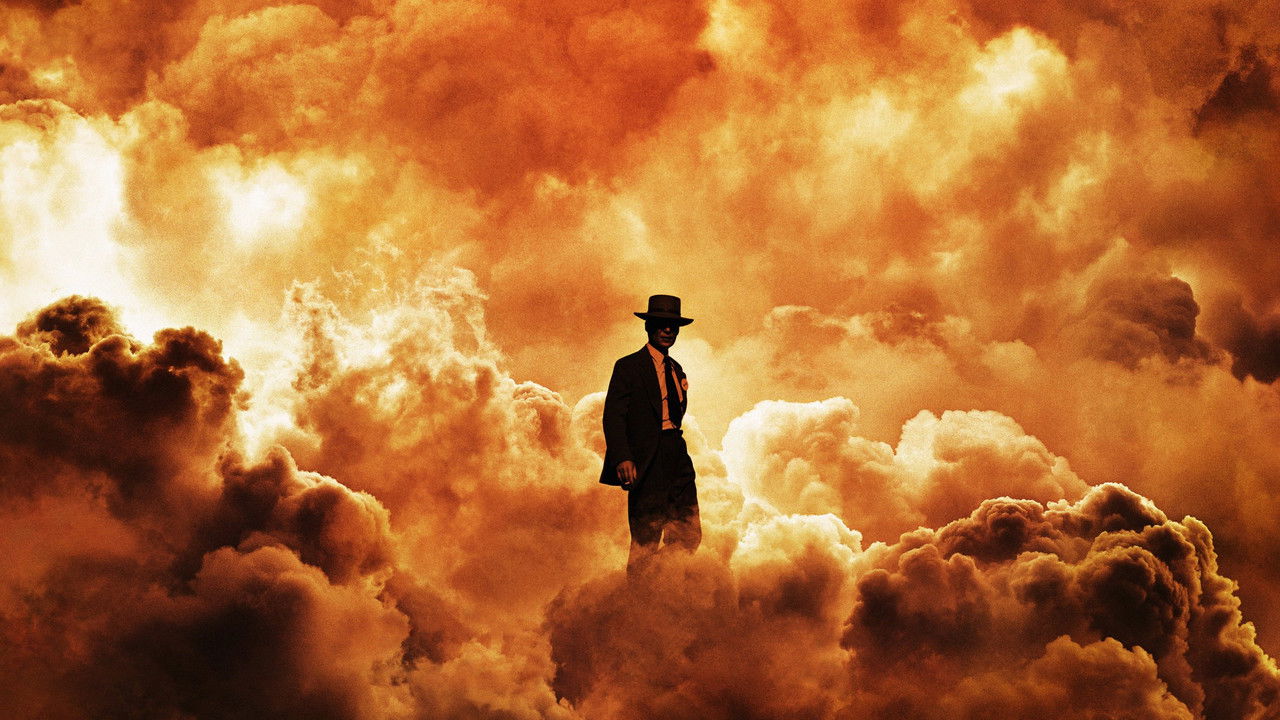
Oppenheimer (2023) is a biographical thriller written, directed, and co-produced by Christopher Nolan. Distributed by Universal Pictures with a reported $100 million budget, the film grossed $952 million worldwide and swept the 96th Academy Awards. The credits that follow its devastating final scene represent one of the most technically ambitious productions in modern cinema — shot on IMAX 65mm and 65mm large-format film, with a crew spanning every major film department.
This breakdown analyzes the end credits as a piece of craft: structure, typography, department hierarchy, and the choices that made these credits both technically precise and quietly controversial.
Oppenheimer Credits at a Glance
| Detail | Value |
|---|---|
| Credits duration | ~7 minutes |
| Total people credited | ~500+ (with 130+ VFX artists notably omitted) |
| Title font | Gotham Bold (Hoefler&Co) |
| Credits font | Clean sans-serif in the Gotham/Helvetica family |
| Style | Traditional scroll on black |
| Background | Solid black |
| Post-credits scene | No (consistent with all Nolan films) |
| Guild compliance | DGA, WGA, SAG-AFTRA, IATSE, PGA |
Oppenheimer Credits Structure
How the Credits Sequence Unfolds
Oppenheimer follows Christopher Nolan’s established credits architecture. The film opens with a Prometheus epigraph — “Prometheus stole fire from the gods and gave it to man. For this he was chained to a rock and tortured for eternity” — before the narrative begins. Minimal title cards appear during the film. The title “OPPENHEIMER” itself appears only once, early in the first act.
The end credits begin immediately after one of the most emotionally devastating final scenes in recent cinema: Oppenheimer’s lakeside conversation with Einstein, followed by a vision of nuclear fire consuming the Earth. The audience sits in silence as the credits roll.
Opening credits cards (pre-scroll): The first cards present the principal billing block in the order dictated by contractual and DGA requirements:
- A Christopher Nolan Film
- CILLIAN MURPHY
- EMILY BLUNT, MATT DAMON, ROBERT DOWNEY JR.
- Above-the-line ensemble: Florence Pugh, Josh Hartnett, Casey Affleck, Rami Malek, Kenneth Branagh
- Written and Directed by CHRISTOPHER NOLAN
- Based on “American Prometheus” by Kai Bird and Martin J. Sherwin
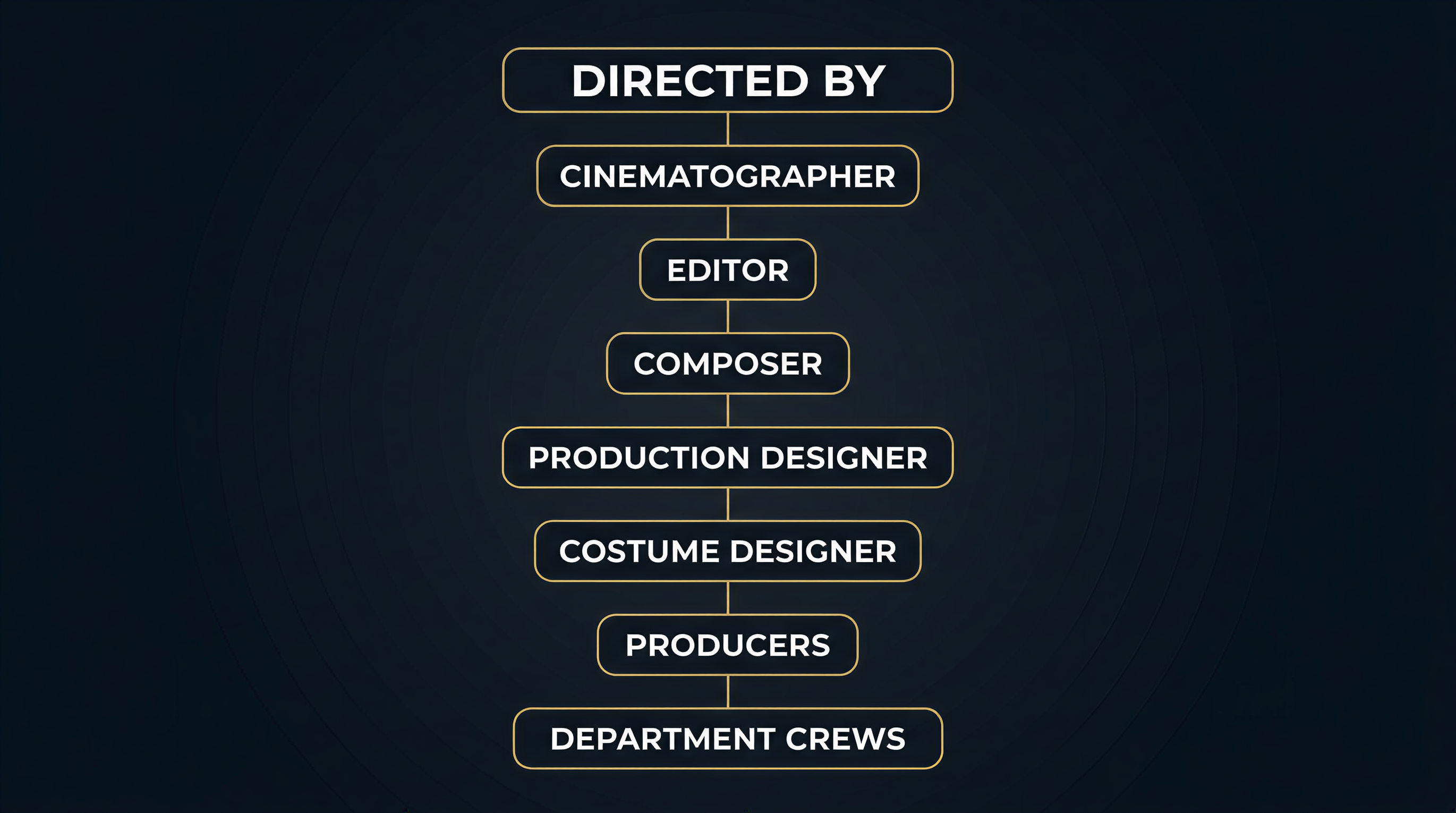
Scroll section: After the title cards, the credits shift to a continuous vertical scroll. Departments appear in an order consistent with standard feature film credits hierarchy:
- Cast (in order of appearance)
- Casting Director — John Papsidera
- Music — Ludwig Goransson
- Costume Designer — Ellen Mirojnick
- Production Designer — Ruth De Jong
- Edited by — Jennifer Lame
- Director of Photography — Hoyte van Hoytema
- Executive Producers
- Produced by — Emma Thomas, Charles Roven, Christopher Nolan
- Department heads and crews (camera, sound, art, wardrobe, hair/makeup, grip/electric, transportation, locations, post-production, VFX, music)
Oppenheimer Credits Typography & Design
Clean Geometry for a Nuclear Age
The title design for Oppenheimer uses Gotham Bold by Hoefler&Co — a geometric sans-serif originally designed by Tobias Frere-Jones and Jesse Ragan in 2000. The promotional materials feature subtle custom modifications to the standard Gotham letterforms, but the DNA is unmistakable.
The end credits themselves maintain a clean, restrained sans-serif aesthetic consistent with Nolan’s body of work. No decorative flourishes, no animated transitions, no background footage. White text on solid black, scrolling at a steady pace. This is deliberate: Nolan’s credits across Dunkirk, Tenet, Interstellar, and now Oppenheimer share a visual language of typographic restraint.
The font choice aligns with what professionals in the title design field would classify as a “transparent” approach — the typography does not call attention to itself. For a film about the weight of scientific achievement and moral consequence, the credits offer no visual distraction from the names themselves.
For a deeper look at why productions choose specific typefaces for credits, see our guide to the best fonts for film credits.
Oppenheimer Credits Department Breakdown
Key Department Heads
Oppenheimer’s credits reveal the scale of a production that built practical sets across multiple states and shot on the largest film format available.
Above the Line:
| Role | Name | Notes |
|---|---|---|
| Director / Writer | Christopher Nolan | Also producer; adapted from American Prometheus |
| Producer | Emma Thomas | Nolan’s long-time producing partner (Syncopy) |
| Producer | Charles Roven | Atlas Entertainment |
| Cinematographer | Hoyte van Hoytema | 4th Nolan collaboration; won Oscar |
| Editor | Jennifer Lame | Won Oscar; first Nolan film without Lee Smith |
| Composer | Ludwig Goransson | Won Oscar; recorded score in 5 days |
| Production Designer | Ruth De Jong | Reconstructed Los Alamos at Ghost Ranch, NM |
| Costume Designer | Ellen Mirojnick | 1,000+ costumes; first Oscar nomination |
| Casting Director | John Papsidera | Assembled one of the largest ensembles in modern film |
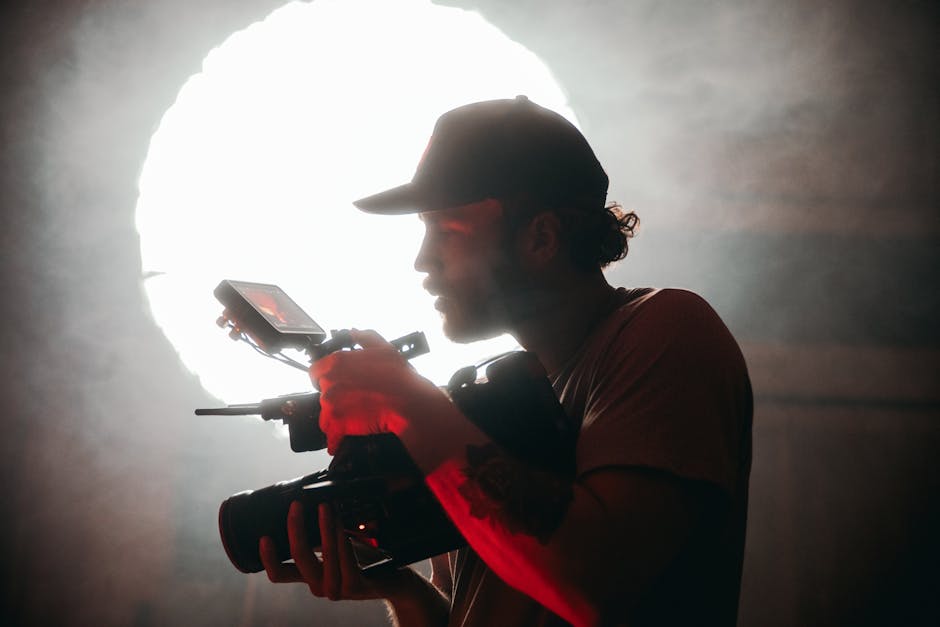
Camera Department: Hoyte van Hoytema shot with the IMAX MKIV, IMAX MSM 9802, and Panavision Panaflex System 65 Studio cameras. Kodak manufactured a new IMAX-compatible black-and-white film stock (Eastman Double-X 5222 in 65mm) specifically for this production — the first time black-and-white IMAX photography had ever been attempted. Panavision lens specialist Dan Sasaki adapted Hasselblad and custom lenses for the extreme close-up work Nolan demanded.
Sound Department: The production sound, sound editing, and re-recording mixing teams are credited in the scroll. The score by Ludwig Goransson — which won both the Academy Award and the Grammy for Best Score Soundtrack — features a solo violin as Oppenheimer’s leitmotif, with no drums in the entire score. Goransson composed roughly two and a half hours of music, recorded over just five days.
Art Department: Ruth De Jong’s team built a scaled reconstruction of the Los Alamos townsite, with dozens of functional buildings serving as both set pieces and actual production department offices during filming. Set decorator Claire Kaufman shared the Art Directors Guild nomination.
The VFX Credits Controversy
80% of the VFX Team Went Uncredited
The most significant credits story surrounding Oppenheimer is what the credits left out.
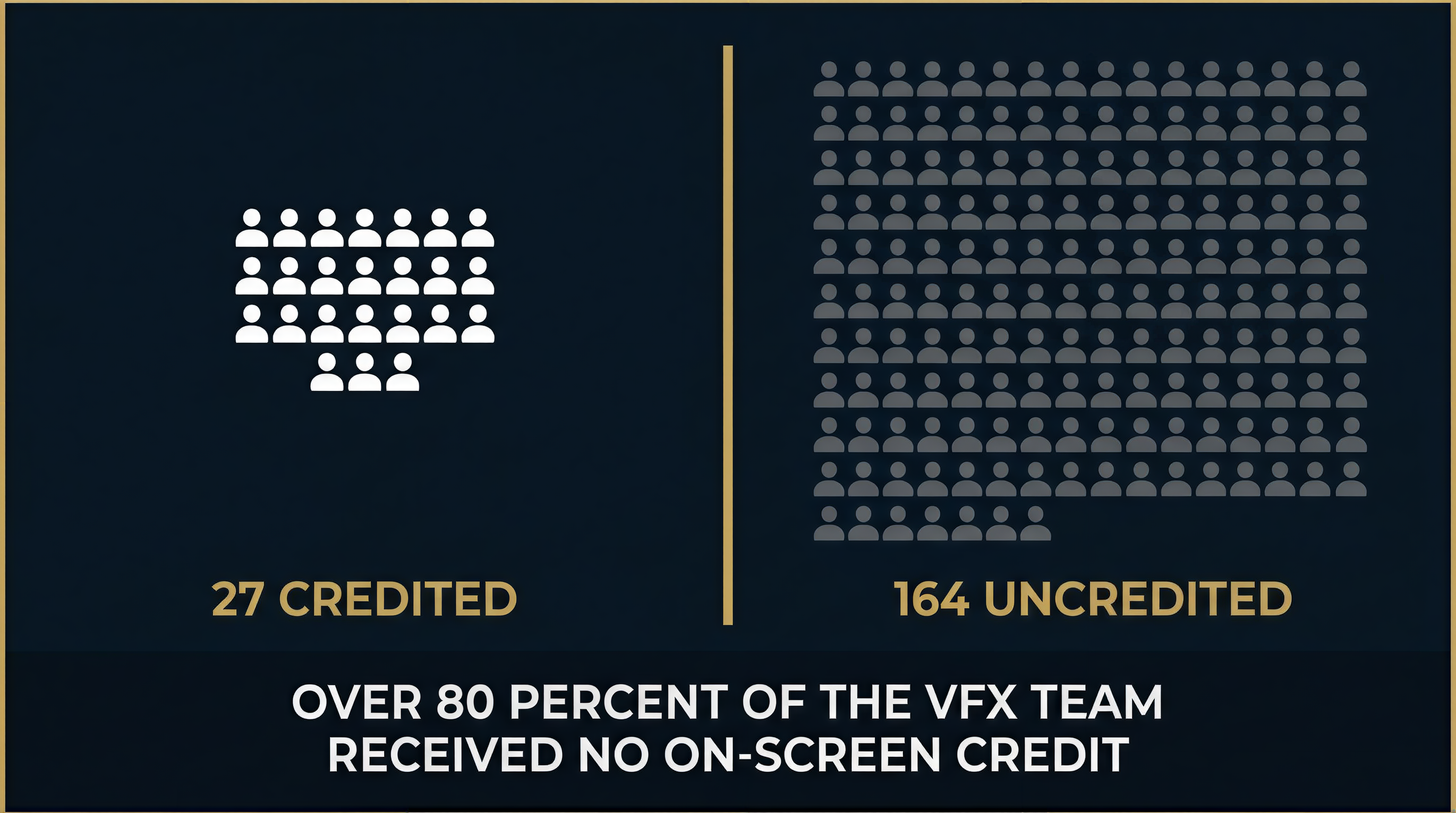
Despite Nolan’s public emphasis on practical effects and the marketing line of “no CGI,” the film contained several hundred visual effects shots — compositing, digital enhancement, retouching, and integration work performed by DNEG. The end credits list just 27 VFX artists, including VFX Supervisor Andrew Jackson. DNEG’s own website, however, credited 164 VFX artists who worked on the film.
That means over 80% of the VFX crew received no on-screen credit.
VFX artist Pia Josephson responded publicly: “With a short credit list in general, and as the ONLY VFX vendor, this is highly disappointing.” David Rouxel, whose credits include Avatar and Guardians of the Galaxy, wrote: “Hundreds of people, mostly from India, whose efforts have not been recognised. Shame on the production team.”
This controversy reflects a broader industry pattern. VFX artists frequently receive fewer credits than their contribution warrants, particularly on productions that employ international teams. Unlike departments covered by IATSE or SAG-AFTRA agreements — which mandate specific crediting protocols — VFX crediting has no universal standard enforced across all studios. The omission on Oppenheimer was especially conspicuous given the film’s relatively small overall VFX vendor footprint (DNEG was the sole vendor).
For filmmakers building their own credits, this is a cautionary note: crediting every contributor is not just ethical — it is increasingly expected by the industry and its audiences. A credit is often the only public acknowledgment a crew member receives for months of work.
Oppenheimer Credits Score & Music
Ludwig Goransson’s Oscar-Winning Soundtrack
The music accompanying Oppenheimer’s end credits is drawn from Ludwig Goransson’s three-movement score. The score is structured around the film’s narrative arcs: Oppenheimer’s physics background, the Manhattan Project, and the Atomic Energy Commission hearing.
The standout track “Can You Hear the Music” — which went viral with over 2.1 billion impressions on TikTok and 60+ million streams — uses a hexatonic scale and multiple tempo changes to evoke the feeling of scientific discovery. Nolan’s sole musical direction to Goransson was to represent Oppenheimer with a solo violin, which he felt captured “the highly-strung intellect and emotion of Robert Oppenheimer.”
The end credits music sustains the film’s emotional intensity without resolution — a deliberate choice that leaves the audience sitting with the weight of what they have just witnessed.
Oppenheimer Guild Compliance Notes
Credits Requirements Across Five Guilds
Oppenheimer’s credits comply with requirements from multiple guilds:
- DGA (Directors Guild of America): Nolan receives sole “Directed by” credit and “A Christopher Nolan Film” possessory credit. His “Written and Directed by” card is a combined credit that the DGA and WGA must jointly approve.
- WGA (Writers Guild of America): Screenplay credit to Christopher Nolan, with “Based upon the book” credit for Kai Bird and Martin J. Sherwin.
- SAG-AFTRA: Cast credits appear in order of appearance. The ensemble’s billing order reflects negotiated contractual positions — Murphy’s sole card above the title, Blunt/Damon/Downey Jr. sharing a card, then the supporting ensemble.
- IATSE: Department crews (camera, grip, electric, wardrobe, hair/makeup, props, set decoration, transportation) follow IATSE crediting conventions.
- PGA (Producers Guild of America): The “p.g.a.” mark appears alongside the producer credits for Emma Thomas, Charles Roven, and Christopher Nolan.
For a complete guide to guild crediting requirements, see our compliance guides.
Post-Credits Scene
There is no post-credits scene in Oppenheimer. None of Christopher Nolan’s films have ever included mid- or post-credits sequences. The film ends with its final devastating image, and the credits are the last thing the audience sees.
The credits run approximately seven minutes. Given the film’s three-hour runtime, that represents a credits-to-runtime ratio of about 3.9% — slightly below average for a major studio production, partly explained by the compressed VFX credits.
For context on typical credits lengths, see our analysis of how long movie credits typically run.
Sources & Further Reading
- Oppenheimer full cast & crew on IMDb
- Hoyte van Hoytema cinematography breakdown (Kodak)
- Ludwig Goransson on recording the score in 5 days (Variety)
- VFX credits controversy (80 Level)
Create credits worthy of your production. Whether you are finishing a studio feature or an independent film, EndCreditsPro helps you build professional, guild-compliant credits with the precision your crew deserves. Start with a template or explore our credits tools.