What Is a Casting Director in Film?
Marion Dougherty cast Midnight Cowboy, Bonnie and Clyde, and Lethal Weapon — and spent most of her career without a single award to show for it. The Academy didn’t add a casting category until 2026. That gap tells you everything about how the industry values this role.
The casting director (CD) is the professional responsible for assembling the acting talent for a film, television series, or commercial. They sit in the pre-production phase of filmmaking, bridging the script on the page and the performers on screen. Without a casting director, most productions above micro-budget scale would collapse under the weight of managing thousands of actor submissions, negotiations, and scheduling logistics.
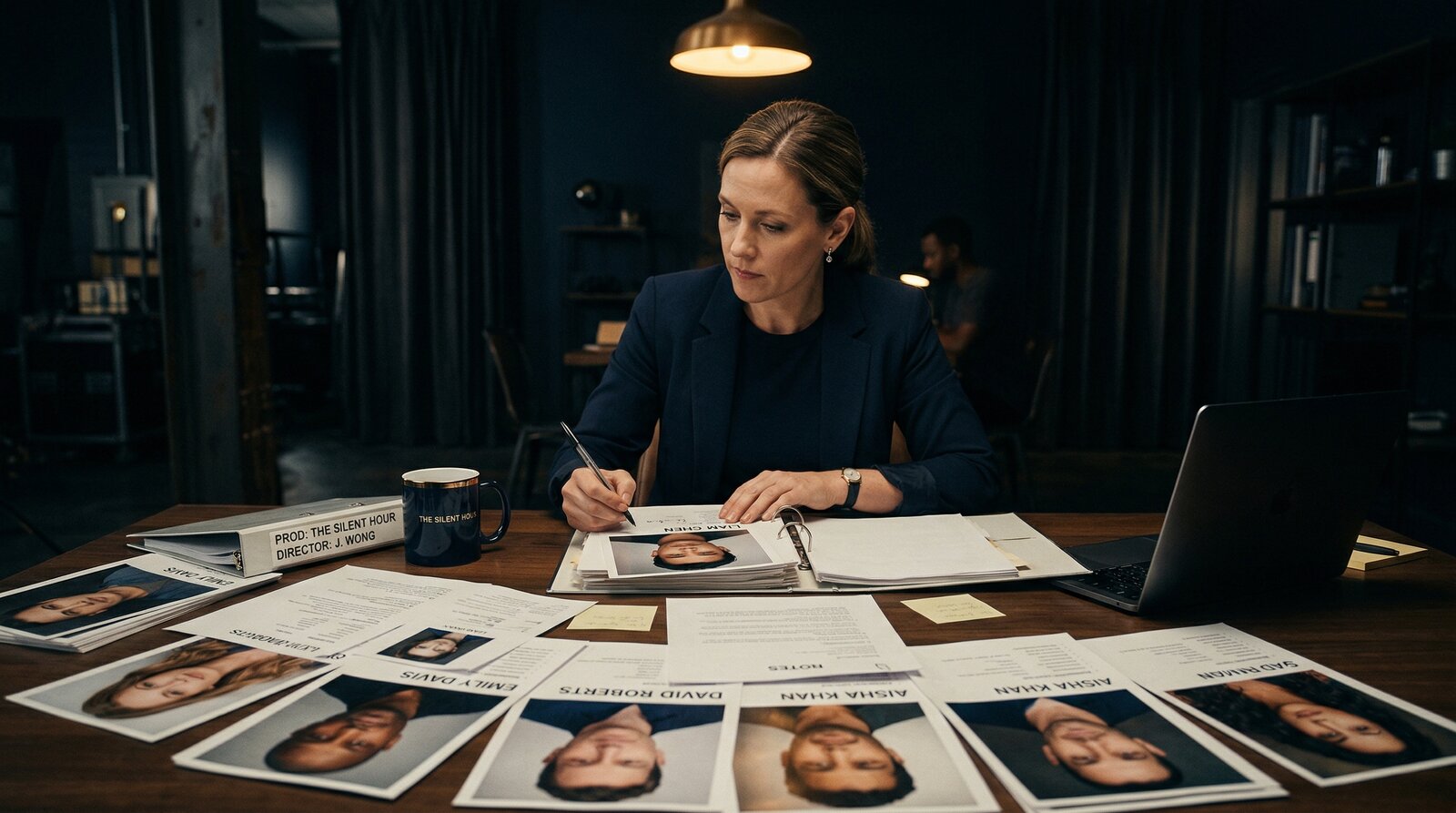
Casting directors belong to the Other department category in credits — alongside the location manager — rather than to any single department. They report to the director and producers, with final casting decisions resting with the director.
What does a casting director do?
What Does a Casting Director Do?
The job is logistics, relationship management, and creative judgment in equal measure. A casting director’s core responsibilities:
- Script breakdown — Before any auditions happen, the CD analyzes the script character by character, noting age ranges, physical requirements, accent demands, and special skills needed
- Breakdowns — The CD submits character descriptions to agents and managers via Breakdown Services, generating actor submissions
- Auditions and callbacks — The CD organizes and runs audition sessions, often doing preliminary reads without the director present, then filtering to callbacks
- Recommendations — The CD builds shortlists for director review, presenting options the director may never have considered
- Offer negotiations — Once casting decisions are made, the CD negotiates directly with agents on availability, billing, and deal points — before the contract goes to business affairs
- Contract coordination — The CD confirms deals, manages scheduling conflicts, and coordinates with the UPM on start dates
- Extras and day players — On larger productions, the CD either handles background casting themselves or oversees a separate extras casting director
Who they report to: The director, with producers signing off on deals.
Who reports to them: Casting associate, casting assistant, extras casting director (on larger productions).
The CD’s creative contribution is often invisible once a film is released — but it’s decisive. When The Silence of the Lambs casting director Jane Feinberg pushed for Jodie Foster over other contenders for Clarice Starling, she was shaping the film’s entire emotional register.

What does a casting director do in pre-production vs. production?
Pre-Production vs. Production vs. Post
| Phase | Casting Director Activities |
|---|---|
| Development | Informal conversations about talent; sometimes attached early to help secure financing |
| Pre-Production | Script breakdown, breakdowns, auditions, callbacks, offers, deals |
| Production | Available for replacements, day player casting, resolving scheduling conflicts |
| Post-Production | Rarely involved unless reshoots require new casting |
Most of the casting director’s work is done before the first day of principal photography. By the time cameras roll, the CD’s contract is often wrapping up or already closed.
Where does the casting director appear in film credits?
Casting Director Credits: Opening vs. End
The casting director appears in both opening and end credits on most feature films — a distinction that reflects their above-the-line status.
Opening credits (main titles): In theatrical features, the casting director often receives a card in the main title sequence. The standard position is after the heads of key departments (director of photography, production designer) but sometimes grouped with other above-the-line credits near the top. The exact placement varies by negotiation.
End credits (closing crawl): In the end crawl, the casting director appears in the above-the-line section, typically grouped with the other key creative contributors before the departmental crew roll. On many studio features, the casting credit appears as a single card early in the end crawl sequence.
Standard credit format:
Casting by
JANE FEINBERG, CSA
MIKE FENTON, CSA
Or on a single line within the main title sequence:
Casting by Jane Feinberg, CSAThe CSA designation — Casting Society of America — functions like a professional credential suffix. It is not a guild designation (the CSA is a trade organization, not a union), but it signals verified professional membership in the industry’s primary casting body. Many productions include it; some omit it. Its presence is a courtesy to the casting director, not a legal requirement.
TV credits: On episodic television, the casting director receives a credit in each episode. They appear in the opening titles on many one-hour dramas. On half-hour comedies, the casting credit is often in the end roll.
How to credit a casting director correctly
Formatting the Casting Credit
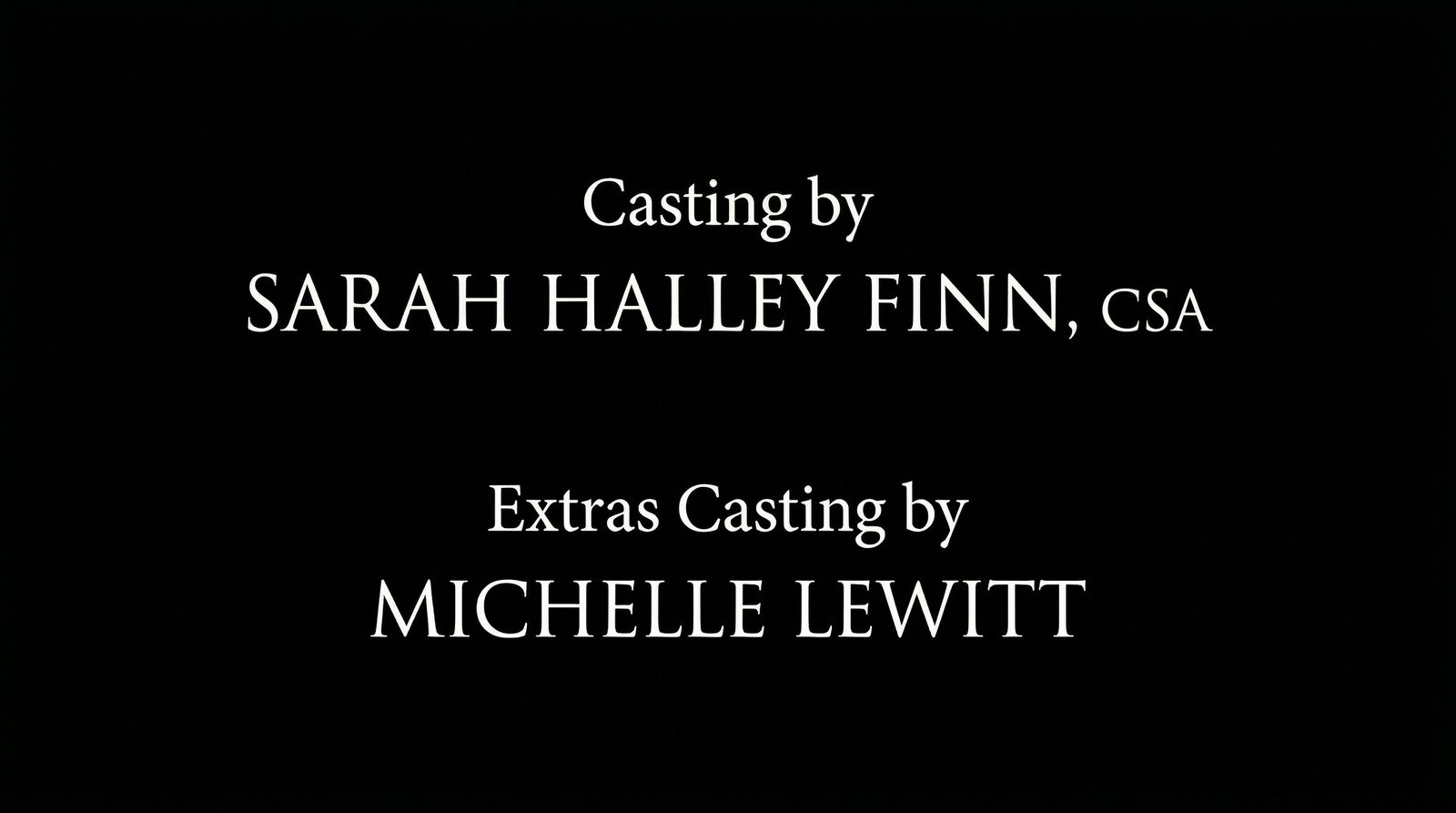
The industry standard format uses the label “Casting by” followed by the director’s name:
Casting by
SARAH HALLEY FINN, CSA
For co-casting arrangements, both names appear together:
Casting by
DAVID RUBIN, CSA
RICHARD HICKS, CSA
Common variations:
- “Casting Director” as the label (less common than “Casting by”)
- Name only, no CSA designation (acceptable on independent productions)
- “Extras Casting by” for a separate credit when background casting is handled separately
What to avoid:
- Do not omit the casting director credit on SAG-AFTRA productions — the performer union contracts typically require it
- Do not list the casting director under a department heading in the crew roll if they have received an above-the-line card — double-crediting is redundant and can cause billing disputes
- Do not add “C.D.” as a suffix — this is not a standard industry abbreviation
If a single person handled all casting functions on a low-budget film, one card is sufficient. If a casting associate did primary work under a named CD, both can receive credits — the CD on their own card, the associate in the crew scroll.
Casting director vs. director
Casting Director vs. Director: Who Decides?
This is one of the most misunderstood divisions in film production. The short answer: the casting director recommends, the director decides.
| Function | Casting Director | Director |
|---|---|---|
| Identify candidates | Yes | Rarely |
| Run initial auditions | Yes | No |
| Attend callbacks | Yes | Yes |
| Final approval | No | Yes |
| Negotiate deals | Yes | No |
| Creative input on character | Yes, actively | Final word |
The CD’s value is in knowing the talent pool — who’s available, who’s good on camera but not in auditions, which actors have chemistry together. Directors who override CDs on every choice tend to miss talent the CD already screened out for reasons that aren’t visible in a headshot.
Casting director salary
What Does a Casting Director Earn?
Compensation varies widely by production type and budget level:
- Entry-level / low-budget indie: $500–$1,500/week flat deal
- Mid-level TV: $3,000–$6,000/week
- Studio feature: $8,000–$15,000/week, sometimes with backend bonuses
Casting directors are typically hired on a flat-fee or weekly rate basis for the duration of the project. They are not employees of the studio — most work as independent contractors or through their own production companies.
The ArtsUSA survey puts the average annual salary at around $60,755, but this reflects the full range from first-time CDs on student films to senior directors on studio tentpoles. The figure is not meaningful as a benchmark.
How casting directors get paid: Directly by the production company, at the rate negotiated in their deal memo. Agents and managers for actors receive their fees separately — casting directors do not take a commission from the talent they cast.
How to become a casting director
Career Path and Education
There is no formal degree path into casting directing. The standard route:
- Internship or PA work at a casting office
- Casting assistant — handling submissions, scheduling, reader work
- Casting associate — running sessions, managing callbacks, building relationships with agents
- Casting director — leading projects independently
Most working CDs spent 3–7 years as assistants and associates before taking on their first solo credit. The relationships built during those years — with agents, managers, and actors — are the actual foundation of the career.
CSA membership requires two years of experience at the associate level. Candidates are sponsored by existing CSA members.
No specific degree is required, though backgrounds in theater, acting, or psychology are common. What matters: knowing who the actors are, how to read a room, and how to manage a director’s wishlist against the realities of availability and budget.
Notable casting directors in film history
Notable Casting Directors
Marion Dougherty built the modern casting director role from scratch. Starting in live TV in the 1950s and moving to film, she discovered Dustin Hoffman, Warren Beatty, Gene Hackman, and Robert Duvall — all before they were names. Her work on Midnight Cowboy (1969) and Bonnie and Clyde (1967) helped define the New Hollywood era.
Lynn Stalmaster was the first casting director to receive an Academy Honorary Award (2017), recognizing a career that included The Graduate, In the Heat of the Night, Coming Home, and Tootsie. He pioneered the practice of casting directors receiving prominent billing.
Sarah Halley Finn, CSA is the casting director behind almost every Marvel Cinematic Universe film since Iron Man (2008). She cast Robert Downey Jr., Scarlett Johansson, and Chris Hemsworth in their defining MCU roles — and has maintained casting continuity across a 20-year franchise spanning dozens of films and series.
Avy Kaufman is known for her casting on Brokeback Mountain, Lincoln, and Schindler’s List (US casting) — projects that required sensitive, precise character work.

Sources & Further Reading
- Casting Society of America (CSA) — Professional organization, membership standards, Artios Awards
- SAG-AFTRA Theatrical Contracts — Contracts that govern productions where casting director credits appear
Create Professional Credits with EndCreditsPro
Casting credits have specific formatting conventions — and getting the billing order wrong can trigger a dispute before your film’s premiere. EndCreditsPro auto-formats your end credits with the correct above-the-line hierarchy, CSA designations, and department ordering so your final crawl meets industry standards.
Generate guild-compliant credits in minutes →
See also: Film Crew Roles · Line Producer · Associate Producer · Film Credits Format & Order Guide