What Is a Focus Puller in Film?
One missed rack cue on a $2 million shot — and it’s unusable. No fix in post, no second chance. That’s what the focus puller lives with on every take.
A focus puller, officially titled First Assistant Camera (1st AC), is the camera department crew member responsible for maintaining optical focus throughout every shot. They adjust the lens focus distance in real time as subjects move, cameras track, and cinematographers make split-second decisions. The 1st AC reports directly to the Director of Photography (DP) and manages the second assistant camera (2nd AC or clapper loader) beneath them.
As DP Oliver Stapleton observed: “The 1st AC has one of the hardest jobs on the set. Focus Pulling not only involves what it sounds like, but also the Focus Puller ‘runs’ the department.” In the camera department, the focus puller sits directly below the DP and camera operator in authority — a technical and managerial role combined.
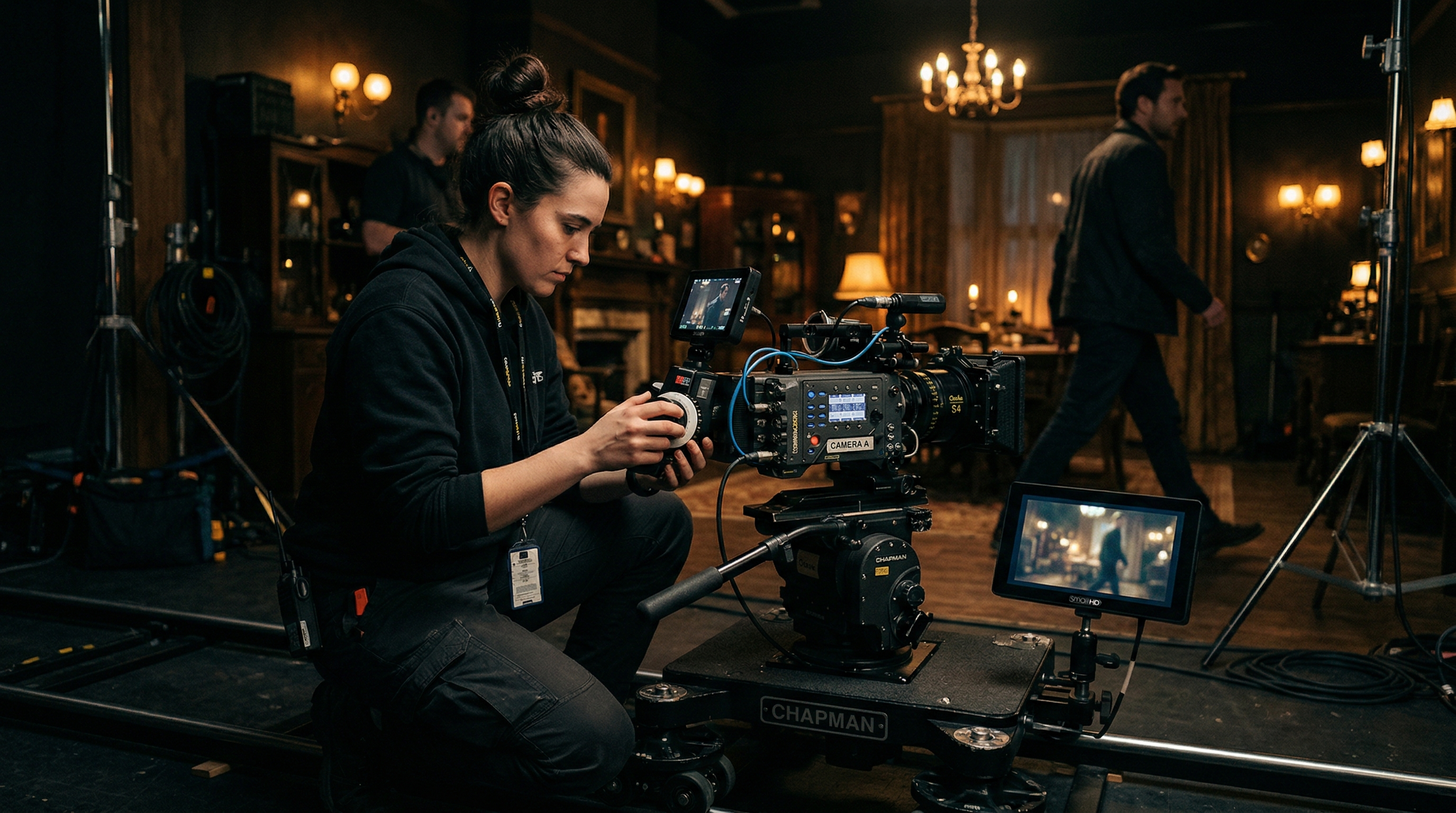
What does a focus puller do?
What Does a Focus Puller Do on Set?
The job title undersells the scope. Yes, a focus puller adjusts the lens focus ring during takes — but that’s the visible tip of a much larger role.
Pre-production:
- Coordinates with the DP and rental house to test and spec the camera package
- Calibrates cinema lenses and verifies parfocal performance
- Builds and tests wireless follow focus systems, confirming signal integrity
- Scouts locations to establish focus reference points
On set (each shooting day):
- Builds camera from scratch each morning
- Measures distances from actors’ marks to the camera’s focal plane using tape measures or laser range finders
- Marks lens barrels with grease pencil — a map of focus positions for each setup
- Executes smooth focus transitions during takes, including complex rack focus moves
- Monitors focus via HD or 4K reference monitors
- Changes lenses, filters, and adjusts exposure per DP specifications
- Manages and directs the 2nd AC, loader, and camera trainees
Specialty work: Steadicam, crane shots, underwater productions, and VFX-heavy sequences all require the 1st AC to adapt their technique. During handheld or Steadicam operation, wireless follow focus units allow the focus puller to work remotely while the operator moves freely.
Matt Sanderson, 1st AC on Everything Everywhere All at Once and Gaslit, describes his core practice as “staring at people’s eyes, trying to keep their eyes as in-focus as possible” — a deceptively simple description of a technically demanding job.
What is a follow focus system?
Focus Puller Equipment
The follow focus system is the focus puller’s primary tool — a geared ring that attaches to the lens barrel, allowing precise rotation control from a handset rather than gripping the lens directly.
Standard equipment on a professional set:
| Tool | Purpose |
|---|---|
| Preston FIZ | Industry-standard wireless lens control system (Focus, Iris, Zoom) |
| ARRI WCU-4 | Wireless follow focus unit, common on ARRI camera packages |
| Tilta Nucleus-M | Mid-range wireless system, popular on indie and commercial shoots |
| RT Motion | High-end wireless FIZ, frequent on features and episodic TV |
| HD/4K reference monitor | Real-time focus checking, often run in B&W to sharpen edge definition |
| Laser range finder / tape measure | Pre-shot distance measurement to establish focus marks |
| Lens barrels with depth-of-field markings | Pre-marked focus positions using grease pencil or dry-erase marks |
Traditional mechanical follow focus units remain viable on lower-budget productions. Wireless systems are standard on studio features and high-end episodic television.

Where does the focus puller appear in film credits?
Focus Puller Credits: Where and How They Appear
The focus puller appears in the end credits, within the Camera Department block. No opening credit — this is a below-the-line crew position.
Standard credit order within the camera department:
Director of Photography    JANE SMITH
Camera Operator            JOHN DOE
1st Assistant Camera       ALEX MORGAN
2nd Assistant Camera       RILEY CHEN
Digital Imaging Technician SAM TORRES
The focus puller is credited as “1st Assistant Camera” on virtually all American productions — this is the standardized IATSE Local 600 title. “Focus Puller” appears more often on British and European productions, where the term remains the standard industry usage. Both titles refer to identical responsibilities.
On multi-camera shoots or productions with a second unit, you’ll see expanded credits:
A Camera 1st Assistant Camera    ALEX MORGAN
B Camera 1st Assistant Camera    PRIYA PATEL
2nd Unit 1st Assistant Camera    JAMES REEVES
IATSE Local 600, the International Cinematographers Guild, represents focus pullers on union productions in the United States. The guild’s collective bargaining agreements establish minimum credit requirements, ensuring that 1st ACs receive on-screen credit on covered productions.
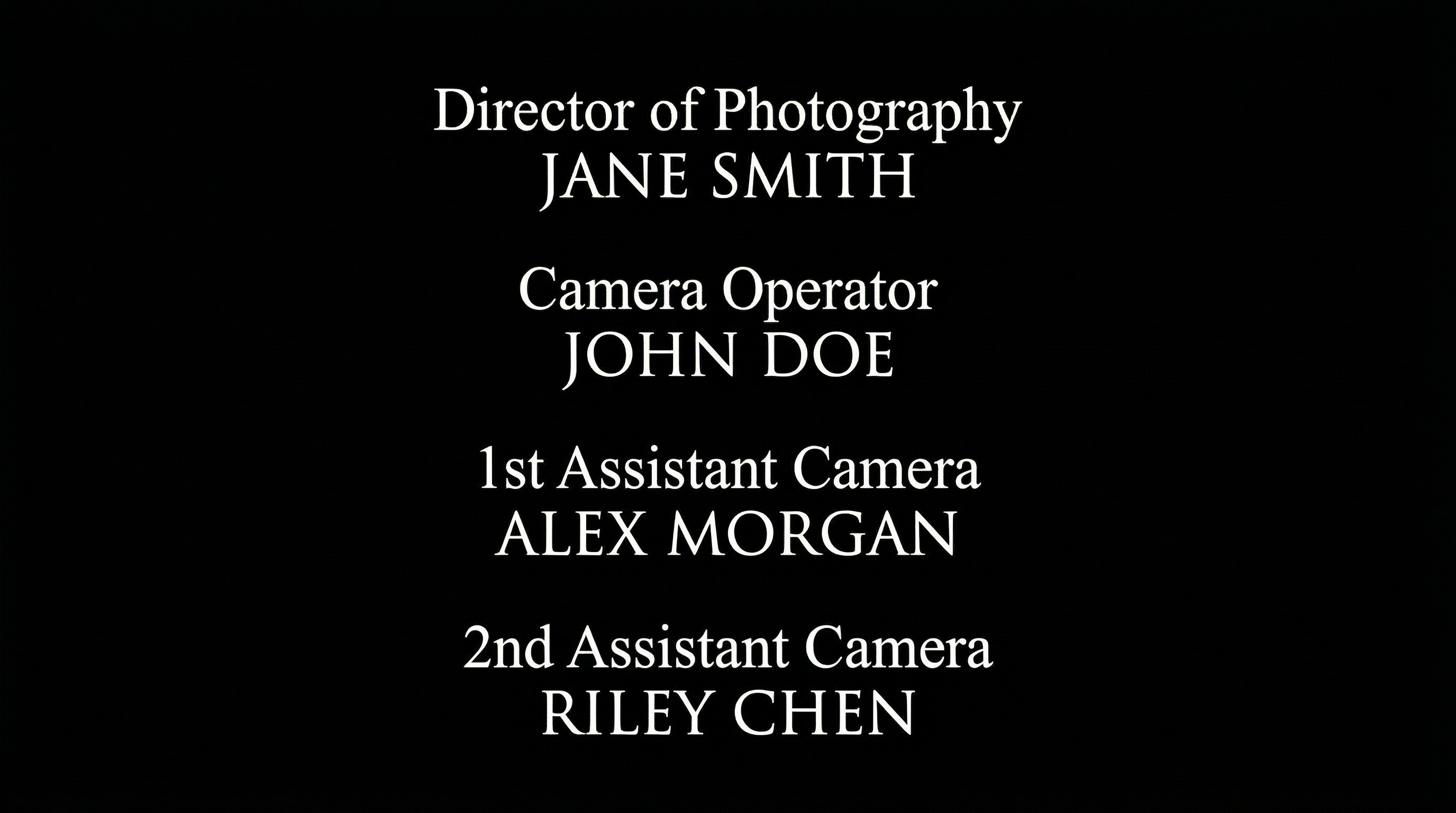
How to credit a focus puller correctly
Correct Credit Format for a Focus Puller
US productions (union standard):
1st Assistant Camera ............. FIRST LASTUK/international productions:
Focus Puller ............. FIRST LASTCommon variations by production type:
- Feature films: “1st Assistant Camera” — full name, sometimes one card for A-camera and B-camera 1st ACs together
- Television: Same as features, often listed by camera (A Cam 1st AC, B Cam 1st AC)
- Commercials and music videos: “Focus Puller” or “1st AC” both appear; no strict standard
- Documentary: Sometimes credited as “Camera Assistant” on smaller productions
If one person served as both camera operator and 1st AC (common on low-budget shoots), they should be credited under the higher-tier title — Camera Operator — not both.
IATSE Local 600 requirement: On productions covered by the ICG Basic Agreement, the 1st AC must receive screen credit. The standard title is “First Assistant Camera” or “1st Assistant Camera.”
Focus puller vs camera operator
Focus Puller vs Camera Operator: What’s the Difference?
The confusion is understandable — both work with the camera on every shot. But their jobs are distinct.
| Focus Puller (1st AC) | Camera Operator | |
|---|---|---|
| Primary task | Lens focus control | Camera movement and framing |
| During takes | Adjusting focus ring, monitoring sharpness | Operating the camera body, executing moves |
| Department role | Department technical manager | Reports to DP, above 1st AC in hierarchy |
| Guild | IATSE Local 600 | IATSE Local 600 |
| End credit title | 1st Assistant Camera | Camera Operator |
On lower-budget productions, the camera operator will often pull their own focus — this is called self-focusing or self-pulling. It’s common on documentary, run-and-gun commercial work, and solo shoots. On any production where coverage and sharpness matter, a dedicated focus puller is non-negotiable.
Focus puller salary & day rate
Focus Puller Salary and Day Rate
Compensation varies significantly by market, budget tier, and union status.
IATSE Local 600 union productions (US):
- Day rate: approximately $325–$550 for 10-hour days, depending on region and production type
- Annual earnings: $70,000–$250,000 depending on project scale and how consistently you work
- Western Region (Los Angeles) and Eastern Region (New York) rates are typically higher than Central Region
Non-union: Lower rates without the benefit protections — pension contributions, health coverage through the Motion Picture Industry Pension and Health Plans, or overtime minimums.
IATSE Local 600 membership requires either 30 days of covered union work within one year, or 100 days of non-union work documented over three years. Initiation fees typically exceed $5,000.
The UK has its own rate structures through BECTU and the Broadcasting and Creative Industries Dispute Resolution scheme, with experienced focus pullers on major features earning comparable rates to their American counterparts.
How to become a focus puller
Career Path: How to Become a Focus Puller
The standard progression in the camera department:
Camera PA → Camera Trainee → 2nd AC (Clapper Loader) → 1st AC (Focus Puller) → Camera Operator → Director of Photography
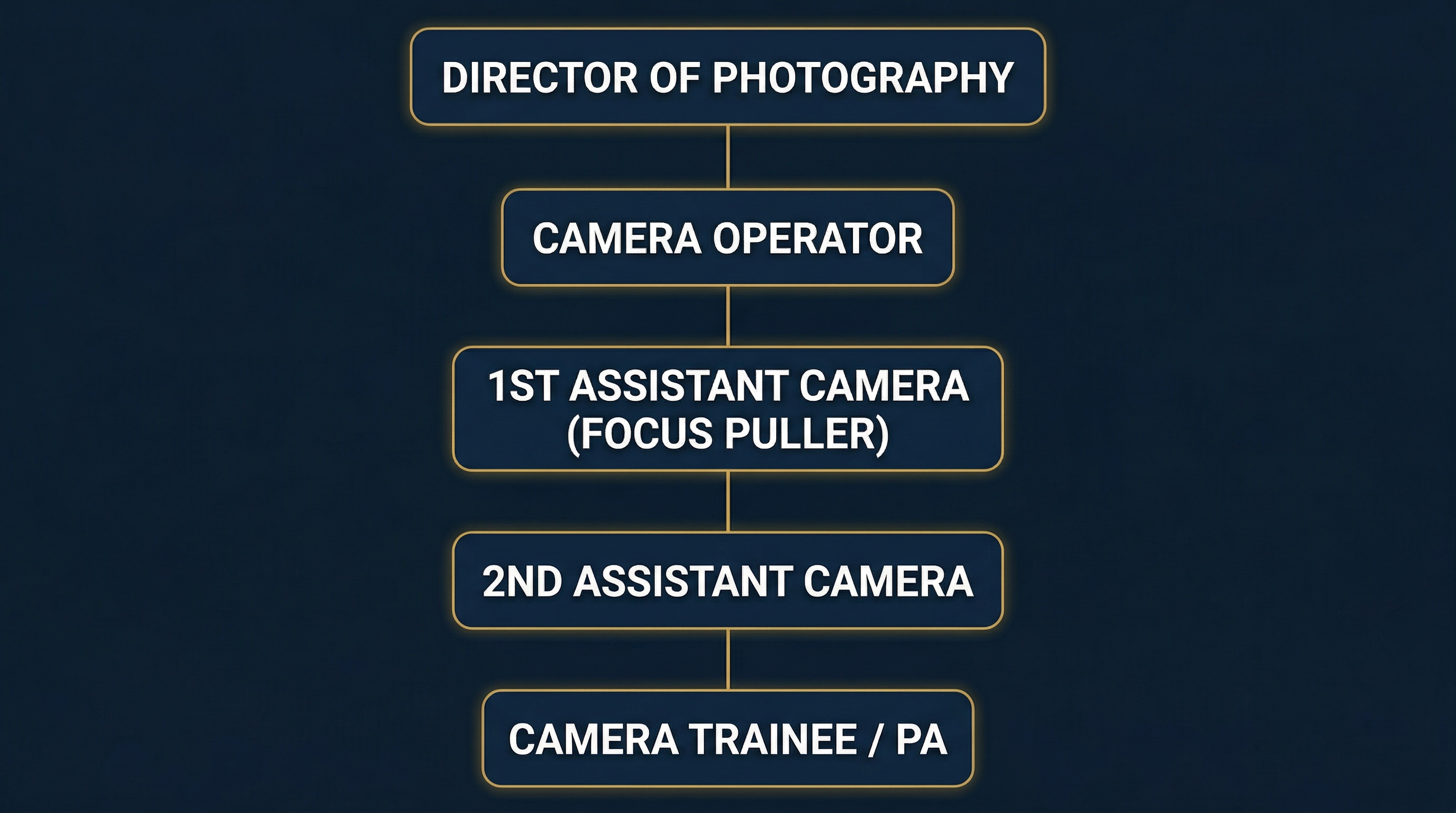
Most working 1st ACs reach the role through years of 2nd AC experience — typically 3–7 years, depending on how quickly they accumulate credits and build relationships.
Practical routes in:
- Film school (USC, NYU Tisch, AFI, Chapman) provides technical foundation but doesn’t replace on-set experience
- Camera rental houses are “one of the best ways to develop technical knowledge” according to industry practitioners — handling professional gear daily builds fluency with lens behavior, camera systems, and troubleshooting
- Starting in smaller production markets (Atlanta, New Orleans, Austin, Chicago) builds credits before relocating to Los Angeles or New York
- Manufacturer training and certification programs for specific systems (ARRI, Preston, Tilta) signal technical seriousness
DPs rarely hire 1st ACs they haven’t worked with before — most are hired through prior relationships or recommendations from trusted sources. Building a track record and a reputation for reliability matters more than any credential.
Notable Focus Pullers in Film
Notable Focus Pullers
Matt Sanderson has worked extensively with DP Larkin Seiple on Everything Everywhere All at Once (2022), Swiss Army Man (2016), and Childish Gambino’s “This is America” music video — productions known for inventive cinematography requiring sophisticated focus work.
Lauren Peele brought consistent 1st AC work to television, including The L Word: Generation Q, building a reputation in episodic drama.
The focus puller’s contributions to landmark cinematography are rarely acknowledged publicly — they’re the invisible hand behind sequences audiences take for granted. Christopher Nolan’s Inception (2010) and Alejandro González Iñárritu’s The Revenant (2015) both required precise focus pulling on complex tracking shots and long takes where a single soft frame would have broken the illusion.
Create Professional Film Credits with EndCreditsPro
EndCreditsPro auto-formats your camera department credits in the correct industry order — 1st AC, 2nd AC, DIT, and every other position placed exactly where it belongs. Generate guild-compliant end credits →
Sources & Further Reading
- IATSE Local 600 — International Cinematographers Guild — union rates, membership requirements, and guild coverage
- Focus Puller — Wikipedia — foundational overview with industry context
- Meet the First Assistant Camera: Matt Sanderson — Entertainment Partners — first-person account of the 1st AC role from a working professional
Related roles in the camera department:
- Cinematographer (Director of Photography) — the focus puller’s direct supervisor
- Camera Operator — works alongside the focus puller on every shot
- Film Crew Roles Hub — complete guide to every department