What Is a Sound Editor in Film?
Four Academy Awards. One credit line. Most audiences have no idea what it took.
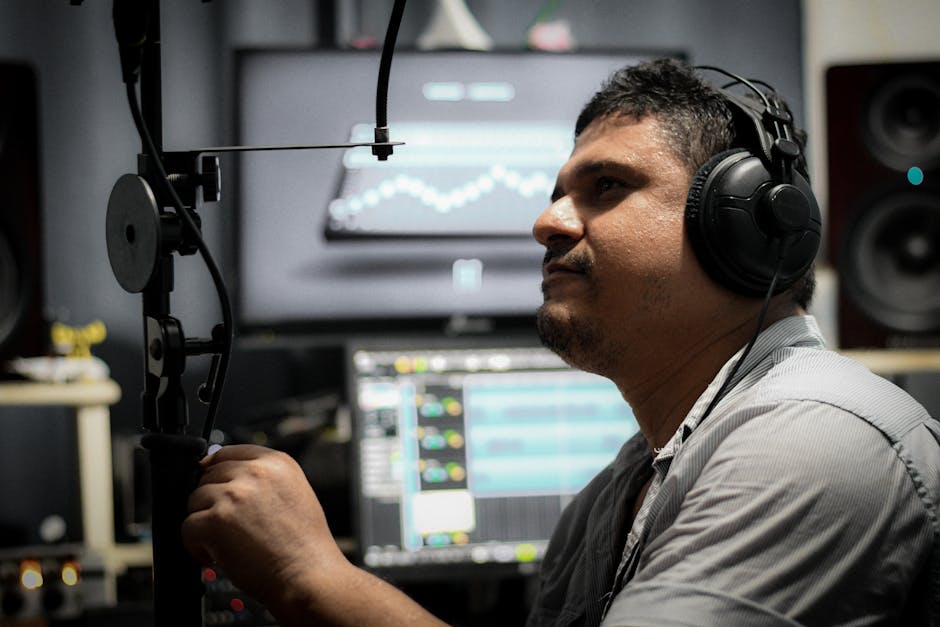
A sound editor is a post-production professional responsible for selecting, creating, and assembling all non-music, non-dialogue audio elements that build a film’s sonic world. They work after picture lock, turning a film with rough production audio into a fully realized auditory experience. On larger productions, the supervising sound editor leads a team of specialists; on independent films, one person often handles the entire post-production sound workflow alone.
Sound editors belong to the Sound department and report to the director and producers during post-production. They work in close collaboration with the re-recording mixer, who assembles the final mix from the edited tracks sound editors deliver.
What does a sound editor do?
What Does a Sound Editor Do?
The supervising sound editor’s job officially begins at picture lock — the moment the director and producers have approved the final picture edit. Before that point, however, on larger productions, the supervising sound editor is often brought in during pre-production to plan the post-production sound workflow, budget, and hire the editorial team.
Core responsibilities include:
- Attending the spotting session — a review with the director that determines where each sound effect is needed, which dialogue needs ADR, and the overall sonic approach (naturalistic vs. stylized)
- Organizing and supervising the sound editorial team, which typically includes:
- Dialogue editor — cleans and assembles the production dialogue; fixes background inconsistencies between takes; manages ADR sessions
- Sound effects editor — selects and designs all hard sound effects (impacts, vehicles, weapons, crowds)
- Foley editor — works with the Foley artist to record and edit footsteps, cloth movement, and prop sounds in sync with picture
- Music editor — syncs the composer’s score to picture; manages temp music during post
- Building and maintaining the production’s sound effects library
- Managing ADR (Automated Dialogue Replacement) sessions when on-set dialogue is unusable
- Delivering edited stems to the re-recording mixer for the final mix
- Overseeing deliverables after the final mix, including M&E (music and effects) tracks for international distribution
The standard DAW in use across the American film industry is Pro Tools, running on Mac. Other systems — Nuendo, Logic — see use in smaller markets.
In smaller productions, the supervising sound editor may perform all of these roles simultaneously — editing dialogue, designing effects, and sometimes mixing the final track themselves. In that case, the correct credits are “Supervising Sound Editor” and “Re-Recording Mixer” as two distinct credits.
Sound editor salary
Sound editor compensation varies significantly by market and production budget. In Los Angeles and New York, IATSE-affiliated sound editors on studio features earn negotiated union rates. Day rates for supervising sound editors on mid-budget features typically range from $700–$1,500/day, while specialist editors (dialogue, SFX) earn $400–$900/day. Television post-production often involves weekly rates under IATSE Local 700 or Local 695 agreements. On independent productions with deferred pay, rates are negotiated project by project.
Sound editor film responsibilities: where to start
Breaking Down the Sound Editorial Process
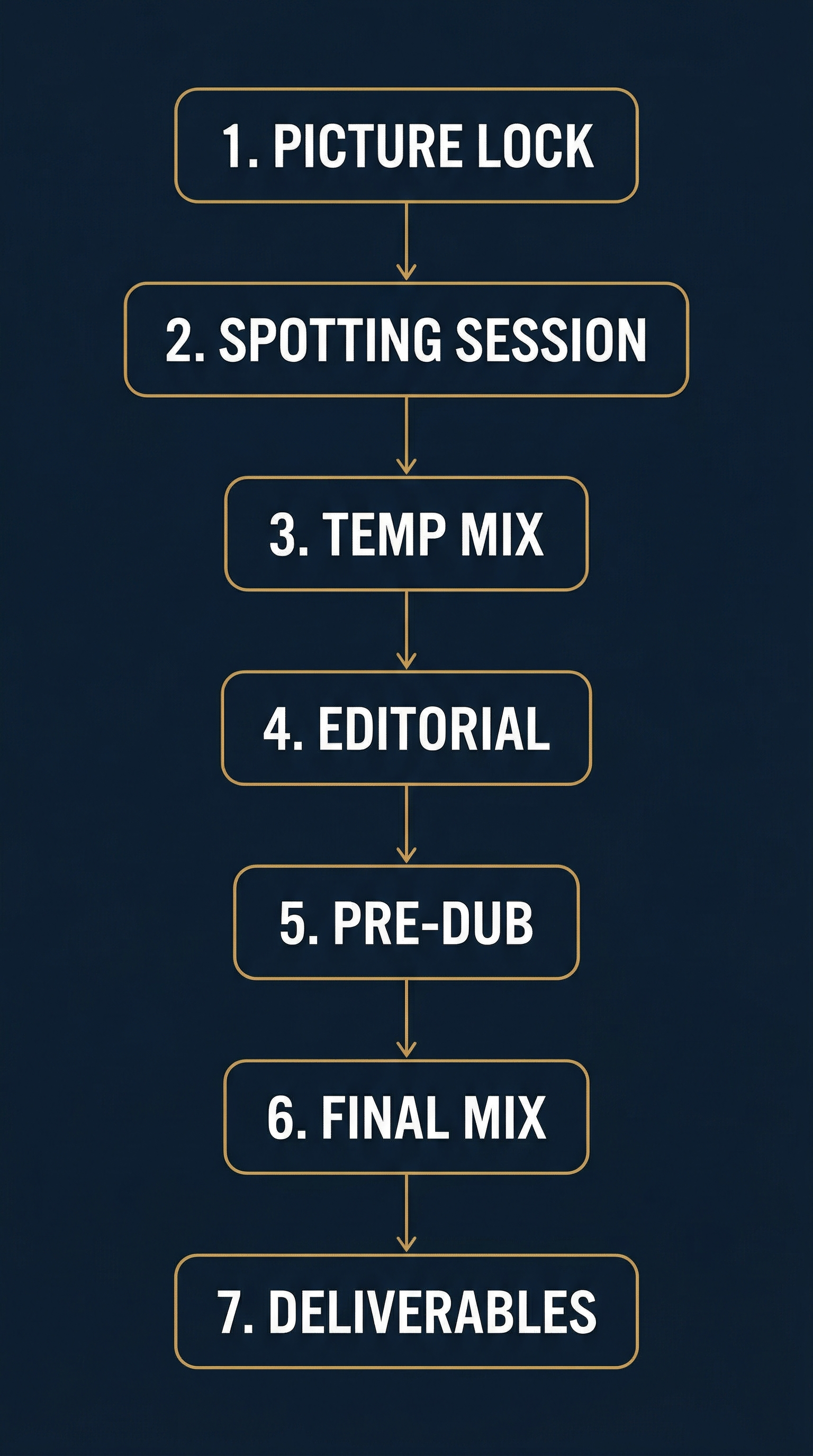
A film’s sound post-production follows a consistent workflow regardless of budget:
- Picture lock → sound editorial officially begins
- Spotting session → director and supervising sound editor review every scene for sound needs
- Temp mix → rough audio assembled for internal screenings
- Editorial → dialogue, SFX, Foley, and music tracks built simultaneously
- Pre-dub → individual stems are mixed by the re-recording mixer
- Final mix (dubbing stage) → all elements combined and balanced
- Deliverables → print master, M&E track, Atmos/5.1/stereo versions
Richard King — four-time Oscar winner for Best Sound Editing on Dunkirk, Inception, The Dark Knight, and Master and Commander: The Far Side of the World — has described the process as building “an impossible sound that could never be heard in real life” by layering the components of a single event (impact, whiz, crack) in a way the ear processes as hyperreal. The jarring “CRACK” of the plane crash in Dunkirk, rather than a conventional low boom, was a deliberate editorial choice to subvert audience conditioning.
Sound editor vs sound mixer — what’s the difference?
Sound Editing vs. Sound Mixing: Two Different Jobs
This is the most common source of confusion in post-production sound credits, and getting it wrong will make you look uninformed on a call sheet.
| Sound Editor | Sound Mixer (Re-Recording Mixer) | |
|---|---|---|
| When | During post-production editorial phase | Final stage of post-production |
| What they do | Selects, creates, and assembles audio tracks | Combines and balances all tracks into the final soundtrack |
| Tool | Pro Tools (editorial) | Pro Tools or mixing console on a dubbing stage |
| Output | Edited stems (dialogue, SFX, Foley, music) | Mixed print master |
| Guild | IATSE Local 700 (editors), MPSE (professional org) | IATSE Local 695 |
Key distinction: The sound editor builds the raw material. The re-recording mixer assembles and balances it into the finished track you hear in the theater.
At the Academy Awards, these are recognized separately: Best Sound covers the final mix (the re-recording mixers and production sound mixer), while historically Best Sound Editing recognized the supervising sound editor. The Academy merged these two categories into a single Best Sound award starting with the 2021 ceremony.
On independent productions where one person does both jobs, the correct approach — as confirmed by practitioners — is to take both credits: “Supervising Sound Editor” and “Re-Recording Mixer.”
Where does the sound editor appear in film credits?
Sound Editor Credits Placement in End Credits
Sound editors appear in the end credits, never in the main titles (opening credits). The placement follows a consistent hierarchy within the Sound department section.
Standard end credit order for Sound department:
SOUND

Production Sound Mixer . . . . . . . . . . . JANE SMITH
Boom Operator  . . . . . . . . . . . . . . . ALEX JONES

POST-PRODUCTION SOUND

Supervising Sound Editor . . . . . . RICHARD KING
Re-Recording Mixer . . . . . . . . . GARY RIZZO
Dialogue Editor  . . . . . . . . . . SARAH CHEN
Sound Effects Editor . . . . . . . . TOM WARD
Foley Artist . . . . . . . . . . . . PETER FLANNERY
Foley Mixer  . . . . . . . . . . . . LEE PRICE
ADR Mixer  . . . . . . . . . . . . . DAVID PARK
Music Editor . . . . . . . . . . . . JANA BROWN
The Supervising Sound Editor appears first within the post-production sound block. On films without a designated supervisor, the “Sound Editor” credit occupies that top position.
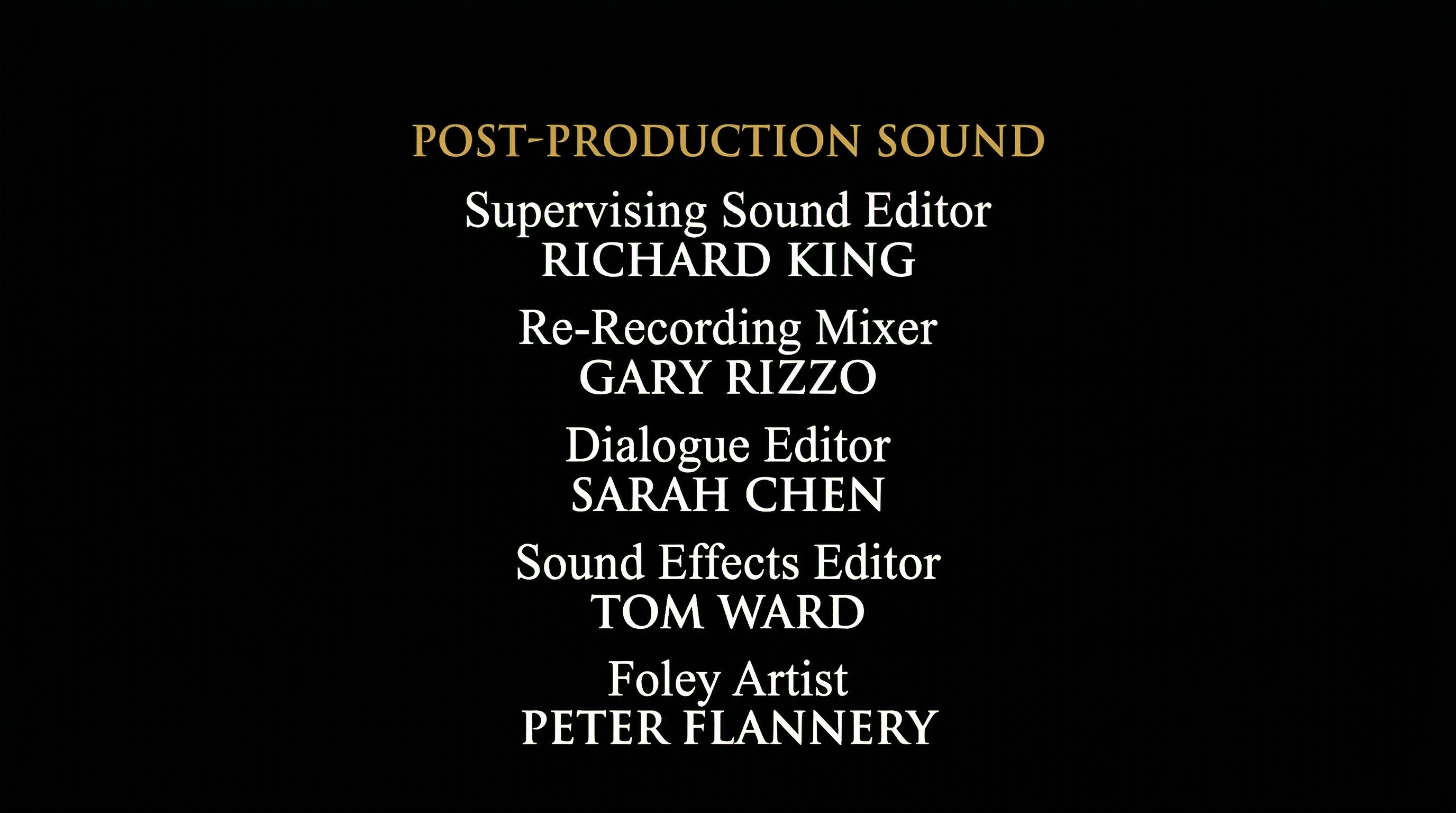
Single card vs. scroll: Sound editor credits always appear in the scroll, not on a single card. Only the above-the-line talent (director, producers, writer, stars) and department heads of the most prominent departments receive single-card treatment.
Possessory credit: Occasionally, and almost exclusively on documentaries or very small productions, a sound editor may receive a “Sound by [Name]” credit. This is non-standard for features.
How to credit a sound editor correctly
Credit Formatting for Sound Post-Production Roles
The title you use in the credits should match the actual scope of work. Industry practitioners are specific about this — using “Sound Designer” instead of “Supervising Sound Editor” is increasingly common on indie films, but it creates complications if the film goes to awards consideration.
Correct titles, in order of seniority:
| Credit Title | When to Use |
|---|---|
| Supervising Sound Editor | The lead sound editorial role; oversees a team OR performs all sound editing on the production |
| Re-Recording Mixer | The mixer of the final soundtrack (often a separate person on features) |
| Dialogue Editor | Dedicated editor for production dialogue and ADR |
| Sound Effects Editor | Dedicated editor for hard effects and sound design |
| ADR Mixer | Records and mixes automated dialogue replacement sessions |
| Foley Editor | Edits Foley tracks recorded by the Foley artist |
| Music Editor | Syncs score and manages music tracks in post |
If one person handles everything: Credit as “Supervising Sound Editor” and “Re-Recording Mixer” on separate lines. Adding “Sound Designer” as a third credit is redundant and, per industry consensus, not a recognized union title.
What to avoid:
- “Sound Designer” as the primary post-production credit — it’s vague, not universally recognized, and may exclude you from guild award eligibility
- “Sound Editor” without “Supervising” when you led or were the sole post-production sound person — undersells the role
- Conflating the production sound mixer (on-set) with the sound editor (post-production) — these are different departments
Sound editor vs sound designer — is there a difference?
Supervising Sound Editor vs. Sound Designer
“Sound Designer” is a title that emerged in the 1970s, largely credited to Walter Murch, who received the title on Francis Ford Coppola’s Apocalypse Now (1979) to describe his holistic approach to the film’s sonic world. Since then, the title has been used inconsistently.
In practice:
- Supervising Sound Editor is the formal union/guild title recognized by IATSE and the Academy
- Sound Designer is often used interchangeably, particularly on productions with ambitious or experimental sound work
- On large studio productions, a “Sound Designer” may be credited in addition to the supervising sound editor — focusing specifically on the creation of unique, iconic sounds (like Ben Burtt’s work on Star Wars)
The Motion Picture Sound Editors (MPSE) — the professional organization for sound editorial — uses “supervising sound editor” as the standard professional designation.
Notable sound editors in film history
Sound Editors Who Defined the Craft
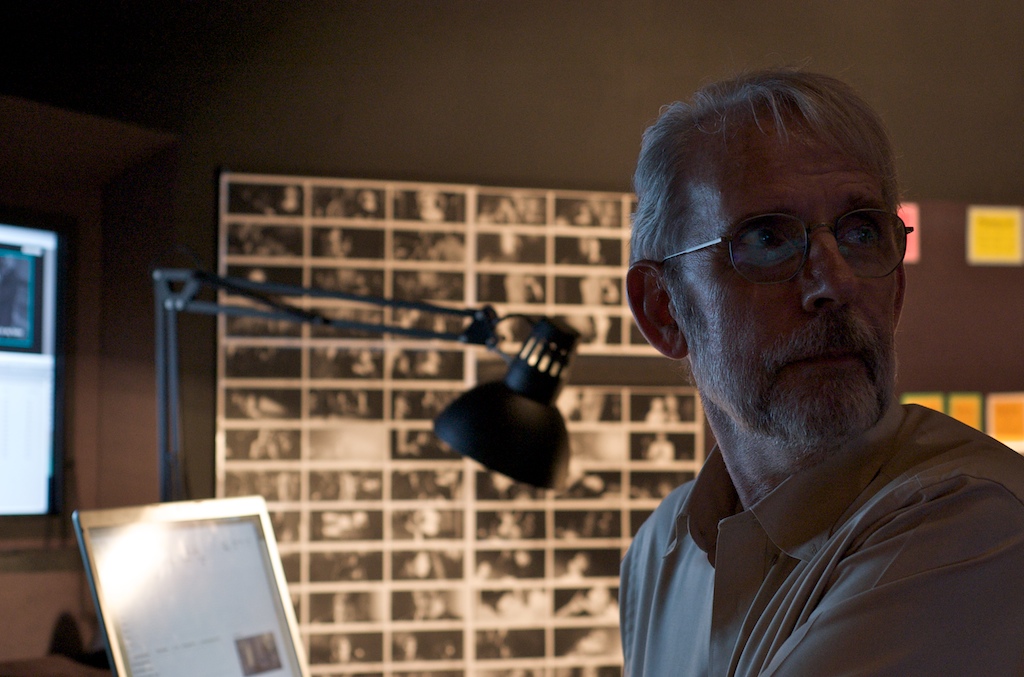
Walter Murch — Apocalypse Now, The Godfather trilogy, The English Patient. Widely regarded as the godfather of modern sound editing. Coined the “rule of six” for editing decisions. The title “Sound Designer” was created for his Apocalypse Now credit.
Richard King — Dunkirk, Inception, The Dark Knight, Interstellar, No Country for Old Men. Four Academy Awards for Best Sound Editing. Longtime collaborator of Christopher Nolan, known for hyperrealistic sonic textures and subverting genre conventions.
Gary Rydstrom — Terminator 2, Saving Private Ryan, Jurassic Park. Seven Academy Awards. Created the iconic T. rex roar and the water-ripple sequence in Jurassic Park using a combination of real animal recordings and custom synthesis.
Ben Burtt — Star Wars saga, E.T., WALL-E. Created R2-D2’s voice, the lightsaber hum, and Chewbacca’s growl. His name is synonymous with the concept that sound effects can carry characterization.
Sources & Further Reading
- Motion Picture Sound Editors (MPSE) — the professional organization for sound editing professionals
- Berklee: Supervising Sound Editor Career Guide
- Wikipedia: Sound editor (filmmaking)
Create Professional Sound Credits with EndCreditsPro
Getting sound credits right — supervising sound editor, dialogue editor, Foley artist, re-recording mixer — in the correct order, with the correct title formatting, matters for guild compliance and professional presentation. EndCreditsPro auto-formats your end credits according to industry standards, so your sound department is credited correctly every time. Generate guild-compliant credits in minutes.
Related roles: Boom Operator, ADR Mixer, Composer. See the full film crew roles guide.