What Is a Set Dresser in Film?
Everything the camera sees — every dish on the table, every book on the shelf, every piece of furniture that makes the world feel lived-in — a set dresser put it there.
A set dresser is a member of the art department responsible for physically placing, arranging, and maintaining all set dressing elements on a film or television production. Set dressing includes furniture, soft furnishings, decorative objects, plants, books, and any non-actor element that gives a location its on-screen character.
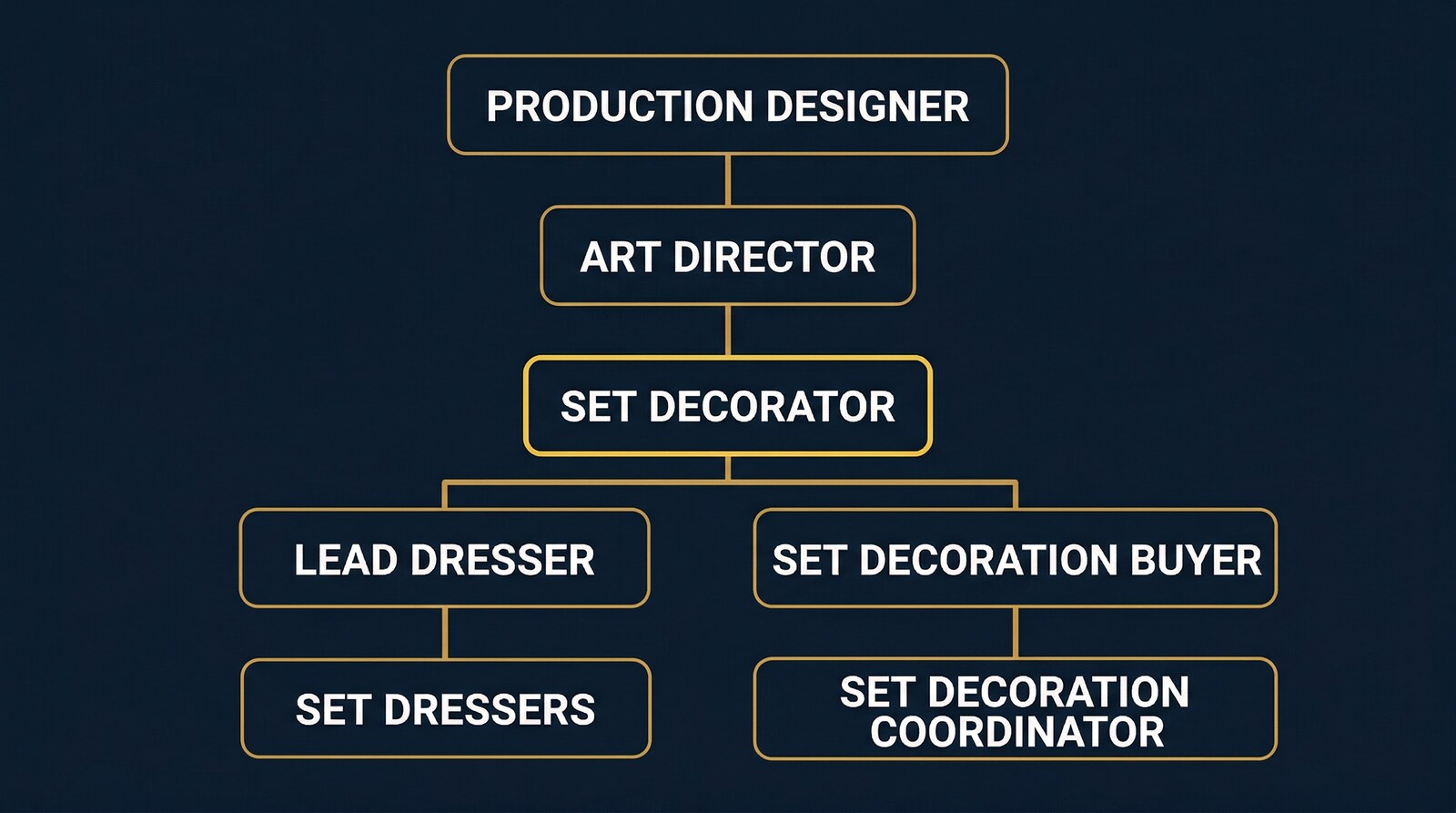
The set dresser works under the direction of the Set Decorator, who in turn reports to the Production Designer. The set dresser is the person who executes the decorator’s vision in physical space — sourcing, transporting, placing, adjusting, and striking every item that appears on set.
Set dressers belong to the Art Department / Set Decoration unit, which sits within the broader production design department. On IATSE-signatory productions in Los Angeles, set dressers are represented by IATSE Local 44 (Affiliated Property Craftspersons).

What does a set dresser do?
Set Dresser Job Description & Responsibilities
The set dresser’s work begins before the first day of shooting and doesn’t end until the last item is wrapped and returned. The role is physically demanding, detail-oriented, and requires constant problem-solving in tight windows of time.
Pre-production duties:
- Attending tech scouts and location surveys to assess the space and plan the dressing approach
- Sourcing furniture, props, and decorative items from prop houses, rental vendors, retail stores, and set dressing stock
- Loading and transporting items from the prop house or warehouse to location — set dressers drive trucks, load dock plate, and wrangle large furniture
- Labeling and documenting every item for continuity and returns
- Preparing a “return kit” for retail items that will be purchased and returned post-shoot — IKEA, Crate & Barrel, and Pottery Barn returns are standard practice on lower-budget productions
On-set duties:
- Dressing the set from the set decorator’s approved layout plan before the shooting crew arrives
- Adjusting dressing between camera setups — an item that reads perfectly in a wide may need to be repositioned for a close-up
- Maintaining continuity across shooting days: photographing the set before each scene and re-dressing to match across non-consecutive shoot days
- Striking the set (removing all items) at the end of a day’s shooting or when a location wraps
- Running items to and from the production truck during the shooting day
The on-set dresser distinction: On larger productions, there is often a dedicated on-set dresser (sometimes credited separately from the swing gang). The on-set dresser stays on set during shooting, making real-time adjustments between takes — pulling a lamp further back, adjusting a picture frame, straightening a rug — while the rest of the dressing crew works ahead preparing the next location.

Tools of the trade: Furniture blankets, hand trucks, tie-down straps, a fully stocked dresser’s kit (glue gun, fishing line, poster putty, double-sided tape, measuring tape, scissors, gaff tape, marker), and a vehicle capable of hauling large loads.
What is set dresser salary and day rate?
Set Dresser Salary & Day Rates
Set dresser compensation varies by union status, production tier, and market.
IATSE Local 44 (Los Angeles, union):
Set dressers working under IATSE Local 44 agreements receive negotiated minimum rates. Rates are updated with each contract cycle; current minimums for feature and episodic television are published on the IATSE Local 44 website. Day rates for union set dressers on major studio productions typically range from $400–$600/day, with higher rates for experienced lead dressers and on-set dressers.
Non-union productions:
Day rates on non-union features and independent productions are negotiated directly and vary widely — from $150–$300/day on microbudget projects to $300–$500/day on well-funded independents.
Lead dresser rates:
A lead dresser (or gang boss) — the set dresser who supervises the rest of the swing gang — earns a premium above standard dresser rates, typically 10–20% above the scale minimum. The lead dresser coordinates the crew, calls the call times, and is the primary point of contact between the decorating department and the set dressers.
Annual salary: Set dressers on long-running episodic series (network, cable, or streaming) working full seasons can earn $60,000–$120,000 per year depending on union tier, market, and overtime. Day-playing on features and short runs brings considerable variability — most working set dressers patch together income across multiple productions.
Where does the set dresser appear in film credits?
Credits Placement for Set Dressers
This is the question most guides don’t answer. Here is exactly where the set dresser credit lands.
Opening Credits
Set dressers do not appear in opening credits. Opening title cards are reserved for above-the-line talent — studio, production company, lead cast, director, producer, writer, and occasionally the Production Designer on prestige productions. No below-the-line art department crew receives an opening card.
End Credits
Set dressers appear in the set decoration section of the end credit crawl. This section falls within the broader art department block, positioned after the Production Designer and Art Director credits and under the Set Decorator’s heading.
The standard credit order within the set decoration / art department block:
| Position | Credit Order |
|---|---|
| Production Designer | Department head — often above the department block |
| Art Director | 2nd in art department |
| Set Decorator | Heads the set decoration unit |
| Lead Dresser / Gang Boss | 1st within the dressing crew |
| On-Set Dresser | Often credited separately if dedicated to set |
| Set Dressers | Listed by seniority or alphabetically |
| Set Decoration Buyer | Within the department block |
| Set Decoration Coordinator | Within the department block |
The set decoration block typically appears in the below-the-line section of the crawl, positioned near the prop department and construction department.
On-Set Dresser vs. Set Dresser — Credit Distinctions
On productions with a dedicated on-set dresser, that person is frequently given a separate credit line above the general dressing crew:
On-Set Dresser
JANE SMITH

Set Dressers
JOHN DOE
ALEX JOHNSON
This distinction matters when preparing credits — conflating the on-set dresser with the swing gang is a common crediting error that can create contract disputes on union productions.
Single Card vs. Scroll
Set dressers receive a shared scroll credit within the set decoration department block. No set dresser — other than possibly the Set Decorator themselves — receives a solo card. On large productions, the set dressing crew may span a dozen names or more in the crawl.
How to credit a set dresser correctly
Exact Format, Variations, and Guild Rules
The standard screen credit for set dressers uses the department heading followed by crew names:
SET DECORATION

Set Decorator
PATRICIA HART

Lead Dresser
MARCUS WEBB

On-Set Dresser
DANA YOUNG

Set Dressers
CARLOS REYES
SOPHIE BELL
JAMIE PARK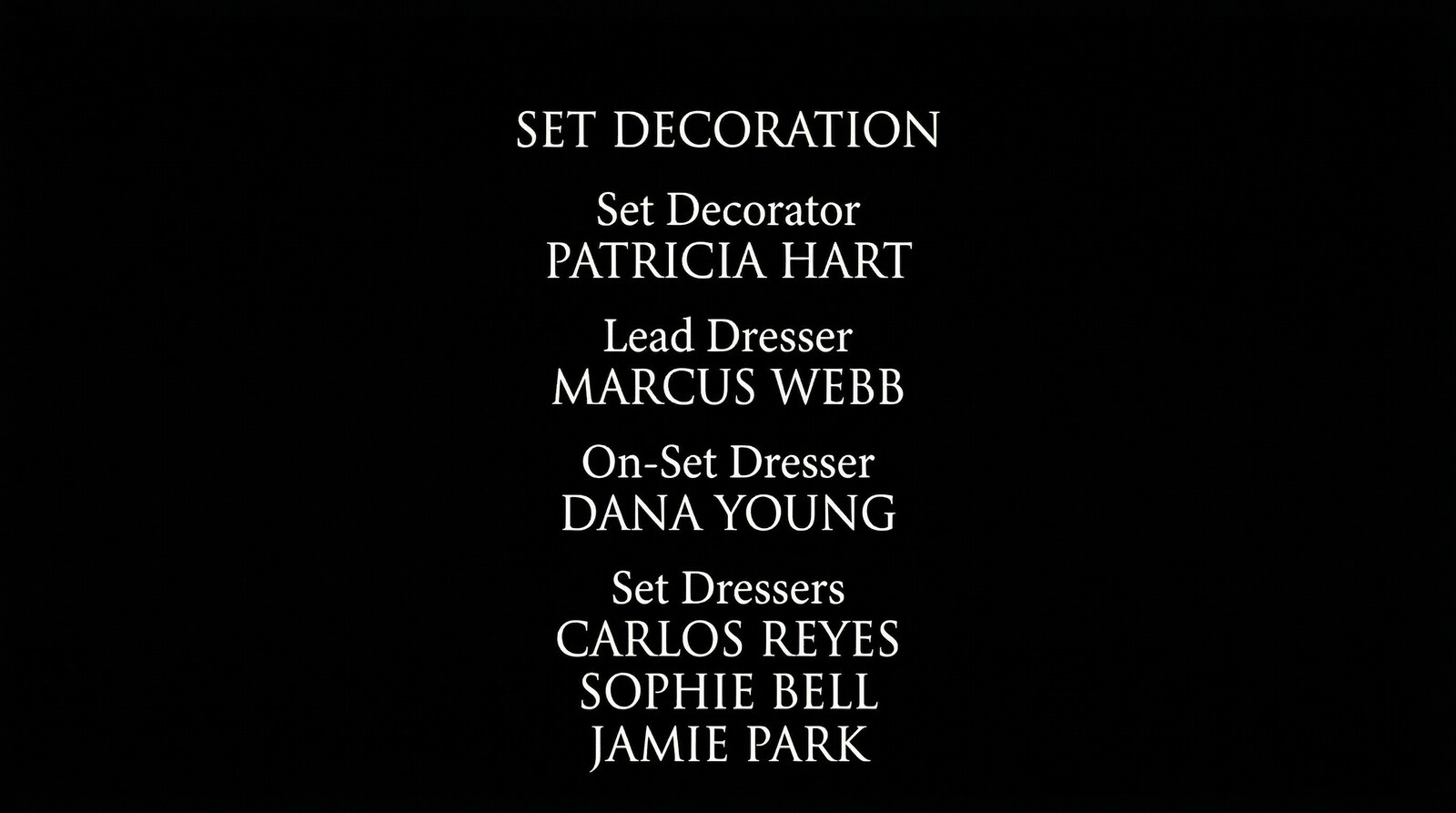
Accepted title variations:
- Set Dresser — the standard industry title used across film and television
- Lead Dresser — the senior set dresser who supervises the crew; sometimes called “Gang Boss” on older productions
- On-Set Dresser — the set dresser assigned to the shooting set during production
- Swing Gang — an informal term for the full set dressing crew; not used as a screen credit title
What not to use: “Set Stylist,” “Interior Dresser,” or “Prop Dresser” are not industry-standard titles and should not appear in a professional credit crawl.
IATSE Local 44 requirements: On productions signatory to IATSE Local 44 agreements, set dressers have contractual credit rights. The production must credit all IATSE members who work on the production in the end crawl. The specific format is governed by the applicable collective bargaining agreement and the specific deal memo for each crew member.
Multiple roles: If one person served as both lead dresser and set decoration coordinator, credit both roles on separate lines under the set decoration heading. Do not invent a combined title. For guidance on the full end credit order across all departments, see the film credits format and order guide.
Set dresser vs set decorator
What’s the Difference Between a Set Dresser and Set Decorator?
This is the most common confusion in the art department’s credit structure, and it matters for crediting accurately.
| Set Decorator | Set Dresser | |
|---|---|---|
| Function | Creative lead — chooses and designs all set dressing elements | Executes — physically places and maintains those elements on set |
| Reports to | Production Designer | Set Decorator |
| Manages | Set dressers, lead dresser, buyers, coordinator | Works within the dressing crew under the lead dresser |
| Pre-production | Develops the decorating concept, sources key pieces, establishes the look | Assists sourcing, handles logistics, transports and tracks items |
| On set | Approves final dressing, approves camera-ready looks, works with director | Dresses and strikes the set, maintains continuity, makes on-the-fly adjustments |
| Guild | Set Decorators Society of America (SDSA); IATSE Local 44 | IATSE Local 44 |
| Credit position | Named credit above the dressing crew | Listed below set decorator in the set decoration block |
The simplest distinction: the set decorator decides what the set looks like; the set dresser makes it actually look that way.
On micro-budget productions, one person frequently performs both jobs — in which case they should receive credit for both:
Set Decorator / Set Dresser
JORDAN HAYES
How to become a set dresser
Career Path Into Set Dressing
Set dressing is one of the more accessible entry points into the art department — it requires no formal degree, and the skills are learned on the job.
Common entry paths:
- Production assistant (PA) → art department PA → set dresser — The most common route. General PAs who express interest in the art department often get pulled into dressing roles on smaller projects.
- Prop house or rental house work — Working at a furniture or prop rental house teaches the vocabulary of set dressing: period styles, materials, sourcing, condition tracking. Many working set dressers started at prop houses.
- Student films and short films — Building a resume of credits, even on low/no-budget projects, establishes the experience needed to get hired on paid productions.
- IATSE Local 44 — In Los Angeles, joining the union is the gateway to studio and major streaming work. The union has an apprentice program. To qualify, you typically need to document 100+ days of on-set experience in the classification.
Skills that matter:
- Physical stamina — the job involves long days of heavy lifting, standing, and constant movement
- Visual eye — understanding proportion, period accuracy, color, and spatial composition
- Organizational discipline — tracking dozens of items across multiple locations with return logistics
- Discretion — returning purchased items unmarked and undamaged is a practical skill that matters on budget-conscious productions
No interior design degree is required. Working set dressers consistently cite on-the-job experience as the only qualification that counts.
Notable set dressers in film history
The Professionals Who Built the Worlds on Screen
Set dressers rarely receive individual public recognition — their names scroll past at speed — but some have built careers defining iconic production environments.
-
Barbara Munch — Set decorator and long-time art department professional whose credits include Magnolia (1999, Paul Thomas Anderson) and Boogie Nights (1997). The meticulously dressed suburban interiors in both films demonstrate the set decoration department working at the top of its craft.
-
Jan Pascale — Set decorator on No Country for Old Men (2007, Coen Brothers) and True Grit (2010). Pascale’s work on the Coens’ films illustrates how rigorous period accuracy in set dressing — every West Texas gas station stocked with the right product labels for 1980 — functions as character and story, not just background.
-
Ellen Brill — Set decorator on The Royal Tenenbaums (2001) and multiple Wes Anderson productions. Anderson’s hyper-specific aesthetic — every label, every color-matched wallpaper, every institutional detail — depends entirely on the set decoration crew executing a vision with zero tolerance for improvisation.
Sources and Further Reading
Official resources:
- IATSE Local 44 — Affiliated Property Craftspersons — the union representing set dressers in Los Angeles
- Set Decorators Society of America (SDSA) — professional organization for set decorators; resources on the decorating department’s structure
Further reading:
- Backstage — How to Become a Set Dresser for Movies + TV — career overview with entry path details
- Wikipedia — Set dresser — basic definition and role overview
Watch:
Related EndCreditsPro guides:
- Film Credits Format and Order Guide
- All Film Crew Roles
- Complete Guide to Film Credits
- Related roles: Set Decorator · Scenic Artist · Production Designer
Create Professional Credits with EndCreditsPro
Getting every set dresser, lead dresser, and on-set dresser into the right section, in the right order, with the right title — it takes more attention than most productions budget for it. EndCreditsPro auto-formats your end credits with correct department hierarchy, guild-compliant ordering, and broadcast-ready layouts.