What Is a Scenic Artist in Film?
Every faux marble column, aged brick wall, and forced-perspective backdrop you’ve seen on screen was painted by someone. That someone is the scenic artist — and their entire job is to make you forget they exist.
A scenic artist is a specialized paint department professional who creates realistic surface treatments, decorative finishes, and illusionistic effects on film and television sets. Where a standard set painter applies base coats and finishes to construction, the scenic artist handles the high-craft work: trompe l’oeil painting, faux material finishes (marble, wood grain, stone, rusted metal), mural work, aging and distressing effects, and the reproduction of period-accurate signage and textures.
Scenic artists sit within the art department, reporting to the Production Designer and Art Director through the Key Scenic Artist (the department head of the scenic paint crew). They work in close coordination with the Set Decorator and Props Master to ensure all painted surfaces match the visual world the production is building.

What Does a Scenic Artist Do?
The Day-to-Day of a Film Scenic Painter
The scenic artist’s work spans prep through principal photography — and sometimes overlaps with post when set extensions require painted backdrops for visual effects plates.
Pre-production and prep duties:
- Reading the production designer’s paint elevations and interpreting them for execution on set materials
- Researching historical periods, architectural styles, and regional aesthetics to inform accurate surface treatments
- Mixing custom paint colors and preparing specialty mediums for specific finishes
- Executing full-scale faux finishes on flats, practical set pieces, and props — marble, limestone, weathered concrete, corroded metal, aged wood, painted glass
- Painting scenic backdrops and murals used as in-camera backgrounds
- Aging and distressing set elements: artificially worn paint, water staining, grime accumulation, battle damage
- Creating trompe l’oeil effects — depth illusions, perspective painting, and decorative architectural details that would be too expensive to build in three dimensions
On-set duties (on-set scenic / standby scenic):
The on-set scenic painter — also called a standby scenic — is the art department’s representative on the shooting floor during principal photography. Unlike the rest of the paint crew who work in the shop or on stages during prep, the on-set scenic is present every shoot day. As one working on-set scenic describes the role: “My job is the art department representative on set for the camera — my contact would be the art director and production designer.”
- Monitoring every setup for paint continuity issues visible to camera
- Touching up scuffs, chips, and abrasions that occur during lighting or blocking
- Adjusting surface sheen when the Director of Photography flags a hot spot or unwanted reflection
- Making last-minute aging or matching adjustments requested by the director or DP
- Keeping a paint continuity log for sets that will be struck and re-dressed
Tools and materials: Artist-grade acrylic paints, scenic dyes, casein paints, aniline dyes, oil glazes, texture mediums, airbrushes, fitch brushes, dragging tools, combs, sponges, and custom-mixed specialty coatings. Large-format work is done with wide-bristle brushes and paint rollers; detail work may use brushes under 1/4 inch.

Scenic Paint Department Hierarchy
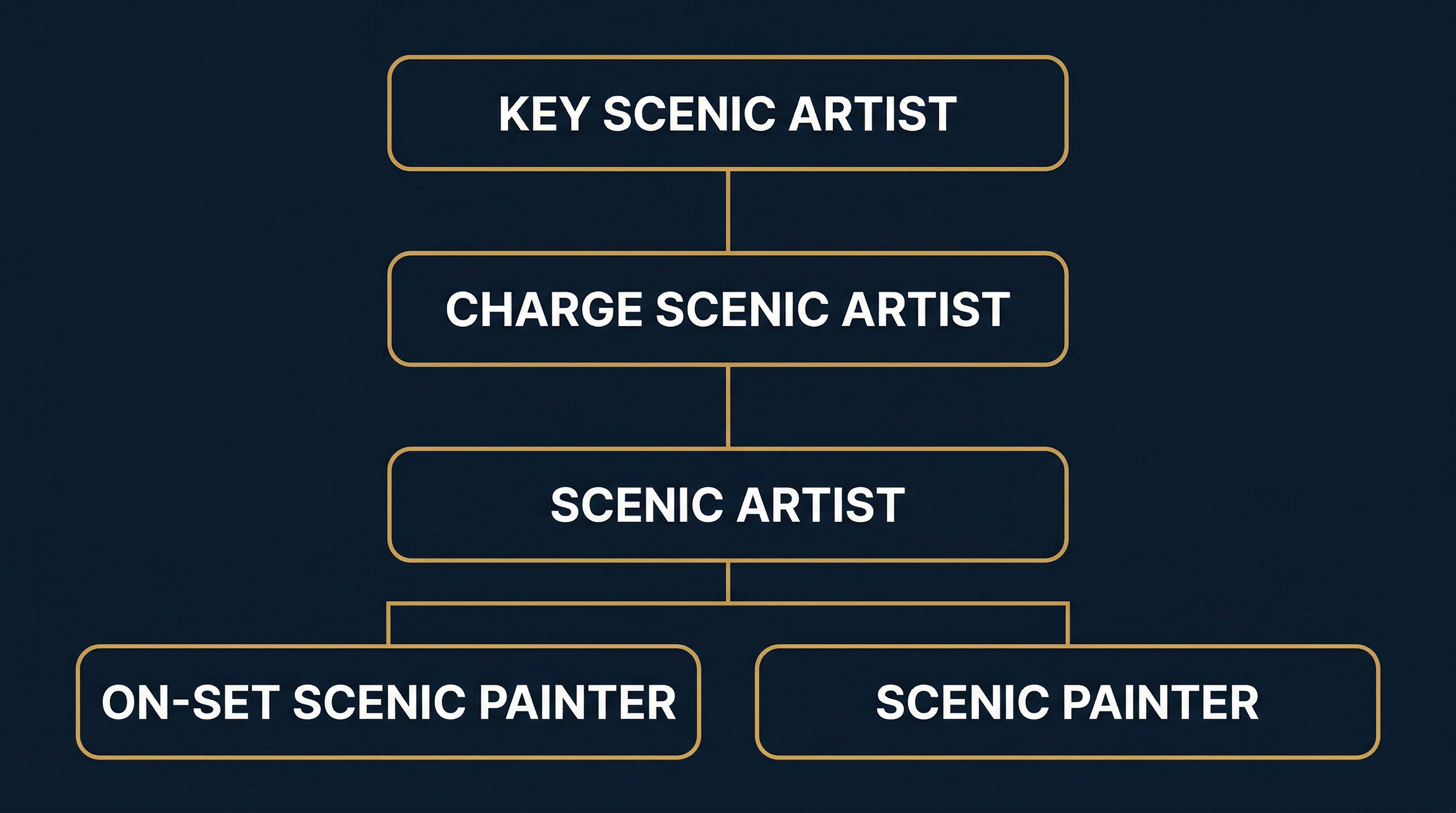
Key Scenic, Charge Scenic, and Scenic Artist — The Full Structure
The scenic paint department has a defined hierarchy on union productions. Understanding the tiers matters for crediting — each level gets a distinct credit.
| Title | Role |
|---|---|
| Key Scenic Artist | Department head. Supervises all painting work, interprets the production designer’s vision, manages the paint budget and materials procurement, hires and schedules the paint crew. Reports directly to the Production Designer and Art Director. |
| Charge Scenic Artist | Also called the “charge artist” or “head scenic artist.” Leads a crew of scenic artists on large productions where the key scenic needs another supervisor. Oversees execution of specific set areas or scenic elements. On smaller productions, this tier may not exist — the key scenic absorbs the duties. |
| Scenic Artist | Executes specialty finishes, faux effects, murals, aging, and high-craft scenic painting under the direction of the key scenic. This is the core skill-trade level. |
| On-Set Scenic Painter | Dedicated to the shooting unit. Maintains paint continuity and executes last-minute changes during principal photography. Does not paint sets — monitors and corrects what the camera sees. |
| Scenic Painter | Executes base coats, standard finishes, and repetitive work that does not require specialist scenic techniques. The entry-level tier on union productions. |
| Sign Painter | Specialist who prepares and executes all period and practical signage for the set. |
| Plasterer | Handles mold prep, concrete casting, and plaster surface work within the paint department on productions with significant practical effects elements. |
On smaller non-union productions, the “scenic artist” title may be used loosely for anyone doing set painting. On union productions, these distinctions are contractual.
Where Does the Scenic Artist Appear in Film Credits?
Credit Placement for the Scenic Paint Department
This is where the guides end and the actual production detail begins.
Opening Credits
Scenic artists do not appear in opening credits under any circumstances. Opening title cards are for above-the-line talent: studio, production company, director, lead cast, writer, and selected key producers. No below-the-line crew from the art or paint department receives an opening card.
End Credits
The scenic paint department appears within the Art Department section of the end credit crawl. The art department block typically runs after the production design credits and before or alongside set decoration.
The standard credit order within the scenic paint department:
| Position | Credit Title | Order |
|---|---|---|
| Department head | Key Scenic Artist | 1st |
| Lead supervisor (if present) | Charge Scenic Artist | 2nd |
| Specialty painters | Scenic Artist(s) | After department heads |
| On-set painter | On-Set Scenic Painter / Standby Scenic | Listed with scenic artists |
| Sign work | Sign Painter | Within the department block |
| Base painters | Scenic Painter(s) | After scenic artists |
The Key Scenic Artist is the named individual at the top of the scenic department block — analogous to how the Gaffer heads the electrical department. The charge scenic artist, if credited separately, follows immediately after.
Individual scenic artists and painters below the key scenic typically appear in a group listing or as a crew block, depending on production size and union agreement.
Single Card vs. Scroll
Scenic artists receive scroll credits within the art department block — not individual cards. The Key Scenic Artist may occasionally receive a single-line placement in a condensed “department heads” section before the full departmental crawl on prestige productions, but this is not standard practice.
How to Credit a Scenic Artist Correctly
Exact Format, Variations, and Guild Rules
The standard screen credit format for the scenic paint department:
Key Scenic Artist ............. JANE DOEOr in a department block layout:
ART DEPARTMENT

Production Designer
FIRST LAST

Art Director
FIRST LAST

Key Scenic Artist
JANE DOE

Charge Scenic Artist
FIRST LAST

Scenic Artists
FIRST LAST
FIRST LAST
FIRST LAST

On-Set Scenic Painter
FIRST LAST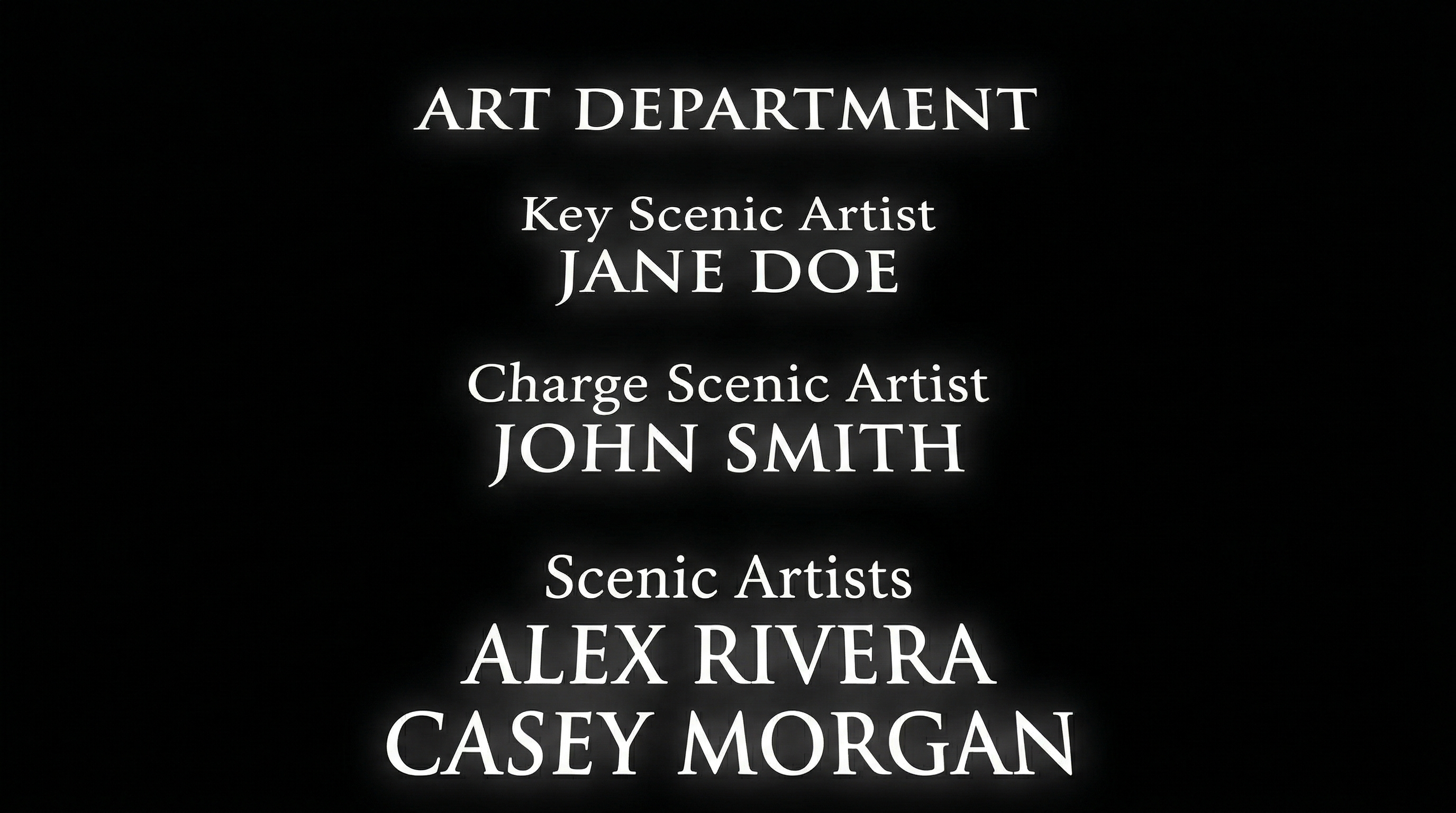
Accepted title variations:
- Key Scenic Artist — the IATSE-standard title used across the majority of union productions
- Head Scenic Artist — used interchangeably on some productions; acceptable but less common in formal credits
- Scenic Artist — the standard title for non-key scenic department members
- Charge Scenic Artist / Charge Artist — for the supervisory tier below the key
Avoid “Lead Painter” or “Head Painter” — these are non-standard titles that misrepresent the role’s specialized nature and may cause confusion with non-scenic painters in the department.
Guild requirements: On IATSE-signatory productions, scenic artists are typically represented by United Scenic Artists (USA), IATSE Local 829 — the union covering scenic designers, art directors, and scenic artists in film, television, and theater. The USA contract governs rates and billing for key scenic artists and above; below that tier, jurisdiction may fall to the local IATSE that covers general art department workers depending on the production’s agreement.
Receiving a screen credit in the scenic department is typically a contractual right for the Key Scenic Artist on union productions. For IATSE compliance specifics, check your production’s guild agreement.
Multiple roles: On very small productions where one person serves as both Key Scenic Artist and Set Decorator (unusual but it happens), credit each role separately on its own line. Do not invent a combined title.
United Scenic Artists (USA)
The Union Representing Scenic Artists in Film and TV
United Scenic Artists, IATSE Local 829, is the collective bargaining union for scenic designers, art directors, scenic artists, and related art department professionals working in film, television, theater, opera, and ballet in the United States.

Key facts about USA Local 829 for film and TV:
- Membership is required for key scenic artists on productions signatory to USA agreements
- USA represents the design tier of the art department — production designers, art directors, scenic designers, and key scenic artists
- The union maintains minimum rates, credit requirements, and working conditions
- USA administers an apprenticeship program (United Scenic Artists Apprenticeship) for those seeking to join as scenic artists — one of the formal paths into union membership
- Grade 1 Scenic Artist is the entry-level classification in some USA-affiliated markets and union structures
Scenic painters below the key scenic tier may instead be members of a local IATSE union (such as IATSE 800, which covers art department workers in various categories) depending on geography and the specific production agreement. The distinction matters for credits: USA-covered workers have stronger contractual credit protections than workers covered only by general IATSE agreements.
If you are building credits for a USA-signatory production, the Key Scenic Artist must be credited by name in the end crawl. Review the current USA Basic Agreement for the complete language.
Scenic Artist vs. Production Designer
Two Different Jobs That Beginners Confuse
The scenic artist and the Production Designer are not interchangeable titles. The confusion is common among people outside the industry, but no one on a set would mix them up.
| Scenic Artist | Production Designer | |
|---|---|---|
| Primary function | Executes painted surfaces and finishes | Conceives and oversees the entire visual design of the film |
| Output | Finished painted sets, backdrops, faux finishes | Design concepts, creative direction, department management |
| Reports to | Key Scenic Artist → Art Director → Production Designer | Director and Producers |
| Credits section | Art Department (scenic paint block) | Above the art department block, often near director/producer credits |
| Union | USA Local 829 (key scenic) / IATSE | USA Local 829 |
The Production Designer decides what a room should look like. The scenic artist is among the people who make it look that way — specifically through paint and surface treatments. One designs; the other executes.
Notable Scenic Artists in Film History
The Professionals Behind the Painted Frame
Scenic artists rarely appear in press coverage, but their work is embedded in the most recognizable set design in cinema.
-
Robert Swarthe — Special effects artist who contributed matte paintings and scenic work on the original Star Wars trilogy. The large-format optical effects work of that era required scenic painting skill at an industrial scale — backdrops painted by hand that would hold up on 70mm prints.
-
Yuri Makoveychuk — Listed among notable charge scenic artists in the field, with work spanning theater and large-scale scenic productions.
-
National Theatre Scenic Department (UK) — The NT’s scenic art team has set the standard for high-craft scenic painting in performance for decades. Their process — described in production documentation as “intensely handmade” work where “you never really want the audience to think too much about how did this object come into being” — captures the professional ethos of scenic artistry across all media.
The role of the scenic artist is defined by this invisibility. If the audience notices the paint technique, the scenic artist has failed. The goal is a world the eye accepts completely.
Sources and Further Reading
Official resources:
- United Scenic Artists, IATSE Local 829 — the union representing scenic artists in film, TV, and theater
- ArtDepartmental — Scenic Paint Department Roles — detailed breakdown of the full scenic paint department hierarchy
- IATSE — the parent union covering many below-the-line film crew roles
Further reading:
Related EndCreditsPro guides:
- Film Credits Format and Order Guide
- All Film Crew Roles
- IATSE Compliance Guide
- Related roles: Set Decorator · Set Dresser · Art Director · Special Effects Supervisor
Create Professional Credits with EndCreditsPro
Crediting the scenic paint department correctly — Key Scenic Artist at the top, charge and crew below, all within the right art department block — takes more attention than most productions give it. EndCreditsPro auto-formats your end credits with correct role hierarchy and department ordering so no one gets left out or misplaced.