Executive Producer vs Producer: What’s the Difference?
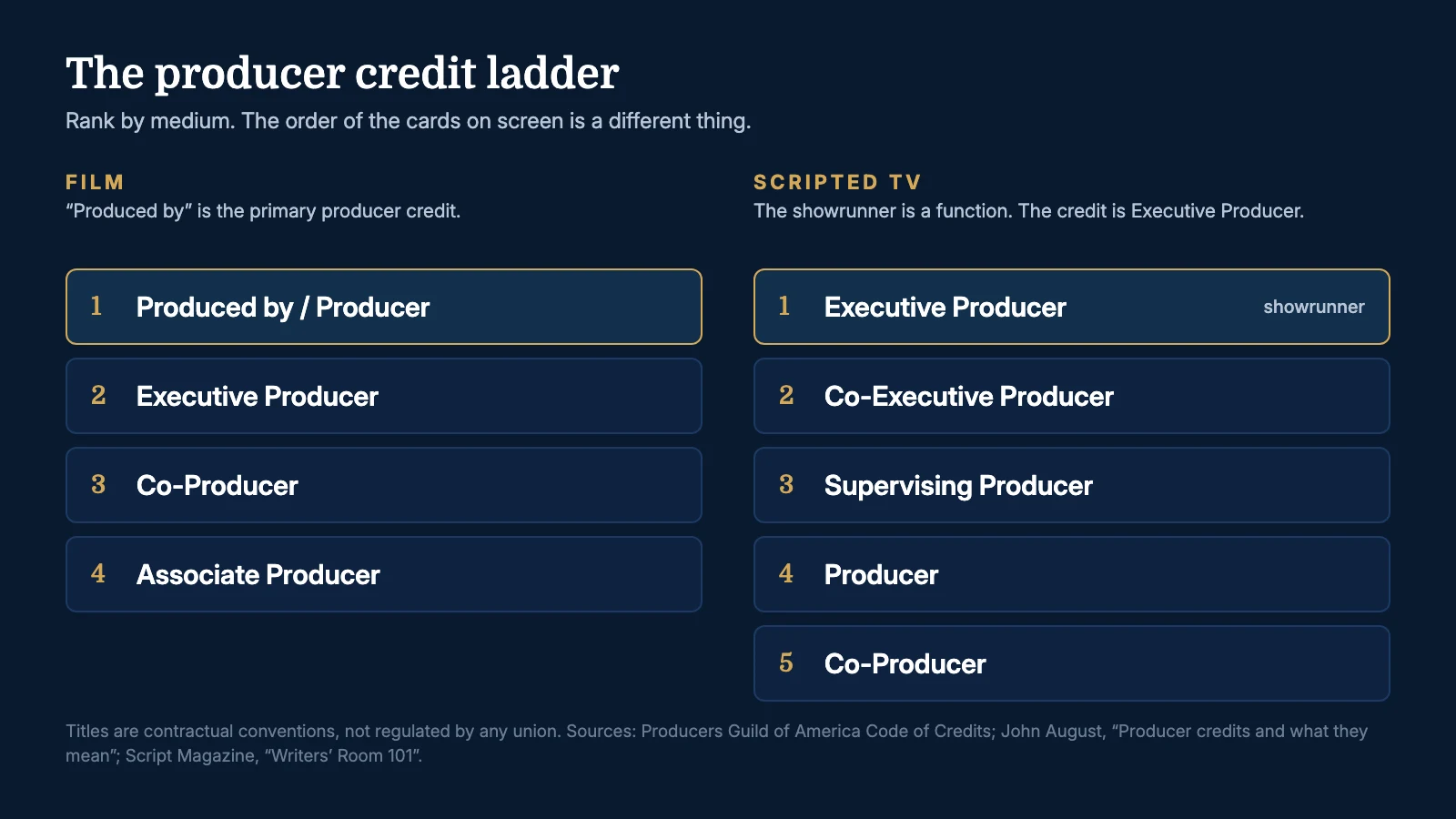
In film, “Produced by” outranks “Executive Producer”. In scripted TV it is the other way round, and the Oscars only count one of them.
The producer makes the production happen. The executive producer made it possible. In film, that means the producer runs the project and the executive producer brought the money, the rights or a name. In scripted television, the executive producer is the person who runs the series, and the producers work under them.
That is the short answer. The long one is in the credits, and in who gets a statuette, a profit share or a say in the final cut.
| Executive producer | Producer | |
|---|---|---|
| In film | Financing, rights or talent; usually off set | The primary producer: runs development to delivery |
| In scripted TV | Runs the series; usually the showrunner | A writer-producer or production rung below the EPs |
| Rank | Film: second. TV: first | Film: first. TV: fourth |
| Best Picture Oscar | Not eligible | Eligible, up to three |
| Emmy, series categories | Eligible | Eligible |
| p.g.a. mark | Not on an EP credit alone | Can be licensed it |
Video: What Does an Executive Producer Do? (Executive Producer vs Producer vs Line Producer), from our series Film Crew Roles, Explained. It loads from YouTube when you press play. Watch it on YouTube.
is a producer higher than an executive producer
Is a Producer Higher Than an Executive Producer?
In film, yes. The Producers Guild of America’s code calls “Produced By/Producer” the primary producer credit. Screenwriter John August, explaining producer credits for writers, puts the order this way: “The highest ranking producer is simply called Producer… After that comes Executive Producer.”
In scripted TV, no. The PGA’s TV code gives the executive producer credit to the showrunner, the series creator and other people whose only reporting line is to the studio or financiers. Producers sit lower: the standard writer-producer ladder runs Staff Writer, Story Editor, Executive Story Editor, Co-Producer, Producer, Supervising Producer, Co-Executive Producer, Executive Producer, with the showrunner credited as an executive producer.
Two traps make the question harder than it looks:
- Screen order is not rank. On posters and in main titles, executive producers usually appear before “Produced by”. That is billing order, not seniority.
- “Produced By” and “Producer” are one credit, not two tiers. The PGA code treats them as the same primary credit.
who gets the oscar
Who Gets the Oscar and the Emmy
This is where the difference stops being theoretical. The Academy’s rules for Best Picture say the credited individuals “must have screen credit of ‘producer’ or ‘produced by’”, and that “Persons with screen credits of executive producer, co-producer, associate producer, line producer… shall not receive nominations or Academy statuettes.” The nominees are “three or fewer producers who have performed the major portion of the producing functions.”
The Television Academy goes the other way. Executive producers are eligible in the drama, comedy, limited series and movie categories, as long as the credit is on at least half of the episodes and they have “substantial or final control over creative and financial aspects of the production”. Nominee caps for drama and comedy are guidelines (10 and 11), not hard limits.
The PGA’s own certification follows the Oscar logic (see PGA credits and the p.g.a. mark). The p.g.a. Producers Mark “may be considered… only if they have been contractually credited and credited onscreen as ‘Produced By’ or ‘Producer’”. An executive producer credit on its own cannot qualify.
what does a producer do
What a Producer and an Executive Producer Each Do
The PGA describes “Produced By” as applying to the people primarily responsible for the origination and management of a production and its delivery, across development, pre-production, production and post-production. A producer owns the day-to-day problems: schedule, budget, hires, delivery. An associate producer or line producer usually works under them in film.
The executive producer’s contribution is different in kind. The full breakdown is in what an executive producer does, but in film the pattern is usually the same: the EP brings something the project could not start without, then steps back.
what counts as financing
What Counts as Financing for an Executive Producer Credit
The PGA’s film code requires early-phase advocacy plus either an essential portion of the financing (no less than 25%), a significant contribution to the literary property such as securing the underlying rights, or both. It explicitly excludes anyone who “only provides or arranges financing (regardless of the sum)” and has no managerial or creative duties.
In independent film, practitioners describe “financing” more broadly than the Code does. Producer Alexi Ouzas, in a video on who is the boss, lists direct investors, a post house deferring part of its fee, a distributor putting up an advance, and the financier who cash-flows a tax credit. He says the person who only introduces the investor usually gets an associate-producer or co-producer credit, not an EP one. He also notes that producing credits go to individuals, not companies.
The Code is guidance, not law: the PGA “is not involved in… the negotiation of any specific producing credits”.
why do actors want executive producer credit
Why Do Actors Want to Be Executive Producers?
Some bring real value: financing, a rights deal or the name that gets a film financed. The Guardian, reporting on the trend in 2024, quotes Robert Mitchell of Gower Street Analytics: “Sometimes they are on from an early stage, helping to get it made.” Then: “In other cases they’re a name added much later in the day, sometimes after the film is completed, often on documentaries. Suddenly, it becomes ‘presented by Martin Scorsese’, which seems to be much more of a marketing thing.”
Others take the credit as a perk. Amanda Seyfried described hers on The Housemaid as “one of those vanity credits”, obtained because “that’s what your agent negotiated” (Variety, February 2026). On r/Filmmakers, when a director asked whether to give an actor the credit, the top answer was “it costs you nothing, so why not?” The cautionary reply came from another filmmaker, who said to make sure they know that being made an executive producer “doesn’t make it ‘their’ movie”.
why do movies have so many executive producers
Why Do Movies Have So Many Executive Producers?
Because the credit is cheap to give and no one polices it. Stephen Follows counted the credits on the 100 highest-grossing films of each year from 1994 to 2013. In the mid-to-late 1990s they averaged just under two executive producers per film. In 2013 the average was 4.4, against 3.2 producers. His extreme case, Lee Daniels’ The Butler, listed 39 producing credits: “5 producers, 17 executive producers, 6 co-executive producers, 4 co-producers and 7 associate producers”.
The trade has complained about this for decades. In 2001, Screen International reported six executive producers and two producers on Pearl Harbor, and quoted the PGA’s then executive director, Vance Van Petten: “There are many individuals who do not perform the role but get the credit for extra power, extra money or extra ego gratification.” A 2025 Follows analysis of 8,415 movies found the average rising from 1.9 in 2000 to 5.1 in 2021, on a different sample from the 2014 study.
who has the final say
Who Has the Final Say?
It depends on the film’s structure, not on the title.
- Low-budget independent, no completion bond. Ouzas says the producer is the boss and the executive producers have limited control, often none over creative decisions. Their rights are mainly about recouping the investment.
- Bonded film. The producer is in charge until the film goes off schedule or off budget; then the completion guarantor can step in on behalf of the financiers.
- Scripted TV. The showrunner, credited as an executive producer, has final say. Betsy Beers, a producer of Grey’s Anatomy and Scandal, describes the film EP as traditionally the person who shepherds a project into being and then steps back, with the hands-on work falling to producers. In television, she says, the executive producer does that hands-on job.
do executive producers get paid
Do Executive Producers Get Paid More Than Producers?
There is no standard answer. Film producer fees are private contracts, and Follows notes that producers are “typically classified as management rather than labour”. The only hard numbers cover television writer-producers: WGA East’s 2025 compensation guide reports a median of $52,500 per one-hour episode for executive producers, against $32,500 for co-executive producers and $75,000 for showrunners.
On the film side, producer Bill Doyle told the Guardian that “EPs get paid well, especially if they are actively involved, shepherding the project into action, fighting the battles in getting it funded and making it happen”. Ouzas describes a typical independent-film split as net profit divided roughly 50/50 between producers and the financiers, with the producer holding the copyright and the liability. That is one practitioner’s description of independent deals, not a rule.
executive producer vs director
Executive Producer vs Director, Line Producer and Co-Executive Producer
- vs director. The director is the film’s creative lead and the last name in the billing block; “Directed by” is the only form the DGA accepts in paid advertising. An executive producer has no fixed creative role in film. In scripted TV, the showrunner has “overall creative authority”, in the PGA’s words.
- vs line producer. The line producer owns the budget and logistics. The PGA says the line producer “may receive under certain circumstances Co-Producer, Producer, or Executive Producer credit”.
- vs co-executive producer. In TV, the PGA says the co-executive producer “reports directly to the Executive Producer, from whom the Co-Executive Producer assumes direct supervisory responsibilities”. The film code lists the credit only for television movies, “in rare or unique circumstances”.
can you be an executive producer and a producer
Can One Person Be Both?
Yes. Some guides say you cannot, but none of the PGA texts we read forbids it, and Follows notes that the exact title “is not regulated by any union or guild”. Producing credits are discretionary and negotiated.
When it happens, list each credit as the deal states it. The p.g.a. mark goes with “Produced by” only:
Produced by
FIRST LAST, p.g.a.

Executive Producer
FIRST LAST
how executive producer credits appear on screen
How the Credits Read on Screen
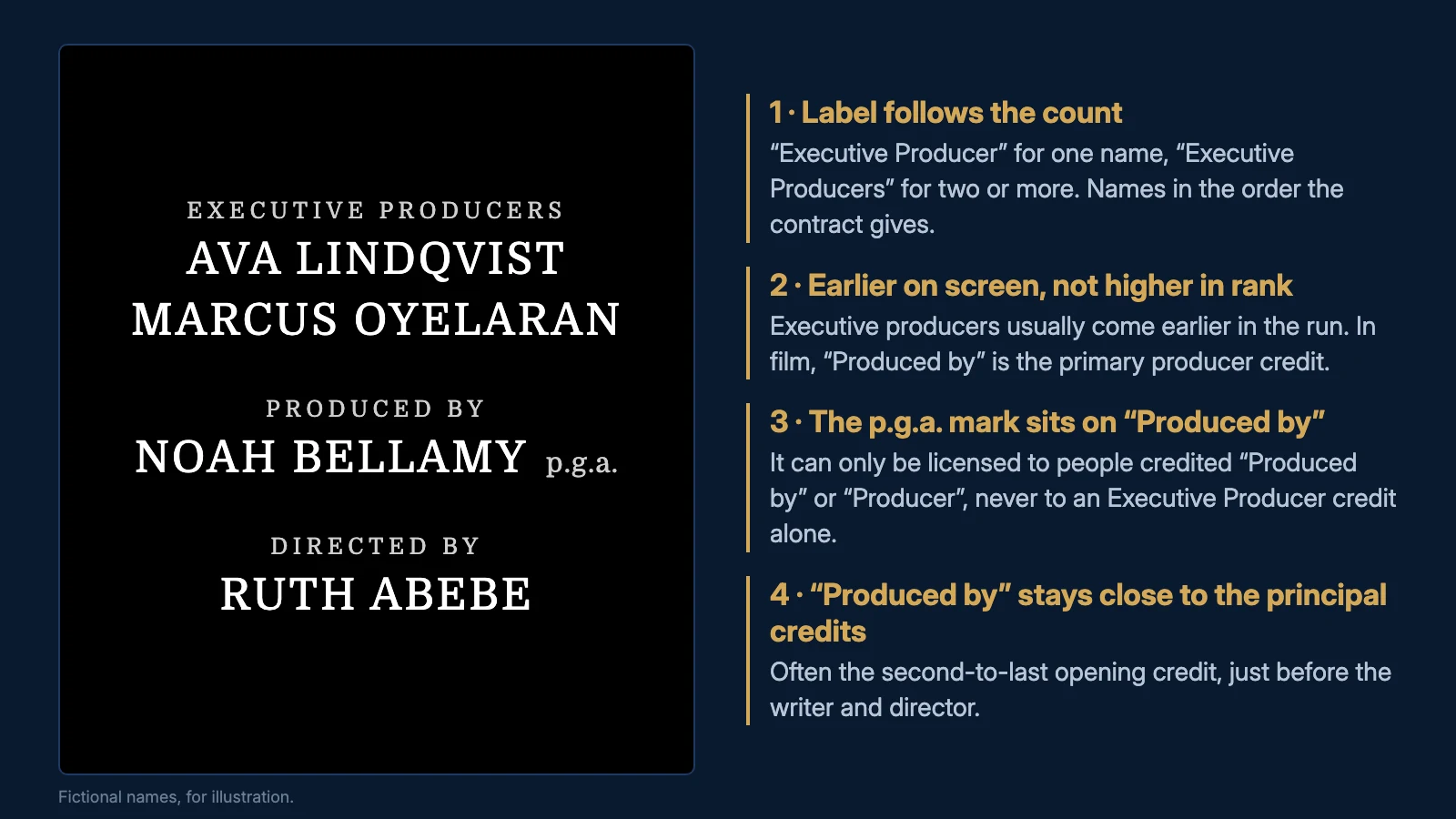
Producing credits cluster near the end of the opening titles, and the “Produced by” name is often second-to-last, just before the writer. The label follows the number of names (“Executive Producer” for one, “Executive Producers” for two or more), the order follows the contract, and the p.g.a. mark never follows a combined credit such as “Directed and Produced By”. For the whole sequence, see the film credits order guide, the film credits format and order guide and the billing block rules for posters.
executive producer vs producer FAQ
Common Questions
Is a producer higher than an executive producer? In film, yes: “Produced by” is the primary producer credit. In scripted TV, no: the executive producer is at the top.
Why do actors want executive producer credit? Some contribute financing or rights, others use it as marketing or take it as a perk. The credit is negotiated, and the PGA does not award it.
Do executive producers get paid? Usually, but fees are private. For TV writer-producers, WGA East reports a median of $52,500 per one-hour episode for executive producers.
Why do movies have so many executive producers? The credit is unregulated and cheap to give. Among the 100 top-grossing films, the average rose from just under two in the 1990s to 4.4 in 2013.
Sources & Further Reading
- PGA Code of Credits, feature films and scripted television
- PGA Producers Mark and Does the PGA do this?
- 99th Academy Awards rules (Rule Twenty) and 78th Emmy Awards rules
- John August: Producer credits and what they mean
- Script Magazine: Writers’ Room 101, TV Writer Job Titles
- Stephen Follows: How many movie producers does a film need? (2014) and Are movies with fewer producers better? (2025)
- The Guardian: What is behind A-listers queueing up to become executive producers? (January 2024)
- Screen International: Proliferating producer credits weave tangled web (2001)
- Variety: Amanda Seyfried on her Housemaid credit (February 2026)
- WGA East: Narrative Series Compensation Guide 2025
- Video: Alexi Ouzas, Producer vs Executive Producer: Who’s the Boss?
Browse all producing credits in the film crew roles directory, and see how the DGA treats the “Directed by” credit that closes the producing run.
Build your end credits with EndCreditsPro. Lay out the producer, executive producer and director cards of your film in one place, without design software. Try EndCreditsPro →