Producers Guild of America Credits: The Code of Credits and the p.g.a. Mark (2026)
The PGA cannot make a production give you a producer credit. What it controls is the three letters after the name, and the Oscar that depends on them.
The Producers Guild of America (PGA) is not a union, and it is not the golf tour. It is a non-profit trade association for producers, and its credit rules work differently from the DGA, the WGA or SAG-AFTRA: no collective agreement forces a studio to follow them. What the PGA offers is two documents. The Code of Credits defines what each producing credit should mean. The Producers Mark (written “p.g.a.”) certifies which producers did the work on a specific film.
This guide covers both, how to display the mark, and what it decides. It belongs to our guild compliance series, and the line between what is binding and what is guidance runs through every section.
Disclaimer: Based on the PGA’s Code of Credits for feature films and scripted television (pages dated September 24, 2024) and its Producers Mark rules for motion pictures (document PM.TMP, dated July 31, 2026). The PGA revises its documents without notice. Verify with the PGA for your production.
what is the pga
The Producers Guild of America: A Trade Association, Not a Union
The PGA describes itself as a “non-profit trade organization that represents, protects and promotes the interests of all members of the full producing team”. Its FAQ is blunter: “No. We are a professional association, not a union.” It has had no industry-wide agreement since 1975, when it signed its last collective bargaining agreement with Paramount and Universal. The Hollywood Reporter put its membership at about 8,400 in 2024.
That has three consequences for anyone building credits:
- There are no PGA “signatory” productions. The DGA and WGA can require a credit in a contract. The PGA cannot.
- Negotiation happens elsewhere. The Code says the PGA “is not involved in, and does not represent any producer(s) or producer group(s) in the negotiation of any specific producing credits and/or agreements”. Those talks are “exclusively between the producer(s), applicable companies, copyright owner(s), and/or their representatives.”
- Its leverage is awards. The Academy, the Golden Globes and BAFTA can rely on the PGA’s determination to decide which producers are eligible for their producing honors. That is the practical weight behind the process.
For the full map of who controls what, see the film industry unions and guilds guide.
pga code of credits
What the Code of Credits Is and What It Covers
The Code is a set of definitions. Its own introduction calls it “a resource for the entertainment community” meant to “inform and educate producers and companies” so that “appropriate producing credits and terms can be negotiated”. The legal note is explicit: the information is “for education purposes only and does not constitute legal or other professional advice.”
It covers film (feature films, animated, documentary and short films), television (scripted episodic, non-fiction and special event), digital short form, immersive media, special venues, video games and transmedia.
The history explains the design. Former co-president Hawk Koch told Deadline in 2026 that one trigger was the five producers who went on stage to collect the Best Picture Oscar for Shakespeare in Love. His co-president Mark Gordon said credits “are oftentimes, and still to this day, are given away in lieu of cash”. A group of producers wrote the criteria in the early 2000s, and Koch says the Academy began using them by 2006. The last major revision, in September 2024, added animated, documentary, special-event TV and immersive formats, according to The Hollywood Reporter, which says the PGA plans to review the Code annually.
pga producer credit definitions
How the Code Defines Each Producing Credit on Features
| Credit | What the PGA code says |
|---|---|
| Produced By / Producer | The primary producer credit. It applies to “individuals primarily responsible for the origination and/or management of a motion picture’s production and delivery”, making “regular, continuous, and substantial decisions regarding creative, production, budgetary, and legal concerns” |
| Executive Producer | When not the primary producer: an early champion who secured financing in the early phases, and who either brought “no less than 25%” of it, contributed significantly to the literary property (typically the underlying rights), or both |
| Co-Producer / Line Producer | ”The single individual who has the primary responsibility for the budget and logistics” of the production; reports directly to the primary producer |
| Associate Producer | ”A support role”, “granted sparingly at the discretion of the primary producer”; does not apply to people who “primarily function as an assistant” |
| Post Production Supervisor | Responsible for “the supervision and coordination of the post production process” and for approving the final technical deliverables |
The Code also defines production manager, production supervisor, production coordinator, post production producer and coordinator, and the visual effects producer chain. Those entries carry a recurring condition: the credit is limited to people employed by the production and “not concurrently working as an executive for the production company, studio, network, or streamer.”
For the “Produced By” job, the Code lists producing functions across four stages: development (concept, rights, initial funding), pre-production (key hires, final script, schedule and budget), production (daily operations, liaison with financial and distribution partners), and post-production and marketing.
pga executive producer credit
The Executive Producer Credit: The 25% Test
The film code is specific about who does not qualify. The credit “does not apply to outside individuals, or late phase participants whose primary role… is one or more of the following: Financier, Vendor, Sales Agent, Business Affairs, Legal Affairs, Crowdfunding, Completion Guarantor, Distributor, Distribution Aggregator, Public Relations, Studio/Network/Streamer Executive, Governmental Liaison.” A note adds that it does not apply to “someone who only provides or arranges financing (regardless of the sum)” with no managerial or creative duties.
In scripted television the test is different. The EP credit goes to people whose only reporting line is to the studio or financiers, and who are the showrunner, a creative producer who packaged and sold the series, the series creator, or a hyphenate producer. The executive producer role guide explains the film and TV split in full, and executive producer vs producer compares the two credits.
p.g.a. mark
The p.g.a. Producers Mark: Who Can Get It and How
The Producers Mark is “a no-cost Certification Mark which PGA licenses to a producer”. It “identifies which producers performed a major portion of the producing functions on a specific motion picture in a decision-making capacity.” Four rules define it:
- It attaches to “Produced By” or “Producer” only. A producer qualifies only if “contractually credited and credited onscreen” under one of those two titles. An executive, co-producer or associate producer credit cannot be licensed on its own.
- It covers features, not series. The PGA licenses it for motion pictures: theatrical, animated, documentary, and televised or streamed motion pictures.
- Membership is irrelevant. “Membership in the PGA is not required for — and is not relevant to — Producers Mark eligibility.” There is no numerical limit on licensed producers per film.
- It is decided project by project. The mark is “granted solely on a project-to-project basis”.
The process. The production company, the copyright owner or another authorized party starts it by submitting the film, late in post-production, once it is substantively complete. The PGA collects forms from the producers and written verification from key department heads and crew; no oral testimony is allowed. The PGA may decide administratively when nobody disputes who did what, or convene a panel of at least two experienced producers (each with at least two producer credits) to decide. Producers may strike arbiters, up to 10% of the list collectively. A producer can appeal, and the appeal goes to at least three arbiters whose decision “shall be final”.
The timing. The rules say “approximately six (6) to eight (8) weeks”, while the Producers Mark page says “a minimum of eight to ten weeks”. Plan for the longer figure.
Hyphenates and financiers. A director, writer, actor or representative who is also credited “Produced By” has to show producing work “beyond what they normally would perform” in their other role. A financier needs “a significant and dedicated commitment to production of the Motion Picture that goes beyond safeguarding the financing.”
how to display the p.g.a. mark
How to Display the p.g.a. Mark in Credits
Once the mark is licensed, the production company agrees to “place the Producers Mark immediately next to the name of the Produced By (e.g., Jane Smith, p.g.a.) in the on-screen credits and in any advertisements and promotional materials under the Production Company’s control.”
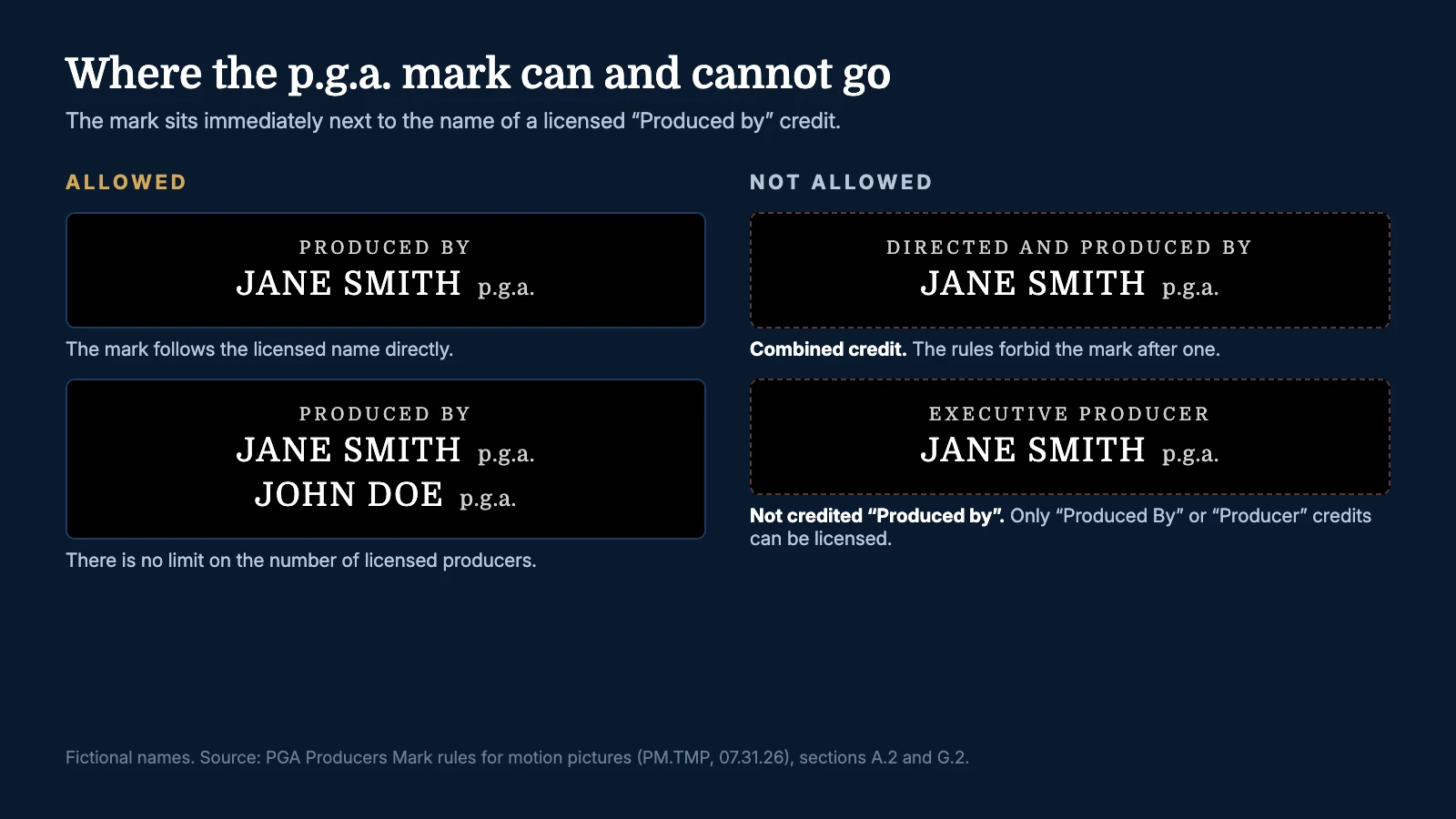
The rules add three constraints:
- No other mark after the name. The mark “may not be used if there is any other mark following the name(s) of the producer(s) who have been licensed”.
- No combined credits. It “may not be used following a combined credit (i.e. the credit may not state ‘Directed and Produced By [NAME], p.g.a.’)”.
- Position. The “Produced By” credit “must be contiguous to the principal credits of the Motion Picture (e.g. contiguous to the writer or director credit) or otherwise considered the main producing credit”.
Use of the mark without a licence “is prohibited and may result in legal action”. The same rules govern posters: see the billing block guide for where the mark sits in the block, and the film credits order guide for the full card sequence.
pga credit dispute
Disputes: What the PGA Will and Will Not Decide
The PGA has no procedure for disputing who gets an executive producer, co-producer or associate producer credit. Its arbitration decides one question: which credited “Produced By” producers get the mark. That makes it different from the WGA, which determines writing credits by arbitration, and the DGA, which enforces its credit rules in contract. Gordon addressed the gap directly: “Would it have been nice if we could have made the determination, like the Writers Guild does, who should actually get the credit… We knew that wasn’t going to happen.”
The PGA also steps back from live disputes. It may “refuse, delay or discontinue” certification where it has been notified of “a pending or potential legal dispute concerning the film’s credits”. If your credits are contested, settle that first.
pga awards eligibility
Why the Mark Matters: Oscars and Emmys
The mark exists because awards need a definition. Under the Academy’s rules for the 99th Oscars, Best Picture nominees are “those three or fewer producers who have performed the major portion of the producing functions”, and the producer “must have been determined awards-eligible by the Producers Guild of America… or have successfully appealed”. Credits such as executive producer, co-producer, associate producer and line producer “shall not receive nominations or Academy statuettes”. The Academy states that it “does not participate in the initial determination or arbitration process”.
For television the PGA runs a separate awards-eligibility process, in which executive producer and co-executive producer are eligible titles and the PGA notes that “a particular Eligible Title’s placement within the sequence of credits is often an indicator of that individual’s producorial involvement”. The Television Academy makes its own Emmy eligibility decisions.
The scale is substantial. The mark launched in 2012 on films including Lawless and Silver Linings Playbook, and The Hollywood Reporter counted 384 films applying for it in 2022 and 402 in 2023.
pga policy on producing credits
Crowdfunding Perks: The Credit Policy That Can Disqualify a Film
The PGA’s policy on producing credits says a producer credit “is not an honorary title to be given out as a benefit or a perk during any part of the production process”. It goes further for crowdfunding: a project supported by “the sale or offering of any ‘producer’ credit as a benefit or perk for campaign backers on public crowdfunding websites will not be recognized” for membership or evaluated for the mark or awards eligibility. The rules repeat it: such a film “will not be considered for Producers Mark certification”, regardless of whether the submitted producers were involved in the campaign.
Backers can still be thanked in the credits. The restriction is on the word “producer”.
Common PGA credit mistakes
What Productions Get Wrong
- Treating the Code as a contract. Citing “PGA rules” to demand or deny an EP credit has no force. The credit comes from the deal.
- Printing p.g.a. without a licence. The PGA calls unauthorized use prohibited. Wait for the determination letter.
- Putting the mark on the wrong credit. It follows “Produced By” or “Producer”. It does not follow an executive, co-producer or associate producer credit.
- Using a combined credit. “Directed and Produced By JANE SMITH, p.g.a.” breaks the rules.
- Selling “producer” credits to crowdfunding backers. It can remove the film from the mark process altogether.
- Submitting too early. The film should go in “as late as practicable in the post-production process after the film is substantively complete”.
PGA credits checklist
Pre-Delivery Checklist
- Each producing credit matches the wording in the deal memo; the PGA does not set it
- “Produced By” sits next to the principal credits (writer or director)
- A licensed producer’s name is followed directly by “p.g.a.”; nothing else follows the name
- No “p.g.a.” after a combined credit or an executive, co-producer or associate producer credit
- The mark appears in the end credits and in ads and posters under the production company’s control
- No producer credits were offered as crowdfunding perks
- The determination letter is on file for every producer using the mark
- Poster billing block matches the credits: see the billing block guide
PGA credits FAQ
Common Questions
What does p.g.a. mean in movie credits? It is the Producers Mark, a certification mark licensed by the Producers Guild of America to producers who performed a major portion of the producing functions on that film.
Is the PGA a union? No. It is a professional association with no collective bargaining agreement since 1975.
Does an executive producer get the p.g.a. mark? Not on an executive producer credit alone. The mark attaches to people credited “Produced By” or “Producer”.
Does the p.g.a. mark cost money? Certification is free. A fee applies only to putting a film on the Producers Guild Awards ballot.
Is the mark mandatory? No. Participation by a producer is voluntary, although a producer who does not take part when invited “may not later be eligible”.
Sources & Further Reading
- PGA Code of Credits: feature films and scripted television
- PGA Producers Mark and Producers Mark rules for motion pictures
- PGA policy on producing credits and Does the PGA do this?
- 99th Academy Awards rules (Rule Twenty, Best Picture)
- Deadline: How Shakespeare in Love’s Oscar inspired the PGA’s Code of Credits (2026)
- The Hollywood Reporter: Producers Guild cracks down on vanity film credits (October 2024)
Related reading: executive producer, associate producer and line producer role guides, and the film credits format and order guide.
Build Your Credits with EndCreditsPro
Producer credits, the p.g.a. mark and the order of the cards all have to match the deal before delivery. EndCreditsPro is built for assembling end credits for film and TV productions in one place, without design software.