What Is a Key Grip in Film?
Every fluid dolly shot, every camera crane move, every flag cutting hard light off an actor’s forehead — the key grip made it happen. They are the most powerful department head you have probably never heard of.
A key grip is the head of the grip department on a film, television, or commercial production. The key grip works directly under the Director of Photography (DP) to execute all camera support, rigging, and light-shaping work on set. They manage the grip crew, own the equipment package, and are the person the DP calls when a shot requires anything that isn’t powered.
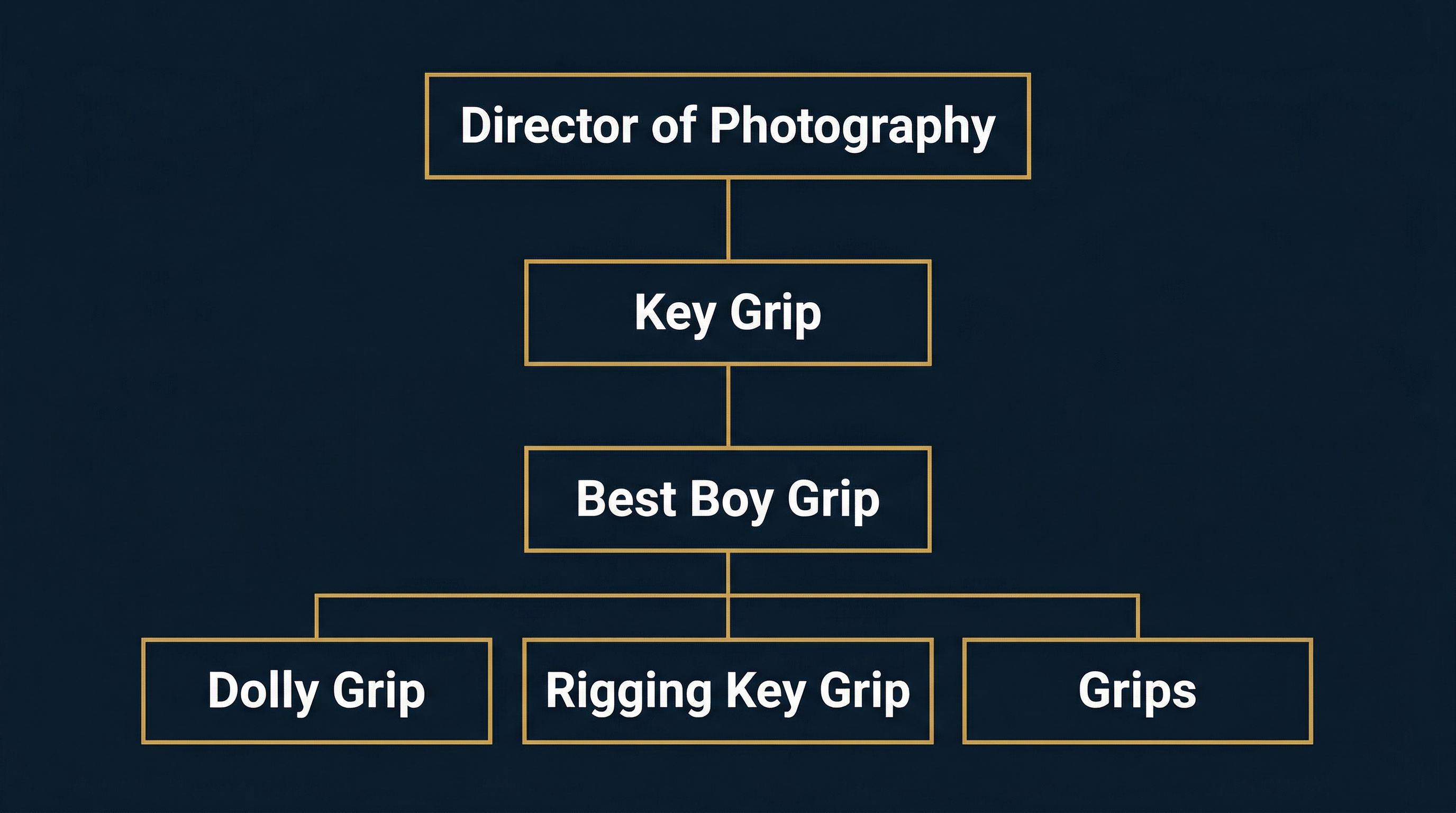
The grip department hierarchy runs: DP at the top, then the key grip, then the Best Boy Grip (who manages the crew’s day-to-day logistics), then dolly grips, rigging grips, and grips. On large productions, a separate rigging key grip may pre-rig locations before the shooting crew arrives.
What does a key grip do?
The Day-to-Day of the Grip Department Head
The key grip’s job has three distinct domains: camera support, rigging, and safety. Their scope goes well beyond moving equipment — it requires structural engineering instinct, a working knowledge of the DP’s visual language, and the ability to make complex rigs safe under time pressure.
Pre-production duties:
- Reading the script and flagging scenes that require unusual camera movement, vehicle rigs, wire work, or large-scale rigging
- Scouting locations with the DP and gaffer to assess rigging points, structural load limits, and camera placement options
- Building the grip equipment package: dollies, cranes, tracks, car rigs, flags, frames, diffusion, apple boxes, and safety gear
- Hiring the grip crew: Best Boy Grip, dolly grips, and rigging grips based on the production’s scope
On-set duties:
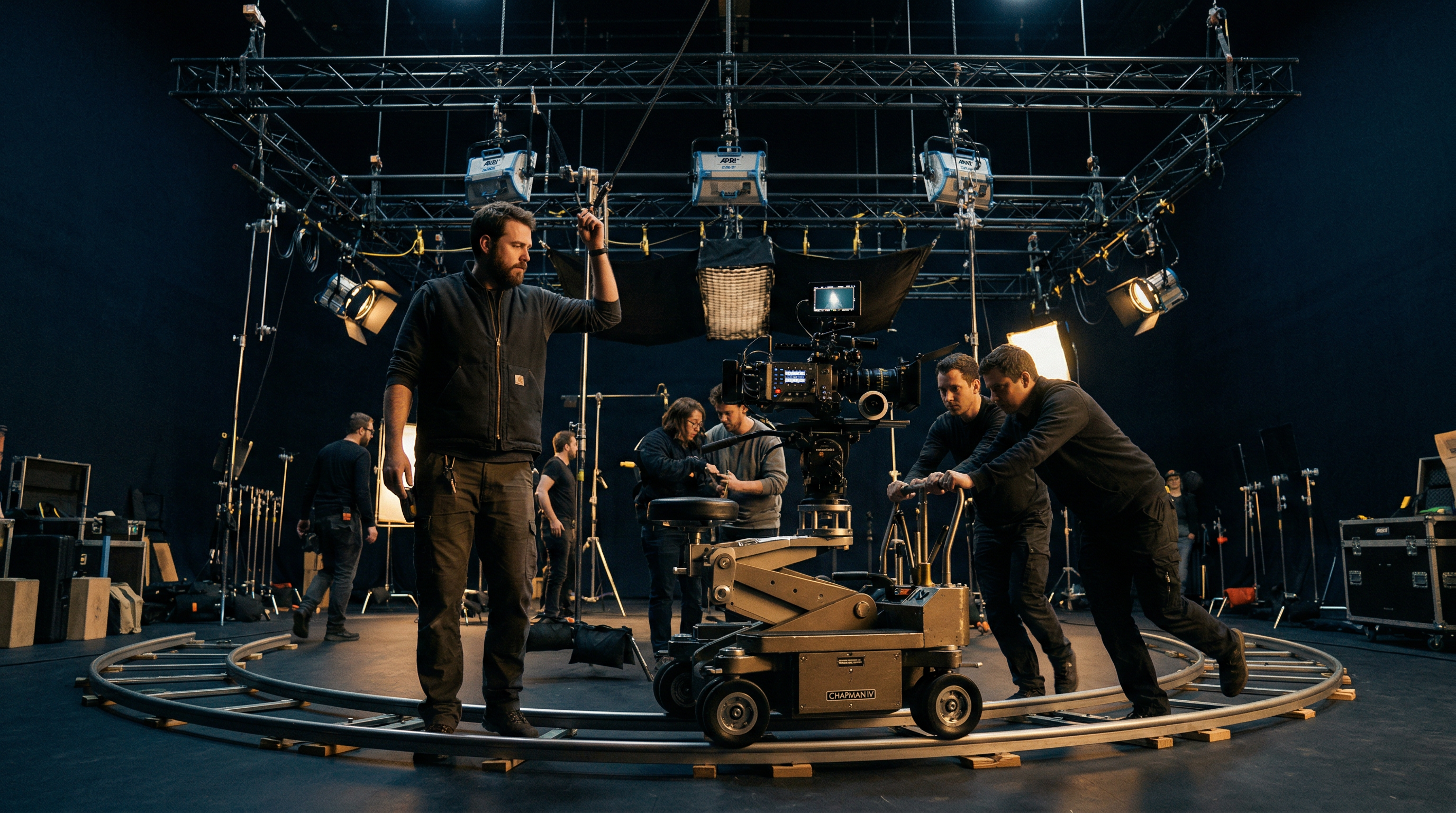
- Setting up and operating the dolly, crane, technocrane, Steadicam platform, or any other camera support system
- Rigging camera mounts to vehicles, boats, aircraft, or any moving object
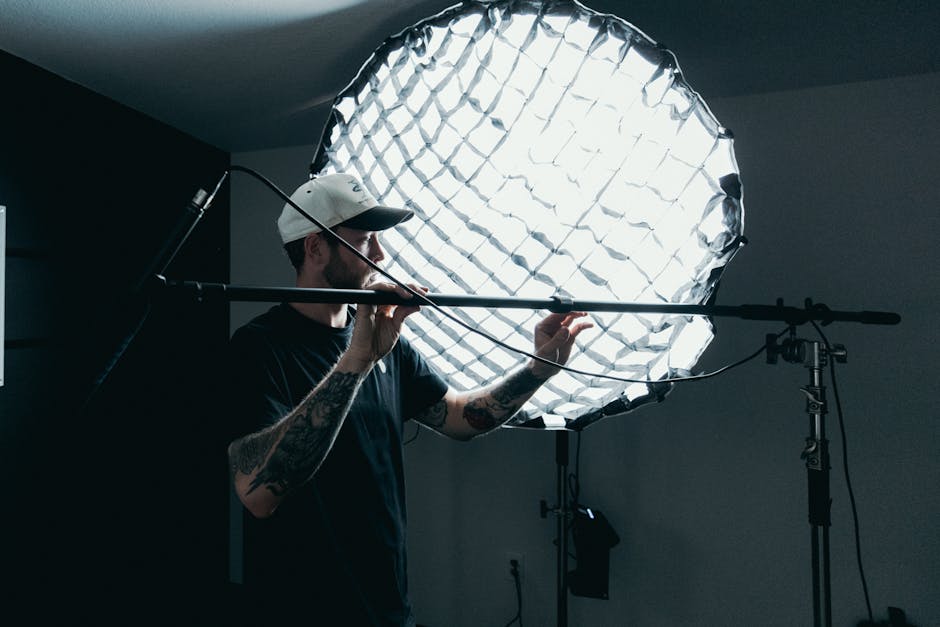
- Placing flags, nets, and diffusion frames to shape and control light at the DP’s direction
- In the US, grips are also responsible for placing and securing lighting stands — a responsibility that falls to the electrical department in some other countries
- Handling complex overhead rigging: pole cats between walls, 20×20-foot diffusion frames on heavy-duty stands or trusses, and large blackouts rigged on a Manitou or scissor lift
- Consulting with the director, DP, and stunt coordinator on the safety of any setup that places crew or cast on film equipment
Safety authority:
The key grip has final say on the physical safety of any camera or lighting rig. Rental companies require a credited, experienced grip to be present when heavy-duty equipment such as technocranes is in use. This authority is not ceremonial — if a rig is unsafe, the key grip stops the shot.
Equipment the key grip works with: Chapman/Hustler dolly, Fisher 10 and 11, Technocrane, Sidewinder arm, Dana Dolly, car mount suction cups, slider systems, baby pins, C-stands, speed rail, pipe, clamps, flags, frames (single and double net, silk, rag, griff), sandbags, and apple boxes. The key grip is responsible for knowing load limits and safe working loads for every piece of structural equipment on set.
Where does the key grip appear in film credits?
Credits Placement for the Grip Department Head
This is where most job description articles stop. Here is the full breakdown of exactly where the key grip credit appears.
Opening Credits
The key grip does not appear in opening credits. Opening title cards are reserved for above-the-line talent: the studio, production company, lead cast, director, writer, and producers. Occasionally the DP receives an opening card — the key grip does not.
On some prestige features, there is a “Key Crew” or “Department Heads” section at the very top of the end crawl — before the full departmental scroll — which may include the key grip alongside the gaffer, production designer, and costume designer. This is a production choice, not a guild requirement.
End Credits
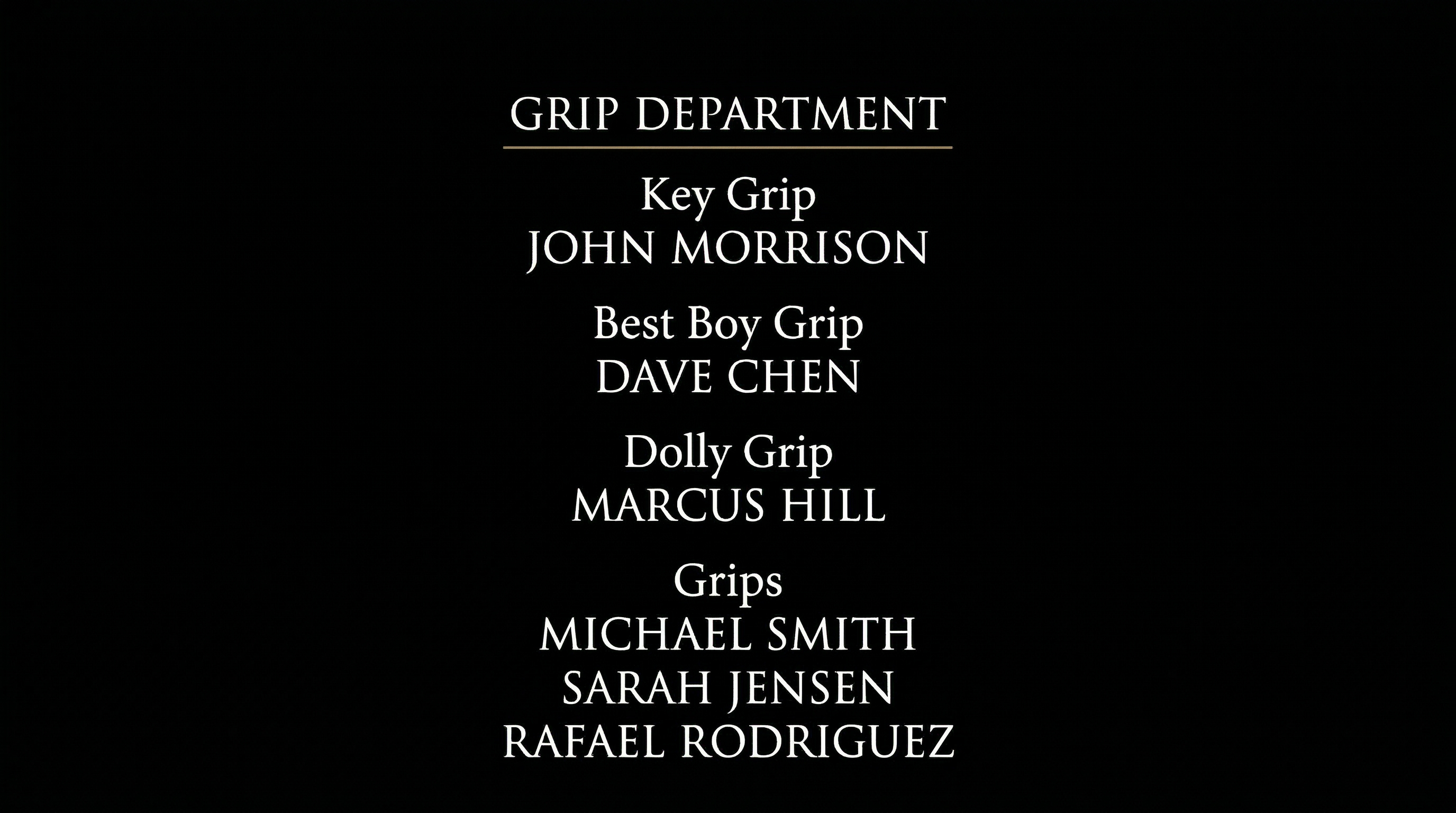
The key grip appears at the top of the grip department block in the end credit crawl. Their position within that block is consistent across union and non-union productions: key grip first, always.
Standard credit order within the grip department:
| Position | Credit Order |
|---|---|
| Key Grip | 1st (department head) |
| Best Boy Grip | 2nd |
| Dolly Grip | 3rd |
| Rigging Key Grip | 4th (if applicable) |
| Rigging Best Boy Grip | 5th (if applicable) |
| Grips | After department heads |
The grip department block typically appears near the electrical department block in the below-the-line crew section of the crawl. The exact position relative to camera, art, sound, and other departments varies by production, but the key grip’s position at the top of the grip block does not.
Single Card vs. Scroll
On most features and episodic television, the key grip receives a shared scroll credit within the grip department block — not a solo card. The key grip and gaffer are the two grip/electrical department heads and are treated symmetrically in the credits: both head their respective blocks, neither receives a solo card on standard productions.
How to credit a key grip correctly
Exact Format, Variations, and Guild Rules
The standard screen credit format for a key grip:
Key Grip ......................... JOHN DOEOr in a department block layout:
GRIP DEPARTMENT

Key Grip
JOHN DOE

Best Boy Grip
JANE SMITH

Dolly Grip
ALEX JONES
Accepted title variations:
- Key Grip — the universal standard across US productions, union and non-union
- Key Rigging Grip — used specifically for the grip who runs the rigging crew on large productions; this is a different credit from “Key Grip”
- On some international productions: Grip or Chief Grip — not standard in the US, but acceptable in the local context
Avoid using “Head Grip” — it is not a standard US film credit title. Stick to “Key Grip.”
Guild requirements: Key grips on IATSE-signatory productions fall under IATSE Local 80 (Grips) in Los Angeles and New York. The union does not mandate a specific on-screen credit format the way the DGA or WGA do, but the key grip credit is a contractual obligation — the production must credit them in the end crawl.
Multiple roles: If one person served as both key grip and gaffer on a low-budget production, credit both roles separately:
Gaffer / Key Grip
JOHN DOE
Never collapse them into a single invented title. Both roles should be readable independently. For formatting guidance across all departments, see the film credits format and order guide.
Key grip vs. gaffer
Two Parallel Department Heads Under the DP
The key grip and the gaffer are the two most frequently confused department heads in film crew roles. Both work under the DP. Both run large crews. But they own separate departments.
| Key Grip | Gaffer | |
|---|---|---|
| Department | Grip | Electrical |
| Manages | Grips, dolly grips, rigging grips | Electricians, lamp operators |
| Primary focus | Camera support and light shaping — flags, frames, diffusion, dollies, cranes | Light generation — fixtures, power, color |
| Reports to | Director of Photography | Director of Photography |
| Second-in-command | Best Boy Grip | Best Boy Electric |
| Simple rule | If it shapes or blocks light, or supports the camera — grip’s domain | If it plugs in — gaffer’s domain |
Neither role outranks the other. On set, the gaffer places a light; the key grip rigs a flag in front of it to control the spill. They collaborate on every setup, but their crews, equipment, and budgets are entirely separate.
Their credits also appear in separate department blocks in the end crawl — the key grip heads the grip department, the gaffer heads the electrical department.
Key grip responsibilities on complex productions
Camera Support at Scale
The sophistication of a key grip’s work scales directly with budget. On a $5M indie, the key grip may operate the dolly personally. On a $150M studio feature, they are running a department of 15+ people managing simultaneous units, pre-rigging locations, and supervising technocrane operators on a stage while a second unit shoots on location.
Some specific setups that require a key grip’s expertise:
- Vehicle rigs: mounting cameras to moving cars, motorcycles, or helicopters using suction cup mounts, bumper mounts, or custom fabricated rigs. The key grip is responsible for the structural integrity of every mount.
- Wire rigs: working with the stunt department to rig camera cables or wires for actors — the key grip ensures the mechanical safety of the rig before any performer is attached.
- Underwater and aerial rigs: coordinating with specialty operators to integrate camera support with non-standard platforms.
- Process trailer work: on productions using a process trailer (a flatbed truck on which a car scene is filmed), the key grip rigs the cameras to the vehicle and manages all camera positions.
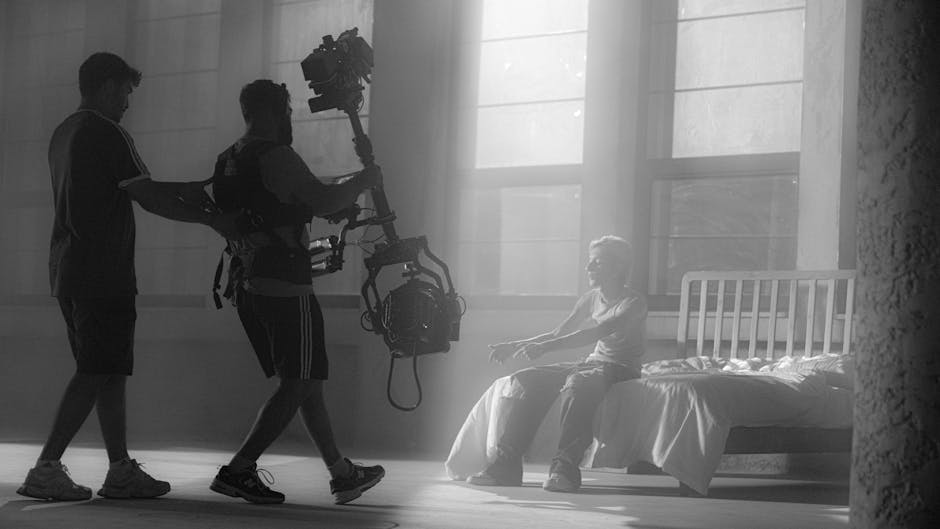
Notable key grips in film history
The Professionals Behind the Shots
Key grips rarely receive public profiles, but their work shapes the camera movement that audiences remember.
-
Tom Ramsey — Key grip on The Dark Knight (2008) and The Dark Knight Rises (2012), working with cinematographer Wally Pfister. Ramsey’s grip work supported the film’s practical IMAX camera setups — technically demanding work that required custom rigging for large-format cameras on location in Chicago and Pittsburgh.
-
Bob Munroe — Key grip on Terrence Malick’s The Tree of Life (2011), shot by Emmanuel Lubezki. Lubezki’s handheld, natural-light approach to Tree of Life demanded grip work that was invisible but constant — rigging sunshades, controlling fill with large silks outdoors, and keeping Lubezki’s camera mobile under difficult conditions.
-
Richard Moran — Long-running key grip relationship with Roger Deakins on films including Fargo, The Big Lebowski, and No Country for Old Men. The Deakins-Moran collaboration demonstrates the key grip-DP partnership that defines top-tier production: the DP imagines the frame, the key grip makes it physically possible.
Sources and Further Reading
Official resources:
- IATSE Local 80 — Grips — the union representing key grips in Los Angeles
- ScreenSkills — Grip (Film and TV Drama) — UK industry perspective on the role
Related viewing:
Related EndCreditsPro guides:
Create Professional Credits with EndCreditsPro
Getting the key grip credit in the right position — at the top of the grip department block, separate from the electrical department, formatted correctly — matters. EndCreditsPro auto-formats your end credits with correct role hierarchy, department ordering, and guild-compliant layouts.