What Is a Special Effects Supervisor in Film?
Neil Corbould spent months rigging the zero-gravity sequences on Gravity before a single digital frame existed. What Alfonso Cuarón needed first was not a VFX artist — it was a special effects supervisor who could make the physical world behave like there was none.
A special effects supervisor — also called an SFX supervisor or special effects coordinator — is the department head responsible for all practical, physical effects created on set during principal photography. Explosions, rain rigs, wind machines, breakaway props, pyrotechnics, mechanical rigs, atmospheric fog: if it happens in camera, the SFX supervisor owns it.
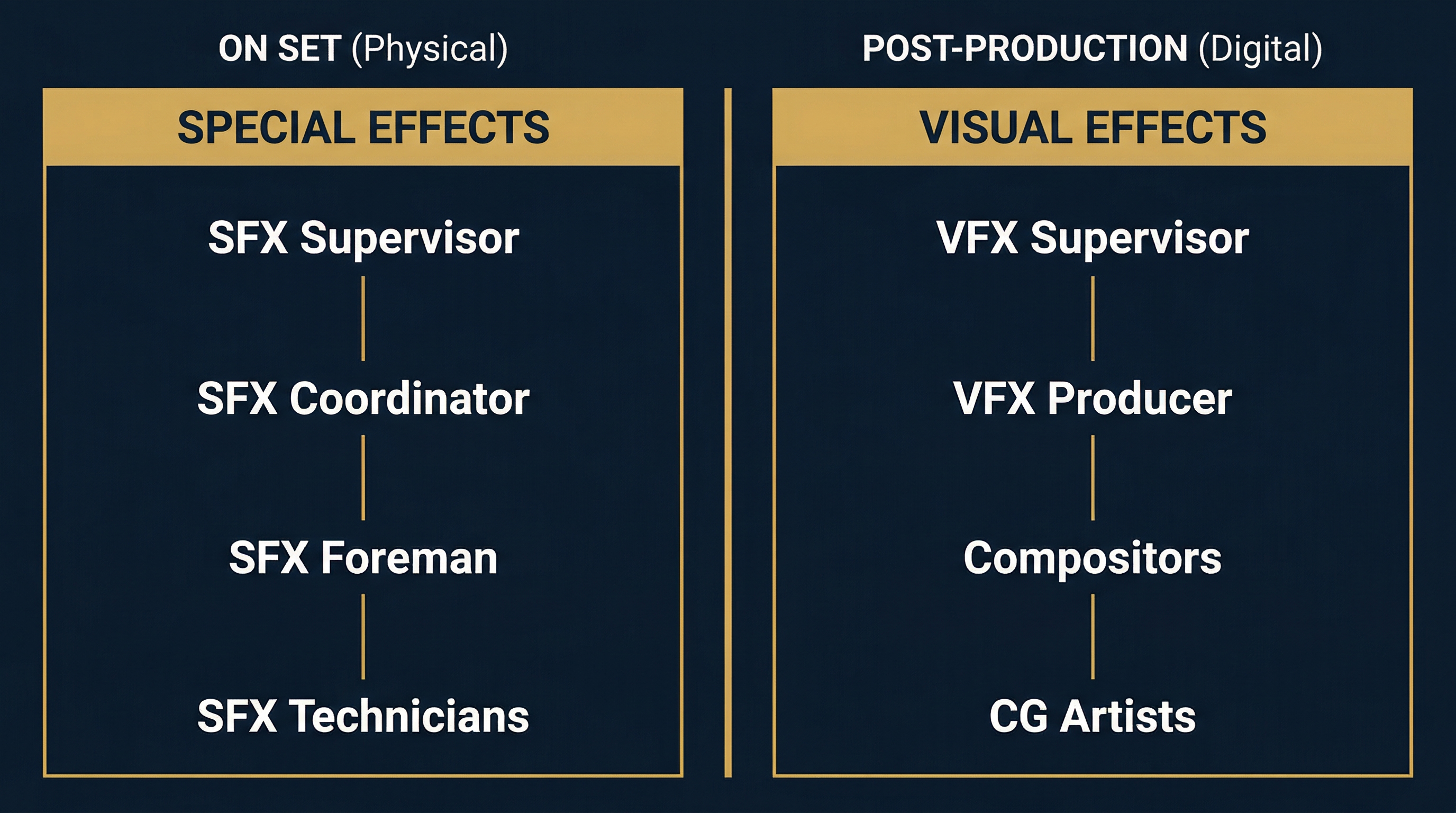
The role sits within the special effects department, separate from the visual effects (VFX) department. The SFX supervisor reports directly to the director and producers, and collaborates closely with the production designer, art director, and director of photography. SFX technicians, pyrotechnic specialists, and effects riggers all report to the SFX supervisor.

What does a special effects supervisor do?
Special Effects Supervisor Responsibilities
The SFX supervisor’s work begins in pre-production and runs through the final day of principal photography.
Pre-production:
- Reading the script and identifying every scene requiring practical effects
- Meeting with the director to understand the intended look and feel of each effect
- Collaborating with the production designer and DP on how effects interact with sets, lighting, and camera placement
- Engineering custom solutions — mechanical rigs, breakaway materials, pyrotechnic charges
- Sourcing materials, equipment, and specialist subcontractors (e.g., licensed pyrotechnicians)
- Building and managing the effects budget, scheduling crew days
- Filing permits for pyrotechnics, atmospheric releases, and hazardous materials
Production:
- Setting up and operating all physical effects for each shooting day
- Briefing cast, the director, the DP, and safety officers before every effects sequence
- Supervising SFX technicians and coordinating with camera, grip, and electric departments
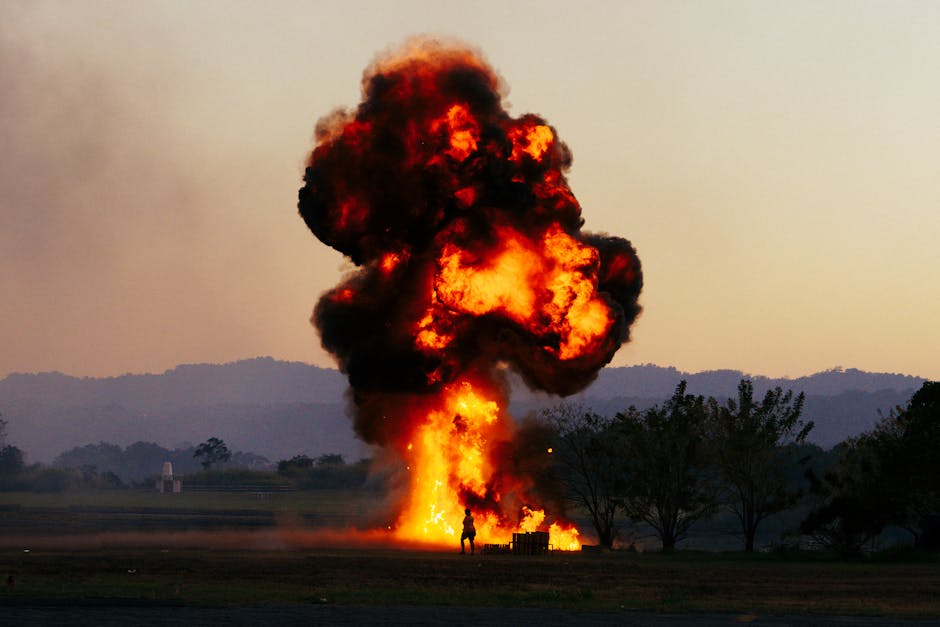
- Managing live pyrotechnics, controlled explosions, rain and snow rigs, wind machines, fog and smoke, fire effects, and mechanical stunts
- Performing safety checks on all rigs and equipment before cameras roll
- Adapting effects in real time when lighting, blocking, or weather conditions change
- Coordinating with the stunt coordinator on any effects tied to stunt work
Wrap:
- Safe disposal of hazardous materials (pyrotechnic residue, chemicals)
- Documenting effects for continuity if pickups or reshoots are needed
- Handing off to the VFX department any elements (e.g., explosions, rain plates) that will be enhanced in post
The SFX supervisor is not a generalist — they typically specialize in one or more areas: pyrotechnics, mechanical effects, atmospheric effects, or water work. Paul Stephenson, who worked six Harry Potter films and two Bond productions, describes the job as “serious play”: every production brings a new technical problem with no existing manual.
Special effects supervisor vs VFX supervisor
SFX vs VFX: What’s the Difference?
This is the most persistent point of confusion in production, and it matters for credits.
| Special Effects Supervisor | VFX Supervisor | |
|---|---|---|
| When | Principal photography (on set) | Post-production (and some on-set supervision) |
| How | Physical, practical, in-camera | Digital, computer-generated |
| Examples | Explosions, rain, mechanical rigs, pyro | CGI, compositing, digital environments |
| Department | Special Effects | Visual Effects |
| Reports to | Director, producers | Director, producers, VFX producer |
| Credit location | Special Effects department block | Visual Effects department block |
Both supervisors may be on set simultaneously — the SFX supervisor rigging a practical explosion while the VFX supervisor marks reference data for digital enhancement in post. On Gravity, both departments worked in tandem: physical rigs for actor movement, digital environments built around them.
Do not conflate these roles in your credits. They are separate department heads, represented by different union agreements, and listed in separate sections of the end crawl.
Where does the special effects supervisor appear in film credits?
Special Effects Supervisor Credit Placement
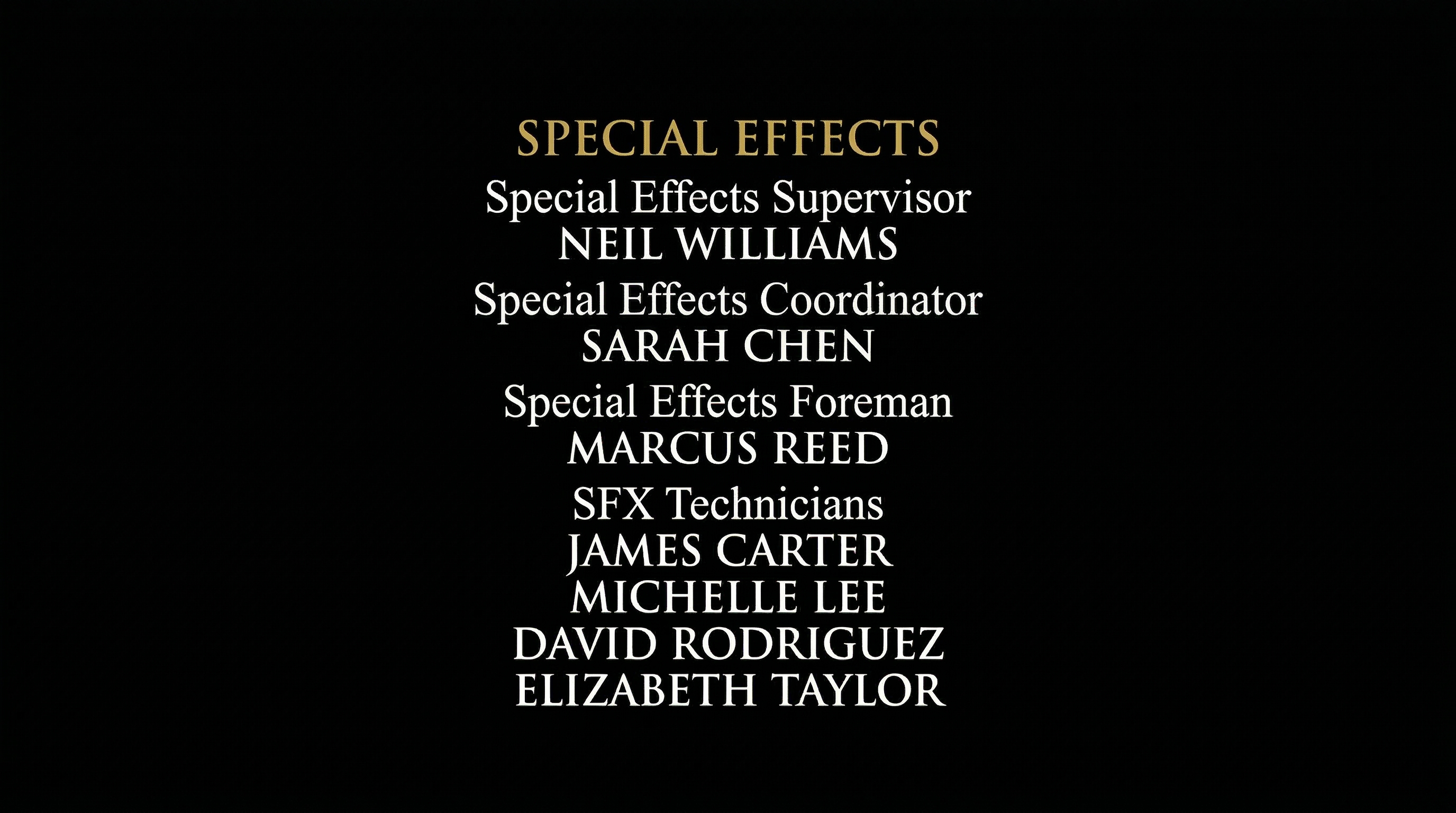
The SFX supervisor receives credit in the technical credits block of the end crawl, typically within a dedicated Special Effects department section.
Position in the end crawl:
The special effects department section appears toward the latter half of the end crawl, after the main production departments (camera, sound, art, wardrobe) and typically alongside or just before the visual effects department block. On productions where practical effects are substantial — action films, large-scale period pieces, tentpole features — the department can run 10-30+ names.
Standard credit order within the Special Effects department:
- Special Effects Supervisor (department head — first credit)
- Special Effects Coordinator (if separate from supervisor, second credit)
- Special Effects Foreman / Key SFX Technician
- Senior SFX Technicians
- SFX Technicians
- Pyrotechnic Specialists / Pyrotechnicians
- SFX Assistants / Trainees
Opening credits: The SFX supervisor does not typically receive an opening card. On productions where practical effects are a central creative element, the supervisor may receive an “additional production credits” card at the end of the main title sequence, but this is rare and usually negotiated individually.
Union billing: On IATSE-covered productions in the U.S., the SFX department is typically covered by local agreements (locals vary by region: Local 44 covers property crafts including effects in Los Angeles; other locals in New York, Canada, and the UK have jurisdiction depending on where production occurs). The collective bargaining agreement governs minimum credit requirements, but in practice the SFX supervisor is always credited as a department head.
How to credit a special effects supervisor correctly
Special Effects Supervisor Credit Format
Standard title formats used in production credits:
| Format | When Used |
|---|---|
| Special Effects Supervisor | Standard — most common on features and episodic television |
| Special Effects Coordinator | Common alternative, especially on episodic TV and lower-budget features |
| SFX Supervisor | Informal — acceptable in internal documents, not standard in formal credits |
| Special Effects Director | Used occasionally but less standard; avoid on IATSE productions |
| Supervisor of Special Effects | Older format; still seen on archive and classic productions |
Recommended format for formal credits:
SPECIAL EFFECTS SUPERVISOR
John Smith
Or in a department header style:
SPECIAL EFFECTS

Supervisor ........................... John Smith
Coordinator .......................... Jane Doe
Key SFX Technician ................... Robert Evans
When one person covers both SFX and practical stunts coordination: Credit both functions — do not roll them into one. Guild rules generally require that each credited function reflects actual work performed and that supervisory roles receive their own title.
When a production uses no practical effects: The Special Effects section is simply omitted. Do not include a placeholder or leave the section empty.
Special effects supervisor salary
What Does a Special Effects Supervisor Earn?
SFX supervisors are among the higher-paid craft positions in production. Pay varies substantially based on production scale, union status, and whether the supervisor is handling pyrotechnics (which carry a premium).
Typical ranges (U.S. market):
- Low-budget independent productions: $1,500–$3,000/week
- Mid-range studio features and streaming series: $4,000–$8,000/week
- Large-scale studio tentpoles: $10,000–$20,000+/week, sometimes with back-end bonus structures
IATSE scale agreements set minimums for SFX technicians; supervisors typically negotiate above scale. Pyrotechnic-licensed supervisors command higher rates because pyrotechnic permits and liability fall on their license.
Day rates for testing, pre-production prep, and on-call effects days are negotiated separately from the production shooting rate.
Notable special effects supervisors in film history
SFX Supervisors Who Defined the Craft
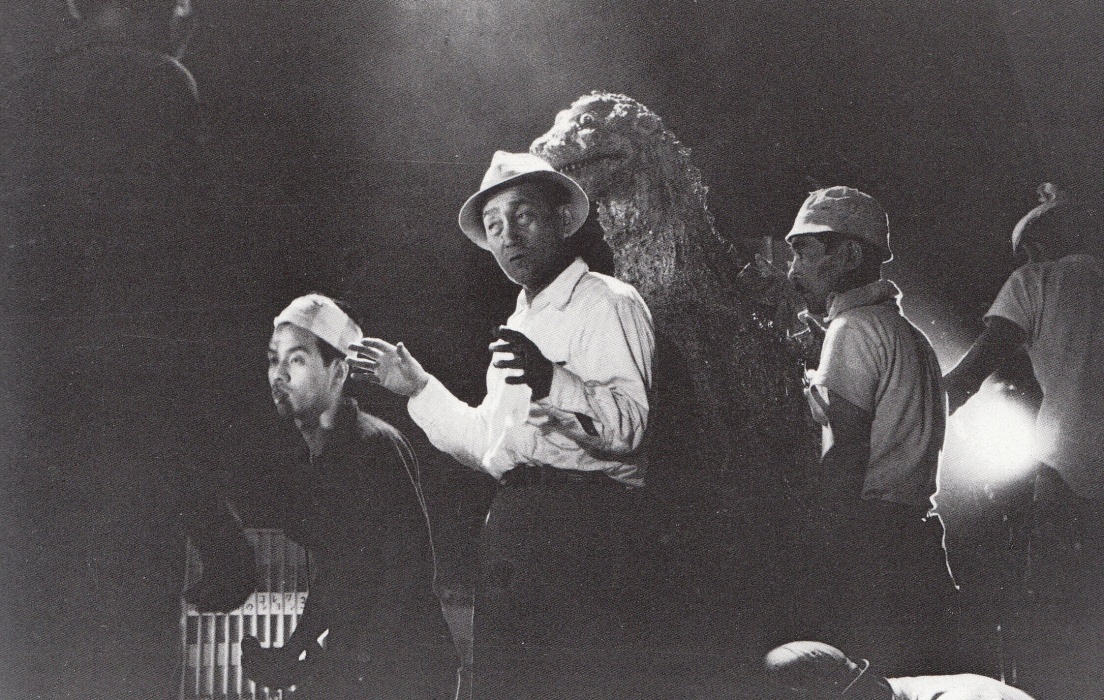
Eiji Tsuburaya — The foundational figure in practical effects. Tsuburaya created the original Godzilla (1954) using miniature cities, suitmation, and forced-perspective techniques that defined a generation of practical filmmaking in Japan.
Neil Corbould — Eight-time Oscar nominee, twice winner (for Saving Private Ryan and Inception). Corbould’s department on Gravity included full-scale zero-g rigs and practical debris systems. His work on the original Star Wars trilogy as a crew member and later as SFX supervisor on the prequels helped define modern practical effects workflows.
Douglas Trumbull — Designed the in-camera stargate sequence for 2001: A Space Odyssey and the physical effects for Blade Runner (1982). His commitment to in-camera solutions over post-production remains a benchmark for what practical effects can achieve.
John Dykstra — Developed the motion-control camera systems used on the original Star Wars (1977), which later became the foundation for Industrial Light & Magic’s early practical effects work.
Sources & Further Reading
- IATSE — International Alliance of Theatrical Stage Employees — Union representation for SFX departments
- Wikipedia: Special Effects Supervisor — Overview and historical context
- StudioBinder: What Is a Special Effects Supervisor — Role breakdown and job description
- Reel Canada: Careers in Film — Canadian film career profiles
The special effects department is one of the most technically complex to credit correctly — multiple specialists, multiple functions, and a clear hierarchy that varies by production size. EndCreditsPro auto-formats your special effects department block, applies the correct title hierarchy, and ensures every SFX crew member is listed in the right order. Join the waitlist for early access.
For more on how individual departments are structured in end credits, see the complete guide to film credits format and order and the IATSE compliance guide for film credits.
Browse related roles in the special effects and production departments:
- Gaffer — head of the electrical department, a frequent collaborator with SFX
- Cinematographer — the DP who coordinates with SFX on every effects shot
- VFX Supervisor — the digital counterpart who extends practical effects in post
- Stunt Coordinator — co-designs every gag where effects and performers meet
- Armorer — handles prop firearms alongside SFX pyrotechnics
- Scenic Artist — paints and ages the breakaway and rigged set pieces
- All film crew roles