What Is a Stunt Double in Film?
Every action sequence the audience believes the star performed — someone else did it. The face you see, the body doing the work: different people.
A stunt double is a trained stunt performer who substitutes for a principal actor during physically hazardous or demanding sequences — falls, car crashes, fight choreography, fire work, and high-impact impacts that would put an uninsured, untrained actor at serious risk. Unlike a stand-in (who fills in for lighting and blocking purposes, never on-camera), a stunt double is photographed as the character.
The stunt double reports to the Stunt Coordinator, who designs and supervises all stunt sequences on a production. On large-scale films, a single actor may have multiple stunt doubles — one for driving sequences, one for high falls, one for wire work — each selected for their specialty.
Stunt doubles belong to the stunt department, which sits outside the standard crew department hierarchy. Under SAG-AFTRA rules, stunt performers are a separate contract category from principal actors.
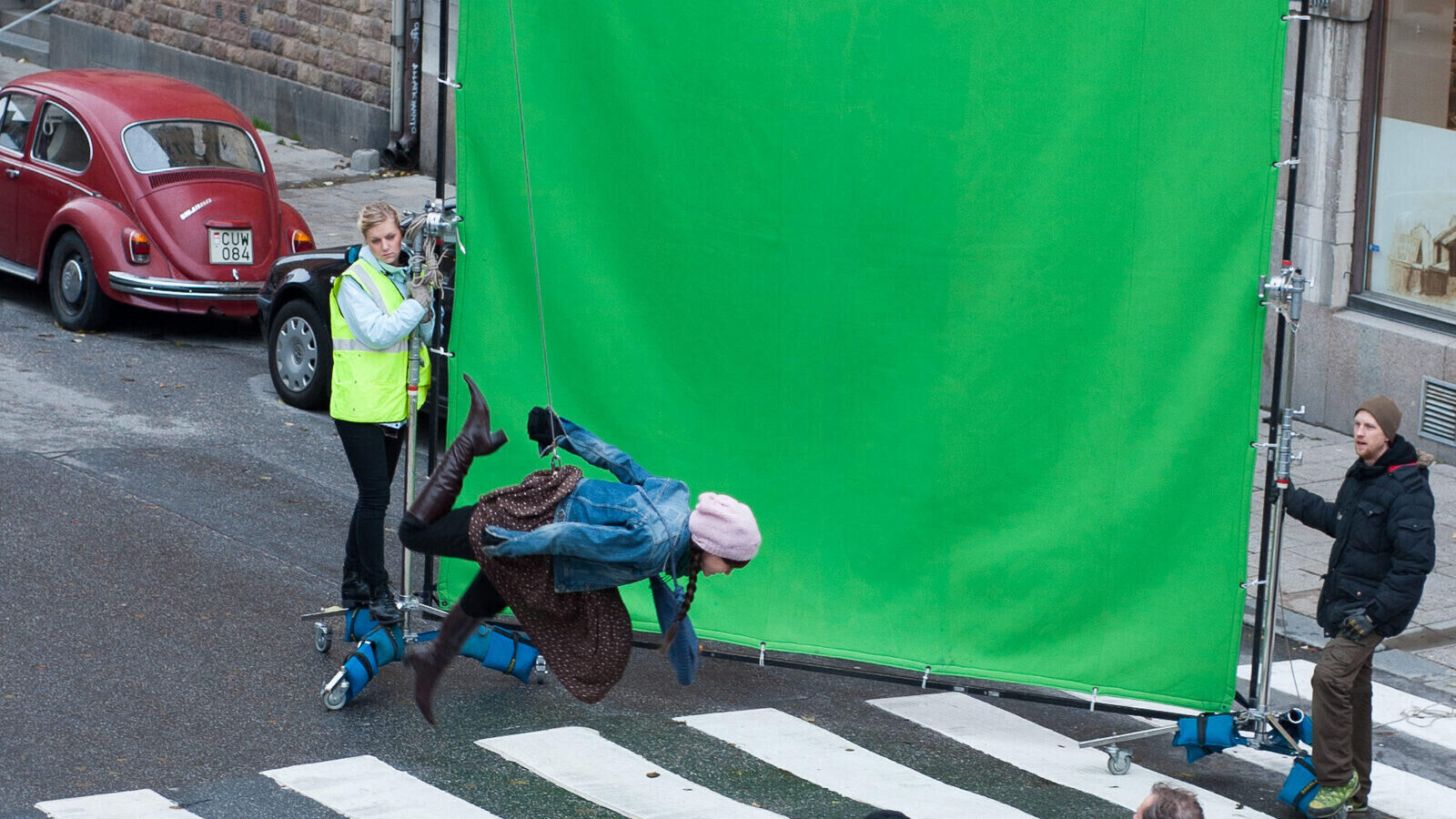
What does a stunt double do?
The Stunt Double’s Job on Set
The stunt double’s primary function is to perform dangerous or physically extreme actions in place of the credited actor — but the job extends well beyond execution day.
Pre-production:
- Rehearse sequences with the Stunt Coordinator and 2nd Unit Director
- Complete physical conditioning and skill-specific training (wire work, driving, fight choreography)
- Attend costume and makeup fittings to match the principal actor’s look precisely
- Participate in stunt rigging tests and safety checks
On set:
- Perform the stunt as rehearsed and choreographed
- Work closely with the Camera Department to ensure angles conceal their face where required
- Coordinate with Special Effects for practical effects elements (ratchets, explosives, fire)
- Provide coverage across multiple takes, adjusting for camera position and director notes
Key collaborators:
- Stunt Coordinator — immediate supervisor; designs the gag and approves execution
- 2nd Unit Director — typically directs action sequences where the stunt double works
- Director of Photography — frames shots to serve the illusion that the principal performed the stunt
- Wardrobe and Makeup — ensure continuity with the principal actor
Stunt doubles are also expected to physically match the actor they double: matching height, build, hair color, and skin tone. For above-the-waist shots or partial reveals, the resemblance must hold under production lighting.

Where does the stunt double appear in film credits?
Stunt Double Credits in Film and Television
This is where most sources stop short — and where productions frequently make errors.
End credits placement: Stunt doubles appear in the Stunts section of the end crawl, which falls within the main crew block. They do not receive opening title cards. The format is:
STUNTS

Stunt Coordinator ........... JOHN SMITH
Stunt Double for [Actor Name] ........... JANE DOE
Stunt Double for [Actor Name] ........... MIKE JOHNSON
Additional Stunts ........... ALEX REED
                              SARAH LANE
                              CHRIS PARK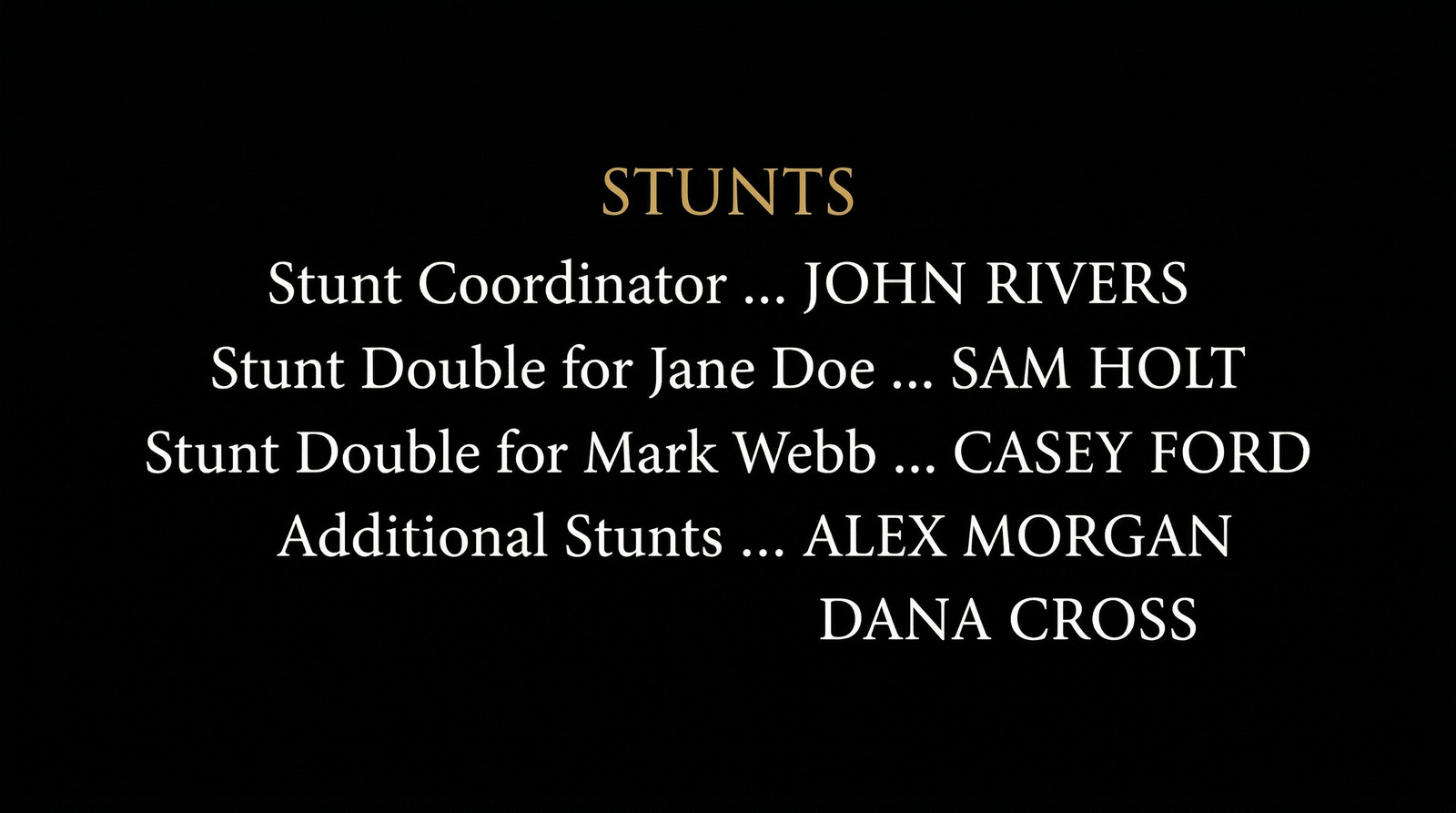
SAG-AFTRA rules: Under the SAG-AFTRA Stunt Agreement, stunt performers performing a specific stunt as a double for a principal actor must be credited as “Stunt Double for [Principal Actor Name].” The principal actor’s name used in the credit must match their credited name elsewhere in the film — not a nickname or informal reference.
Productions that list stunt doubles in a generic “Additional Stunts” block without attribution violate the intent of the contract, even if they technically comply with minimum credit requirements. The Screen Actors Guild has historically pushed for more transparent attribution, and productions of the 2020s have increasingly moved toward full “Stunt Double for [Name]” credits.
Television vs. feature film:
- Features: Full stunt performer roster listed in end crawl, typically with “Stunt Double for [Name]” attribution for principal doubles
- Television (episodic): End credits are compressed; stunt performers may be listed collectively or under the Stunt Coordinator’s umbrella credit, particularly on network television with strict runtime constraints
- Streaming originals: Generally follow feature film conventions with full stunt department listings
When they don’t appear: Non-union productions and some international co-productions do not always list stunt performers at all. This is legally permissible outside of SAG-AFTRA jurisdiction but is considered poor practice by industry standards.
How to credit a stunt double correctly
Correct Credit Format for Stunt Doubles
The standard formats used across major productions:
Format 1 — Named double with attribution (recommended):
Stunt Double for Jane Doe ......... SAM RIVERSFormat 2 — Role-specific:
Driving Double for John Actor ......... CASEY HALL
Fight Double for John Actor ......... MORGAN WELLS
Format 3 — Grouped stunt performers:
Stunt Performers
  ALEX FORD
  DANA CROSS
  JAMIE SONG
(Used when performers executed general stunts not tied to a specific double assignment.)
Common errors to avoid:
- Listing a named stunt double in the generic “Stunt Performers” block without attribution — this denies them the contractual credit they earned
- Misspelling the principal actor’s name in the “Stunt Double for [Name]” credit
- Omitting the stunt department entirely from episodic credits when stunt performers worked under a buyout deal
- Using informal names: the principal actor’s credit must match exactly — “Stunt Double for Elizabeth Olsen,” not “Stunt Double for Scarlet Witch”
Stunt double vs. stand-in vs. body double
Understanding the Three Types of Doubles
These terms are often used interchangeably outside the industry — on set, they are three distinct roles with different contracts, different unions, and different credit treatment.
| Role | On Camera? | Purpose | Credit Location |
|---|---|---|---|
| Stunt Double | Yes — during stunts | Performs dangerous physical action | End credits, Stunts section |
| Stand-In | No | Lighting and blocking preparation | Typically not credited, or thanked in special acknowledgments |
| Body Double | Yes — specific shots | Substitutes for actor’s body (nudity, hands, etc.) when face not shown | End credits, may appear as “Body Double for [Name]” or in Additional Crew |
A body double performs shots where their face is not shown — close-ups of hands, intimate scenes where the actor isn’t comfortable or available, or situations where a physical trait (height, build) needs to match exactly. Body doubles do not necessarily have stunt training. They are credited separately from stunt doubles, typically in the Additional Crew section if credited at all.
The stand-in is not photographed as the character — they occupy the actor’s position while the crew sets up. They are paid a day rate under a separate contract and are rarely credited publicly.
How to become a stunt double
Stunt Double Career Path and Training
There is no formal degree program for stunt performance — the path is built from athletic specialization, industry networking, and demonstrated skill.
Foundation skills:
- Martial arts (most in-demand): Brazilian jiu-jitsu, boxing, krav maga, Muay Thai
- Gymnastics and acrobatics: essential for wire work and fall sequences
- Driving: precision driving and high-speed vehicle control for automotive stunts
- Swimming and diving: underwater sequences and high-dive work
- Horseback riding: required for period productions
Most working stunt performers are competitive-level athletes in at least two disciplines before they seek their first stunt job.
Breaking in:
- Join a stunt school or training group connected to working coordinators
- Build a demo reel showcasing specific skills — fights, falls, driving
- Get a SAG-AFTRA Stunt Performer voucher through non-union work, then upgrade
- Network with Stunt Coordinators directly — the stunt community is small and referral-driven
The Stunt Coordinator is the gatekeeper. New stunt performers rarely get hired without a personal recommendation from someone the coordinator trusts. Entry-level work includes background stunts, crowd action, and uncredited adjustment work.
Stunt double salary
How Much Do Stunt Doubles Earn?
SAG-AFTRA sets minimum rates for stunt performers under the Stunt Agreement. As of the current contract cycle:
- Day rate (minimum): approximately $1,006/day (SAG-AFTRA scale)
- Weekly guarantee: most coordinators negotiate week-long minimums for their performers
- Stunt adjustment: an additional negotiated fee paid on top of the day rate for each specific stunt performed — the more dangerous the gag, the higher the adjustment
Stunt adjustments are where the real compensation lives. A high fall might add $500–$3,000 to a day’s base rate. A fire gag, a full car crash, or a motorcycle slide can add significantly more. Top stunt performers — those with specialized skills and feature film credits — negotiate adjustments that bring single-day earnings into five figures.
Non-union and low-budget productions often pay flat rates with no adjustment structure, which is one reason injuries disproportionately occur on lower-budget sets: performers accept underpaid gags with fewer safety resources.
Notable stunt performers with long careers — coordinators like David Leitch (John Wick, Bullet Train) and performers like Zoë Bell (Kill Bill, Death Proof) — have used stunt careers to move into directing and producing. Bell began as a stunt double for Uma Thurman in Kill Bill and later appeared as herself in Tarantino’s Death Proof, a rare on-screen acknowledgment of stunt work’s artistry.
Notable stunt doubles in film history
Famous Stunt Doubles and Their Work
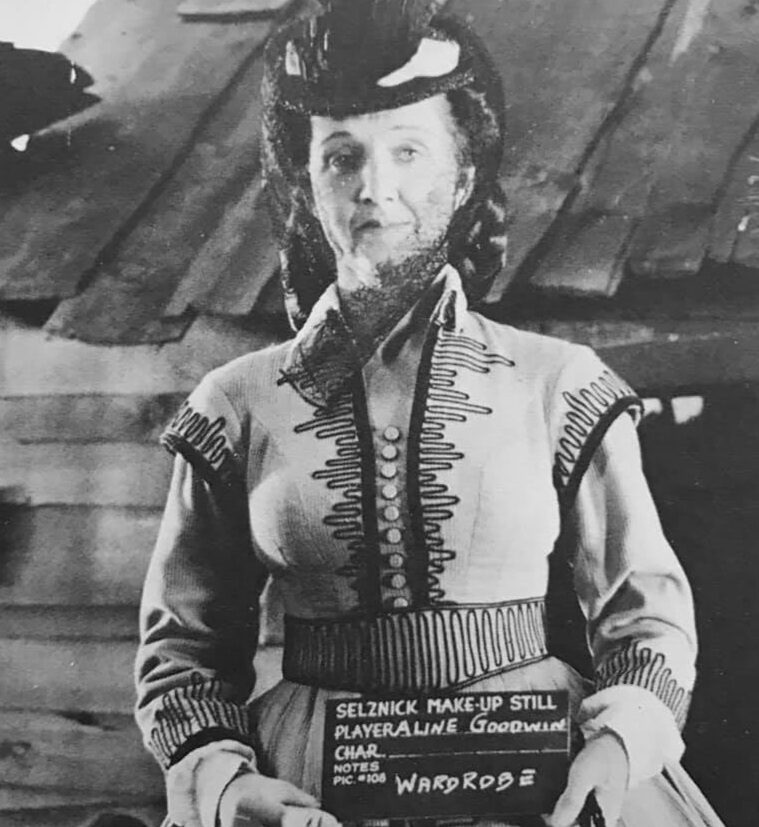
Zoë Bell — Stunt double for Lucy Lawless (Xena: Warrior Princess) and Uma Thurman (Kill Bill: Vol. 1 and Vol. 2). Later cast as herself in Quentin Tarantino’s Death Proof (2007), making her one of the few stunt performers whose double work became the basis of a starring role.
Chad Stahelski — Stunt double for Keanu Reeves in The Matrix trilogy. Stahelski went on to co-direct John Wick (2014) and its sequels, built directly on his stunt background. He and David Leitch are among the most commercially successful filmmakers to come out of the stunt community.
Gary Powell — British stunt coordinator who has doubled and coordinated on James Bond films for decades. Powell’s work spans from GoldenEye to No Time to Die, representing some of the most technically complex practical stunt work in franchise filmmaking.
Dar Robinson — Pioneered high-fall and skyscraper stunt work in the 1970s and 1980s. His world record falls for films like Sharky’s Machine (1981) set the technical standard for height work before safety equipment reached current sophistication.
Sources & Further Reading
- SAG-AFTRA Stunt Agreement — rates, credit requirements, and stunt adjustment definitions
- Double (occupation) — Wikipedia — overview of doubles categories
- Stunt Performers: AFTA Career Overview — career path overview
Create Professional Credits with EndCreditsPro
Getting stunt performer credits right — attributed correctly, formatted per guild standards, ordered within the Stunts section — matters to the professionals who earned them. EndCreditsPro auto-formats your full crew credit roll with the correct department structure, including proper stunt department attribution. Generate guild-compliant end credits in minutes.
Related roles: Stunt Coordinator · Gaffer · Foley Artist · All Film Crew Roles
See also: SAG-AFTRA Compliance Guide · Film Credits Format & Order Guide