What Is a First Assistant Director in Film?
The director gets the credit. The 1st AD gets the shot.
The first assistant director (1st AD) is the operational commander of any film or TV set. While the director focuses on performance and story, the 1st AD controls time — building the shooting schedule, managing every department head, calling the roll before each take, and keeping the day on schedule so production wraps on budget. No other below-the-line role has more authority over how a day on set actually runs.
In the film credits hierarchy, the 1st AD sits at the top of the assistant directors department — a position defined not by creative input but by logistical precision. Lose two hours on set without a plan to recover them, and it’s the 1st AD who answers for it. Or gets replaced.
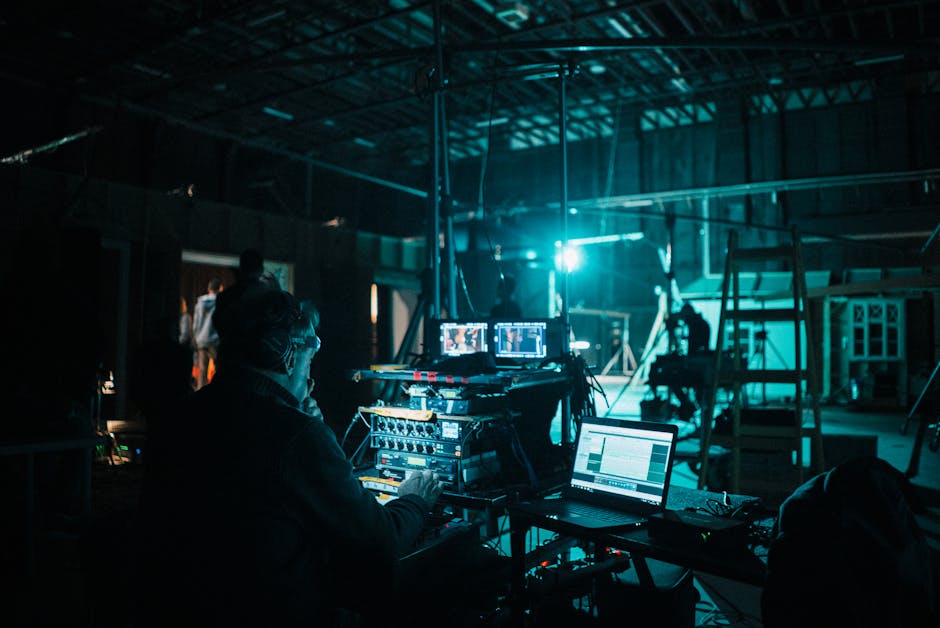
What does a first assistant director do?
The 1st AD Runs the Set
The 1st AD’s job begins weeks before the first day of principal photography. In pre-production, they work alongside the director, Director of Photography (DP), and production designer to break down the script scene by scene — identifying what’s needed to shoot each scene, how long it will take, and in what order scenes should be scheduled. The result is the shooting schedule, the document that governs every day of production.
Pre-production responsibilities:
- Script breakdown: analyzing every scene for cast requirements, locations, time of day, and special elements
- Building and maintaining the shooting schedule (often using Movie Magic Scheduling)
- Coordinating with department heads to ensure logistics align with the director’s vision
- Preparing the production board (strip board) — one strip per scene, arranged in shoot order
- Scouting locations alongside the director and DP
Production responsibilities:
- Calling the set to order and calling the roll (“Quiet on set. Roll sound. Roll camera.”) before the director calls “Action”
- Tracking every shot against the day’s schedule — and continuously recalculating what can still be accomplished
- Communicating across all departments through a headset system (walkie-talkies)
- Calling “First team!” to bring principal cast to set after a lighting setup is complete
- Running set safety — leading safety meetings and enforcing protocols. Legal responsibility rests with the production company, but the 1st AD is the person who makes it happen on the floor
- Delegating secondary tasks to the 2nd AD
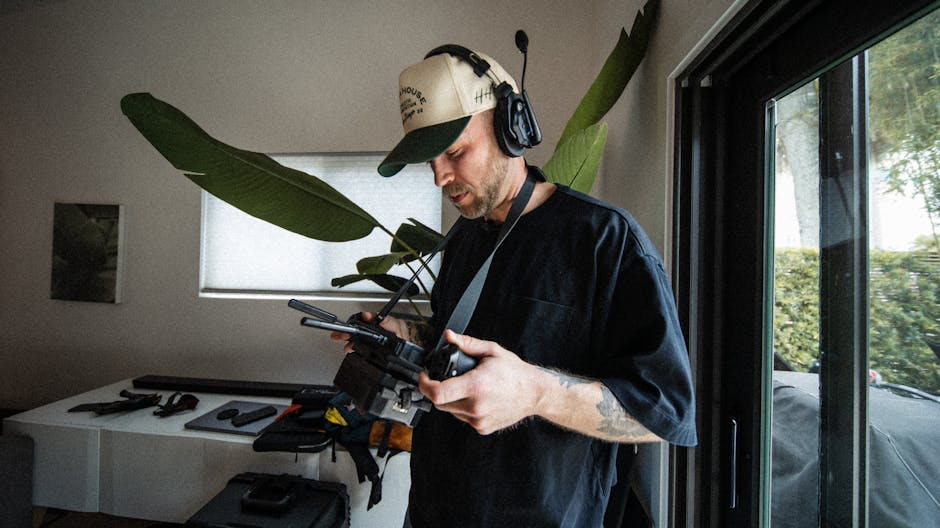
The 1st AD reports directly to the director and to the Unit Production Manager (UPM). Department heads — Gaffer, Key Grip, Sound Mixer, Props Master — all take floor-level direction from the 1st AD during the shooting day.
First assistant director salary
What 1st ADs Earn
Pay varies significantly based on experience, DGA membership, and production scale. The non-union figures below are rough industry estimates; the DGA figures are the guild minimums.
| Experience Level | Annual Range | Notes |
|---|---|---|
| Entry-level (non-union) | $30,000–$45,000 | Day rate ~$150–$250 |
| Mid-career | $50,000–$75,000 | Typical industry average |
| DGA member | Depends on weeks worked | Minimum $6,843/week at the studio, $9,571/week on distant location (from July 2026), plus a weekly production fee |
DGA members receive minimum rates set by the guild’s Basic Agreement. Non-DGA productions pay less, and income is inherently variable — a 1st AD works job to job on a day rate, not a salary. A strong year might mean 220+ shooting days; a slow year can cut that in half.
DGA 1st ADs also share in residuals: under the DGA Basic Agreement, part of the supplemental-markets payments on a production is divided among the UPM, the First AD and the Key Second AD.
What does a first assistant director do in the credits?
Where the 1st AD Appears in End Credits
On DGA productions the 1st AD’s credit is not optional. The DGA Basic Agreement (section 13-209) requires the Unit Production Manager, First Assistant Director and Key Second Assistant Director to be credited together in a “prominent place”: a separate card, or its equivalent in a crawl, shared by no more than three names, in that order (UPM, 1st AD, 2nd AD) and in the same size and style of type. The only technical credits allowed a more prominent place are the Director of Photography, the Art Director and the Film Editor. The same rule applies to features and television (multi-camera prime-time series follow a variant in section 24-406).
The agreement does not say whether that card goes in the opening or the closing titles. In practice it almost always sits in the end credits, usually opening the crew section (see the standard credits order):
UNIT PRODUCTION MANAGER ................ ALEX KIM
FIRST ASSISTANT DIRECTOR ............... JANE DOE
SECOND ASSISTANT DIRECTOR .............. JOHN SMITH
Opening credits: Rare. First ADs normally do not get an opening card on mainstream releases, although nothing in the agreement prevents a more favorable credit if it is negotiated.
How to credit a first assistant director correctly
Credit Format and Common Variations
The standard credit format on a theatrical feature:
FIRST ASSISTANT DIRECTOR Jane DoeOn television, especially multi-episode productions, you may see:
1ST ASSISTANT DIRECTOR Jane DoeBoth are acceptable: the DGA agreement does not prescribe the wording. “1st AD” is a set abbreviation, so most productions spell the title out on screen.
If multiple 1st ADs worked on the same production (common on long TV series where ADs rotate between episodes or units), each receives a separate line credit:
FIRST ASSISTANT DIRECTORS    Jane Doe
                              Marcus Webb
                              Tomás García
Second unit: If the production had a second unit, that unit’s 1st AD is typically credited separately as “SECOND UNIT FIRST ASSISTANT DIRECTOR” or listed under a dedicated Second Unit block in the credits.
Common crediting mistake: Some productions omit the 1st AD’s credit, bury it in a generic “Production Staff” block, or split the UPM, 1st AD and 2nd AD across different cards. On a DGA production, all of these break section 13-209. On non-union productions, it’s still considered professional courtesy — and the kind of oversight that gets noticed by crews and agents.
1st AD vs 2nd AD
How the AD Department Works
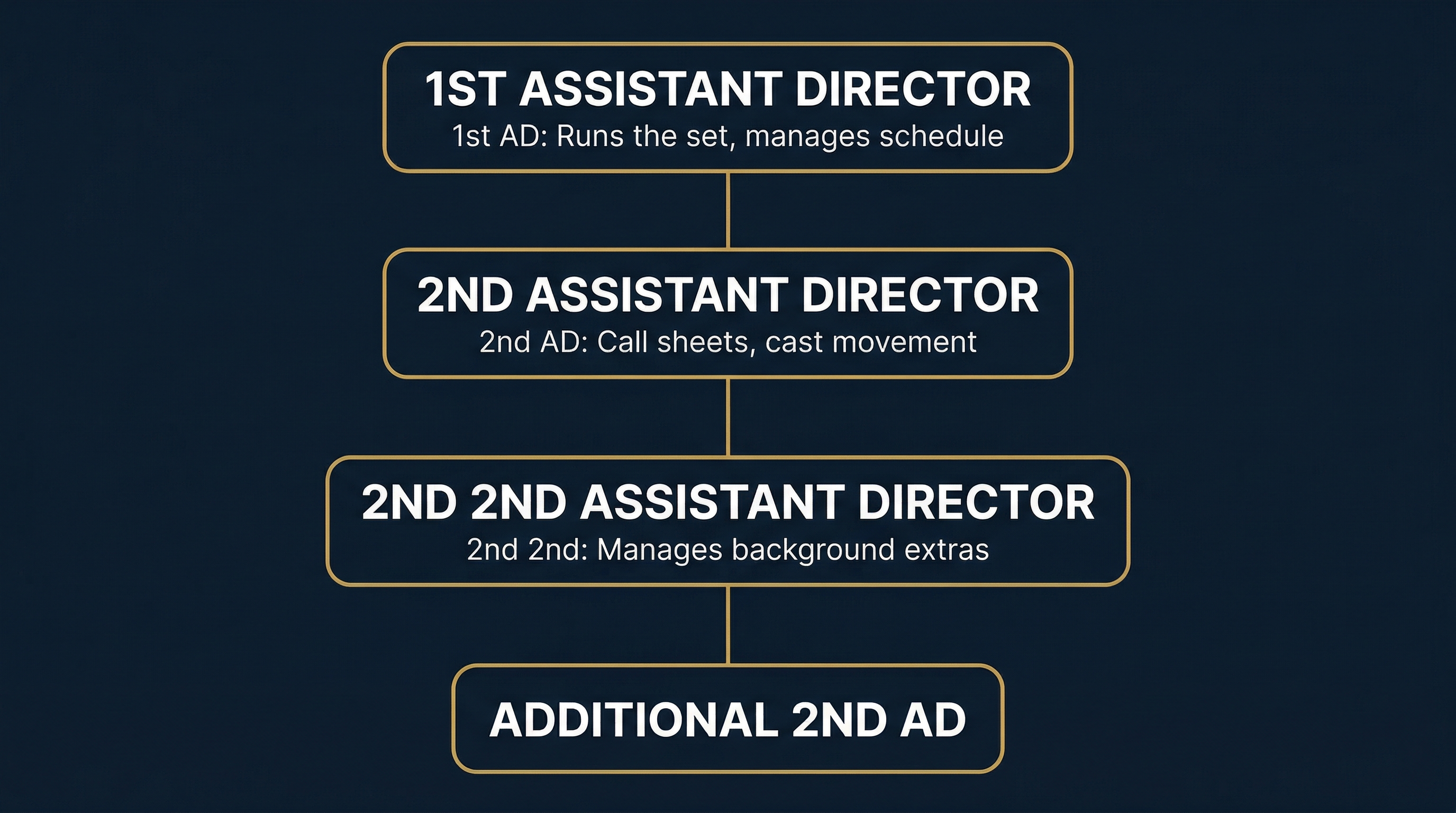
The assistant directors department has a clear hierarchy on any production:
| Role | Primary Responsibility |
|---|---|
| 1st AD | Runs the set, manages the schedule, calls action |
| 2nd AD | Creates and distributes call sheets, manages cast movement off-set |
| 2nd 2nd AD | Manages background (extras) on-set; assists the 2nd AD |
| Additional 2nd AD | Used on large productions or complex shooting days |
The 2nd AD’s relationship to the 1st AD is best understood this way: the 1st AD works in front of the camera, managing the shooting floor; the 2nd AD works behind it, managing logistics and paperwork. The 2nd AD also handles actor wrangling — moving cast from trailers through hair and makeup to set — so the 1st AD can focus entirely on the camera.
In the credits, the Key 2nd AD appears directly below the 1st AD on the shared UPM / 1st AD / 2nd AD card. The 2nd 2nd AD and additional 2nd ADs are not covered by that rule and are usually listed further down the crew credits.
How to become a first assistant director
Career Path to the 1st AD Chair
No film school guarantees a 1st AD position. The standard career path moves through the production department:
- Production Assistant (PA) — entry point; handling logistics, driving, running errands, learning set protocols
- Set PA / Office PA — specialized PA roles, closer to department heads
- 2nd 2nd AD — first official AD title; managing background on-set
- 2nd AD — creating call sheets, managing cast movement, direct experience with schedule management
- 1st AD — running the set
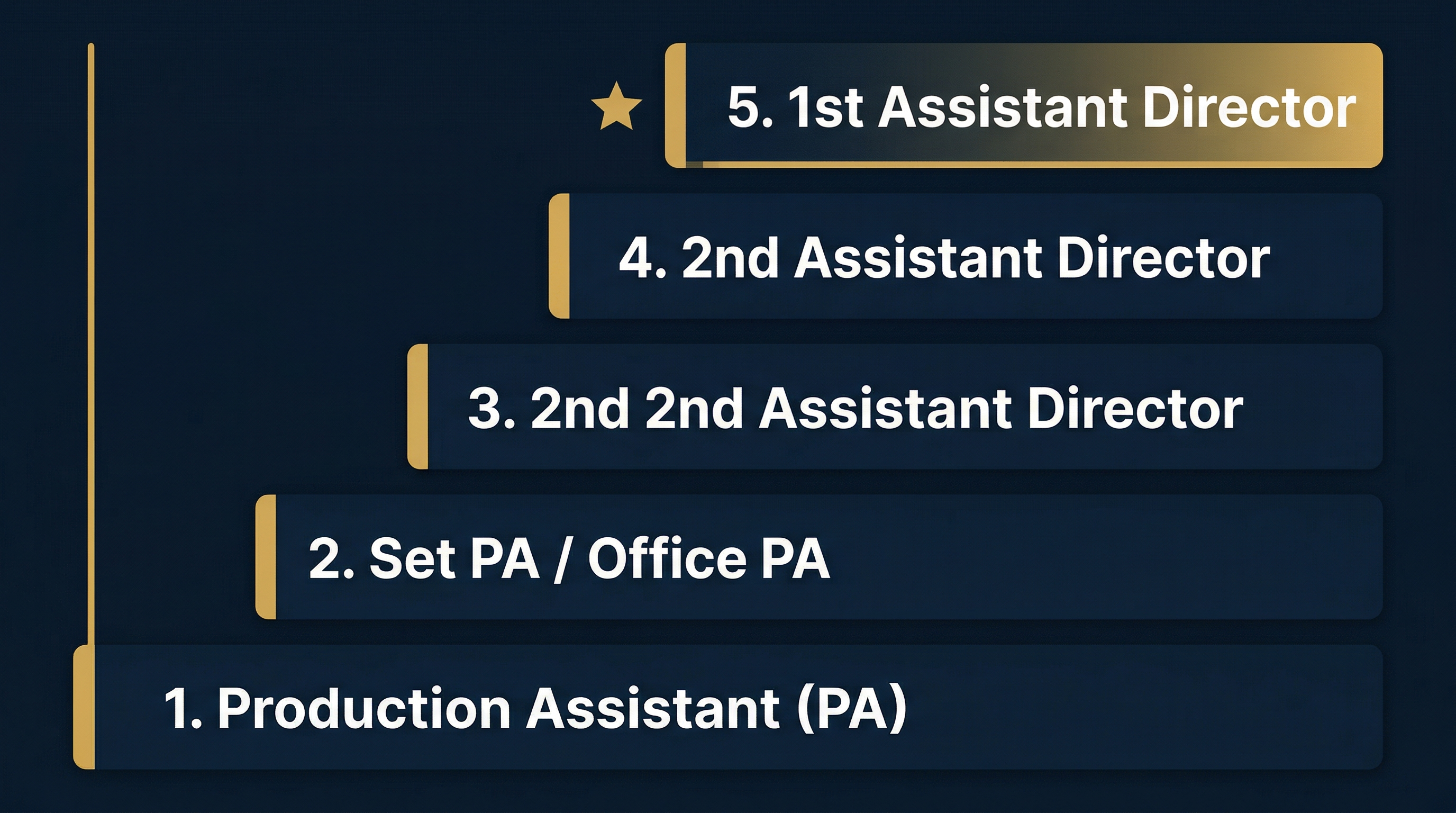
The jump from 2nd to 1st AD is the hardest step. Most working 1st ADs spent 4–8 years as a 2nd AD before making the move. Some work in commercials or music videos at the 1st AD level — shorter shoots, lower stakes — before transitioning to features.
DGA qualification: To work as a 1st AD on a DGA production you must be on the guild’s qualification list for the area. Most ADs get onto the list through the DGA Assistant Director Training Program or by accumulating days. Moving up from 2nd AD to 1st AD takes 520 days worked as a 2nd AD in Southern California or New York, or 240 days in the “Third Area” (the rest of the US).
The qualities that get a 1st AD hired — and keep them hired — are not primarily technical. Scheduling software can be learned. What can’t be taught is the ability to stay authoritative under pressure, make rapid decisions with incomplete information, and keep 80 people moving toward the same goal simultaneously.
Notable First Assistant Directors
1st ADs Who Left a Mark
Tommy Gormley was 1st AD on Star Wars: The Force Awakens (2015) and Mission: Impossible – Fallout (2018), two of the largest and most logistically complex productions of the decade.
Adam Somner (1967–2024) was Steven Spielberg’s 1st AD on ten films and worked with Ridley Scott, Martin Scorsese and Paul Thomas Anderson. He was nominated for an Oscar as a producer of Licorice Pizza.
Anya Adams came through the DGA Assistant Director Training Program, worked as a 1st AD on shows like The Mindy Project and Black-ish, and has been directing television since 2017.
The historical precedent is significant: Alfred Hitchcock and Akira Kurosawa both worked as assistant directors before becoming directors — a transition that became less common as the 1st AD role evolved into an operational rather than creative position.
Sources & Further Reading
- Directors Guild of America — AD/UPM Contract Information
- ScreenSkills — First Assistant Director Skills Checklist
Create Professional End Credits with EndCreditsPro
Formatting a 1st AD credit — and every other crew position — correctly takes time, especially on productions with dozens of department heads. EndCreditsPro is being built to collect, check and render end credits with the right hierarchy and guild ordering. Join the waitlist for early access, or start today with the free end credits template.
Related roles in the direction and production department:
- Associate Producer — above-the-line production role that sits in a different hierarchy than the AD department
- Line Producer — the LP and 1st AD work in parallel: LP controls the budget, 1st AD controls the day
For credit formatting guidance: